人工智能经济

Search documents
不只是稀土!中国把白银升级管控,扼住美国高科技产业“咽喉”
Sou Hu Cai Jing· 2026-01-11 09:12
Core Insights - Silver has transitioned from being merely a decorative metal to a critical component in high-tech industries, significantly contributing to its price surge in 2025, which saw a 146% increase compared to gold's 60% rise [1][3]. Demand Drivers - The explosive growth in demand for silver is primarily driven by three high-growth sectors: the photovoltaic industry, electric vehicles, and artificial intelligence [3][13]. - The photovoltaic industry, essential for solar panels, is projected to require 450 million ounces of silver by 2030, significantly boosting demand [8]. - The electric vehicle sector, which uses several times more silver than traditional vehicles, is growing at a compound annual growth rate (CAGR) of 13% [7][8]. - The AI industry relies heavily on high-performance chips that require silver for internal connections and packaging, enhancing the metal's strategic value [9][11]. Supply Constraints - The global silver market has faced a supply-demand imbalance for five consecutive years, with a projected shortfall of 3,660 tons in 2025 [15][17]. - Major silver-producing countries like Mexico and Peru are experiencing declining production due to aging mines and rising extraction costs [19]. - China's silver production is limited, with annual output of over 3,400 tons against a consumption of 9,400 tons, leading to a reliance on imports [25][21]. Export Control Policies - In early 2026, China implemented new export controls on silver, elevating it to a strategic resource level similar to rare earths, which will significantly impact global supply [27][29]. - The stringent conditions for obtaining export licenses aim to prioritize domestic industrial needs, particularly in high-tech sectors [29][31]. Global Market Impact - The new export policies are expected to reduce global silver supply by 4,500 to 5,000 tons annually, exacerbating existing shortages [33]. - Countries worldwide are beginning to recognize silver's strategic importance, leading to a global race to stockpile the metal [35][42]. - Financial market speculation is intensifying the demand for silver, with a significant disparity between physical inventory and paper contracts on exchanges like COMEX [38]. Future Outlook - The ongoing trends in the photovoltaic, electric vehicle, and AI sectors will continue to drive silver demand, maintaining upward pressure on prices [40][42]. - Experts predict that silver prices could reach $100 per ounce by the second half of 2026, reflecting its revalued strategic importance in global technology and resource competition [44].


中金公司首席经济学家彭文生:加强财政政策和货币政策协调
Zhong Guo Jin Rong Xin Xi Wang· 2025-12-31 03:25
Core Viewpoint - The speech emphasizes the need for coordination between fiscal and monetary policies to address medium-term economic fluctuations and ensure sustainable growth [3][4][7]. Group 1: Economic Theories and Adjustments - The traditional New Keynesian theory suggests that the economy can achieve macro balance in the medium to long term, but short-term frictions can lead to welfare losses, necessitating counter-cyclical monetary policy [3]. - There is a call for reflection and adjustment of this framework, particularly emphasizing the importance of medium-term fluctuations and the need for cross-cycle adjustments, which may require greater intensity than counter-cyclical adjustments [4]. Group 2: Medium-term Influencing Factors - Financial cycles are identified as a medium-term force, with the current phase being a downward trend, leading to a relative demand shortage compared to supply [5]. - Economies of scale are highlighted as another medium-term influencing factor, with the green industry and AI being significant contributors. The green industry benefits from economies of scale, while fossil energy typically does not [5][6]. - AI's impact on economic growth is debated, with estimates suggesting it could contribute an additional 0.8-1.3 percentage points to annual growth over the next decade, while other analyses predict a more modest increase of 0.07 percentage points [6]. Group 3: Geoeconomic Issues - The shift in China's trade partners towards the "Belt and Road" initiative and the increasing share of direct investment in these countries are noted as significant geoeconomic trends [7]. - Both economies of scale and geoeconomic factors contribute to the relative demand shortage, necessitating coordinated fiscal and monetary policies to boost domestic demand and ensure sustainable medium-term growth [7].


更好发挥财政扩内需的主动力和稳定锚作用
Sou Hu Cai Jing· 2025-12-30 01:28
Core Viewpoint - The Ministry of Finance emphasizes the need to prioritize domestic demand in 2026, focusing on boosting consumption and effective investment to support a strong domestic market [2] Group 1: Policy Effectiveness in 2025 - The government has utilized public budget funds to enhance disposable income through various subsidies, thereby increasing consumer willingness to spend [3] - Special long-term bonds have been employed to support the replacement of old consumer goods, stabilizing and expanding consumption [3] - Employment services and vocational training have been improved through policies like tax reductions and employment subsidies, promoting job opportunities for key demographics [3] - A comprehensive social security system has been established to alleviate concerns for citizens, thereby boosting consumer confidence [3] - Development funds have been allocated to support commercial construction in rural areas, enhancing the consumption environment and unlocking rural consumption potential [3] Group 2: Challenges in Policy Implementation - Global economic growth is sluggish, and rising protectionism necessitates a greater reliance on domestic markets to drive economic growth [5] - Despite being a leader in agricultural and industrial consumption, challenges remain in scaling and improving quality in domestic demand [5] - New infrastructure investments still have room for growth, but issues such as reliance on imported technology and lack of unified standards pose significant challenges [5] - The government faces difficulties in balancing short-term performance pressures with long-term investments in human capital [7] Group 3: Recommendations for Expanding Domestic Demand - The government should increase fiscal spending to ensure necessary expenditures, focusing on public service and social welfare investments [9] - There is a need to combine domestic demand expansion with improving living standards, ensuring that public services meet the quality and quantity required by citizens [9] - Policy support and innovative reforms should be implemented to provide robust fiscal backing for expanding domestic demand, enhancing budget management and efficiency [10]
哈塞特:美联储是时候谨慎降息了,未与特朗普讨论过主席相关话题
Sou Hu Cai Jing· 2025-12-05 13:32
Core Viewpoint - The current economic environment is seen as an opportune moment for the Federal Reserve to consider a "cautious rate cut" [1] Economic Outlook - The impact of a potential government shutdown is expected to be larger than previously anticipated, yet a stronger economic rebound is projected for the first quarter of next year [1] - Economic growth rates of 3% in the first and second quarters of next year would be considered disappointing [1] Productivity and Technology - Productivity in 2026 may reach 4%, indicating a significant long-term growth potential [1] - The development of the artificial intelligence economy is advancing faster than the internet economy did in the 1990s [1] Trade and Tariff Concerns - There are warnings regarding potential chaos if the Supreme Court ultimately overturns current tariff policies [1]
美国白宫国家经济委员会主任哈塞特:现在是美联储 “谨慎降息”的好时机,预计美联储下周将采取这一行动。预计政府关门的影响比预期的
Sou Hu Cai Jing· 2025-12-05 13:26
Core Viewpoint - The current environment is seen as a suitable time for the Federal Reserve to consider "cautious rate cuts," with expectations for action in the upcoming week [1] Economic Outlook - The impact of a potential government shutdown is anticipated to be larger than previously expected [1] - A significant rebound in economic activity is projected for the first quarter [1] - If economic growth in the first and second quarters of next year is only 3%, it would be considered disappointing [1] Productivity and Technology - By 2026, productivity is expected to potentially reach 4% [1] - The development of the artificial intelligence economy is progressing at a faster pace than the internet economy in the 1990s [1] Trade and Legal Considerations - A ruling by the Supreme Court against tariffs could lead to significant disruption [1]
使用AI的正确姿势,不是破局,而是做局
Hu Xiu· 2025-10-21 00:28
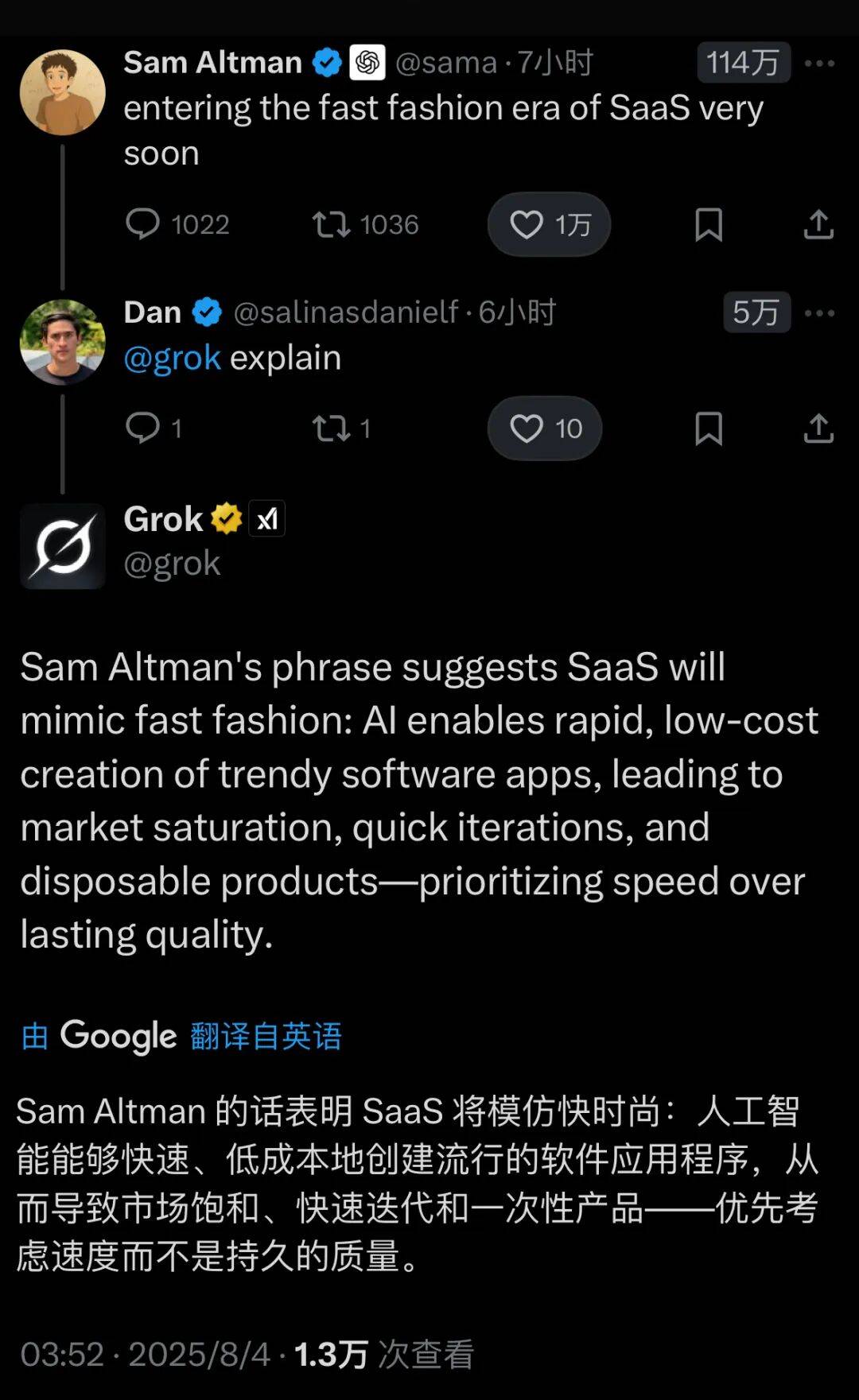
Core Insights - The software industry is entering a "fast fashion" era, where AI can rapidly and cheaply create popular software applications, leading to market saturation and a focus on speed over lasting quality [4][6] - This shift indicates a fundamental disruption for professionals in the software service sector, as the lifespan of certain jobs is drastically shortened [5][10] - The rise and fall of roles such as "Prompt Engineer" exemplify this trend, with job cycles compressed to as little as 18 months [9][10] Industry Trends - The emergence of AI-generated roles, such as Prompt Engineers, has seen high demand and salaries, but these roles can quickly become obsolete [8][9] - The concept of "career fast fashion" suggests that professionals must adapt rapidly to changing job requirements and skill sets [6][12] Strategic Insights - To survive in the AI-driven landscape, professionals should learn from the luxury fashion industry, which balances rapid obsolescence with the creation of timeless brands [13][14] - Building a personal brand akin to a luxury brand involves defining a core identity that transcends transient skills [34][37] - Professionals should focus on their "brand DNA," which represents their enduring value proposition rather than specific skills that may quickly become outdated [38][40] Brand Development Strategies - Strategy One: Identify your "brand DNA" by focusing on solving fundamental, lasting problems rather than temporary solutions [37][39] - Strategy Two: Cultivate your "brand aesthetics," which includes taste and unique insights that differentiate you in a crowded market [43][45] - Strategy Three: Become a "brand curator," ensuring high standards and a deep connection to your core identity, thus elevating your work beyond basic tasks [50][54] Long-term Perspective - The traditional approach of "lifelong learning" may lead to anxiety and a reactive stance; instead, professionals should focus on building a personal luxury brand that leverages new skills as tools rather than identities [58][63] - Skills may have a short lifecycle, but personal branding and core values are enduring assets that can provide stability and growth in a rapidly changing environment [65]