电动化

Search documents
BRP (NasdaqGS:DOOO) 2025 Investor Day Transcript
2025-10-09 14:32
Summary of BRP's 2025 Analyst and Investor Day Company Overview - **Company**: BRP (Bombardier Recreational Products) - **Event**: 2025 Analyst and Investor Day - **Key Management Presentations**: José Boisjoli (President and CEO), José Perreault (Chief Marketing Officer), Sandy Scullion (President of Powersports), David Baker (VPGM North America), Steve Peltier (VPGM International), Thomas Uhr (CTO), Patrick Dussault (EVP Global Manufacturing), Sébastien Martel (CFO) [1][2][4] Strategic Plan: M28 - **Introduction of M28**: A new strategic plan aimed at capturing the full potential of the powersports market, following the previous M25 plan [5][25] - **Financial Targets**: - Revenue target of $12 billion and normalized EPS of $8 by fiscal year 2028 [7][30] - Growth in revenue of 7% CAGR and EPS growth of 33% CAGR [30][31] - **Focus Areas**: - Powersports market leadership, particularly in Off-Road Vehicles (ORV) [25][52] - International market expansion with a revenue target of $2.5 billion [27][53] Historical Context and Performance - **M25 Achievements**: - Revenue increased by 36% and normalized EBITDA by 32% since fiscal year 2020 [6] - Adjusted financial targets in June 2022 due to market conditions [7][8] - **Market Challenges**: - Experienced disruptions from COVID-19, supply chain issues, cyberattacks, and geopolitical tensions [10][11][12] - Inventory management strategy led to a 31% reduction in Powersports inventory in North America [12] Market Position and Competitive Landscape - **Market Share Growth**: - Increased market share from sub-10% to 25% in the off-road industry over the last decade [62][65] - Can-Am retail grew over 60% from fiscal 2019 to fiscal 2025, outperforming competitors [61] - **Dealer Relationships**: - Focus on dealer profitability and support, leading to improved dealer sentiment [50][52] - BRP is now the leading OEM in terms of units sold per dealer [21] Customer Insights - **Customer Base Expansion**: - Added 1 million unique customers since 2021, with a focus on engaging new entrants and conquesting from competitors [37][38] - Customer demographics have shifted, with an increase in wealth among customers [40][41] - **Brand Awareness**: - Significant improvements in brand awareness and customer perception, particularly in the ORV segment [42][43] Strategic Initiatives - **Powersports Focus**: - Aim to regain 30% market share in side-by-side vehicles and 25% in ATVs by fiscal year 2028 [27][52] - **International Growth**: - Targeting growth in emerging markets, particularly in South Asia and China [53] - **Customer Experience Enhancements**: - Initiatives to improve dealer and customer experience, including service excellence and ownership experience [54][55] Future Outlook - **Investment in R&D**: - Continued investment in R&D at approximately 5% of revenue to drive innovation [22] - **Defense and Specialized Vehicles**: - Exploring opportunities in defense and specialized vehicles, responding to increased global demand [34][35] Conclusion - **Overall Strategy**: - The M28 plan is positioned to leverage BRP's strengths in innovation, dealer relationships, and market presence to achieve ambitious growth targets in the powersports industry [25][30][31]

溯联股份跌10.44% 某券商给予增持评级话声刚落
Zhong Guo Jing Ji Wang· 2025-10-09 08:11
Core Viewpoint - The stock of Su Lian Co., Ltd. (301397.SZ) closed at 41.88 yuan, experiencing a decline of 10.44% [1] Group 1: Company Performance - Su Lian Co., Ltd. reported a stock price drop of 10.44% on October 9 [1] - A brokerage firm issued a report on October 6, rating the company as "overweight" [1] Group 2: Industry Trends - The report highlighted that Su Lian Co., Ltd. is positioned to benefit from the trends of electrification and lightweighting in the pipeline industry [1] - The company is also expanding its AI computing power liquid cooling business [1]
通用汽车三季度在华零售销量47万辆 同比增长10.1%
Mei Ri Jing Ji Xin Wen· 2025-10-09 06:41
Group 1 - General Motors and its joint ventures are accelerating their electrification process, with Buick's new energy sub-brand "Zhijing" launching its first electric sedan, Zhijing L, in September [1] - Starting this year, all new models launched by Buick in China will be electric vehicles, with the flagship model Buick Shijia expected to be released within the year [1] - By next year, it is projected that the sales proportion of new energy vehicles within the company will exceed 50% [1] Group 2 - In the third quarter, General Motors reported retail sales of approximately 470,000 units in the Chinese market, representing a year-on-year growth of 10.1%, achieving consecutive quarters of sales and market share growth [3] - Buick brand sales in the third quarter increased by 54.3% year-on-year, while Cadillac brand sales grew by 11.2% [3]


2025中国汽车工程学会年会暨创新技术展10月开幕
Zhong Guo Qi Che Bao Wang· 2025-10-09 02:50
Core Insights - The 32nd China Society of Automotive Engineers Annual Conference and Exhibition (SAECCE2025) will be held from October 22 to 24 in Chongqing, focusing on the release of the "Energy-saving and New Energy Vehicle Technology Roadmap 3.0" and addressing industry hot topics [1][6] Group 1: Major Systemic Transformations in the Automotive Industry - The automotive industry in China is undergoing a comprehensive transformation driven by low-carbon, electrification, and intelligence, marking a shift in five major systems: technology, innovation, product, industry, and market [2] - The technology system has evolved from a mechanical engineering focus to a new paradigm integrating low-carbon, electrification, and intelligence, with vehicles becoming super intelligent mobile terminals [2] - The innovation system has transitioned from linear "chain R&D" to a networked structure empowered by AI, enhancing efficiency across the entire process from demand insight to product definition [2] Group 2: Product and Market Dynamics - The product system is shifting from primarily fuel vehicles to new energy vehicles, with sales projected to reach 12.866 million units in 2024, and market penetration increasing from 0.3% in 2014 to 40.9% [3] - The market system is transitioning from reliance on domestic growth to global expansion, with exports reaching 4.292 million vehicles in the first eight months of 2025, a 13.7% increase year-on-year, and new energy vehicle exports growing by 87.3% [3] Group 3: Highlights of the Conference - The conference will feature over 130 activities focusing on six major technology areas, with participation expected to exceed 10,000 attendees, including representatives from 200 exhibiting companies [4] - The event will emphasize the integration of AI in automotive applications, showcasing its role in transforming vehicles into "embodied intelligent agents" [5] - An international committee will be established to enhance global collaboration, with multiple international forums planned to elevate the conference's international profile [5]
2025MID峰会洞见未来全球智能汽车发展
Zhong Guo Qi Che Bao Wang· 2025-10-09 02:34
Group 1 - The 2025 Mobility Intelligence Dialogue (MID Summit) focuses on the future development of smart vehicles, emphasizing the importance of collaboration in the automotive industry to address challenges and promote intelligent, connected, electric, and sustainable development [1][3] - The global automotive industry is at a critical stage characterized by both uncertainty and opportunity, with geopolitical fluctuations and trade policy adjustments posing challenges, while trends in electrification and connectivity continue to drive long-term growth [3][5] - By 2025, global automotive sales are projected to reach 90 million units, increasing to 95 million units by 2030, primarily driven by the penetration of new energy vehicles and the release of demand in emerging markets [3] Group 2 - China's automotive industry is highlighted as a key player in the global transition, with its export growth and leadership in new energy vehicles drawing significant attention [3][4] - Although China's new energy vehicle exports are growing, challenges remain due to the limited scale of emerging markets, necessitating further expansion into mature markets like Europe and North America [4] - The commercialization path of Software Defined Vehicles (SDVs) is a major focus, with global connected vehicle market size expected to grow from 56 million units in 2023 to 77 million units by 2030, with a penetration rate increasing from 68% to 85% [5][6] Group 3 - The shift from "selling cars" to "selling services" represents a key transformation in the business model for automotive companies, with software services becoming a significant source of high-margin, recurring revenue [6] - China is positioned to lead in the SDV market, with nearly one-third of new vehicles expected to reach L4 or L5 levels by 2037, supported by policy, technological advancements, and data accumulation [6] - China has established a comprehensive advantage in the power battery sector, with solid-state batteries expected to revolutionize range and reliability, potentially achieving vehicle validation next year [6]

综述|80余家中企亮相世界客车博览会 电动和智能成焦点
Xin Hua She· 2025-10-07 15:13
Group 1 - The World Bus Expo held in Brussels from October 4 to 9 showcased over 550 companies, focusing on zero-emission vehicles, smart transportation, and next-generation battery innovations [1] - Chinese companies made a significant impact with over 80 exhibitors, surpassing Germany for the first time, while Turkey led with 107 exhibitors [1] - European manufacturers introduced new products, including Daimler's first intercity electric model and MAN's first electric bus developed by a major European manufacturer [1] Group 2 - Yutong Bus showcased four electric models and advanced technologies such as "vehicle-battery co-lifetime," covering various transportation scenarios, and won multiple awards at the World Bus Awards [2] - BYD launched three new electric models, including two 12-meter buses and one 18-meter articulated bus, all equipped with intelligent driving assistance systems and proprietary blade batteries [2] - Xiamen Golden Dragon displayed a range of vehicles, including an L4 level autonomous bus, which features a comprehensive intelligent system to handle complex traffic situations [3] Group 3 - BYD has deployed over 5,000 electric buses across 26 countries and 160 cities in Europe, accumulating 650 million kilometers of operation, which has helped reduce carbon emissions by 690,000 tons [3] - Chinese companies in the bus industry also presented electric components and solutions, including batteries, motors, and electric control systems, highlighting the industry's comprehensive capabilities [3]
吉利汽车:拟23亿港元回购
Zheng Quan Shi Bao· 2025-10-06 23:29
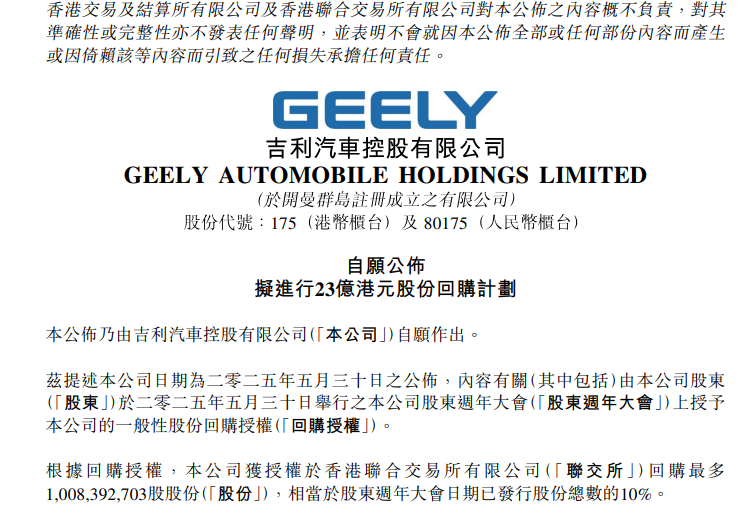
Core Viewpoint - Geely Automobile announced a share repurchase plan of HKD 2.3 billion, aiming to enhance shareholder value and demonstrate confidence in its business outlook [1][3]. Group 1: Share Repurchase Plan - The board of Geely believes that the share repurchase plan aligns with the best interests of the company and its shareholders, especially in the current uncertain market environment [3]. - The plan will be executed through an automated mechanism in the open market and is subject to certain conditions, including compliance with the Hong Kong Stock Exchange regulations [3]. - The company plans to repurchase up to 1.008 billion shares, representing 10% of the total shares issued as of the date of the 2025 annual general meeting [3]. Group 2: Sales Performance - In September, Geely's monthly sales reached 273,125 units, marking a year-on-year increase of 35% and a month-on-month increase of 9%, with overseas exports accounting for 40,665 units [3]. - The sales of new energy vehicles (NEVs) reached 165,201 units in September, reflecting a year-on-year growth of 81% and a month-on-month increase of 12%, achieving a historical high [3]. - The total sales for 2025, including all brands, are projected to reach 2,170,189 units, representing a year-on-year increase of 46% [4]. Group 3: Market Outlook - Analysts from Guohai Securities view the company's fuel vehicle base as resilient, with expectations for growth driven by electrification, globalization, and premiumization [4]. - According to Kaiyuan Securities, the performance of new vehicles in the second half of 2025 is expected to exceed expectations, with the company's platform-based manufacturing cost advantages translating into the ability to continuously create popular models [4].

吉利汽车:拟23亿港元回购!
Zheng Quan Shi Bao· 2025-10-06 13:49
Group 1 - The company announced a share buyback plan of HKD 2.3 billion, which will be executed through an automated mechanism in the open market [2] - The board believes that the buyback plan aligns with the overall best interests of the company and its shareholders, showcasing confidence in the business outlook amid market uncertainties [5] - The plan is subject to certain conditions, including obtaining a waiver from the Hong Kong Stock Exchange regarding compliance with specific listing rules [5] Group 2 - In September, the company achieved a monthly sales volume of 273,125 units, representing a year-on-year increase of 35% and a month-on-month increase of 9%, with overseas exports accounting for 40,665 units [6] - The sales of new energy vehicles reached 165,201 units in September, marking an 81% year-on-year increase and a 12% month-on-month increase, setting a historical record [6] - The company’s total sales for 2025, including all brands, reached 2,170,189 units, reflecting a 46% year-on-year growth [6]
2025叉车行业市场空间、发展趋势及行业龙头杭又集团销量、布局分析报告
Sou Hu Cai Jing· 2025-10-06 07:14
Core Viewpoint - The forklift industry is undergoing significant globalization and intelligent transformation, with Hangcha Group leading the market through diversified strategies and global expansion [1][2]. Group 1: Market Overview - The global forklift market reached a sales volume of 2.14 million units in 2023, with a compound annual growth rate (CAGR) of 8% from 2013 to 2023. Asia and Europe account for 47% and 30% of the market, respectively [1][2]. - China is the largest consumer of forklifts, with a sales volume of 36% of the global total in 2023, and a CAGR of 12.2% from 2013 to 2023. In 2024, China's total forklift sales are projected to reach 1.29 million units, with exports increasing to 480,000 units, representing a 37% export share [1][2]. Group 2: Competitive Landscape - The global forklift industry is highly concentrated, with the top three companies holding a 55% market share in 2023. Hangcha Group and Anhui Heli dominate the Chinese market, with Hangcha's global sales market share at 11% and approximately 22% in China for 2024 [2][3]. - Hangcha Group's international revenue is expected to reach 42% of total revenue in 2024, with a gross margin of 54% from international sales, significantly higher than the domestic gross margin of 19% [2][3]. Group 3: Industry Trends - Automation is a key trend in the forklift industry, with global sales of unmanned forklifts reaching 30,700 units in 2023, reflecting a CAGR of 52% from 2019 to 2023. In China, unmanned forklift sales are projected to reach 25,000 units in 2024, with a CAGR of 55% from 2019 to 2024 [3][4]. - The electric forklift market is also expanding, with the total cost of ownership for electric forklifts significantly lower than that of internal combustion models. From 2017 to 2024, sales of lithium battery forklifts in China increased from 8,700 units to 448,800 units, with a CAGR of 76% [3][4]. Group 4: Smart Logistics Systems - The global market for smart logistics solutions is expected to reach 471.1 billion yuan in 2024, with China's market projected to reach 101.3 billion yuan. The sector is characterized by automation and efficiency improvements, reducing labor costs and losses [4][5]. - Hangcha Group is actively developing its smart logistics systems, achieving over 1,000 successful project implementations and securing contracts exceeding 1 billion yuan in 2024 [4][5]. Group 5: Company Performance - Hangcha Group has demonstrated steady growth, with a revenue CAGR of 13% and a net profit CAGR of 26% from 2019 to 2024. In Q1 2025, the company reported revenue of 4.5 billion yuan, a year-on-year increase of 8%, and a net profit of 440 million yuan, up 15% year-on-year [6][7]. - The company is focusing on technological innovation and resource integration, including the acquisition of Zhejiang Guozi Robotics to enhance its competitive edge in the smart logistics sector [5][6].

中国摩都,电动车产量半年激增近59%
21世纪经济报道· 2025-10-03 00:10
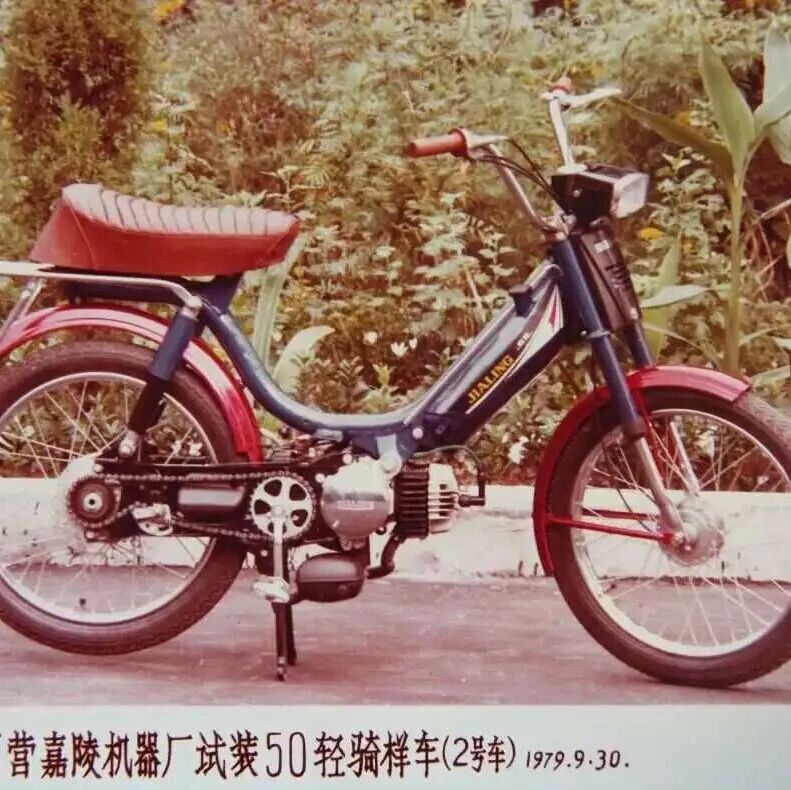
Core Viewpoint - Chongqing is transforming into a global industrial base for smart connected electric vehicles, with ambitious production targets and a focus on electric two-wheelers, aiming for an annual output of over 15 million units by 2027 [1][14]. Group 1: Industry Transformation - The production of electric motorcycles in Chongqing reached 1.45 million units from January to July this year, marking a 34% year-on-year increase, indicating a rapid shift towards electrification [2]. - Chongqing has attracted seven of the top ten electric vehicle companies in China, including Yadea and Aima, with a local supply rate exceeding 60% for key components [1][10]. - The local government has initiated the "Chongqing Smart Connected Electric Vehicle Industry Development Action Plan (2025-2027)," aiming to establish a global industrial base for smart electric vehicles [1][14]. Group 2: Historical Context - Chongqing was once the heart of motorcycle manufacturing in China, producing the first civilian motorcycle, the "Jialing CJ50," in 1979, which symbolized the beginning of motorized transportation for Chinese families [4][7]. - The decline of the "Big Three" motorcycle manufacturers—Lifan, Longxin, and Zongshen—was attributed to policy changes, market saturation, and technological limitations, leading to a significant shift in the industry landscape [8][9]. Group 3: Smart and Electric Integration - The focus is shifting from merely achieving electrification to integrating smart technologies, with companies like Tailin implementing Huawei's HarmonyOS for enhanced connectivity features [12][13]. - The Chongqing government is promoting the development of a "Smart Electric Vehicle Data Service System" to facilitate future applications like battery swapping and shared mobility [10][12]. - The challenge lies in balancing the cost of smart features with consumer willingness to pay, as the electric two-wheeler market is highly price-sensitive [12][13]. Group 4: Global Expansion - With the domestic market reaching saturation, Chongqing's motorcycle companies are looking to expand internationally, particularly in Southeast Asia, Africa, and Latin America [2][16]. - The logistics network in Chongqing is a competitive advantage for exporting electric vehicles, with efficient routes established to key markets [19]. - Companies are adapting their products for international markets, focusing on customization and smart technology to differentiate themselves from competitors [20][21].