
人才红利

Search documents
各项民生事业取得长足发展 截至8月底,城镇新增就业超额完成5500万人的目标任务
Jing Ji Ri Bao· 2025-09-27 22:01
Employment and Social Security - The employment situation in China during the "14th Five-Year Plan" period is generally stable, with a cumulative urban new employment of 59.21 million by the end of August this year, exceeding the target of 55 million [1] - The average urban survey unemployment rate over the past four years is 5.3%, lower than the expected control target of 5.5% [1] - A comprehensive policy framework has been established, including fiscal incentives, tax reductions, and financial support, to enhance employment priority policies [1] Social Insurance Reform - The number of participants in the national basic pension insurance reached 1.072 billion, an increase of over 73 million compared to the end of the "13th Five-Year Plan," with the participation rate rising from 91% to over 95% [2] - The total scale of the three social insurance funds reached 69.27 trillion yuan, with a cumulative balance of 9.81 trillion yuan, indicating a stable increase in fund support capacity [2] - The investment operation scale of the basic pension insurance fund is 2.6 trillion yuan, having doubled since the end of the "13th Five-Year Plan," with an average annual investment return rate of 5.15% [2] Talent Development - The gradual implementation of a delayed retirement age policy is underway to transform demographic dividends into talent dividends during the "14th Five-Year Plan" [3] - Over the past five years, 92 million people have received subsidized vocational skills training, with 72 new occupations and 328 national occupational standards introduced [3] - The number of professional technical talents exceeds 80 million, and skilled workers total over 220 million, with over 72 million high-skilled talents [3]
保障民生改善民生,人社部门这样回答“民生为大”
Xin Hua She· 2025-09-26 07:49
Group 1 - The core viewpoint emphasizes the importance of improving people's livelihoods as part of China's modernization efforts, particularly during the "14th Five-Year Plan" period [1] - The human resources and social security departments are focused on enhancing the development and utilization of human resources, leading to significant advancements in employment and social security [1] - The overall goal is to increase the sense of gain, happiness, and security among the populace, contributing positively to the improvement of living standards [1] Group 2 - The national basic pension insurance coverage reached 1.072 billion, an increase of over 73 million compared to the end of the "13th Five-Year Plan," with the participation rate rising from 91% to over 95% [3] - The number of participants in unemployment insurance and work injury insurance reached 246 million and 302 million, respectively [3] - The total scale of the three social insurance funds' income and expenditure during the "14th Five-Year Plan" period was 69.27 trillion yuan, with a cumulative fund balance of 9.81 trillion yuan [3] Group 3 - During the "14th Five-Year Plan," approximately 92 million people received subsidized vocational skills training, aligning with market trends [6] - A total of 72 new occupations were announced, and 328 national occupational standards were issued, aimed at stimulating the entrepreneurial spirit among various talents [6] - The number of professional technical personnel in China exceeds 80 million, with over 22 million skilled workers, including more than 7.2 million high-skilled talents [6] Group 4 - The establishment of over 2,300 one-stop mediation centers for labor disputes in new employment forms has been implemented [8] - More than 10,000 major wage arrears violations have been published and addressed since the beginning of the "14th Five-Year Plan" [8] - Over 14,000 cases of suspected refusal to pay labor remuneration have been transferred for prosecution, effectively curbing malicious wage arrears [8]

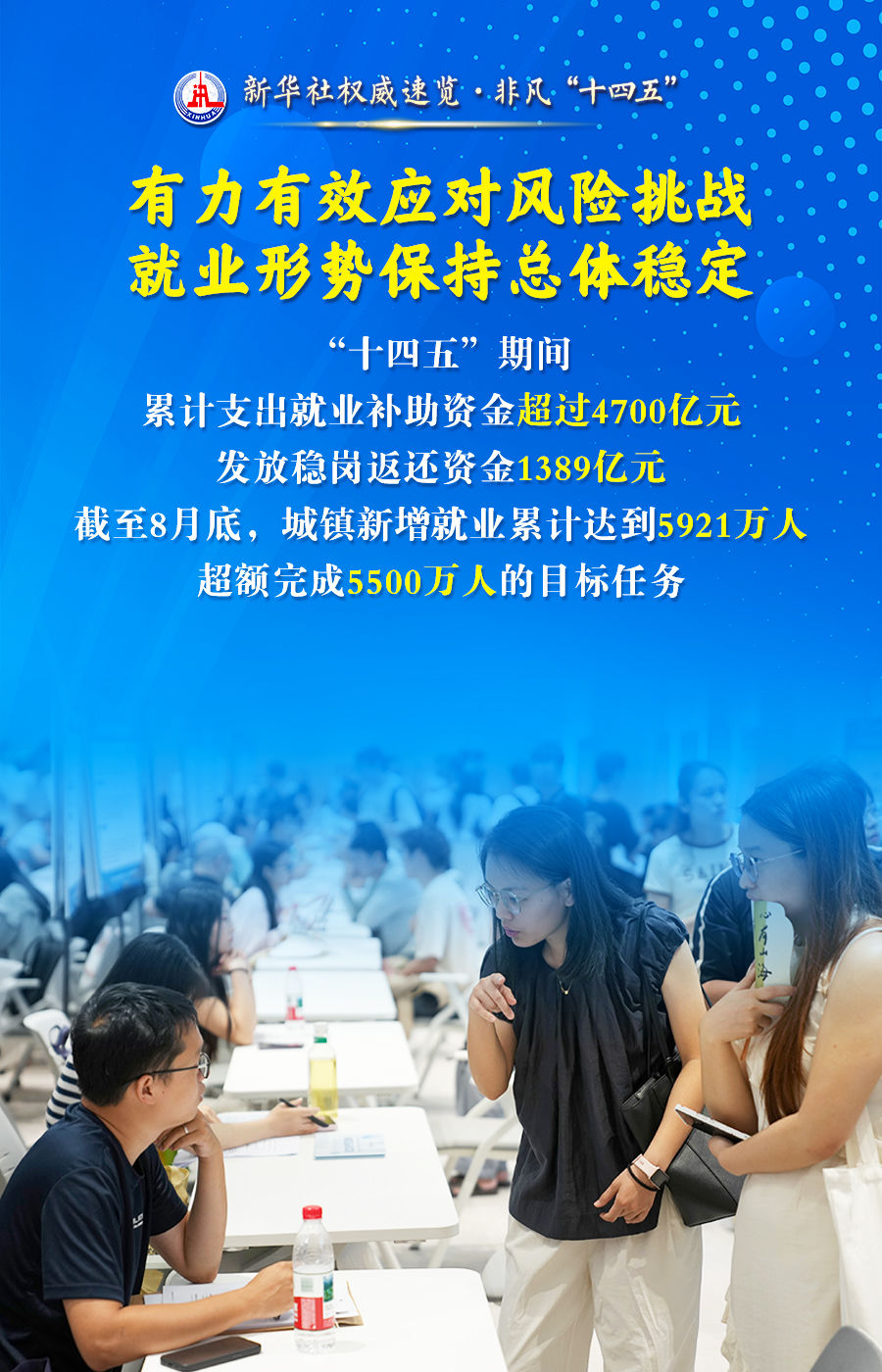
数说“十四五”成就丨从社会保障成绩单感知民生获得感
Xin Hua Wang· 2025-09-26 04:16
Core Insights - The "14th Five-Year Plan" period has seen significant achievements in employment and social security, with a focus on high-quality development and improved living standards for citizens [1] Employment Stability - During the "14th Five-Year Plan," over 470 billion yuan was spent on employment subsidies, with 138.9 billion yuan allocated for job retention funds [3] - As of August, urban new employment reached 59.21 million, exceeding the target of 55 million [3] - The average urban survey unemployment rate over the past four years was 5.3%, below the expected control target of 5.5% [3] Social Security System Enhancement - The "14th Five-Year Plan" marked a period of significant reform in social security, including nationwide coordination of basic pension insurance for employees and provincial-level coordination for unemployment and work injury insurance [5] - The number of participants in basic pension insurance reached 1.072 billion, an increase of over 73 million from the end of the "13th Five-Year Plan," with the participation rate rising from 91% to over 95% [6] - The total scale of social insurance fund revenue and expenditure reached 69.27 trillion yuan, with a cumulative surplus of 9.81 trillion yuan, indicating a stable support capacity for social security [6] Talent Development and Labor Rights - The "14th Five-Year Plan" has seen a shift towards a new normal in population development, with gradual implementation of delayed retirement policies and reforms in talent development systems [7] - A total of 92 million people have received subsidized vocational skills training, with 72 new occupations and 328 national occupational standards introduced [7] - The rights protection system for workers has been improved, with over 2,300 new mediation centers established for new employment forms, and significant actions taken against wage violations [10][12]

全球观·中国策丨对话张许颖:逐步建立、实施具有中国特色的“开端计划”
Sou Hu Cai Jing· 2025-09-22 11:00
Core Insights - The article discusses the transition of China's population development from growth to reduction, highlighting the challenges and strategies for promoting high-quality population development during the "14th Five-Year Plan" period [4][5][6]. Group 1: Population Trends and Challenges - China is entering a new phase of population development characterized by declining birth rates, aging population, and regional population disparities [4][5]. - The total fertility rate in China is expected to fluctuate at low levels during the "14th Five-Year Plan" period, indicating that low birth rates will accompany the entire process of building a modern strong country [5][6]. - The reduction of the school-age population is projected to decrease by approximately 130 million from 2020 to 2035, presenting both challenges and opportunities for educational reform [6]. Group 2: Policy Recommendations - It is recommended that the government elevate the response to declining birth rates to a national strategy, develop a high-quality population development plan, and establish a comprehensive population governance system [4][7]. - The establishment of a Chinese-style fertility guarantee system is crucial, focusing on maternity insurance, childcare services, and reproductive health services [7][9]. - The article emphasizes the need for increased investment in early childhood development, particularly for children aged 0-6, to enhance human capital and address family support issues [9][10]. Group 3: Transition from Population Dividend to Talent Dividend - The transition from a "population dividend" to a "talent dividend" requires high-quality talent to meet the demands of new productive forces, supported by appropriate policy measures [11][12]. - The integration of education, health, and technology into a multi-dimensional population analysis framework is essential for improving overall population quality and countering the negative impacts of declining labor force numbers [11][12]. - The shift in policy terminology from "birth subsidies" to "child-rearing subsidies" reflects a significant milestone in China's population development, indicating a new phase focused on high-quality population growth [12].
不要错过人口变局中的改革之机
Di Yi Cai Jing· 2025-08-23 15:09
Group 1: Education Sector Impact - The decline in school-age population is leading to increased attention on school vacancies and surplus teachers, prompting reforms in the education system [1][2] - Measures such as cross-grade and cross-regional teaching are being implemented to adapt to the new demographic reality, with a focus on improving teaching quality through smaller class sizes [2] - The shift from a "demographic dividend" to a "talent dividend" emphasizes the need for investment in human capital and the development of vocational education [2] Group 2: Labor Market Effects - The shrinking labor force and increasing aging population are weakening traditional growth models, necessitating a transition to a "talent dividend" approach [2] - There is a consensus on enhancing the overall quality and productivity of the labor force through lifelong investment in human capital [2] - The development of the "silver economy" and the optimization of industrial structures are crucial for addressing labor shortages [2] Group 3: Social Security System Challenges - The aging population poses significant challenges to the social security system, requiring reforms in medical insurance funding and efficiency [3] - Key reforms include establishing a provincial-level coordination for basic medical insurance and improving long-term care insurance systems [3] - The uneven demographic changes across regions necessitate optimized land use planning and urban-rural coordination [3] Group 4: Long-term Trends and Strategic Planning - Population decline is expected to be a long-term trend, highlighting the importance of early risk identification and strategic planning for high-quality development [3]
不要错过人口变局中的改革之机
第一财经· 2025-08-23 14:40
Core Viewpoint - The article discusses the profound impacts of China's declining population growth, characterized by low birth rates and aging demographics, on various sectors, particularly education, labor market, social security, and urban planning [3][4]. Education Sector - The decline in school-age population is leading to under-enrollment in schools and an oversupply of teachers, prompting discussions on the need for educational reform [3][4]. - The Ministry of Education emphasizes the need to adapt teacher resource allocation in response to demographic changes and urbanization [3]. - Opportunities for reform include transitioning teachers across educational stages and regions, improving school standards, and promoting smaller class sizes to enhance teaching quality [4][5]. Labor Market - The shrinking labor force is weakening traditional economic growth models, necessitating a shift from "demographic dividend" to "talent dividend" [5]. - There is a consensus on increasing investment in human capital throughout its lifecycle to improve overall labor quality and productivity [5]. - The development of the "silver economy" and the optimization of industrial structures towards knowledge and technology-intensive sectors are crucial for addressing labor shortages [5]. Social Security System - The aging population poses significant challenges to the social security system, particularly in healthcare funding and efficiency [5]. - Key reforms include enhancing the basic medical insurance system, improving funding mechanisms, and establishing long-term care insurance [5]. Urban and Regional Planning - Population changes are uneven across urban and rural areas, necessitating optimized land use and spatial planning [6]. - The article advocates for a coordinated regional development strategy, focusing on enhancing urban centers' capacity while addressing the needs of shrinking areas [6]. - Identifying risks and planning systematically can transform challenges into opportunities for high-quality development in the context of demographic shifts [6].

壹快评|不要错过人口变局中的改革之机
Di Yi Cai Jing· 2025-08-23 12:34
Group 1: Education Sector Impact - The decline in school-age population and the surplus of teachers are becoming increasingly prominent issues, leading to discussions on the direct impact on the education system [1][2] - The Ministry of Education has highlighted the need to recognize the challenges posed by fluctuations in school-age population and urbanization on the equitable distribution of teaching resources [1][2] - The education system can leverage this challenge to accelerate the transition from scale expansion to quality improvement and structural optimization [2] Group 2: Labor Market and Economic Transition - The shrinking labor force and increasing aging population are weakening the traditional growth model, necessitating a shift from "demographic dividend" to "talent dividend" [2] - There is a consensus on increasing investment in human capital throughout its lifecycle to enhance overall labor quality and productivity [2] - The development of the "silver economy" and the promotion of knowledge-intensive and technology-intensive industries are essential to address labor shortages [2] Group 3: Social Security System Challenges - The aging population presents unprecedented challenges to the social security system, requiring improvements in medical insurance funding and efficiency [3] - Reforms such as provincial-level coordination of basic medical insurance and the establishment of long-term care insurance systems are critical as demographic changes deepen [3] Group 4: Regional Development and Spatial Planning - Population changes exhibit significant disparities between urban and rural areas, necessitating optimized land use planning [3] - The "multi-planning integration" system for land use has been established, and further regional spatial planning is needed to promote coordinated urban-rural development [3] - Strategies for areas facing population decline include land consolidation and the development of specialized industries for sustainable growth [3]
人才储备,三个之最和一个500万
Ren Min Ri Bao Hai Wai Ban· 2025-08-12 00:34
Core Insights - China is transitioning from a "demographic dividend" to a "talent dividend," with the highest global totals in talent resources, scientific and technological human resources, and R&D personnel [1][3][10] - The country produces over 5 million STEM graduates annually, leading globally in this area [5][11] Talent Resource Expansion - China's total talent resources have reached 220 million, with over 200 million skilled workers and more than 60 million high-skilled talents [3][10] - The contribution of talent to GDP in regions like Haidian District, Beijing, is significant, with a talent contribution rate of 65.21% [2] R&D and Innovation - China has over 7 million R&D personnel, maintaining the world's highest total, with R&D expenditure intensity surpassing the EU average [3][10] - The country ranks 11th globally in the innovation index, reflecting a robust environment for technological advancement [10] Education and Talent Development - The focus on STEM education has led to a significant increase in the number of graduates in these fields, with 60% of master's and over 80% of doctoral students in science and engineering disciplines [7][11] - The establishment of 40 National Excellent Engineer Colleges has created new platforms for collaborative talent training between academia and industry [11] Agricultural and Technological Advancements - The integration of talent into agriculture has improved production quality and efficiency, exemplified by the increase in the price and yield of kiwifruit in Shaanxi Province [8] - High-tech manufacturing and digital economy sectors are experiencing substantial growth, with high-tech manufacturing value added increasing by 42% [9][10] Future Outlook - The continuous enhancement of talent cultivation quality is expected to yield more top-tier innovative talents, ensuring the sustained release of the "talent dividend" [10]
人才储备,三个之最和一个500万(“十四五”,我们见证这些“第一”⑥)
Ren Min Ri Bao Hai Wai Ban· 2025-08-11 22:01
Group 1 - Gansu Province's Zhangye City is focusing on developing a potato seed breeding system, showcasing collaboration between Tianrun Potato Industry and Peili College for research and development [2] - Heilongjiang Province's Harbin City is accelerating the integration of innovation, talent, and industry chains to develop new productive forces [2] Group 2 - Hainan Province hosted a talent matchmaking event in Haikou, attracting 280 employers from various sectors including agriculture, marine, aerospace, digital economy, and tourism [4] - Wuhu's Mengxi Science and Technology Innovation Corridor in Anhui Province is a key project integrating research, incubation, and commercial support, fostering a technology ecosystem [4] Group 3 - China's talent resources have reached a total of 220 million, with over 200 million skilled workers and more than 60 million high-skilled talents, making it the largest talent resource country globally [6][14] - The number of STEM graduates in China exceeds 5 million annually, leading globally, with a significant focus on integrating education with industry needs [9][14] Group 4 - The contribution of talent to Beijing's Haidian District GDP is 65.21%, indicating a high concentration of intellectual resources [6] - The total number of R&D personnel in China exceeds 7 million, maintaining the world's highest position, with R&D expenditure intensity surpassing the EU average [6][14] Group 5 - The establishment of technology small courtyards across China has led to significant improvements in agricultural production, with 1,800 such units set up nationwide [11] - The high-tech manufacturing industry's added value is projected to grow by 42% by 2024, with the digital economy's core industries increasing by 73.8% [12]

首届粤港澳大湾区创业大赛报名项目突破7000个
2 1 Shi Ji Jing Ji Bao Dao· 2025-08-11 07:49
Group 1 - The first Guangdong-Hong Kong-Macao Greater Bay Area Entrepreneurship Competition will be held in August-September 2023, with over 7,000 projects registered from across China, including Hong Kong and Macau [1][2] - The registered projects are concentrated in five active sectors: artificial intelligence and robotics, integrated circuits and low-altitude economy, pharmaceutical health and biomanufacturing, modern agriculture and food technology, and modern services and cultural creativity [1][2] - The competition has attracted over 1,700 projects from Hong Kong and Macau, particularly in the modern services and cultural creativity sectors, indicating a growing integration of entrepreneurs from these regions into the mainland entrepreneurial ecosystem [1][2] Group 2 - The Guangdong-Hong Kong-Macao Greater Bay Area is expected to see the establishment of 349,900 new technology innovation enterprises in 2024, making it one of the most active regions for entrepreneurship in China [2] - The region has built over 50 national key laboratories and 10 joint laboratories, with significant research resources made available to Hong Kong and Macau, enhancing collaborative innovation [2] - The "Employment + Entrepreneurship" dual-drive strategy and the "Million Talents Plan" are being implemented to strengthen the talent base and support entrepreneurs through a comprehensive support system covering policies, platforms, resources, and talent [2][3]
