基金业绩比较基准

Search documents
公募业绩基准调整潮起
Jing Ji Guan Cha Wang· 2025-06-20 13:58
Core Viewpoint - The recent emphasis on the performance benchmark for public funds, highlighted by the China Securities Regulatory Commission's action plan, is expected to lead to significant adjustments in the industry, with many funds proactively revising their benchmarks to align with investment strategies and market conditions [2][3][7]. Group 1: Industry Response to New Regulations - As of June 19, 2023, 134 funds have adjusted their performance benchmarks, an increase of approximately 80% compared to the same period last year [2][4]. - The adjustment trend has accelerated since the release of the action plan in May, with 16 fund companies modifying benchmarks for 26 products [4][6]. - Fund companies are conducting self-assessments to ensure compliance with the new requirements, focusing on reducing discrepancies between benchmarks and actual investment styles [7][8]. Group 2: Characteristics of Adjusted Funds - A significant portion of the adjusted funds are actively managed equity funds, with 55 out of the 134 being equity-related [5]. - Fixed-income products are also adjusting their benchmarks to better match their bond asset allocations, reflecting a more precise investment strategy [5]. - Fund of funds (FOF) have shown frequent benchmark adjustments, indicating new asset allocation needs, with 44 FOFs adjusting their benchmarks this year [6]. Group 3: Importance of Performance Benchmarks - The action plan clarifies the role of performance benchmarks in determining product positioning, clarifying investment strategies, and measuring performance [12]. - Industry experts suggest that the current benchmarks are often homogeneous, primarily tracking major indices like the CSI 300 and government bonds, which may not adequately reflect diverse investment strategies [11][13]. - There is a call for a more dynamic adjustment mechanism for benchmarks to ensure they remain relevant to market changes and fund strategies [13]. Group 4: Investor Awareness and Education - Many investors do not adequately consider performance benchmarks when selecting funds, often focusing more on absolute returns [9][10]. - It is suggested that investors should understand the risk-return characteristics of benchmarks to make informed decisions about fund selection [10][14]. - The industry recognizes the need for better investor education regarding the significance of performance benchmarks in managing investment risks and expectations [10][14].


主动权益基金应该如何选业绩比较基准?——后明星时代公募基金研究系列之六
申万宏源金工· 2025-06-06 06:49
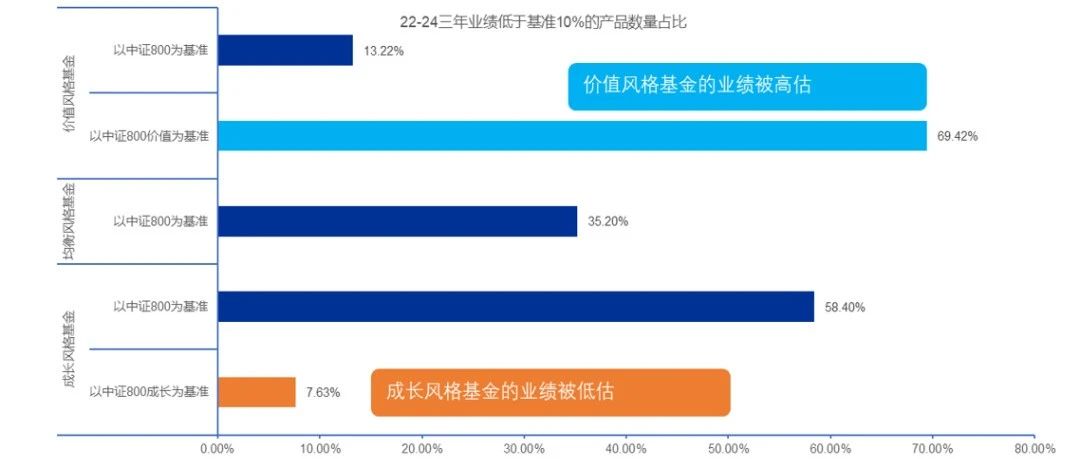
Core Viewpoint - The article discusses the implications of the China Securities Regulatory Commission's "Action Plan for Promoting the High-Quality Development of Public Funds," particularly focusing on the constraints of performance benchmarks for fund managers and the potential impact on their investment strategies and fee structures [1][15]. Group 1: Market Misestimation of Active Equity Funds - The market has overestimated the proportion of active equity funds that will underperform their benchmarks by 10% from 2022 to 2024, with 68.76% of funds projected to face this issue, compared to only 1.05% from 2019 to 2021 [2][6]. - The first method of estimating the probability of underperformance is flawed due to historical data not reflecting future performance accurately, as active equity funds have historically downplayed benchmark tracking [2][5]. - The second method assumes fund managers will align their strategies with broad indices like the CSI 800, which may not be realistic as managers typically select benchmarks that suit their investment styles [2][5]. Group 2: Benchmark Selection Challenges - If fund managers choose broad indices like the CSI 300 or CSI 800 as benchmarks without adjusting their investment strategies, the probability of underperforming these benchmarks by over 10% becomes uncontrollable [5][8]. - Fund managers face two choices: either select a broad index and adjust their portfolio to minimize deviation or choose a benchmark that aligns with their investment style, effectively turning their products into "enhanced index funds" [5][8]. Group 3: Importance of Style-Matched Benchmarks - Choosing benchmarks that align with a fund manager's investment style significantly reduces the proportion of funds underperforming their benchmarks from 47.82% to 22.34% [7][8]. - Growth-style fund managers are often underestimated, while value-style fund managers may be overestimated when using inappropriate benchmarks [7][8]. - The article emphasizes that selecting a suitable benchmark is more critical than conforming to broad indices, as it enhances the stability of excess returns and management fee income [8][11]. Group 4: Short-Term Market Expectations - The market is currently assessing the gap between fund allocations and benchmark indices, which may lead to short-term trading opportunities in certain sectors [15][16]. - Active equity funds are generally underweight in financials and traditional consumer sectors while overweight in technology and growth sectors, indicating a need for adjustments if broad indices are adopted as benchmarks [15][18]. Group 5: Industry and Stock Allocation Insights - Balanced style funds are underweight in non-bank financials, banks, and food and beverage sectors, while they are overweight in media, automotive, and machinery sectors [15][18]. - Growth-style funds show significant underweighting in food and beverage, transportation, and utilities, while being overweight in electronics, power equipment, and machinery [18][19]. - Value-style funds are underweight in banks, non-bank financials, and construction decoration, while overweight in power equipment, real estate, and biomedicine [18][19].
3年跑输基准超10%将降薪 哪些基金经理“亮红灯”?
Nan Fang Du Shi Bao· 2025-05-29 23:10
Core Viewpoint - The China Securities Regulatory Commission (CSRC) has released an "Action Plan for Promoting the High-Quality Development of Public Funds," which links fund managers' compensation to long-term performance, addressing the industry's focus on scale over returns [2] Group 1: Fund Manager Compensation - Fund managers with products underperforming their benchmarks by more than 10 percentage points over three years will see a significant decrease in their performance-based compensation [2] - Conversely, fund managers whose performance significantly exceeds benchmarks may see reasonable increases in their compensation [2] Group 2: Underperforming Funds - As of May 21, nearly 6000 public funds have been managed for over three years, with 1341 funds underperforming their benchmarks by over 10 percentage points, involving 735 fund managers [3] - Among these, 31 funds have underperformed their benchmarks by over 50 percentage points, including notable managers like Yao Zhipeng from Harvest Fund and Shi Cheng from Guotai Junan [3] - The worst performer is Morgan Fund's Guo Chen, whose fund has a cumulative return of -23.03%, lagging behind the benchmark by 128 percentage points [3] Group 3: High-Performing Funds - There are 543 funds that have outperformed their benchmarks by over 10 percentage points, with 33 funds exceeding benchmarks by over 50 percentage points [6] - Notable high performers include the Huaxia North Exchange Innovation Small and Medium Enterprises Fund, managed by Guo Xin, which achieved a cumulative return of 194%, surpassing its benchmark by 176 percentage points [6][7] - The North Exchange theme funds have emerged as a concentrated area of excess returns, with several funds exceeding their benchmarks by over 60 percentage points [7] Group 4: Adjustments to Performance Benchmarks - In response to the new action plan, many fund companies have begun to adjust their performance benchmarks, with over 100 funds changing their benchmarks by May 26 [8][10] - Adjustments are made to ensure benchmarks accurately reflect the risk-return characteristics of the funds, addressing previous inadequacies in benchmark design [10][11] - The CSRC emphasizes the need for strict regulation of benchmark selection and modification to ensure alignment with investment strategies and product positioning [11]

基金业绩比较基准研究系列:国内主动型债券基金
CMS· 2025-05-26 09:04
1. Report Industry Investment Rating No relevant content provided. 2. Core Viewpoints of the Report The report focuses on the performance comparison benchmarks of domestic active bond funds. It analyzes the benchmark settings of various sub - types of active bond funds and their deviations in actual operations. After the release of the "Action Plan", some bond funds have adjusted their performance comparison benchmarks. The report also studies the correlation between funds and benchmarks, tracking errors, and excess returns [1][9]. 3. Summary According to the Table of Contents 3.1 Introduction On May 7, 2025, the CSRC issued the "Action Plan for Promoting the High - quality Development of Public Funds", emphasizing the importance of performance comparison benchmarks. The report, as the second in the series, will analyze the benchmark settings and actual operation deviations of domestic active bond funds [9]. 3.2 Active Bond Fund Performance Comparison Benchmark Characteristics - **Generalized Active Bond Fund Sample Selection**: As of May 7, 2025, 4191 generalized active bond funds in existence and with performance comparison benchmarks were selected as samples, with a total scale of 9.05 trillion yuan. The samples include 7 types of funds, and the medium - long - term pure - bond funds have the largest number and scale [9][10][12]. - **Performance Benchmark Composition Method**: The performance comparison benchmarks of active bond funds have various forms, mainly including single bond indexes or weighted composites of different indexes. The component indexes can be classified into 6 major categories, and the bond index can be further divided into 5 sub - types, while the stock index can be divided into 9 sub - types [13]. - **Performance Benchmark Commonly Used Indexes**: The top ten "main benchmark indexes" of medium - long - term pure - bond funds are mainly indexes compiled by ChinaBond. For example, the number of funds with ChinaBond - Composite Full Price (Total Value) Index as the main benchmark index is 964, accounting for 52.56%. The main benchmark indexes of convertible bond funds are mainly convertible bond indexes, with CSI Convertible Bond Index being the most used. The main benchmark indexes of fixed - income enhanced funds are mainly A - share market indexes such as CSI 300 Index [36][41][50]. - **Comparison of Commonly Used Index Clusters**: The ChinaBond index system is compiled by the Central Government Bond Depository Trust & Clearing Co., Ltd., and the CSI index system is compiled by CSI Index Co., Ltd. The component bond listing locations, remaining maturities, and credit ratings of ChinaBond and CSI indexes are different [54][57]. - **Weight Distribution of "Main Benchmark Indexes"**: For most active bond funds, the weights of ChinaBond - Composite Full Price (Total Value) Index and ChinaBond - Composite Wealth (Total Value) Index are mainly in the range of 90 - 100% for medium - long - term pure - bond funds, mixed bond - type first - level funds, and mixed bond - type second - level funds. The weights of equity indexes in the performance comparison benchmarks of mixed bond - type second - level funds, convertible bond - type funds, and partial - debt hybrid funds are relatively concentrated [62][66]. 3.3 Fund Performance and Benchmark Correlation and Other Analyses - **Correlation Analysis between Active Bond Funds and Their Benchmarks**: From 2022 to 2025, convertible bond - type funds, short - term pure - bond funds, medium - short - term pure - bond funds, medium - long - term pure - bond funds, and partial - debt hybrid funds have relatively high correlations with their performance comparison benchmarks, while mixed bond - type first - level funds and mixed bond - type second - level funds have relatively low correlations [72][73]. - **Tracking Error and Excess Return of Funds Relative to the Benchmark**: The average tracking error of pure - bond funds is less than that of products with embedded options. Among fixed - income enhanced bond funds, first - level bond funds have lower tracking errors, second - level bond funds and partial - debt hybrid funds are relatively close, and convertible bond funds have the highest and most volatile tracking errors. Most pure - bond funds can outperform the benchmark in most years, and the average outperformance is within 2%. Among fixed - income enhanced funds, partial - debt hybrid funds have relatively high average excess returns [3][78]. - **Distribution of Fund Types with Significant Underperformance against the Benchmark**: Pure - bond funds have relatively small deviations from the benchmark and a low proportion of significant underperformance. The performance of fixed - income enhanced funds is related to the selected time interval and the performance of the equity market. In the long - term, active bond funds have the ability to obtain positive excess returns relative to the benchmark, but there are significant performance differences within each type of fund [3].
十年坚守!实力老将王鹏历史投资收益跑赢基准超90%
Sou Hu Cai Jing· 2025-05-23 01:58
Group 1 - The core viewpoint of the article highlights the exceptional performance of Wang Peng, a seasoned fund manager at Guotai Junan, who has significantly outperformed benchmarks over the past decade, particularly in the context of the new regulatory framework for public funds in China [2][5][12] - The China Securities Regulatory Commission (CSRC) has introduced a new action plan aimed at enhancing the performance benchmarks for public funds, indicating a shift away from guaranteed returns in the fund industry [2][5] - Wang Peng has managed the Guotai Junan New Silk Road fund since April 2015, achieving a return of 99.42% as of March 31, 2025, compared to a benchmark growth of only 5.59%, resulting in an excess return of 93.83% [2][5][15] Group 2 - Wang Peng's investment philosophy emphasizes independent thinking, probabilistic reasoning, contrarian courage, and forward-looking vision, focusing on identifying undervalued stocks and constructing a balanced portfolio to minimize risks while pursuing long-term excess returns [7][11] - Since 2017, Wang has de-emphasized market timing, maintaining a high equity position (over 90%) in the Guotai Junan New Silk Road fund, which allows for a deeper focus on industry and company research [8][10] - The fund's strategy includes a diversified selection of stocks, targeting undervalued companies, high-quality stocks, and technology stocks, with a focus on long-term holding and strategic exits based on market conditions [11][12] Group 3 - Wang Peng's recent investment strategy includes a focus on the healthcare and technology sectors, aligning with the broader market consensus that anticipates a favorable equity market in the coming year [13][12] - The article notes that the revaluation of Chinese technology assets is creating new investment opportunities, with indices related to robotics, internet, and software outperforming the market [12][13] - Wang's approach is characterized by a commitment to thorough research and a long-term perspective, aiming to create value for investors through a mature investment system and proactive market engagement [13][12]

大小盘、成长价值维度看,海外主动基金能否跑赢基准?
Changjiang Securities· 2025-05-22 09:16
Group 1: Short-term and Long-term Market Trends - Short-term, public fund performance assessments may provide incremental capital support for underweighted sectors due to marginal pricing effects[3] - Long-term, the key to outperforming benchmarks lies in identifying individual stock and sector opportunities[3] - Recent defensive styles have improved, influenced by trade policy uncertainties and a lack of new catalysts in emerging industries[3] Group 2: Performance Benchmarking - As of December 2024, only 42% of active management funds have outperformed their passive counterparts based on asset-weighted performance[9] - Among U.S. domestic investment funds, the success rate in 2024 is approximately 38%, with small-cap active funds outperforming at 43%[9] - Active global large-cap mixed funds saw a decline in success rate to 20%, down from 23% in 2023[9] Group 3: Fund Management and Strategy - The diversification of performance benchmarks is increasing, with many funds now using composite indices rather than single benchmarks[7] - The choice of performance benchmarks is increasingly driven by market selection rather than regulatory constraints, impacting fund performance attribution[8] - Active equity funds are currently underweight in high-dividend stocks compared to the market, despite a growing number of funds tracking dividend-focused indices[10] Group 4: Risk Considerations - Historical data used in this report does not guarantee future performance, and risks include policy implementation falling short of expectations[11] - Differences in domestic and international market environments pose additional risks for fund performance[11]
682位基金经理“三年大考”不达标,公募基金业绩考核新方案还在“等细则”
Hua Xia Shi Bao· 2025-05-20 11:04
Group 1 - The core viewpoint of the article highlights the low performance benchmark achievement rate among fund managers, with only 65.99% of the 2005 fund managers meeting their benchmarks over the past three years [2][3] - The "Action Plan for Promoting High-Quality Development of Public Funds" was released on May 7, aiming to shift the focus of the industry from "scale" to "returns" and to establish a performance benchmark regulatory guideline [2] - Many public funds have yet to implement corresponding assessment systems in response to the new regulatory framework, primarily due to waiting for detailed guidelines and observing the actions of leading companies [5][6] Group 2 - Among the 2005 fund managers, 1323 achieved performance benchmarks, while 682 did not, indicating a significant disparity, especially within mixed fund managers where only 52.13% met the standards [3] - Active equity fund managers have a benchmark achievement rate of 52.19%, with a notable number of managers failing to meet benchmarks due to reliance on popular products launched in 2019-2020 [4] - The performance of stock fund managers shows a 61.54% achievement rate, with over 70% of those not meeting benchmarks concentrated in specific sectors like new energy and semiconductors [4] Group 3 - The industry response to the new assessment guidelines is cautious, with many firms preferring to wait for clearer regulations before making significant changes to their internal assessment systems [5][6] - Some large fund companies have submitted over 180 potential performance benchmark indices to provide a more diverse range of performance standards for their products, although this could complicate operations [6] - Current assessment practices vary, with some firms extending the assessment period to three years and focusing on excess returns relative to benchmarks to maintain investment direction and style consistency [7][8]

让风云君看得头疼,跑赢业绩基准到底有多难?连续五年跑赢基准的主动权益基金只有这些!
市值风云· 2025-05-20 10:02
Core Viewpoint - The article discusses the significant reforms introduced in the public fund industry through the "Action Plan for Promoting High-Quality Development of Public Funds," emphasizing the importance of performance benchmarks and the need for a more rational setting of these benchmarks to improve fund performance [2][6][12]. Summary by Sections Performance Benchmarks - The document highlights the critical role of performance benchmarks for public funds, which serve as a standard for fund managers to achieve and exceed [6][7]. - Most funds currently use indices like CSI 300, CSI 800, and CSI 500 as benchmarks, with nearly half of active funds benchmarked against the CSI 300 [7]. Fund Performance Analysis - Recent data indicates that only 30% of funds have outperformed their benchmarks over the past three years, with nearly 50% of products underperforming by more than 10% [12]. - The average excess return relative to benchmarks has been negative in recent years, with a notable decline in the proportion of funds outperforming benchmarks from 2020 to 2024 [13][14]. Active Fund Management Challenges - Continuous outperformance is challenging, especially during market downturns, where only about 20% of active funds managed to outperform their benchmarks from 2022 to 2024 [14]. - A study identified only 46 funds (2.2% of the sample) that consistently outperformed their benchmarks over five years, with 25 of these having a combined scale of over 1 billion [17]. Fund Manager Performance - The article lists funds that have consistently outperformed their benchmarks over five years, noting that many of these funds are managed by well-regarded fund managers [21][22]. - The performance of fund managers is evaluated not only on returns but also on their ability to control drawdowns, with some funds experiencing significant drawdowns despite strong returns [23][24]. Notable Fund Managers - The article mentions specific fund managers who have successfully managed funds that consistently outperform benchmarks, highlighting their investment philosophies and strategies [25][36]. - It also discusses the impact of fund manager changes on fund performance, particularly in the context of recent departures of notable managers [29][33]. Conclusion on Fund Evaluation - The article concludes that while outperforming benchmarks is a key metric for evaluating fund performance, it should not be the sole criterion, as other factors such as risk management and drawdown control are equally important [44].

后明星时代公募基金研究系列之四:公募基金高质量发展行动方案如何影响基金经理行为和资金配置?
Shenwan Hongyuan Securities· 2025-05-19 03:42
1. Report Industry Investment Rating No relevant content provided. 2. Core View of the Report - The "Action Plan" is long - term oriented, and its short - term impact on the market may be overestimated. Its specific terms have a long - term impact on fund managers' behavior and funds, and the short - term market impact is mainly emotional [2][6]. - In the long run, the index enhancement of active equity funds is a major development trend. The active equity investment betting on a single track may decline, and floating - fee products put forward higher requirements for active equity investment to approach the benchmark [2]. 3. Summary by Directory 3.1 Policy Focuses on the Long - Term, and Short - Term Impact on the Market May Be Overestimated - Future public funds may adjust performance benchmarks according to actual investment characteristics rather than simply approaching existing benchmarks. The current calculation method overestimates the amount of position - adjustment funds [6]. - The three - year relative benchmark - 10% constraint is relatively mild. Fund managers don't need to significantly adjust their positions in the short term. In the three - year dimension, the possibility of correct and implemented active judgments by active equity fund managers increases significantly [7][9]. - The "Action Plan" emphasizes long - term assessment, which protects fund managers' long - term investment decisions and encourages them to take a long - term perspective in investment decisions [15]. 3.2 Long - Term Impact: Index Enhancement of Public Funds Is a Major Trend 3.2.1 Active Investment Betting on Sub - Tracks May Decline - The three - year performance benchmark - 10% constraint may force track - type fund managers to adjust their investment characteristics in the long term. Short - term volatile sub - industries are difficult to outperform broader benchmarks in the three - year dimension [18]. - The "Action Plan" also includes investor return assessment, which will make it difficult for the "business model" of high - volatility single - track products to continue. The active equity investment model of betting on tracks may gradually decline [20][21]. 3.2.2 Floating - Fee Products Are a Real Test for Active Equity Investment to Approach the Benchmark - The "Action Plan" proposes new floating - fee products, which are required to account for no less than 60% of new products. If these products are open - ended funds, they will pose a real challenge to active equity investors to approach the benchmark [23]. - Since fund managers cannot control investors' subscription and redemption behaviors, their optimal decision is to closely follow the benchmark to create excess returns, which puts forward higher requirements for active equity fund managers [24][27].
跑赢基准100个百分点?基金公司密集“纠偏”!什么情况?
券商中国· 2025-05-18 10:38
Core Viewpoint - The China Securities Regulatory Commission (CSRC) has released an action plan to promote the high-quality development of public funds, emphasizing the importance of performance benchmarks for funds [1][7]. Group 1: Changes in Performance Benchmarks - A significant increase in the number of funds changing their performance benchmarks has been observed this year, with 82 funds making changes compared to only 37 in the same period last year [3]. - Several North Exchange theme funds have updated their performance benchmarks to align with relevant indices, although five companies have yet to make these necessary adjustments [3][6]. - The Tianhong Qingxiang Fund and Zheshang Huijin Quantitative Fund have both adjusted their performance benchmarks to better reflect their investment strategies, moving away from indices that do not accurately represent their risk-return profiles [4][5]. Group 2: Importance of Performance Benchmarks - Performance benchmarks are crucial for evaluating fund performance, yet many funds have benchmarks that do not serve their intended purpose, leading to a lack of accountability for fund managers [6][9]. - The CSRC's action plan aims to enforce stricter guidelines for setting and modifying performance benchmarks, linking them to fund company performance assessments and manager compensation [7][10]. - The current benchmarks often reflect a simplistic approach, with a high concentration of funds using major indices like the CSI 300, which may not accurately represent the diverse market landscape [9][11]. Group 3: Future Implications - The action plan is expected to lead to more refined management of performance benchmarks, encouraging fund companies to reassess their benchmarks and align them more closely with their investment strategies [8][10]. - As the industry evolves, there is a push for more sophisticated benchmark selection, including the potential use of composite indices instead of relying solely on broad indices [11].