多元化

Search documents
美国防授权法案众议院“过会” 细节披露
Xin Hua She· 2025-12-11 11:09
Core Points - The U.S. House of Representatives passed the National Defense Authorization Act for Fiscal Year 2026, totaling $901 billion, which includes military aid for Ukraine and provisions for U.S. military personnel [1] - The bill is expected to be approved by the Senate next week, with the White House expressing support [1] Group 1: Military Aid and Defense Initiatives - The bill allocates $400 million annually for military assistance to Ukraine over the next two years, totaling $800 million [2] - It continues the Baltic Security Initiative, providing $175 million for defense in Estonia, Latvia, and Lithuania [2] - The bill mandates that U.S. troop levels in Europe cannot fall below 76,000 for more than 45 days and prohibits the withdrawal of significant weaponry from Europe [2] Group 2: Compensation and Support for Allies - The legislation includes provisions for increasing active-duty military pay and continued support for Israel, including funding for missile defense systems [2] - The bill does not allocate the $2 billion requested for renaming the Department of Defense to the Department of War [2] Group 3: Bipartisan Agreement and Controversies - Both Republican and Democratic parties view the bill as a victory, with an $8 billion increase over the budget requested by former President Trump [3] - The bill eliminates the Pentagon's diversity, equity, and inclusion programs and incorporates several of Trump's executive orders [3] - Some controversial provisions supported by Republicans were excluded, and there are restrictions on actions taken by the Trump administration [3] Group 4: Accountability Measures - The bill includes a provision to withhold 25% of the Secretary of Defense's travel budget unless unedited videos and orders related to military actions against "drug boats" are provided to Congress [4] - This unusual strategy reflects congressional dissatisfaction with the Department of Defense [4] - The bill also requires prior notification to Congress when dismissing senior military officers [4]
AT&T commits to ending DEI programs
Reuters· 2025-12-02 21:47
Core Viewpoint - AT&T has decided to end its diversity, equity, and inclusion programs as part of its strategy to seek approval from the U.S. telecoms regulator [1] Group 1 - The decision to terminate these programs is a significant shift in AT&T's corporate policy [1] - This move is likely aimed at aligning with regulatory expectations and potentially improving operational focus [1] - The announcement reflects broader trends in the telecom industry regarding corporate governance and social responsibility initiatives [1]



中创智领:“A+H”双平台助力企业战略转型 煤机龙头助推区域经济高质量发展
Zheng Quan Shi Bao· 2025-12-02 00:23
Core Viewpoint - The company Zhengzhou Coal Mining Machinery Group Co., Ltd. has rebranded to Zhongchuang Zhiling, marking a strategic shift towards intelligent and diversified development, and has been recognized as the 19th among the top 100 enterprises in Henan Province [1]. Group 1: Strategic Transformation - The coal machinery industry has experienced cyclical fluctuations in market conditions and coal prices, leading to a gradual slowdown in growth and a decline in core operating indicators [2]. - The acquisition of Yaxin Technology in 2017 allowed the company to gain core technologies in engine components and high-end castings, establishing a complete R&D and quality control system for future product development [2]. - The company has successfully opened a "second growth curve" through capital operations, mitigating the impact of single industry cyclical fluctuations while maintaining its global leadership in coal machinery [2][4]. Group 2: Market Expansion and Collaboration - Zhongchuang Zhiling has established overseas production bases through strategic acquisitions, effectively expanding its international high-end customer market and improving global capacity layout [3]. - The company has formed stable partnerships with several well-known vehicle manufacturers, enhancing its competitive supply chain conditions and promoting a virtuous cycle of brand building and market expansion [3]. Group 3: Financial Performance and Market Position - Since its A-share listing in 2010, the company has achieved a cumulative net profit of 19.932 billion yuan and has distributed cash dividends totaling 7.549 billion yuan, exceeding its total capital market financing of 5.369 billion yuan [4]. - The company's market capitalization has grown by 197% from 14 billion yuan at IPO to approximately 41.6 billion yuan by October 2025, reflecting strong shareholder returns and value creation [4]. Group 4: Industry Leadership and Regional Development - Zhongchuang Zhiling has played a significant role in the intelligent and green transformation of traditional industries in Henan, supporting the province's strategy as a major energy raw material base [5][6]. - The company has been recognized as the first "lighthouse factory" in the global coal machinery industry, promoting its smart factory construction experience to support the intelligent upgrade of the local new energy industry [6]. Group 5: Future Plans and R&D Focus - Over the next 3 to 5 years, the company plans to focus on R&D investment and capacity expansion, aligning its goals with Henan Province's high-quality development objectives [8]. - The company aims to enhance its technological barriers by investing in core technologies related to industrial intelligent manufacturing and new energy components, contributing to the intelligent transformation of traditional industries [8]. Group 6: Recommendations for Industry Support - The company emphasizes the importance of core technology for business sustainability and suggests that government departments strengthen support for enterprises with key technologies and innovative models [9]. - It advocates for the establishment of innovation alliances and industry funds to promote the collaborative development of upstream and downstream enterprises [9].

白酒经销商大逃亡:3000家门店关闭背后的生存法则
Sou Hu Cai Jing· 2025-12-01 12:01
Group 1 - The core viewpoint of the article highlights the significant challenges faced by the Chinese liquor industry, particularly the decline in wholesale prices of Moutai below 1600 yuan, leading to widespread store closures and a shift in business strategies [1] Group 2 - The industry is transitioning from a "stockpiling for price increase" model to a "zero inventory and fast turnover" approach, with distributors reducing warehouse space by 80% and adopting a T+7 model for inventory management [2] - Diversification strategies are being implemented, with liquor stores increasing the sale of fast-moving consumer goods (FMCG) to boost customer traffic by 40%, despite liquor sales dropping to 15% of total revenue [3] Group 3 - Regional specialization is becoming crucial, with successful distributors focusing on local markets, such as wedding services, and achieving inventory turnover rates 2.3 times faster than those with broader strategies [4] - The survival of liquor businesses now depends on cash flow management, scenario-based operations, supply chain collaboration, data analysis capabilities, and localized services, emphasizing practicality over prestige in a challenging market [4]

Geospace Technologies (GEOS) - 2025 Q4 - Earnings Call Transcript
2025-11-21 16:00
Financial Data and Key Metrics Changes - For Q4 2025, the company reported revenue of $30.7 million, down from $35.4 million in Q4 2024, representing a decrease of 19.7% [10] - The net loss for Q4 2025 was $9.1 million, or $0.71 per diluted share, compared to a net loss of $12.9 million, or $1 per diluted share in the same quarter last year [10] - For the full fiscal year 2025, revenue totaled $110.8 million, down from $135.6 million in fiscal year 2024, a decrease of 18.3% [10] - The net loss for the full year was $9.7 million, or $0.76 per diluted share, compared to a net loss of $6.6 million, or $0.50 per diluted share in the previous year [10] Business Line Data and Key Metrics Changes - Smart Water segment revenue for Q4 2025 was $8.5 million, down 28% from $11.9 million in Q4 2024; however, for the full year, it increased by 10% to $35.8 million from $32.4 million [11] - Energy Solutions segment revenue for Q4 2025 was $15.7 million, a decrease of 11% from $17.6 million in Q4 2024, and for the full year, it decreased by 35% to $50.7 million from $78 million [12] - Intelligent Industrial segment revenue for Q4 2025 was $6.4 million, up 9% from $5.8 million in Q4 2024, but for the full year, it decreased by 4% to $24 million from $24.9 million [12][13] Market Data and Key Metrics Changes - The company noted a mixed fiscal year performance across market segments, with the smart water segment showing strong growth while energy solutions faced challenges due to lower offshore exploration activity and oil price volatility [5][6] - The company is focusing on international markets, particularly addressing water scarcity and environmental changes, while also enhancing its municipal water management model in the U.S. [5] Company Strategy and Development Direction - The company aims to diversify and innovate, with a strong focus on the smart water and intelligent industrial segments, leveraging technology and manufacturing capabilities [9] - The acquisition of Geovox Security is part of the strategy to enhance recurring revenue through new solutions [8] - The company plans to continue pursuing growth through acquisitions that are immediately accretive to top-line revenue [9] Management's Comments on Operating Environment and Future Outlook - Management acknowledged ongoing trade disputes and tariffs impacting material costs, with expectations of similar impacts in fiscal year 2026 [17] - The company anticipates continued market demand for Hydrocon and Aquana solutions, despite short-term uncertainties in the exploration market due to low oil prices [6][9] - Long-term demand forecasts are expected to drive more favorable market conditions in future periods [7] Other Important Information - The company has a strong backlog going into the next fiscal year, which positions it well for future growth [9] - Cash investments for the rental fleet and property plant and equipment totaled $9.1 million, with an additional $1.8 million invested in the Heartbeat Detector product line [13][14] Q&A Session Summary Question: Can you elaborate on the margin pressure in the energy solutions segment? - Management indicated that margin pressure was due to ongoing price pressure and higher manufacturing costs, but they expect improved margins going forward as manufacturing inefficiencies are resolved [19][28] Question: How much of the margin impact is expected to be transitional? - Management did not provide specific percentages but noted that they are monitoring the situation closely and expect some improvements in margins [21][22] Question: What updates can you provide on government initiatives? - Management mentioned that feedback from Customs and Border Protection is anticipated early next year, while Navy projects are expected to be delayed until mid-next year [32] Question: Have the large projects announced earlier been shipped? - Management confirmed that shipments for the Petrobras project and the Mariner contract have not yet occurred, with expected revenue recognition in fiscal year 2027 [35][36]

2025 Z世代双十一消费行为报告
Sou Hu Cai Jing· 2025-11-11 07:39
Core Insights - The report outlines the consumption behavior of Generation Z during the Double Eleven shopping festival in 2025, based on a survey of 2,770 samples, highlighting a significant increase in participation and diverse spending patterns among this demographic [1][2]. Group 1: Demographics and Participation - Generation Z's main consumer base consists of individuals born in the 1990s, 1995s, and 2000s, with males representing 61.1% of this group [1][5]. - The highest participation rate in Double Eleven is observed in ordinary prefecture-level cities at 28.7%, followed by new first-tier cities and major metropolitan areas [1][6][7]. - Young individuals with a monthly income between 5,001 and 8,000 yuan show the most pronounced consumption demand [1][8]. Group 2: Consumption Trends - In 2025, 93.1% of young people participated in Double Eleven, marking a steady increase from previous years, with 39.1% feeling a stronger sense of festivity this year [1][11]. - 38.6% of young consumers increased their Double Eleven budget compared to 2024, indicating a robust consumer confidence trend [2]. - The consumption categories have diversified, with traditional strong categories like clothing and beauty products, alongside emotional and cultural consumption, including travel, digital services, and creative products [2]. Group 3: Consumer Sentiment and Feedback - The sentiment towards Double Eleven is mixed, with positive feedback focusing on clear promotional rules, direct discounts, and a rich variety of products, while negative feedback includes concerns about prolonged event duration and lack of price advantages [2][12][13]. - Approximately 29% of young consumers feel that there has been no significant change in the shopping experience compared to previous years [13]. - There is skepticism regarding the claim of "lowest prices of the year" during Double Eleven, with 59% of respondents feeling uncertain and 18.2% completely disbelieving this assertion [14][15]. Group 4: Technological Integration and Brand Preferences - Over 70% of young consumers are engaged with offline store activities, and there is a notable increase in preference for domestic brands, particularly in categories like smartphones and home appliances [2]. - The application of AI technology in e-commerce has emerged as a new highlight, with around 70% of young consumers having experienced AI-related services, particularly in intelligent customer service and personalized recommendations [2].

团播成了新风口,你真看明白了吗?
Sou Hu Cai Jing· 2025-11-07 11:13
Core Insights - The resurgence of "group broadcasting" (团播) is attributed to its evolution into a professional and collaborative format, moving away from the individualistic approach of traditional live streaming [2][21][22] - Group broadcasting has become a significant market, generating approximately 15 billion in annual revenue, with around 8,000 group broadcast rooms operating daily [21][22] Industry Evolution - The group broadcasting model has gained popularity due to its ability to create a stage for collective performance, allowing for greater audience engagement and interaction [2][20] - The entry of professional talents from various fields, such as performing arts and media, has elevated the quality and standards of group broadcasting [5][12][20] Professionalization - The industry is witnessing a shift towards professionalization, with an increasing number of applicants from prestigious institutions and backgrounds, indicating a higher entry barrier [5][12] - Group broadcasting teams are structured to include a significant number of behind-the-scenes professionals, ensuring high-quality content production and effective collaboration [10][13] Content Quality and Innovation - The focus on quality has led to substantial investments in hardware and production processes, with costs reaching hundreds of thousands for advanced setups [14][15][18] - Diverse content types have emerged, catering to various audience preferences, including genres like pop dance, traditional culture, and instrumental performances [18][20] Market Dynamics - The regulatory environment is becoming stricter, favoring group broadcasting as a more stable and controlled format compared to individual streaming [22] - Successful group broadcasts are evolving into valuable IPs, capable of generating revenue through various channels, including live events and brand collaborations [24]

美国政坛变天!奥巴马主动当参谋,纽约或将迎来首位穆斯林市长
Sou Hu Cai Jing· 2025-11-07 06:07
Core Points - The New York City mayoral election is focused on two key figures: Obama and Mamdani, with Mamdani leading in polls and gaining significant support from young and immigrant voters [1][3] - Mamdani's progressive policies, such as rent freezes and green energy jobs, resonate particularly well with voters under 35, where 67% express support [3] - The election reflects a clash of governance ideologies, with Mamdani representing the future, Cuomo embodying the past, and Sliwa calling for a return to order [5][17] Political Dynamics - Obama's involvement is seen as a strategic move to ensure the continuation of his political legacy through a new generation, with Mamdani positioned as the ideal successor [7][19] - The Democratic Party is experiencing significant internal divisions, making the New York election crucial for establishing a foundation for future midterm elections [7] Campaign Strategies - Mamdani's campaign has doubled its fundraising in the past month, aided by Obama's extensive fundraising network and the reactivation of his 2012 campaign team [9] - The use of advanced technology in campaigning, including data-driven voter outreach and tailored messaging, marks a significant evolution in election strategies [11] Social Issues and Voter Sentiment - The election is influenced by broader social issues, including rising living costs and tensions between Muslim and Jewish communities, particularly in light of the renewed Israel-Palestine conflict [13] - Voter enthusiasm is mixed, with younger voters supporting Mamdani but historically having lower turnout rates, while older voters tend to vote consistently but may resist new policies [15] Election Impact - The presence of third-party candidates, despite low overall support, could disrupt the election outcome in tightly contested areas [17] - The election serves as a reflection of the broader American political landscape, with Mamdani's rise challenging traditional boundaries of religion, ethnicity, and politics [17][19]

Thermon(THR) - 2026 Q2 - Earnings Call Transcript
2025-11-06 17:00
Financial Data and Key Metrics Changes - Reported revenues increased by 15% year-over-year, reaching $131.7 million for the quarter [16] - Adjusted EBITDA rose by 29% to $30.6 million, with adjusted EBITDA margins at 23.2%, up from 20.8% last year [17][18] - Gross profit increased by 20% to $61 million, resulting in a gross margin of 46%, up from 44% [17] - GAAP earnings per share increased by 61% to $0.45, while adjusted earnings per share rose by 45% to $0.55 [18] Business Line Data and Key Metrics Changes - Large project revenue was $24.7 million, a 41% increase year-over-year, driven by several CapEx projects moving to execution [17] - OPEX revenues were $107 million, up 10% year-over-year, representing 81% of total revenues [16][17] - Organic revenue growth, excluding FOTI, was 9% year-over-year [16] Market Data and Key Metrics Changes - U.S. land sales increased by 8%, while Canada saw a 10% increase in revenue [19] - EMEA revenue doubled, driven by strong performance in organic business and contributions from FOTI [19] - APAC experienced a 4% decline, primarily due to uncertainties surrounding global trade policies with China [19] Company Strategy and Development Direction - The company is focused on a 3D strategy of decarbonization, digitization, and diversification to drive organic growth [9][25] - The establishment of a global engineering center in Mexico aims to handle increased project workloads [8] - The company is actively pursuing opportunities in the data center market, particularly with liquid-cooled data centers and medium voltage heaters [12][14] Management's Comments on Operating Environment and Future Outlook - Management expressed confidence in the company's ability to deliver strong second-half results and raised full-year 2026 financial guidance [23][24] - The company is well-positioned to benefit from favorable secular demand trends, including reshoring, electrification, and decarbonization [7][25] - Management noted that the current tariff structures are expected to remain stable, which is crucial for maintaining customer sentiment [24] Other Important Information - The company ended the quarter with total liquidity of $129 million and a net leverage ratio of 1.0 times [8][22] - The backlog increased by 17% year-over-year, with a 4% organic increase due to positive book-to-bill ratios [18][19] Q&A Session Summary Question: Expectations for large CapEx projects, particularly in LNG - Management indicated robust activity in the LNG market, with a 140% year-over-year increase in the LNG pipeline [29] Question: Details on digitization efforts and their impact - Management highlighted that digitization differentiates the company from competitors and enhances customer engagement, leading to recurring revenues [30][31] Question: Dynamics of gross margin in relation to large projects - Management acknowledged that large projects typically have lower margins but noted that increased volumes and productivity gains helped maintain solid margins [34][35] Question: Timing for other large projects to move to execution - Management confirmed that a broader range of projects across various sectors is moving to execution, not just LNG [38] Question: Impact of data center and medium voltage heater opportunities on results - Management stated that there was no impact in the second quarter, but they are beginning to book orders and see high-probability opportunities [39] Question: Balance between organic and inorganic growth investments - Management emphasized a priority on organic growth initiatives while also tracking potential inorganic opportunities [45]

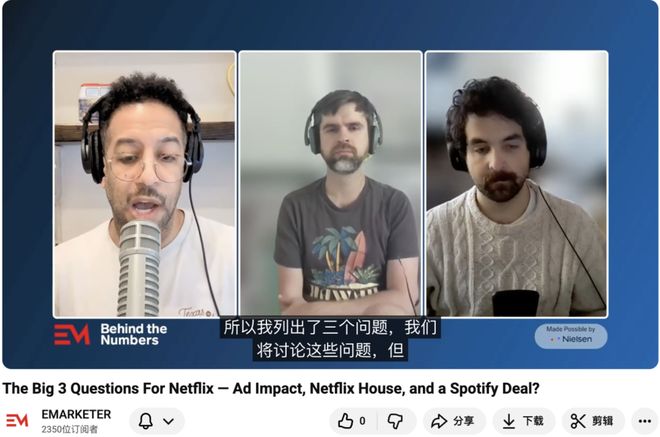
复盘Netflix的2025:广告业务、线下业态和视频播客
Tai Mei Ti A P P· 2025-11-05 08:27
Core Insights - The central question surrounding Netflix is where its next growth curve will come from after the stabilization of subscription revenue [3][20] - Netflix is actively diversifying its business model beyond being a streaming subscription platform, focusing on advertising, physical experiences, and audio content [3][21] Advertising Business - Netflix's advertising revenue is projected to exceed $2 billion in 2023 and could reach $3 billion by 2027, accounting for about 5% of total revenue [6] - The company is increasingly leveraging sports events to drive advertising growth, having recently broadcast a boxing match that attracted over 41.4 million viewers, setting a record for both Netflix and the boxing industry [6][7] - Despite the growth potential, Netflix's advertising business is still considered a secondary revenue stream, lacking the infrastructure for effective performance advertising [8][20] Netflix House - The first Netflix House opened in Philadelphia in November 2025, designed as an immersive entertainment space featuring interactive installations based on popular shows [9] - This initiative is seen as a brand-building exercise rather than a significant revenue generator, lacking a clear monetization strategy compared to Disney's model [10][11] - The current approach appears to be more of a market experiment to test the external visibility of Netflix's IP rather than a fully developed business model [11] Audio Collaboration - Netflix plans to introduce video podcast content from Spotify starting in 2026, with minimal investment and no significant changes to its platform [12][19] - The collaboration primarily benefits Spotify, as it seeks to expand its audience through Netflix's platform, while Netflix does not appear to be prioritizing audio content as a growth engine [14][19] - The existing platform structure does not support the effective consumption of podcast content, indicating that this initiative is more of a low-risk trial rather than a strategic pivot [18][19] Future Directions - The advertising business is seen as the most promising avenue for revenue growth in the next three years, while the physical and audio initiatives are viewed as extensions of brand assets with limited immediate value [20][21] - A significant question for Netflix is whether it will evolve from a content platform to an industry organizer, potentially reshaping its role in the content distribution ecosystem [21][24]