差异化发展

Search documents
浙商基金十五载:亏损再现,破局待解
Bei Jing Shang Bao· 2025-09-04 14:37
Core Insights - Zhejiang Merchants Fund is facing significant challenges as it approaches its 15th anniversary, reporting a net profit loss of 10.51 million yuan in the first half of 2025, marking a shift from profit to loss for the first time in four and a half years [1][3][4] - The fund's management scale has also declined, with a notable drop in the performance of several actively managed equity funds, leading to concerns about its competitive position among peers [1][6] Financial Performance - In the first half of 2025, Zhejiang Merchants Fund reported operating revenue of 69.08 million yuan, down from 96.57 million yuan in the same period of 2024, with a net profit loss of 10.51 million yuan compared to a profit of 235,700 yuan in 2024 [3][4] - The fund's net profit had previously experienced a recovery from 2018 to 2022, peaking at 45.35 million yuan by the end of 2022, but has since declined again [4][5] Management and Governance - The fund has undergone significant leadership changes, with five general managers since its inception, which may have contributed to strategic inconsistencies and challenges in long-term planning [5][6] - Analysts suggest that the fund's governance structure may have underlying issues, exacerbated by frequent changes in management [6][9] Market Position and Competition - As of the second quarter of 2023, Zhejiang Merchants Fund's total management scale was 37.98 billion yuan, with a non-money market fund scale of 27.32 billion yuan, representing year-on-year decreases of 27.24% and 22.01%, respectively [6][8] - Compared to peers established in the same year, Zhejiang Merchants Fund ranks last in both total management scale and non-money market fund scale [8][9] Strategic Recommendations - To overcome its current challenges, the fund is advised to focus on developing differentiated and sustainable products, enhancing research capabilities, and optimizing governance structures [9][10] - Specific strategies include creating niche products in areas like ESG and quantitative strategies, improving investment research and risk management, and leveraging shareholder resources for channel expansion [10]


告别“内卷”,差异化竞争格局渐成,哪些光伏企业能卡位成功?
Sou Hu Cai Jing· 2025-09-04 05:57
Core Viewpoint - The photovoltaic industry is expected to experience a reasonable price recovery and profit restoration, with improvements in the fundamentals driven by policy support and technological innovation [1][4]. Policy Impact - A series of targeted policies have been introduced since 2025 to address the issue of "disorderly low-price competition" in the photovoltaic industry, establishing clear boundaries for healthy industry development [3]. - The revised Anti-Unfair Competition Law prohibits the sale of products like silicon materials and components below cash cost, setting a price floor and curbing "suicidal price cuts" [3]. - The Central Financial Committee emphasized the need to govern low-price competition and promote the orderly exit of backward production capacity, signaling a strong push for supply-side structural optimization [3]. Market Dynamics - Since the second quarter of 2025, prices across the photovoltaic industry chain have shown an orderly recovery, indicating improvements in supply-demand relationships and competitive order [4]. - Silicon material prices have seen a significant increase, with the average transaction price for multi-crystalline silicon reaching 47,900 RMB per ton, marking a 3.37% rise and an eight-week consecutive increase [4]. - The reduction in low-price sales and the gradual decrease in industry inventory have contributed to this price recovery [4]. Industry Trends - The photovoltaic industry is transitioning from homogeneous competition to differentiated development, with leading companies exploring unique market segments [6]. - Companies like Southeast Network Frame are actively pursuing carbon-neutral strategies and investing in renewable energy projects, such as a 110MW agrivoltaic project [6]. - Innovative application models, including photovoltaic + energy storage and photovoltaic + agriculture, are becoming increasingly mature, contributing to the industry's high-quality development [7]. Performance Metrics - In the first half of 2025, the national photovoltaic installed capacity reached approximately 1.1 billion kilowatts, a year-on-year increase of 54.1%, with cumulative power generation of 559.1 billion kilowatt-hours, up 42.9% [7]. - The photovoltaic equipment sector has seen a significant rise, with the sector index increasing by 37.26% since early April 2025 [7].


券商亮眼中报映照一流投行建设路径
Zheng Quan Ri Bao· 2025-09-03 16:21
Core Insights - The new "National Nine Articles" has set a clear direction for the construction of first-class investment banks, leading to a significant transformation in the securities industry over the past year [1] - The industry is witnessing a dual enhancement in profitability and capital strength, with key performance indicators reflecting the positive impact of policy benefits and industry transformation [2] - Mergers and acquisitions are becoming the core strategy for securities firms to achieve first-class investment bank status, moving beyond mere scale expansion to deep resource integration [3] - Smaller securities firms are carving out niche markets through differentiated strategies, demonstrating that they can compete effectively in specific segments [4] Industry Transformation - The new "National Nine Articles" aims for significant progress in first-class investment bank construction by 2035, transitioning brokers from traditional intermediaries to key players in serving the real economy [1] - Regulatory measures are guiding leading firms to strengthen through mergers and acquisitions while allowing smaller firms to explore unique development paths [1][2] - The industry is avoiding homogenized competition, enabling firms of various sizes to find suitable development tracks [1] Performance Metrics - In the first half of the year, total assets of 150 securities firms exceeded 13 trillion yuan, with net profits surpassing 110 billion yuan, reflecting a year-on-year increase of over 40% [2] - The concentration of the industry has notably changed, with the top five firms accounting for 34% of total assets, 30% of net assets, 27% of operating income, and 41% of net profits [2] Mergers and Acquisitions - Mergers and acquisitions are now seen as essential for enhancing competitiveness, with successful examples like Guotai Junan and Haitong Securities demonstrating significant synergy and resource integration [3] - The merger of Guotai Haitong has led to a notable increase in industry competitiveness, while Guolian and Minsheng Securities achieved over 1000% year-on-year growth in net profit through resource integration [3] Niche Strategies - Smaller firms are not being marginalized but are instead finding success in specialized areas such as financial product sales and advisory services, breaking the stereotype of lacking competitive advantages [4] - Regional firms are leveraging local industry needs to provide tailored services, while specialized firms are establishing barriers in IPO underwriting through deep industry research capabilities [4] Future Outlook - The current industry landscape shows that leading firms are advancing towards comprehensive and international first-class investment banks, while smaller firms are establishing themselves in niche markets [4] - Continued policy support and industry consolidation are expected to enhance the maturity of this layered competition and collaborative development, driving the securities industry towards high-quality growth [4]
零售上市公司探寻数字化转型路径
Zheng Quan Ri Bao· 2025-08-25 16:15
Group 1: Industry Overview - As of August 25, 31 retail companies listed in A-shares have released their mid-year reports, with 15 companies showing varying degrees of net profit growth year-on-year [1] - The highest net profit growth was reported by Bubu Gao, with a 357.71% increase to 201 million yuan, alongside a revenue increase of 24.45% to 2.129 billion yuan [1] - The retail industry is focusing on optimizing asset structures and improving profitability by closing inefficient stores and adjusting potential stores to better match regional consumer demands [1] Group 2: Company Strategies - Huijia Times is implementing a "one store, one policy" approach to upgrade traditional department stores into immersive social spaces, enhancing customer experience [2] - The company is also deepening its online and offline integration through detailed consumer analysis, shifting from "traffic competition" to "retention management" [2] Group 3: Digital Transformation - Digital transformation is seen as the internal backbone supporting high-quality development, with improvements in inventory turnover days and fresh produce loss rates through digital technology and supply chain adjustments [3] - Companies are encouraged to enhance operational capabilities and supply chain efficiency while avoiding homogenized competition by leveraging private brands and innovative consumer scenarios [3] Group 4: Future Outlook - The retail industry's transformation is becoming clearer, focusing on store adjustments, digital upgrades, and innovative consumer experiences as pathways to high-quality development [4] - Companies that continuously optimize operational efficiency and accurately grasp consumer needs are expected to gain a competitive edge in the ongoing transformation [4]


“中国电影新力量”再聚长春,碰撞思想、分享洞见
Yang Shi Wang· 2025-08-24 06:19
Core Insights - The forum emphasized the importance of integrating "new forces" into the Chinese film industry to adapt to changing audience demographics, technological advancements, and competitive landscapes [1][2][8] - The event highlighted the success of recent films and the emergence of young creators, showcasing a shift towards innovative storytelling and audience engagement [1][2][8] Group 1: Forum Highlights - The forum was themed "From Life to Audience - Movies Together with the Audience," focusing on the relationship between filmmakers and viewers [2] - Key speakers included prominent figures from the film industry who discussed various topics such as realistic themes, animation innovation, and audience engagement [2] - The event featured discussions on the need for filmmakers to embrace new technologies and audience expectations to create impactful narratives [1][8] Group 2: Film Industry Trends - Recent films like "Nanjing Photo Studio" and "Nezha: The Devil's Child" received high audience satisfaction scores, indicating a positive trend in film quality [8][9] - The number of high-rated films (above 86 points) has increased from 1 in 2015 to 5 in 2023, reflecting the industry's progress [9] - The forum also introduced a list of 34 upcoming films, showcasing the continuous output of quality content in the industry [9] Group 3: Creative Approaches - Filmmakers are encouraged to adopt a "realistic" approach in animation, as demonstrated by the production of "Nezha 2," which involved extensive collaboration and technical innovation [5][6] - The importance of historical narratives in films was emphasized, with creators aiming to transform historical memories into constructive realities [3][4] - The forum underscored the necessity for filmmakers to engage in genuine dialogue with audiences, adapting to their evolving preferences and expectations [7]

县域发展要力避千城一面
Jing Ji Ri Bao· 2025-08-23 00:42
Group 1 - The core viewpoint emphasizes the importance of differentiated development in county-level urbanization to activate the county economy and avoid homogenization [1][2][3] - The article highlights the successful integration of cultural tourism and local industries, exemplified by the popularity of the Xiaoxitian scenic area in Shanxi, which has attracted tourists and encouraged entrepreneurship among university students [1] - The Central Urban Work Conference has proposed a classification approach to urbanization, focusing on the unique functions and characteristics of different counties to promote tailored policies [1][2] Group 2 - The article discusses the necessity of building a robust industrial foundation for county-level urbanization, with examples like Anji in Zhejiang, where the bamboo industry is being upgraded to enhance economic output and employment [2] - Infrastructure development should align with the specific functional positioning of counties, avoiding over-expansion and ensuring efficient connectivity, as demonstrated by the transportation links in Jiangsu and ecological strategies in Fujian [2] - The need for equitable public services is highlighted, advocating for resource sharing and innovative governance to improve the quality of life for residents in county towns [3]
在路径探索中向高水平迈进
Qi Huo Ri Bao Wang· 2025-08-19 22:39
Group 1 - The core viewpoint emphasizes the accelerated internationalization of the futures industry in China, driven by the ongoing opening of the financial market and the need for futures companies to expand their business boundaries and enhance international competitiveness [1][2] - Industry experts highlight the importance of cooperation and differentiation as key strategies for futures companies to succeed in the international market [1][2] - The futures industry is currently experiencing significant opportunities for international development, with companies actively exploring overseas strategies [1][3] Group 2 - Dongzheng Futures focuses on financial technology as a key differentiator, aiming to expand its overseas presence through subsidiaries in Singapore and the UK while enhancing integrated services for cross-border risk management [2] - UBS Futures integrates its team into the global derivatives team to leverage international resources and compliance management, aiming to attract overseas investors to the Chinese futures market [3] - JPMorgan Futures benefits from China's capital market opening, shifting its focus to "bringing in" international products for global investors [3]
银行业“反内卷”进行时:贷款利率、存款定价、房贷“返点”全规范……
经济观察报· 2025-08-15 11:34
Core Viewpoint - The essence of the banking industry's "involution" is systemic failure under competitive conditions in a stagnant market, leading to asymmetric imbalances in loan and deposit pricing [1][7][10]. Group 1: "反内卷" Initiatives - Banks are implementing "反内卷" measures to regulate competition, including setting minimum loan rates above market rates and prohibiting non-market methods to raise deposit costs [2][3][4]. - The Ningbo Banking Association has initiated efforts to standardize personal housing loan market practices, targeting "rebate" behaviors in the mortgage sector [2][9]. - The "反内卷" movement aims to establish a more orderly competitive environment, with banks encouraged to pursue differentiated paths based on their unique strengths [4][10]. Group 2: Market Dynamics and Pricing - The current pricing mechanism has led to a rapid decline in loan rates while deposit costs remain stagnant, creating a risk of asset quality deterioration due to distorted pricing [1][6][10]. - Banks are shifting focus from state-owned enterprises to private enterprises, which may offer higher loan rates, as part of their strategy to meet business growth needs while adhering to "反内卷" guidelines [2][6][10]. - The competition among banks has intensified, particularly in consumer loans, with many banks previously lowering rates to attract customers, leading to a "price war" [8][9]. Group 3: Differentiation and Innovation - The banking sector is characterized by high homogeneity in services, leading to a reliance on traditional interest margin income and a lack of innovative product offerings [10][14]. - Future differentiation strategies may include leveraging technology and capital to transition into comprehensive financial service providers, focusing on wealth management and investment banking services [14]. - Smaller banks are encouraged to maintain local advantages and serve small and micro enterprises, while medium-sized banks should focus on niche markets [14]. Group 4: Employee Dynamics - Despite the "反内卷" initiatives, employee performance metrics and workloads remain unchanged, with staff still facing high pressure to meet performance targets [16][17]. - There is a need for banks to restructure their employee evaluation systems to balance short-term performance with long-term risk management [17].

机构调研券商 聚焦财富管理转型等核心议题
Zheng Quan Ri Bao Zhi Sheng· 2025-08-08 16:40
Group 1 - The core viewpoint of the articles highlights the strong performance of listed securities firms in their mid-year earnings forecasts, which has boosted industry confidence and attracted institutional investors' attention [1] - The increase in institutional research frequency on securities firms is driven by the firms' impressive mid-year earnings, with some companies reporting net profit growth exceeding 1000% year-on-year, significantly above previous institutional forecasts [1][2] - The three main topics of focus during institutional research are wealth management transformation, differentiated development paths, and international business layout, reflecting a reassessment of the securities industry's value and its future development trajectory [1][2] Group 2 - Wealth management has emerged as a high-frequency topic in institutional research, with firms actively developing buy-side advisory services and enhancing their service coverage and core competitiveness [2] - Several securities firms are focusing on high-quality client groups and efficient online operations, with examples including Guangfa Securities and Guosen Securities, which are enhancing their advisory services and leveraging AI tools for rapid growth [2] Group 3 - The differentiated development paths of small and medium-sized securities firms have become a significant focus for institutional research, especially in light of recent regulatory guidance supporting their unique operational strategies [3][4] - Policies encouraging small and medium-sized firms to focus on niche markets and specialized services have led to increased attention from institutions, with firms like Changcheng Securities and Huaxi Securities actively pursuing these strategies [3] Group 4 - International business is recognized as a crucial growth area for Chinese securities firms, with institutions closely monitoring the expansion of major firms in Hong Kong and overseas markets, as well as their risk management strategies [5][6] - Firms like China Merchants Securities and Shenwan Hongyuan are focusing on digital transformation and enhancing their service capabilities in international markets, while smaller firms like Guoyuan Securities are also exploring international paths and strengthening their collaboration with parent companies [5][6]
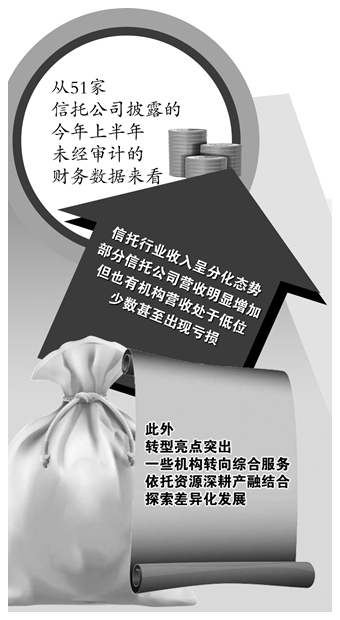
在严监管态势下探索差异化发展
Jin Rong Shi Bao· 2025-08-08 07:52
Core Insights - The trust industry in the first half of 2025 shows a polarized revenue performance, with some companies experiencing significant revenue growth while others remain at low levels or even incur losses [1] - Regulatory scrutiny continues, with multiple institutions receiving fines for various violations during the first half of the year [1] Industry Performance Overview - According to incomplete statistics, CITIC Trust (consolidated) ranked first in operating revenue for the first half of 2025, reaching 2.916 billion yuan; Yingda Trust and Huaxin Trust followed with revenues of 1.941 billion yuan and 1.634 billion yuan respectively [3] - Nine trust companies reported revenues exceeding 1 billion yuan; 13 companies had revenues between 500 million yuan and 1 billion yuan; and 23 companies reported revenues between 100 million yuan and 500 million yuan [3] - Notably, six trust institutions had revenues below 100 million yuan [3] - In terms of fees and commissions, Yingda Trust led with 1.444 billion yuan, followed by CITIC Trust (consolidated) and Huaxin Trust with 1.013 billion yuan and 964 million yuan respectively [3][4] - Only Yingda Trust and CITIC Trust (consolidated) had fees and commissions exceeding 1 billion yuan [4] Profitability Analysis - Among the disclosed data, CITIC Trust (consolidated), Jiangsu Trust, and Yingda Trust were the top three in net profit, each exceeding 1 billion yuan [4] - Seven trust companies reported net profits between 500 million yuan and 1 billion yuan, while 15 companies had net profits below 100 million yuan, including four companies with negative net profits [4] Regulatory Actions - In the first half of 2025, five trust companies received fines from regulatory authorities [5] - Huaao Trust was fined 4 million yuan for multiple violations, including inaccurate asset classification and non-compliance with reporting standards [5] - Lujiazui Trust faced a fine of 4.2 million yuan for five violations, including poor management of related transactions and inadequate risk information disclosure [5] - Other companies received fines of less than 1 million yuan for various infractions [6] Business Development Highlights - Trust companies are transitioning from being mere "fund providers" to "comprehensive service platform builders" [7] - Yingda Trust, backed by state-owned enterprises, reported strong performance in the first half of 2025, focusing on supply chain finance in the electric power sector [7] - Huaxin Trust has actively expanded its financial services, achieving a scale of 65.6 billion yuan in integrated finance by the end of June [7] - Kunlun Trust reported over 400% year-on-year growth in net profit, emphasizing the importance of integrated finance [7][8]