房地产市场止跌回稳

Search documents
国金证券:楼市见底可能并不遥远 预计明年一二季度有望企稳
智通财经网· 2025-10-26 02:15
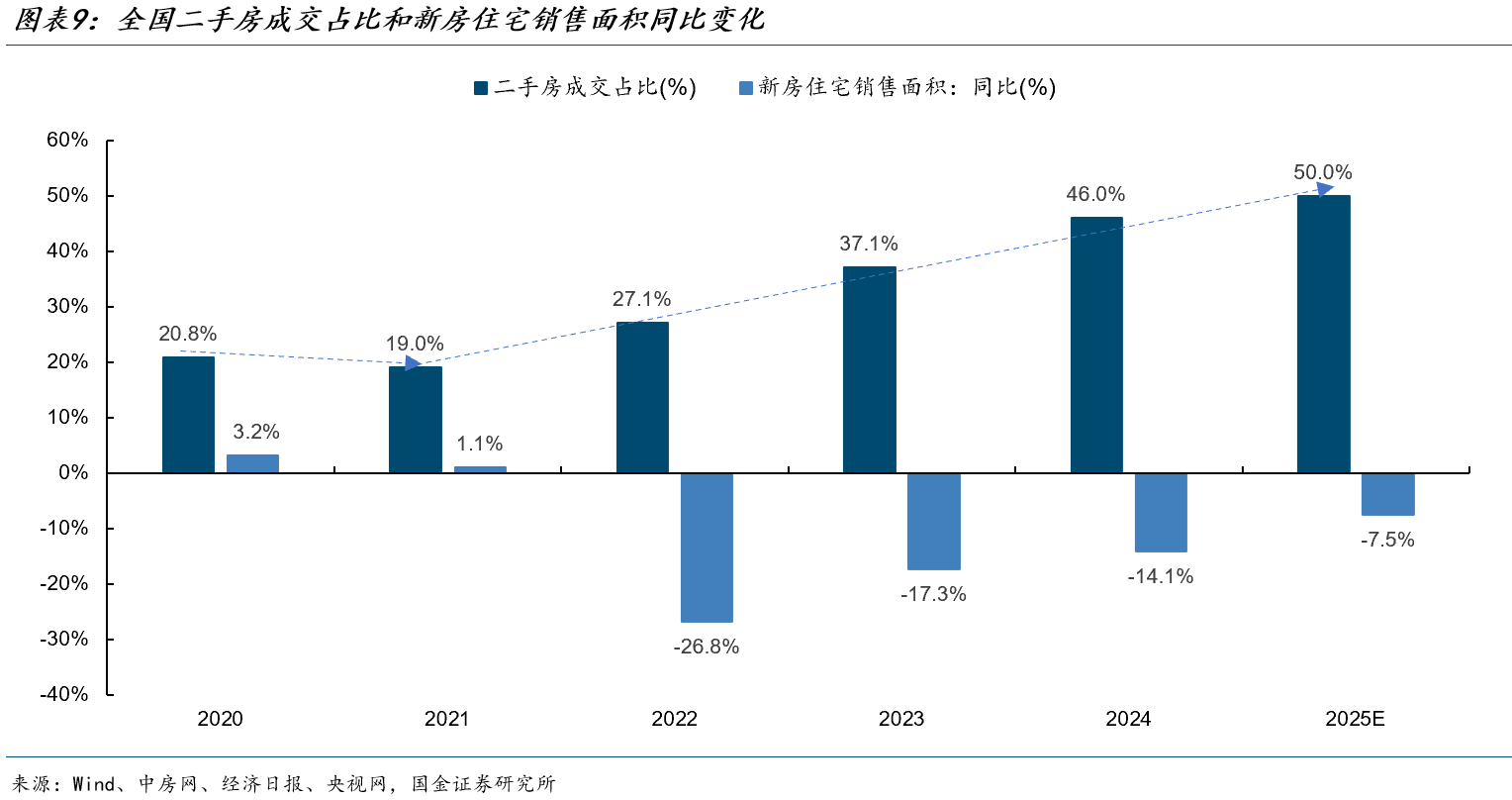
Core Viewpoint - The real estate market is approaching stabilization, with expectations for a rebound in the first half of next year based on current adjustment trends [1][34]. Group 1: Second-hand Housing Transaction Proportion - Since 2022, the transaction area for new and second-hand residential properties has stabilized around 1.5 billion square meters, with second-hand homes increasingly replacing new homes [2][34]. - The average annual increase in the national second-hand housing transaction proportion is projected to be around 8-10 percentage points from 2022 to 2024, with signs of stabilization expected by 2025 [2][34]. - In 2023, the second-hand housing transaction proportion in 18 sample cities reached 57.2%, an increase of 5.8 percentage points year-on-year, indicating a potential approach to the stable range of 60-63% [11][34]. Group 2: Rental Yield and Price Stability - The rental yield is a key factor in determining property value, with a reasonable rental yield expected to be around 2.5%-2.6%, close to the public housing loan interest rate [15][19]. - As of September 2025, the national rental yield across 100 cities was 2.37%, indicating a gap of 10-20 basis points from the reasonable level [23][34]. - The rental price index has shown a declining trend, with an average monthly drop of 0.26% over the past six months, which is crucial for stabilizing the real estate market [28][34]. Group 3: Price-to-Income Ratio - The price-to-income ratio in major cities like Beijing, Shanghai, Guangzhou, and Shenzhen is significantly higher than in cities like New York and Tokyo, indicating a potential overvaluation [30][31]. - Adjusted calculations show that the price-to-income ratios for these cities are now more reasonable, with Beijing at 12.3 and Shanghai at 9.6, reflecting a significant decrease from previous years [31][34]. - The overall price-to-income ratio has returned to levels seen in 2016, while disposable income has increased by nearly 70% during the same period, suggesting a correction in the housing market [31][34]. Group 4: Market Stabilization Timeline - The real estate market is expected to stabilize in the first half of next year, with the second-hand housing price still in a downward trend [34][36]. - The sequence of stabilization is anticipated to be new good houses first, followed by old small houses, improvement houses, and finally old existing houses [38][39]. - The rental yield of 2.5% serves as a benchmark for the overall real estate market stabilization, with variations expected across different city tiers [40][34].


楼市见底可能并不遥远(国金宏观张馨月)
雪涛宏观笔记· 2025-10-26 00:19
Core Viewpoint - The real estate market is expected to stabilize in the first half of next year, based on indicators such as second-hand housing transaction ratios, rental yield rates, and housing price-to-income ratios [2][34]. Group 1: Second-hand Housing Transaction Ratio - Since 2022, the transaction area for new and second-hand residential properties has stabilized around 1.5 billion square meters, with second-hand housing increasingly replacing new housing [5]. - The average annual increase in the second-hand housing transaction ratio is projected to be 8-10 percentage points from 2022 to 2024, with expectations for it to reach around 50% by 2025 [5][12]. - In the first three quarters of this year, the second-hand housing transaction ratio in 18 sample cities reached 57.2%, an increase of 5.8 percentage points year-on-year [12][34]. Group 2: Rental Yield Rate - The rental yield rate is a key indicator of the stability of second-hand housing prices, with a current national average of 2.37%, which is still 10-20 basis points below the reasonable level of around 2.5% [22][23]. - A rental yield rate that approaches the public housing loan interest rate of approximately 2.5%-2.6% is considered reasonable, indicating a balance between renting and buying [17][20]. - If rental prices stabilize, the rental yield rate is expected to reach a reasonable level by the second quarter of next year, potentially leading to a stabilization in housing prices [22][27]. Group 3: Housing Price-to-Income Ratio - The housing price-to-income ratio in major cities like Beijing and Shanghai is reported at 12.3 and 9.6, respectively, indicating a return to a relatively reasonable range [28][30]. - The overall housing price has returned to levels seen in 2016, while disposable income has increased by nearly 70% during the same period, contributing to a more favorable housing price-to-income ratio [30][34]. - The current housing price-to-income ratios suggest that the market has significantly digested previous bubbles, with major cities showing ratios below 15 [28][30]. Group 4: Market Stabilization Timeline - The real estate market is anticipated to stabilize in the first half of next year, with the second-hand housing transaction ratio and rental yield rate approaching reasonable levels [34][37]. - The sequence of stabilization is expected to be new good houses, old small houses, improvement houses, and finally old existing houses, with new good houses stabilizing first due to their strong product appeal [39][41]. - The overall stabilization of the real estate market will depend on macroeconomic conditions and social expectations, alongside the internal dynamics of the real estate market [34][37].

房地产市场何时迎来“最后一跌”?
SINOLINK SECURITIES· 2025-10-24 09:11
Market Overview - The current real estate market shows new homes with prices but low volume, while second-hand homes are trading price for volume[2] - Total transaction area for new and second-hand homes dropped from 1.93 billion square meters in 2021 to 1.5 billion square meters in 2022, stabilizing around 1.5 billion square meters in 2023 and 2024, with a forecast to maintain this level in 2025[2][18] New Home Market Dynamics - New home sales area is projected to decline from 1.57 billion square meters in 2021 to 810 million square meters in 2024, and further to 750 million square meters in 2025[18] - The pressure on new home sales is attributed to the rapid iteration of "good houses" leading to buyer hesitation and insufficient quality supply in core areas[2][26] Second-Hand Home Market Trends - The second-hand home market is experiencing a significant imbalance in supply and demand, with a 17.1% year-on-year increase in transaction area from January to September 2023, and a 29.7% increase in September alone[12] - Second-hand home prices have been under pressure, with a 0.7% month-on-month decline in September, marking the 41st consecutive month of price drops[12] Indicators for Market Stabilization - The proportion of second-hand home transactions is expected to approach or exceed Japan's steady state range of 60%-63% in 18 sample cities by mid-2024, indicating potential stabilization in new home sales volume[3][48] - The national rental yield is currently at 2.37%, which is slightly below the reasonable level of 2.4%-2.8%, suggesting room for price stabilization in the second-hand market[62] Economic and Policy Considerations - The stabilization of the real estate market is influenced by macroeconomic conditions and social expectations, with expectations for increased policy support in 2024[4] - The transition from old to new economic drivers is expected to create a new group of buyers, which could support the real estate market[4] Risks and Variability - The pace of market stabilization may vary across different cities and property types, with new home volume stabilizing before second-hand home prices[5] - Risks include slower-than-expected macroeconomic recovery and potential bottlenecks in new home supply[6]
地产板块发力走高 光明地产、合肥城建等涨停
Zheng Quan Shi Bao Wang· 2025-10-21 03:33
Core Viewpoint - The real estate sector is experiencing a rally, with several companies reaching their daily price limits, driven by anticipated policy relaxations in major cities like Beijing and Shanghai by Q3 2025, which are expected to stimulate demand for improved housing [1] Group 1: Market Performance - On the 21st, companies such as Shanghai Shimao, Bright Realty, and Yingxin Development saw their stock prices hit the daily limit, while Shahe Co. increased by nearly 4% [1] - The overall real estate market in China is moving towards stabilization, with new home sales prices in 70 cities showing a larger month-on-month decline but a smaller year-on-year decline [1] Group 2: Policy Impact - Institutions predict that the implementation of policies aimed at relaxing the real estate market will enhance the sector's investment value [1] - The combination of more proactive fiscal policies and moderately loose monetary policies is expected to accelerate the progress of stockpiling and urban village renovations, improving the existing housing supply-demand relationship [1]

9月70城房价同比降幅持续收窄
Qi Lu Wan Bao· 2025-10-21 02:33
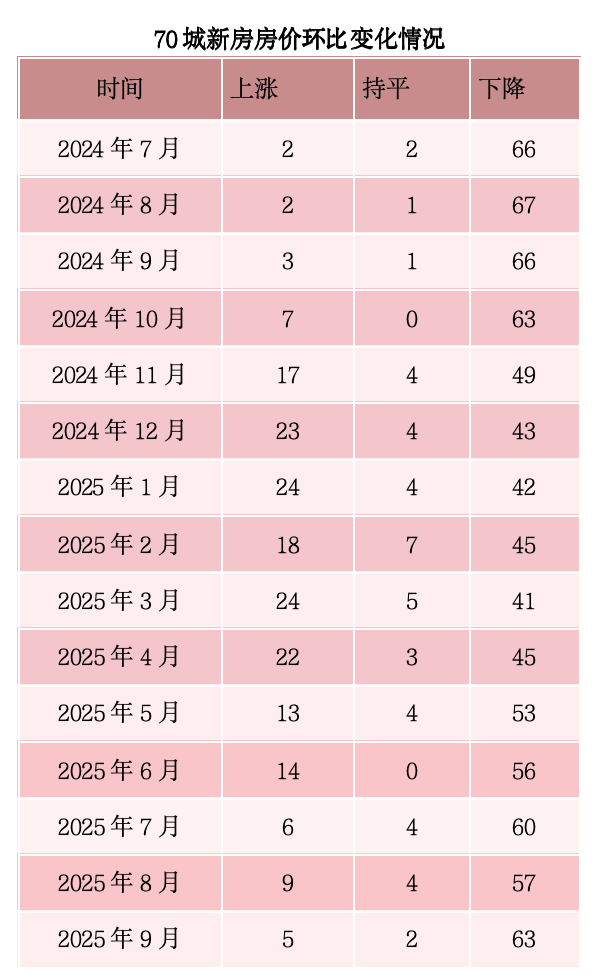
Group 1 - The core viewpoint indicates that in September 2025, the sales prices of commercial residential properties in 70 major and medium-sized cities in China showed a month-on-month decline, while the year-on-year decline continued to narrow, signaling a potential stabilization in the market [1][4]. - In September, new home prices in 63 cities fell compared to the previous month, and all 70 cities reported lower second-hand home prices both month-on-month and year-on-year [1][4]. - In Shandong province, cities like Jinan and Qingdao experienced a consistent decline in both new and second-hand home prices in September 2023, with Jinan's new home prices down 0.4% month-on-month and 2.4% year-on-year [2][3]. Group 2 - The narrowing year-on-year decline in housing prices is seen as a positive signal, indicating that previous policy effects are beginning to take hold, alleviating long-term downward pressure on the market [4][5]. - Core cities such as Beijing and Shanghai showed resilience, with new home prices increasing by 0.2% and 0.3% month-on-month, respectively, and Shanghai achieving a significant year-on-year growth of 5.6% [4][5]. - Looking ahead to the fourth quarter, it is anticipated that continued policy easing will support transaction volumes in core cities, while non-core areas and many small cities will need to adopt "price for volume" strategies to reduce inventory [5].
三季度全国企业销售收入增速达4.4% 盈利改善带动税收稳步回升
Jing Ji Ri Bao· 2025-10-21 00:38
Group 1 - The implementation of a package of incremental policies since September 26 last year has led to a steady recovery in both invoice sales and tax revenue, indicating a positive trend in the economy [1] - The capital market-related tax revenue has shown a high growth rate, with a year-on-year increase of 56.8% in capital market services tax, and a significant 110.5% increase in securities transaction stamp duty [2] - The manufacturing sector's tax revenue has increased by 5.4% year-on-year, contributing 31% to total tax revenue, with high-end manufacturing sectors like railway and aerospace showing a notable growth of 31.5% [2] Group 2 - The real estate sector has seen a narrowing decline in tax revenue, with a year-on-year decrease of 9.8%, reflecting the effectiveness of policies aimed at stabilizing the real estate market [3] - There has been a significant increase in the procurement of machinery and equipment by enterprises, with a 9.7% year-on-year growth, and high-tech manufacturing showing an 11.8% increase [3] - The steady growth in invoice data reflects an improving economic operation, gradual enhancement in corporate profitability, and sustained consumer vitality, supported by active capital market transactions [3]
行业点评报告:新房价格环比降幅扩大,二手房价环比降幅持平
KAIYUAN SECURITIES· 2025-10-20 09:12
Investment Rating - The industry investment rating is "Positive" (maintained) [1] Core Views - The report indicates that the new housing sales prices in 70 cities have seen a month-on-month decline, while the year-on-year decline has narrowed. The first-tier cities have experienced an expanded decline in new housing prices. For second-hand housing, the month-on-month decline has remained stable, but the year-on-year decline has also narrowed. The overall real estate market is moving towards stabilization, supported by various policies aimed at halting the decline [8][29]. Summary by Sections New Housing Price Trends - In September 2025, the month-on-month decline in new housing prices for first, second, and third-tier cities was -0.3%, -0.4%, and -0.4% respectively, with the overall decline for 70 cities at -0.4%, which is an increase of 0.1 percentage points compared to August. Year-on-year, the declines for first, second, and third-tier cities were -0.7%, -2.1%, and -3.4%, with the overall year-on-year decline for 70 cities narrowing by 0.3 percentage points to 2.7% [5][15][17]. Second-Hand Housing Price Trends - The month-on-month decline in second-hand housing prices for 70 cities was -0.6%, remaining stable compared to the previous month. Year-on-year, the decline was -5.2%, which is a reduction of 0.3 percentage points. The first, second, and third-tier cities saw year-on-year declines of -3.2%, -5.0%, and -5.7% respectively, with all declines narrowing compared to August [6][21][24]. Investment Recommendations - The report suggests focusing on companies with strong credit ratings that can cater to improving customer demand, such as Greentown China, China Merchants Shekou, China Overseas Land & Investment, and others. It also recommends companies benefiting from both residential and commercial real estate recovery, such as China Resources Land and Longfor Group. Additionally, it highlights quality property management firms under the "Good House, Good Service" policy [8][30][32].
楼市重要信号!9月北京新房价格环比转涨!
Zheng Quan Shi Bao· 2025-10-20 07:59
Core Insights - The real estate market shows signs of stabilization, with some cities entering a new phase of recovery despite ongoing adjustments [1][4][6] Price Trends - In September, new home prices in first-tier cities decreased by 0.3% month-on-month, while Beijing and Shanghai saw increases of 0.2% and 0.3% respectively [2][3] - Year-on-year, new home prices in first-tier cities fell by 0.7%, but this decline is narrowing compared to previous months [2][3] - The number of cities with rising new home prices increased, with 8 cities reporting year-on-year price increases, up from 5 the previous month [3][4] Market Analysis - Analysts suggest that the current market is still undergoing deep adjustments, but the overall trend remains positive, indicating a potential for recovery [4][5] - The average month-on-month decline in second-hand home prices has decreased from 0.91% before the "9.26 new policy" last year to 0.58% this year [5] - The year-on-year decline in second-hand home prices has also narrowed from 9.0% last September to 5.2% this September, indicating a clearer trend towards market stabilization [5] Future Outlook - The fourth quarter is expected to continue a "weak recovery, strong differentiation" trend, with an overall transaction decline likely to be controlled around 10% [6] - The combination of last year's low base effect and ongoing policy impacts is anticipated to further narrow year-on-year price declines in the last quarter of the year, with first-tier cities potentially seeing price increases [6]

9月房价数据出炉!同比降幅继续收窄
Zhong Guo Zheng Quan Bao· 2025-10-20 04:47
Core Insights - In September, the sales prices of new residential properties in 70 large and medium-sized cities showed a month-on-month decline, with the rate of decline narrowing year-on-year [1][7] Group 1: New Residential Property Prices - In first-tier cities, new residential property prices decreased by 0.3% month-on-month, with Beijing and Shanghai experiencing slight increases of 0.2% and 0.3%, while Guangzhou and Shenzhen saw declines of 0.6% and 1.0% respectively [1] - Second-tier cities experienced a month-on-month decline of 0.4% in new residential property prices, while third-tier cities also saw a 0.4% decline [1] - Year-on-year, first-tier cities' new residential property prices fell by 0.7%, with Shanghai increasing by 5.6% and Beijing, Guangzhou, and Shenzhen decreasing by 2.6%, 4.1%, and 1.8% respectively [7] Group 2: Second-hand Residential Property Prices - In September, second-hand residential property prices in first-tier cities decreased by 1.0% month-on-month, with declines in Beijing, Shanghai, Guangzhou, and Shenzhen of 0.9%, 1.0%, 0.8%, and 1.0% respectively [1] - Second and third-tier cities saw month-on-month declines of 0.7% and 0.6% in second-hand residential property prices [1] - Year-on-year, first-tier cities' second-hand residential property prices fell by 3.2%, with Beijing, Shanghai, Guangzhou, and Shenzhen experiencing declines of 2.7%, 2.4%, 6.0%, and 1.7% respectively [7] Group 3: Market Outlook - The research center expects that in the fourth quarter, relevant departments will continue to focus on high-quality urban development and the construction of new real estate models [8] - Policies will likely be implemented to support affordable housing and urban renewal projects, aiming to accelerate inventory reduction and the establishment of new models in the industry [8]
定调!2025年房地产走势定了,4.4万亿资金入场,市场迎来关键转折
Sou Hu Cai Jing· 2025-10-20 01:50
Core Viewpoint - The Chinese government is determined to stabilize the real estate market, emphasizing the need for a more proactive approach to promote healthy development in both the real estate and stock markets [1][3]. Policy Measures - The government report outlines a shift from "firefighting" to "recovery," with a focus on implementing moderately loose monetary policies and utilizing 4.4 trillion yuan in local government special bonds for direct interventions like land acquisition and stock housing purchases [3][5]. - The report indicates a removal of specific debt relief measures for real estate companies, instead prioritizing a balanced approach to development and safety [3]. Market Data - From January to April 2025, national real estate development investment reached 27,730 billion yuan, a year-on-year decrease of 10.3%, while residential investment fell by 9.6%. However, the National Housing Prosperity Index slightly rebounded to 93.86 [4]. - New housing sales saw a narrowing decline of 0.2 percentage points, and the inventory of unsold commercial housing decreased by 5.22 million square meters, signaling a potential market recovery [4]. Local Initiatives - Various provinces, such as Shanxi and Wuhan, are implementing measures like tax reductions and increased stock housing purchases to stimulate demand and promote sales [7][11]. - The report emphasizes the importance of controlling new land supply while revitalizing existing commercial properties, with a focus on reducing inventory levels [7]. Demand and Supply Dynamics - The report highlights the need for policies that reduce restrictive measures and promote urban village renovations, which are expected to drive housing demand by 0.75 to 1 billion square meters [11]. - The market is showing signs of differentiation, with first-tier cities experiencing a recovery in new housing sales, while second-hand housing prices continue to decline [13]. Price Trends - In the first half of 2025, new housing prices in 100 cities increased by 1.16%, supported by improved project offerings, while second-hand housing prices fell by 3.60% [13]. - The land market is also experiencing disparities, with significant land sale revenues in cities like Hangzhou and Beijing, while other cities see lower transaction values [13].