新能源装机

Search documents
盛屯矿业:拟回购股份用于股权激励等;华能水电:2025年上半年净利润同比增长 | 新能源早参
Mei Ri Jing Ji Xin Wen· 2025-08-28 23:32
Group 1 - Shengtun Mining plans to repurchase shares worth between 500 million to 600 million yuan for employee stock ownership plans or equity incentives, with a maximum repurchase price of 11.82 yuan per share and a duration of up to 12 months [1] - The share repurchase reflects the company's confidence in its value and aims to enhance team cohesion and promote long-term development [1] Group 2 - Huaneng Hydropower reported a revenue of 12.959 billion yuan for the first half of 2025, representing a year-on-year growth of 9.08%, and a net profit of 4.609 billion yuan, up 10.54% year-on-year [2] - The growth in performance is attributed to a significant increase in new energy installed capacity, full capacity operation of TB power station, and favorable water conditions in the Lancang River basin [2] - The company effectively utilized water resources, achieving a power generation of 52.752 billion kWh, a year-on-year increase of 12.97% [2] Group 3 - Defang Nano reported a revenue of 3.882 billion yuan for the first half of 2025, a decline of 10.58% year-on-year, and a net loss of 391 million yuan, continuing its trend of losses [3] - The company has decided not to distribute cash dividends, issue bonus shares, or increase capital from reserves, likely to retain funds to address operational challenges [3] - Investors are advised to monitor the company's future efforts to improve profitability and enhance market competitiveness [3]



华润电力(0836.HK):其他损益波动拉低净利润 核心业务利润维持整体平稳
Ge Long Hui· 2025-08-27 02:38
Core Viewpoint - In the first half of 2025, the company reported a revenue of HKD 50.267 billion, a year-on-year decrease of 1.7%, and a net profit attributable to shareholders of HKD 7.872 billion, down 15.9% year-on-year. The decline in revenue was mainly due to a decrease in the on-grid electricity price of subsidiary power plants, while the drop in net profit was attributed to significant declines in other gains [1][2][3] Financial Performance - The company's core net profit attributable to shareholders reached HKD 8.278 billion, a slight increase of 0.1% year-on-year. The renewable energy segment contributed HKD 5.637 billion to core net profit, up 1.5%, while the thermal power segment's core net profit was HKD 2.641 billion, down 2.7%. Excluding coal business, the pure thermal power segment achieved a core net profit of HKD 2.788 billion, a significant increase of 20.6% [1][2][3] Revenue Breakdown - The renewable energy business saw a revenue increase driven by a 10% rise in sales volume, reaching HKD 14.5 billion in the first half of 2025. The average benchmark coal price for subsidiary power plants was HKD 824 per ton, down 12% year-on-year, leading to a significant improvement in the cost of coal-fired electricity generation [1][2][3] Installed Capacity and Sales - As of June 2025, the company had a controlling installed capacity of 88.93 million kilowatts, with a rights-based capacity of 78.09 million kilowatts. The thermal power rights-based capacity was 39.14 million kilowatts, accounting for 50.1%. The company added 1.24 million kilowatts of wind power and 3.51 million kilowatts of solar power in the first half of 2025 [2][3] Market Dynamics - The decline in coal prices and the relatively loose power supply and demand led to a decrease in on-grid electricity prices. The on-grid electricity prices for coal, wind, and solar were HKD 391.2, HKD 396.8, and HKD 304.9 per megawatt-hour, respectively, representing year-on-year decreases of 6%, 11%, and 6% [3][4] Future Outlook - The company expects stable profitability in thermal power, with a forecasted net profit attributable to shareholders of HKD 13.748 billion, HKD 13.798 billion, and HKD 14.667 billion for 2025 to 2027. The company maintains a stable dividend policy [4]

华润电力(00836):扣非影响业绩下滑,经营指标尽显优秀
Hua Yuan Zheng Quan· 2025-08-25 13:11
Investment Rating - The investment rating for the company is "Buy" (maintained) [6] Core Views - The company is expected to commission 7 new coal power units in the second half of the year, with a total target of 10GW in new energy capacity for the year. The company's strong management capabilities and new installations are anticipated to contribute positively to profit growth [7] - The company forecasts capital expenditures of HKD 56.8 billion for 2025, with HKD 42 billion allocated for renewable energy projects and HKD 9.5 billion for thermal power construction [7] - The company achieved a core profit of HKD 82.78 billion in the first half of 2025, a slight increase of 0.1% year-on-year, while the net profit decreased by 15.9% due to non-recurring gains from the previous year and increased impairments this year [9] Summary by Sections Market Performance - The closing price of the stock is HKD 18.43, with a market capitalization of HKD 95,413.17 million [4] Financial Data - The company’s projected revenues for 2025 are HKD 109.93 billion, with a year-on-year growth rate of 4.41%. The net profit for 2025 is estimated at HKD 14.42 billion, reflecting a slight increase of 0.2% [8] - The company’s return on equity (ROE) is projected to be 13.1% in 2025, with a price-to-earnings (P/E) ratio of 6.6 [8] Operational Highlights - As of June 30, 2025, the company’s installed capacity was 78.09 million kW, with significant contributions from thermal, wind, and solar power [9] - The company’s electricity sales volume in the first half of 2025 was 102 billion kWh, representing a year-on-year increase of 3.8% [9]
华润电力(0836.HK):业绩低于预期 可再生能源利润增长
Ge Long Hui· 2025-08-23 18:33
Core Viewpoint - The company reported a decline in revenue and profit for 1H25, with a focus on the performance of its thermal and renewable energy segments, while maintaining its growth targets for renewable energy installations [1][2] Financial Performance - Revenue for 1H25 decreased by 1.7% year-on-year to HKD 50.267 billion, while profit attributable to shareholders fell by 15.9% to HKD 7.872 billion, below the expected HKD 9.322 billion [1] - The core profit from the thermal power business decreased by 2.7% to HKD 2.641 billion, which was lower than expectations [1] - The renewable energy segment saw a core profit increase of 1.5% to HKD 5.637 billion [1] Dividend and Payout - The company declared a dividend of HKD 0.356 per share for 1H25, maintaining a payout ratio of 23.4%, which is consistent with the previous year [1] Renewable Energy Growth - The company added 4.8 GW of new renewable energy capacity in 1H25, aiming for a total of 10 GW of new installations by 2025 [1][2] - As of June 2025, renewable energy capacity is expected to account for 49.9% of the total installed capacity [2] Pricing and Cost Dynamics - The on-grid electricity prices for wind and solar energy decreased by 11.0% and 6.1% respectively, to HKD 0.3968 and HKD 0.3049 per kWh [2] - The unit fuel cost for coal-fired power generation decreased by 3.52 cents per kWh to HKD 0.2413 per kWh [1] Market Outlook and Valuation - The target price for the company's shares is set at HKD 25.49, with a "buy" rating maintained [2] - Adjustments were made to profit forecasts for 2025-2027, with a decrease of 13.7% to 15.7% in expected profits [2]
龙源电力(00916.HK):电价及利用小时承压 特高压投产提升消纳信心
Ge Long Hui· 2025-08-23 11:13
Core Viewpoint - The company reported a decline in revenue and net profit for the first half of 2025, with a significant impact from wind resource conditions and electricity prices [1][2]. Financial Performance - In 1H25, the company achieved revenue of 15.657 billion RMB, a decrease of 18.6% year-on-year, and a net profit attributable to equity holders of 3.519 billion RMB, down 14.4% year-on-year, which was below expectations [1]. - The company proposed an interim dividend of 0.1 RMB per share, totaling 836 million RMB, with a payout ratio of 24.77% [1]. Operational Highlights - The company’s installed capacity reached 43.20 GW in 1H25, with an increase of 2,053.54 MW, including 986.95 MW from wind power and 1,096.59 MW from solar power [1]. - Solar power generation increased by 71.37% year-on-year due to the growth in installed capacity, while wind power generation grew by 6.07% year-on-year, despite a decrease in average utilization hours [1]. - The average utilization hours for wind power were 1,102 hours, which is 15 hours higher than the industry average, despite a decrease of 68 hours compared to the same period in 2024 [1]. Market Conditions - The average on-grid electricity price for wind power was 422 RMB/MWh, down 16 RMB/MWh year-on-year, leading to a decrease in wind power sales revenue by 239 million RMB [2]. - The average on-grid electricity price for solar power was 273 RMB/MWh, down 5 RMB/MWh year-on-year, with solar power sales revenue increasing by 642 million RMB [2]. Future Outlook - The company continues to pursue its annual installed capacity development goals, with plans to start new renewable energy projects totaling 5.5 million kW and to put into operation 5 million kW in 2025 [2]. - The company signed new development agreements totaling 1.24 GW in the first half of 2025, with a focus on regions with better resources [2]. - The commissioning of three ultra-high voltage transmission projects is expected to enhance the efficient consumption and cross-regional allocation of renewable energy projects [2]. Investment Rating - The company maintains a "Buy" rating, with revised net profit forecasts for 2025-2027 of 6.441 billion, 7.056 billion, and 7.985 billion RMB, respectively [3]. - The current price-to-earnings ratios are projected at 8.1, 7.4, and 6.6 times for the respective years [3].

华润电力(00836):业绩低于预期,可再生能源利润增长
HTSC· 2025-08-22 07:50
Investment Rating - The investment rating for the company is maintained as "Buy" with a target price of HKD 25.49 [2][9]. Core Views - The company's 1H25 performance showed a revenue decline of 1.7% year-on-year to HKD 50.267 billion, and a net profit attributable to shareholders decreased by 15.9% to HKD 7.872 billion, which was below expectations [6]. - The renewable energy segment's core profit increased by 1.5% year-on-year to HKD 5.637 billion, indicating growth potential despite challenges in the thermal power sector [6][8]. - The company aims to add 10GW of new renewable energy capacity in 2025, with 4.8GW already connected to the grid in 1H25 [6][9]. Financial Performance Summary - Revenue projections for the upcoming years are as follows: - 2024: HKD 105.284 billion - 2025E: HKD 102.846 billion - 2026E: HKD 110.355 billion - 2027E: HKD 112.074 billion [5]. - Net profit attributable to shareholders is forecasted as: - 2024: HKD 14.388 billion - 2025E: HKD 12.507 billion - 2026E: HKD 13.430 billion - 2027E: HKD 13.818 billion [5]. - The company’s EPS (Earnings Per Share) for 2025E is projected at HKD 2.42, with a PE ratio of 7.66 [5]. Operational Insights - The core profit from the thermal power business decreased by 2.7% to HKD 2.641 billion in 1H25, while the pure thermal power business (excluding coal) saw a core profit increase of 20.6% to HKD 2.788 billion [7]. - The average utilization hours for wind power increased by 3.7% to 1268 hours, outperforming the national average [8]. - The company’s coal power generation price (excluding tax) decreased by 2.55 cents per kWh to HKD 0.3912 per kWh, while the unit fuel cost dropped by 3.52 cents per kWh to HKD 0.2413 per kWh [7]. Valuation Metrics - The target market capitalization is set at HKD 131.97 billion, reflecting a 25% discount to account for the potential impact of the renewable energy spin-off [9]. - The company’s PB (Price to Book) ratio for 2025E is estimated at 0.82, while the PE ratio is projected at 17.4x [9].
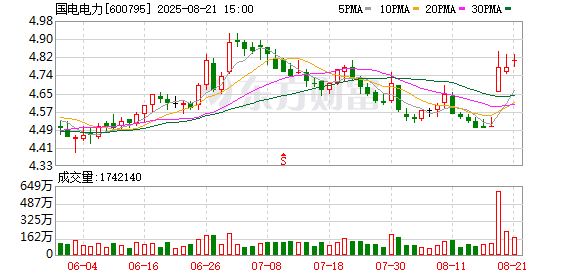
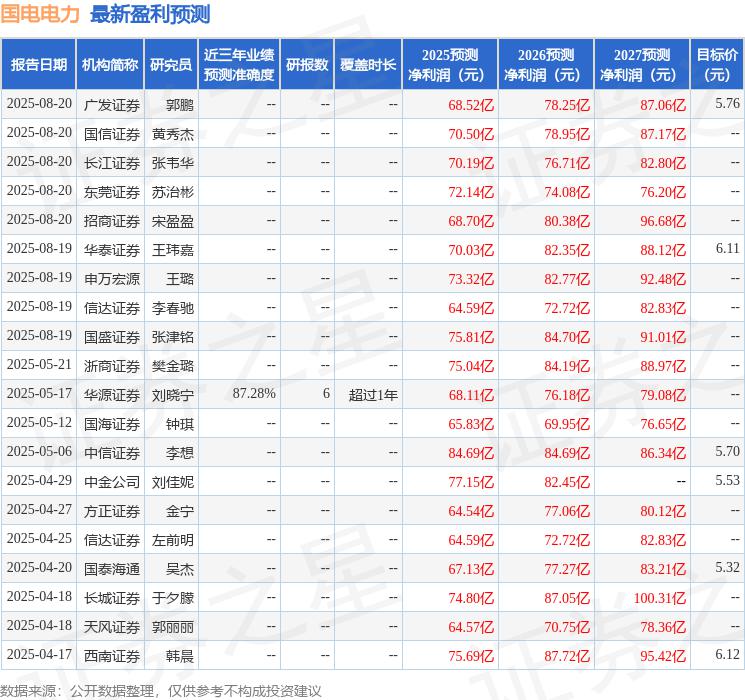
天风证券给予国电电力买入评级:经营业绩整体稳健,新分红承诺提升股东回报
Mei Ri Jing Ji Xin Wen· 2025-08-22 00:49
Group 1 - The core viewpoint of the report is a "buy" rating for Guodian Power (600795.SH) based on strong performance indicators and growth potential [2] - In H1, the company added 6.45 GW of new renewable energy capacity, with the Dadu River project entering a concentrated production phase [2] - Fuel costs have decreased, contributing to an increase in performance, with H1 achieving a net profit of 3.4 billion yuan after deducting non-recurring items [2] - The company has committed to a cash dividend ratio of no less than 60%, with a minimum dividend of 0.22 yuan per share [2]


天风证券:给予国电电力买入评级
Zheng Quan Zhi Xing· 2025-08-22 00:39
Core Viewpoint - The overall operational performance of Guodian Power is stable, and the new dividend commitment enhances shareholder returns, leading to a "buy" rating for the stock [1]. Financial Performance - In the first half of 2025, Guodian Power achieved revenue of 77.655 billion yuan, a year-on-year decrease of 9.52%. The net profit attributable to shareholders was 3.687 billion yuan, down 45.11%, while the net profit excluding non-recurring items was 3.410 billion yuan, an increase of 56.12% [2][4]. New Energy Development - The company added 6.45 GW of new energy capacity in the first half of the year, with 329.3 MW from wind power and 6,122.3 MW from solar power. Additionally, two thermal power units totaling 2 million kW were put into operation [3]. Cost and Profitability - The average on-grid electricity price was 409.70 yuan/MWh, a decrease of 29.51 yuan/MWh year-on-year. The operating costs were 65.022 billion yuan, down 11.27%, primarily due to a decline in fuel costs, with the average coal price at 831.48 yuan/ton, down 87.46 yuan/ton [4]. Dividend Policy - The company has committed to a cash dividend ratio of no less than 60% and a minimum of 0.22 yuan per share. The cash dividend will be distributed annually, contingent on profitability and the absence of major cash expenditures [5]. Profit Forecast and Valuation - The projected net profits for Guodian Power from 2025 to 2027 are 6.8 billion, 7.1 billion, and 7.6 billion yuan, respectively, with corresponding price-to-earnings ratios of 12.7, 12.0, and 11.3 times, maintaining a "buy" rating [6].
华明装备(002270) - 002270华明装备投资者关系管理信息20250817
2025-08-17 09:48
Group 1: Company Growth and Market Performance - The company experienced significant growth in overseas indirect exports, particularly in Europe and Asia, contributing positively to overall performance [4] - The company anticipates challenges in maintaining high growth rates in the coming years due to the low base effect and market dynamics [11] - The company achieved a 5% growth in domestic power equipment business in the first half of the year, with a balanced contribution from both grid-connected and non-grid-connected sectors [21][22] Group 2: Market Strategy and Competition - The company primarily adopts a direct sales model in overseas markets, with distributors acting as service intermediaries [5] - The company views the expansion of competitors' production capacity positively, hoping for overall market growth [8] - The company emphasizes the importance of establishing relationships with end-users in overseas markets, as they hold the final decision-making power [6] Group 3: Product and Pricing Dynamics - The increase in overseas product sales is attributed to higher shipment volumes rather than price increases, as average prices remain stable [7][41] - The company maintains that its product performance is comparable to competitors, although there are advantages in manufacturing quality from established brands [40] - The company has not changed its product pricing, but the overall average price has increased due to a higher proportion of overseas sales [41] Group 4: Future Outlook and Challenges - The company acknowledges that sustaining high growth rates in overseas markets is unrealistic in the long term, with a focus on gradual market share increase [10][11] - The company is cautious about the impact of macroeconomic trends on future growth, emphasizing the need for a long-term strategy [11] - The company plans to continue investing in local production facilities, such as the new factory in Indonesia, to support market expansion [12][22] Group 5: Financial Performance and Capital Expenditure - The company reported a decline in cash flow due to reduced project scale and a lack of large-scale bill discounting [49] - The company’s gross margin improved in the first half of the year, primarily due to changes in revenue structure rather than significant shifts in profitability [50] - Future capital expenditures will focus on optimizing production facilities and supporting the growth of the CNC equipment business [50]

新能源产业高景气延续 上市公司上半年业绩频报喜
Xin Hua Wang· 2025-08-12 05:54
Group 1: Company Performance - TianShun Wind Energy expects a net profit of 520 million to 600 million yuan for the first half of the year, representing a year-on-year increase of 104.72% to 136.22% [1] - Jiejia Weichuang anticipates a net profit of 736 million to 812 million yuan for the first half of the year, with a year-on-year growth of 45% to 60% [2] - China Nuclear Power reported a cumulative operational power generation of 100.827 billion kWh by the end of June, a year-on-year increase of 5.83% [3] - Pinggao Electric expects a net profit of approximately 332 million yuan for the first half of the year, reflecting a year-on-year growth of around 185% [4] Group 2: Industry Trends - The offshore wind power sector is experiencing rapid growth, with TianShun Wind Energy achieving breakthroughs in offshore wind foundation business and increasing delivery volumes [1] - The market for TOPCon battery planning capacity has exceeded 600 GW, with Jiejia Weichuang benefiting from strong demand and successful equipment deliveries [2] - China Nuclear Power is adopting a dual-drive strategy of nuclear and renewable energy, aiming to increase installed capacity significantly by the end of the "14th Five-Year Plan" [3] - The demand for UHV (Ultra High Voltage) construction is rising due to the growth of wind and solar industries, benefiting companies like Pinggao Electric [4]