注册制改革

Search documents
民生证券遭浙江证监局警示,因对保荐上市公司督导不到位
Nan Fang Du Shi Bao· 2025-10-22 03:19
Core Viewpoint - Minsheng Securities received a warning letter from the Zhejiang Securities Regulatory Bureau due to inadequate supervision of the listed company, Weikang Pharmaceutical, during its initial public offering process [2][3]. Group 1: Violations by Minsheng Securities - Minsheng Securities failed to adequately monitor the abnormal delays in construction projects and did not conduct sufficient verification procedures [2]. - The internal controls of Minsheng Securities' investment banking business were found to be deficient, leading to insufficiently cautious conclusions in the continuous supervision documents for Weikang Pharmaceutical's 2023 fiscal year [2][6]. Group 2: Consequences for Weikang Pharmaceutical - Weikang Pharmaceutical was previously fined 14 million due to violations related to information disclosure, with a total penalty of 14.6 million imposed on the company and its responsible individuals [4]. - Specific penalties included a 5 million fine for Weikang Pharmaceutical, 7 million for its actual controller Liu Zhongliang, and additional fines for other responsible personnel [4]. Group 3: Regulatory Context - The actions of Minsheng Securities violated the "Administrative Measures for Sponsoring Securities Issuance and Listing" [3]. - The regulatory environment has increasingly emphasized accountability, with multiple securities firms facing penalties for issues related to sponsored companies, indicating a shift from a focus on underwriting to comprehensive accountability in the investment banking sector [6].


上交所“十四五”成绩单出炉
Zheng Quan Shi Bao· 2025-10-17 12:13
Core Insights - The Shanghai Stock Exchange (SSE) has reported significant progress during the "14th Five-Year Plan" period, focusing on high-quality development and becoming a world-class exchange [1][2][3] Group 1: Market Resilience and Growth - The SSE has enhanced market resilience, with the Shanghai Composite Index annualized volatility decreasing by 2.8 percentage points to 15.9% compared to the "13th Five-Year Plan" [1] - The average annual dividend yield for the Shanghai market is close to 2.5%, indicating improved market expectations and investor confidence [1] Group 2: Support for Technology and Innovation - Nearly 70% of new listings during the "14th Five-Year Plan" period are technology innovation enterprises, with the proportion of technology companies in the market increasing from 32% to 41% [2] - R&D investment by companies listed on the SSE rose from 0.64 trillion yuan to 1.07 trillion yuan, a 66% increase, accounting for nearly 40% of the national total [2] Group 3: Direct Financing and Market Functionality - The total amount raised through IPOs on the SSE increased by 16% compared to the "13th Five-Year Plan" [4] - The bond market's issuance scale reached 31 trillion yuan, a 42% increase, with over 10 trillion yuan in industrial bonds and ABS products [4] Group 4: Long-term Investment Ecosystem - The scale of ETF products grew from 0.9 trillion yuan to 4 trillion yuan, a nearly 3.5-fold increase, supporting long-term capital inflow [5] - The introduction of new indices and the expansion of the ETF options market have further enhanced the investment ecosystem [5] Group 5: Regulatory Enhancements and Market Discipline - The SSE has implemented nearly 800 disciplinary actions, with over 30% being severe penalties, to combat fraud and maintain market integrity [8] - The number of companies delisted during the "14th Five-Year Plan" period totaled 93, with 70 being forced delistings [8] Group 6: International Cooperation and Market Expansion - The SSE has facilitated cross-border investment through initiatives like including stock ETFs in the Shanghai-Hong Kong Stock Connect, with cumulative transactions reaching 99 trillion yuan, a 275% increase [7] - The SSE has engaged in international cooperation, hosting investment conferences and collaborating with foreign exchanges and institutions [7]
回望“十四五”| 更具吸引力和包容性——用数据丈量资本市场的量质升级
Xin Hua She· 2025-10-16 00:18
Group 1 - The core viewpoint of the articles highlights the profound institutional reforms and structural optimization in China's capital market during the "14th Five-Year Plan" period, emphasizing the transition towards a more market-oriented, legal, and internationalized system [2][3][5] - The implementation of the new securities law and the introduction of the registration system have significantly enhanced market efficiency and attractiveness, allowing for a more diverse range of companies, including unprofitable and special equity structure firms, to access the capital market [3][4][5] - The proportion of high-tech enterprises among newly listed companies has exceeded 90%, indicating a strong focus on strategic emerging industries, particularly in sectors like integrated circuits and biomedicine [4][5] Group 2 - The total market capitalization of A-shares surpassed 100 trillion yuan, reflecting a historic breakthrough and increased investor confidence, with daily trading volumes reaching over 2 trillion and 3 trillion yuan [7][8] - The capital market's structure is undergoing significant changes, with long-term funds holding approximately 21.4 trillion yuan of A-share market value, a 32% increase from the end of the "13th Five-Year Plan" [8][9] - The direct financing ratio has steadily increased, reaching 31.6%, with a total of 57.5 trillion yuan raised through stock and bond financing in the past five years, indicating a robust support for the real economy [9][10] Group 3 - Regulatory bodies have implemented over 60 supporting rules since the release of the new "National Nine Articles," enhancing the stability of the capital market and promoting high-quality development [10][11] - The number of asset restructuring cases has increased significantly, with a 40% rise in total disclosures and a 150% increase in major restructurings, indicating a shift towards resource allocation towards new productive forces [11] - The market's resilience and risk resistance have improved, with the annualized volatility of the Shanghai Composite Index decreasing by 2.8 percentage points compared to the "13th Five-Year Plan" period [11]
更具吸引力和包容性 ——用数据丈量资本市场的量质升级
Zhong Guo Zheng Quan Bao· 2025-10-15 22:39
Core Insights - The capital market in China has undergone significant reforms and structural optimization during the "14th Five-Year Plan" period, enhancing its ability to serve the real economy and improving both attractiveness and inclusivity [1][2][3] Group 1: Policy and Regulatory Changes - The implementation of the new Securities Law and the "New National Nine Articles" has fundamentally reshaped the capital market's basic system and regulatory logic, marking the beginning of a new era for high-quality development [2][3] - The introduction of the registration system, which began with the Science and Technology Innovation Board, has shifted the focus to market-driven mechanisms, enhancing market efficiency and investor confidence [1][2] Group 2: Market Performance and Structure - As of August 2023, the total market capitalization of A-shares surpassed 100 trillion yuan, reflecting a significant recovery in investor confidence and a structural transformation within the market [5][6] - The proportion of high-tech enterprises among newly listed companies exceeded 90% during the "14th Five-Year Plan" period, indicating a strong focus on strategic emerging industries [2][4] Group 3: Financing and Investment Trends - Total financing through stock and bond markets reached 57.5 trillion yuan, with a steady increase in the proportion of direct financing, which rose by 2.8 percentage points to 31.6% compared to the end of the "13th Five-Year Plan" [7] - The market has seen a significant increase in long-term capital, with various types of long-term funds holding approximately 21.4 trillion yuan of A-share market value, a 32% increase from the end of the "13th Five-Year Plan" [6][7] Group 4: Market Stability and Risk Management - The regulatory authorities have implemented over 60 supporting rules since the release of the "New National Nine Articles," enhancing the stability of the capital market and addressing key areas such as issuance, listing, and mergers and acquisitions [8][9] - The A-share market has demonstrated resilience against external shocks, with the annualized volatility of the Shanghai Composite Index decreasing by 2.8 percentage points compared to the "13th Five-Year Plan" period [9]
引导要素资源服务新质生产力
Jing Ji Ri Bao· 2025-10-15 22:12
Core Viewpoint - The article emphasizes the importance of capital market reforms in supporting technological innovation and industrial transformation during China's "14th Five-Year Plan" period, highlighting the role of the Science and Technology Innovation Board (STAR Market) and the Growth Enterprise Market (GEM) in enhancing the adaptability of the multi-level market system [1][2]. Group 1: Capital Market Reforms - The capital market is enhancing its inclusivity to support high-tech, high-growth, and high-risk enterprises, providing a full chain of services from venture capital to IPO financing and mergers and acquisitions [2][3]. - The introduction of the registration system in the STAR Market and GEM has significantly improved the inclusivity of the listing process, with over 90% of new listings during the "14th Five-Year Plan" being high-tech enterprises [3][4]. - As of now, the market capitalization of the technology sector in A-shares exceeds 25%, surpassing the combined market capitalization of the banking, non-banking financial, and real estate sectors [4]. Group 2: Private Equity and Venture Capital - Private equity and venture capital funds have accelerated their development, becoming key drivers of technological innovation and industrial transformation, with a management scale of 14.4 trillion yuan and 150,000 projects under investment as of Q2 2023 [6][7]. - These funds have invested in 90% of companies listed on the STAR Market and the Beijing Stock Exchange, demonstrating their role as incubators and accelerators for innovation [7]. - The government has introduced supportive policies to optimize the venture capital ecosystem, enhancing fundraising, investment, and exit mechanisms [6]. Group 3: Quality of Listed Companies - The cultivation of new productive forces relies on high-quality listed companies, with regulatory measures in place to enhance information disclosure, corporate governance, and market-oriented mergers and acquisitions [8][9]. - In 2023, over 2 trillion yuan in cash dividends were distributed by listed companies, reflecting a commitment to shareholder returns and market stability [9]. - The number of major asset restructurings has increased significantly, with 1,234 disclosures in the first eight months of the year, indicating a trend towards optimizing resource allocation through mergers and acquisitions [9][10].
更具吸引力和包容性——用数据丈量资本市场的量质升级
Zhong Guo Zheng Quan Bao· 2025-10-15 20:15
Core Viewpoint - The Chinese capital market has undergone significant institutional reforms and structural optimization during the "14th Five-Year Plan" period, enhancing its efficiency and attractiveness while focusing on serving the real economy [1][2][3]. Group 1: Institutional Reforms - The implementation of the new Securities Law and the introduction of the "National Nine Articles" have fundamentally restructured the capital market's basic systems and regulatory logic [2][3]. - The registration system reform, initiated with the establishment of the Sci-Tech Innovation Board, has shifted the judgment of enterprise value to investors, significantly improving market efficiency [1][2]. - Over 90% of newly listed companies during the "14th Five-Year Plan" period are high-tech enterprises, indicating a strong focus on innovation [2][3]. Group 2: Market Performance - The total market capitalization of A-shares surpassed 100 trillion yuan, reflecting a recovery in investor confidence [3][4]. - The proportion of strategic emerging industry companies in the A-share market has exceeded 50%, with significant representation from sectors like integrated circuits and biomedicine [2][4]. - The market has seen a substantial increase in long-term capital, with mid- to long-term funds holding approximately 21.4 trillion yuan of A-share market value, a 32% increase from the end of the "13th Five-Year Plan" [4][5]. Group 3: Investor Engagement - Listed companies have significantly increased their return to investors, distributing a total of 10.6 trillion yuan through dividends and buybacks, an 80% increase compared to the "13th Five-Year Plan" [5][6]. - The direct financing ratio has steadily increased, reaching 31.6%, indicating a shift towards high-quality development in the capital market [5][6]. Group 4: Regulatory Environment - The regulatory framework has been strengthened with the introduction of over 60 supporting rules since the new "National Nine Articles," enhancing the stability of the capital market [6][7]. - The market has seen a significant reduction in financial fraud and manipulation, with 2,214 administrative penalties issued during the "14th Five-Year Plan," a 58% increase from the previous period [6][7]. - The annualized volatility of the Shanghai Composite Index has decreased by 2.8 percentage points to 15.9%, indicating improved market resilience [7].
更具吸引力和包容性———用数据丈量资本市场的量质升级
Shang Hai Zheng Quan Bao· 2025-10-15 18:37
Core Insights - The capital market in China has undergone significant institutional reforms and structural optimization during the "14th Five-Year Plan" period, enhancing its ability to serve the real economy and improving both attractiveness and inclusiveness [1][2]. Group 1: Institutional Reforms - The introduction of the registration system, starting with the Science and Technology Innovation Board (STAR Market) in 2018, has marked a fundamental shift in the capital market's access and efficiency, allowing for a more market-oriented approach to new listings [2][3]. - The new "National Nine Articles" policy framework, launched in April 2024, aims to systematically reshape the capital market's foundational systems and regulatory logic, ushering in an era of high-quality development [2][3]. Group 2: Market Structure and Performance - Over 90% of newly listed companies during the "14th Five-Year Plan" period are high-tech enterprises, with strategic emerging industries now accounting for over 50% of the A-share market [3][4]. - The total market capitalization of the A-share market surpassed 100 trillion yuan in August 2023, reflecting a significant recovery in investor confidence and a shift towards financial asset allocation [5][6]. Group 3: Financing and Investment Trends - Total financing through stock and bond markets reached 57.5 trillion yuan during the "14th Five-Year Plan" period, with a steady increase in the proportion of direct financing [7][8]. - The market has seen a notable increase in long-term capital, with various long-term funds holding approximately 21.4 trillion yuan in A-share market value, a 32% increase from the end of the "13th Five-Year Plan" [6][7]. Group 4: Market Resilience and Regulatory Measures - The capital market has demonstrated enhanced resilience and risk management capabilities, successfully navigating multiple external shocks during the "14th Five-Year Plan" period [8][9]. - Regulatory bodies have implemented over 60 supporting rules since the introduction of the new "National Nine Articles," focusing on key areas such as issuance, listing, mergers and acquisitions, and delisting to strengthen market stability [8][9].
30股收盘价低于2元 A股低价股同比大降近七成
Bei Jing Shang Bao· 2025-10-09 14:13
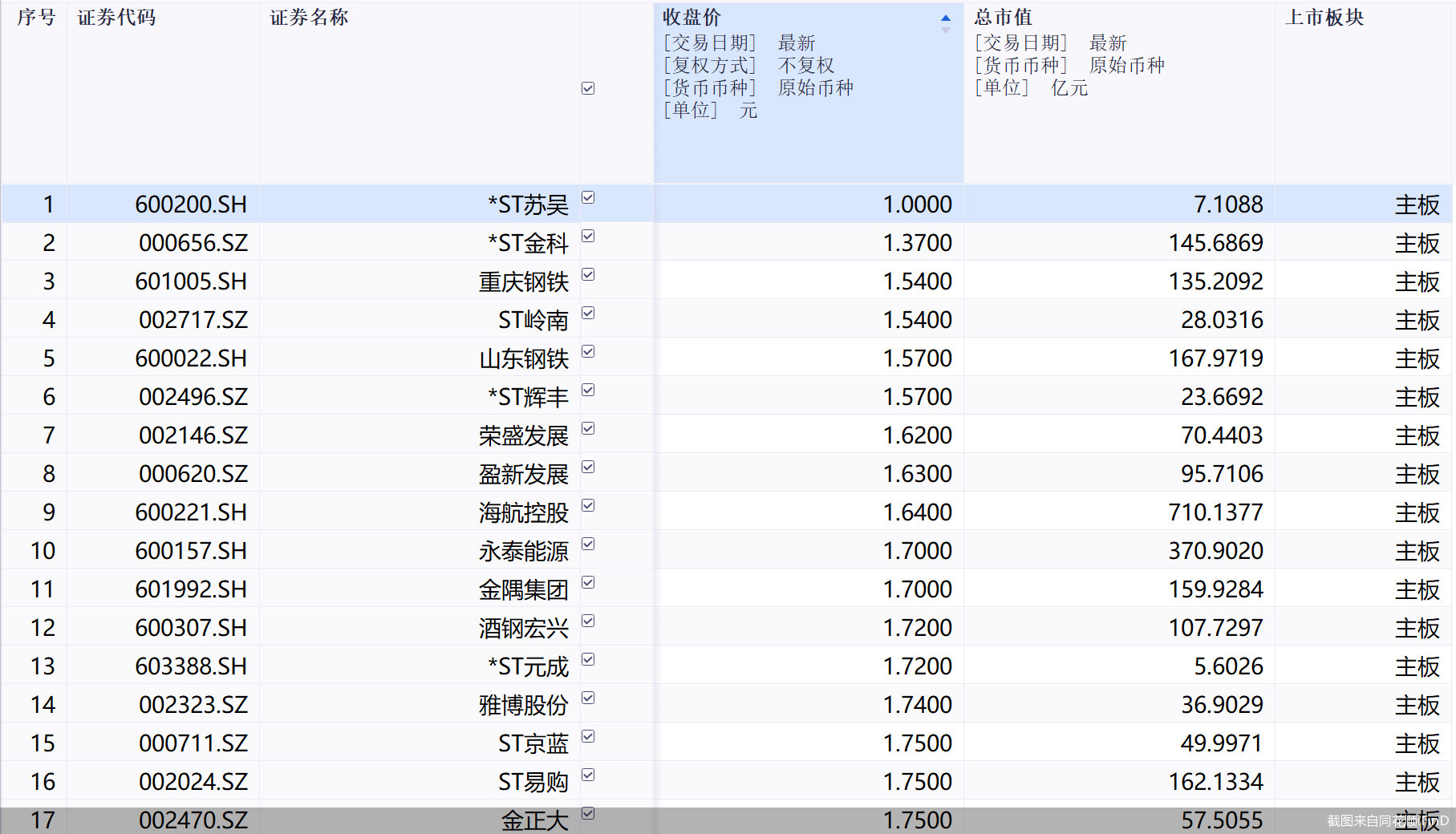
Core Viewpoint - The number of low-priced stocks in the A-share market has significantly decreased, with only 30 stocks closing below 2 yuan as of October 9, compared to nearly 100 a year ago, indicating a market trend towards higher quality stocks and the impact of regulatory reforms [1][2][3] Group 1: Market Overview - As of October 9, there are 30 stocks in the A-share market with closing prices below 2 yuan, a decrease of nearly 70% compared to the same period last year [2] - Among these 30 low-priced stocks, 5 are ST stocks and 8 are *ST stocks, accounting for over 40% of the total [2] - The reduction in low-priced stocks is attributed to the natural result of a rising market and the deepening of delisting and registration system reforms [2][3] Group 2: Performance of Low-Priced Stocks - Nearly 70% of the 30 low-priced stocks reported losses in the first half of the year, with 22 stocks showing negative net profits [4] - *ST Jinkang reported the highest loss, with a net profit of approximately -75.23 billion yuan, marking a decline of 85.28% in revenue [4] - The real estate sector has the highest number of low-priced stocks, totaling 8, followed by the construction and decoration sector with 4 [4] Group 3: Specific Company Analysis - Yongtai Energy has the largest decline in net profit among the few profitable stocks, with a net profit drop of 89.41% to approximately 1.26 billion yuan [6][7] - The company attributes its performance decline to falling coal prices and reduced power generation due to maintenance [7] - Yongtai Energy has implemented measures such as stock buybacks and cash dividends to support its stock price, but it still struggles to reflect its actual value in the market [8]
鸿星科技撤回 IPO:注册制下的理性适配与主业深耕的长远布局
Tai Mei Ti A P P· 2025-09-29 15:03
Core Viewpoint - Hongxing Technology has voluntarily withdrawn its IPO application after 941 days of progress, indicating a strategic choice to align with the evolving capital market environment rather than due to operational risks [2][3][4] Policy Evolution and Company Development - The withdrawal of the IPO application is fundamentally a mismatch between the main board's positioning and the company's development stage, not related to operational risks [3] - Since the submission of the IPO application on March 3, 2023, the company has navigated through the approval process, but the changing capital market rules necessitated a reassessment of its listing strategy [4][5] Financial Metrics and Market Position - When the IPO application was initiated in December 2022, the company's financial indicators met the Shanghai Stock Exchange's requirements; however, subsequent changes in listing criteria have created a misalignment [4] - The company’s global market share in quartz crystal oscillators reached 3.08% in 2023, ranking ninth globally, but its revenue and profit levels have not yet met the expectations for "large-cap blue-chip" companies on the main board [5] Industry Trends and Company Performance - The quartz crystal oscillator industry is experiencing a cyclical downturn due to external pressures, with global smartphone shipments declining by 3.2% in 2023, marking a ten-year low [6][7] - Despite short-term performance fluctuations, the industry and the company are entering a recovery phase, with the global quartz crystal market projected to reach $3.652 billion in 2024, a year-on-year increase of 12.33% [7] Strategic Focus and Future Outlook - The company is expanding into emerging markets such as artificial intelligence, optical communication, and automotive electronics, which are expected to drive future growth [8] - The company has clarified that its recent legal issues and dividend policies are unrelated to the IPO withdrawal, emphasizing a stable shareholding structure and a reasonable approach to dividends [9] Capital Pathway and Business Strategy - The withdrawal of the IPO application is viewed as a new starting point for the company to focus on its core business and adjust its capital strategy [10] - The company plans to continue investing in R&D and talent acquisition while monitoring market conditions to identify the right timing for future capital market initiatives [10]
视频|刘纪鹏:A股仍处价值洼地,A股市盈率40倍甚至更高都是合理的,90后00后在注意风险的基础上可入市买A股
Xin Lang Zheng Quan· 2025-09-25 07:41
Core Insights - The Chinese stock market is viewed as a "huge value gap" with significant potential, but young investors are advised to manage risks carefully and avoid excessive leverage [1][2]. Economic Growth and Market Potential - The resilience of China's long-term economic growth provides a solid foundation for the capital market, with GDP growth over the past 15 to 20 years consistently exceeding that of the U.S. by more than double [1]. - Despite this growth, the stock market has not reflected this advantage, with the U.S. market reaching historical highs while the A-share market remains at around 3899 points, indicating substantial valuation recovery potential [1]. - The overall price-to-earnings (P/E) ratio of the A-share market is approximately 30 times, while the Shanghai Composite Index is around 15 times, significantly lower than the U.S. market's P/E ratio of over 30 times [1]. Investment Caution for Young Investors - Young investors, particularly those born in the 1990s and 2000s, are cautioned about the high-risk nature of capital markets, which can amplify financial risks [2]. - It is recommended that these investors avoid full leverage and manage their positions wisely to prevent repeating the mistakes of older generations who faced significant losses [2]. Future Market Outlook - The Chinese capital market is still in a value gap phase, with vast growth potential ahead [2]. - As reforms such as the registration system advance and market structures optimize, investors are encouraged to adopt a more professional approach to identify opportunities, avoiding blind chasing of short-term trends or excessive reliance on leverage [2].