石油供应过剩

Search documents
【环球财经】国际能源署预测明年石油日均过剩超400万桶
Xin Hua She· 2025-11-14 04:03
Core Insights - The International Energy Agency (IEA) predicts a continued oversupply in the global oil market for the next two years, with a potential surplus of 4.09 million barrels per day by 2026, which is significantly higher than other forecasts [1] - The report highlights an imbalance in the oil market due to increased supply from OPEC and non-OPEC countries, while demand growth remains sluggish [1] - Global oil production has increased by 6.2 million barrels per day since the beginning of the year, with Saudi Arabia contributing 1.5 million barrels per day to this increase [2] Supply and Demand Dynamics - The IEA forecasts a supply increase of approximately 3.1 million barrels per day in 2025 and 2.5 million barrels per day in 2026, while demand growth is expected to be 770,000 barrels per day next year [1] - The report indicates that the demand growth forecast has been revised upward by 70,000 barrels per day due to increased demand from chemical plants [1] Inventory Levels - Global oil inventories have risen significantly, reaching nearly 8 billion barrels as of September, the highest level since July 2021, primarily due to increased storage from maritime transport [2] OPEC and Non-OPEC Contributions - OPEC and non-OPEC countries have shared the increase in oil production, with Russia contributing only 120,000 barrels per day due to sanctions and energy facility attacks [2] - OPEC's own report predicts a much lower surplus of only 20,000 barrels per day by 2026, contrasting with the IEA's more substantial surplus forecast [2]
IEA预估全球过剩会加剧,并提?俄罗斯供给减量?险
Zhong Xin Qi Huo· 2025-11-14 01:07
1. Report Industry Investment Rating No relevant information is provided in the report. 2. Core Views - The global oil market is facing an increasingly imbalanced supply - demand situation, with supply growing and demand growth being mediocre compared to historical standards. The market is expected to remain in a state of oversupply in 2026, and the price of crude oil will be volatile in the short - term [2][8]. - The cancellation of India's domestic certification for 14 chemical imports will bring direct incremental exports for some chemicals, but the exact increase needs further exploration. A refinery accident in South China will lead to a reduction in the supply of aromatics, olefins, and refined oil [3]. - Most energy and chemical products are expected to maintain a volatile and consolidating trend in the short - term, affected by factors such as supply and demand, geopolitical situations, and policy changes [3][5]. 3. Summary by Related Catalogs 3.1 Market News and Main Logic of Crude Oil - **Market News**: Trump lifted restrictions on oil exploration in the Alaska National Petroleum Reserve. EIA data showed that the US continued to accumulate crude oil inventories last week, and the IEA月报 predicted an increase in the oversupply of global oil in 2026 [8]. - **Main Logic**: The oversupply situation is expected to intensify in 2026. Although the refined oil inventory pressure has eased and the crack spread is strong, providing phased support for the demand side, the supply pressure remains difficult to refute. If Russian oil supply does not decrease, the oil price may return to the oversupply pattern [8]. 3.2 Situation of Other Energy and Chemical Products - **Asphalt**: Shandong's spot prices have stabilized, and the futures price is volatile. The supply tension has been relieved, and the over - valuation premium is starting to decline [10]. - **High - sulfur Fuel Oil**: News of the easing of the Russia - Ukraine conflict drove the futures price down. The supply in the Asia - Pacific region may decrease, but the demand is still weak [11]. - **Low - sulfur Fuel Oil**: The weakening of refined oil led to a decline in low - sulfur fuel oil. It is facing supply increase and demand decline, and its valuation is low, following the trend of crude oil [13]. - **Methanol**: High inventory suppresses the price, and overseas disturbances are not significant. It is in a volatile and consolidating state [30]. - **Urea**: Downstream purchases on dips, and the futures price is volatile. It is under high - inventory pressure and coal - cost support [30]. - **Ethylene Glycol**: Although there are more device disturbances and marginal improvement in supply - demand, the oversupply pattern cannot be reversed, and the price will remain in a low - level range [22][24]. - **PX**: India's cancellation of BIS and the speculation of the US - Asia aromatics arbitrage window drove PX to strengthen against cost. It is expected to be volatile and warm in the short - term [16]. - **PTA**: India's cancellation of BIS certification is beneficial to overseas export expectations. The price will follow the cost and be volatile and warm in the short - term [17][18]. - **Short - fiber**: The cancellation of India's BIS certification has limited impact on short - fiber, and the profit is expected to be compressed under passive following [26][27]. - **Bottle - chip**: The price fluctuation has slightly increased, and the trading atmosphere has recovered. It follows the trend of upstream raw materials [28]. - **Propylene**: Downstream trading volume has increased, and PL is volatile [36]. - **PP**: After continuous decline, it has slightly stabilized. Attention should be paid to the change in maintenance [35]. - **Plastic**: The chemical sector has slightly stabilized, and plastic follows the trend [34]. - **PVC**: The cancellation of India's BIS certification may boost sentiment, but the actual export impact is limited. PVC is weakly stable [37]. - **Caustic Soda**: With low valuation and weak expectations, it is in a volatile state [38]. 3.3 Variety Data Monitoring - **Inter - period Spread**: The inter - period spreads of various energy and chemical products have different degrees of change, which reflects the market's expectations for future prices [40]. - **Basis and Warehouse Receipts**: The basis and warehouse receipts of different products also show different trends, which can help analyze the relationship between the spot and futures markets [41]. - **Inter - variety Spread**: The inter - variety spreads of different energy and chemical products have changed, which is affected by factors such as supply - demand and cost [42].
800点大跌
Zhong Guo Ji Jin Bao· 2025-11-13 23:53
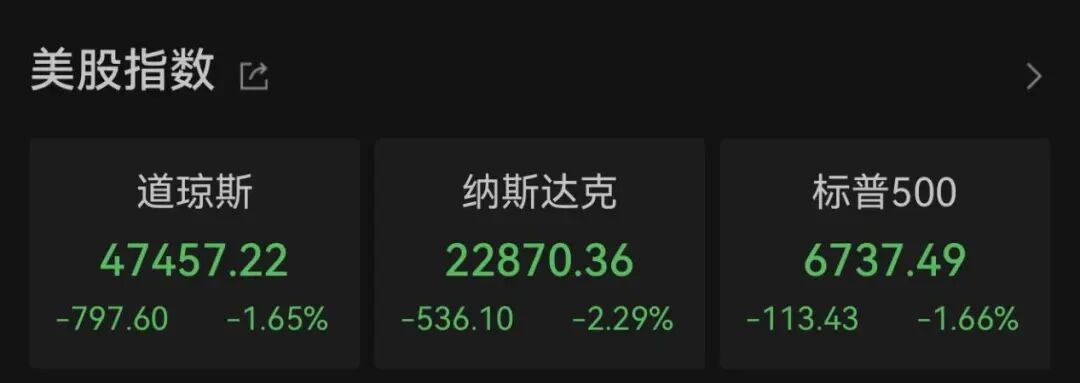
Market Overview - The US stock market experienced a significant decline, with the Dow Jones dropping nearly 800 points, marking a 1.65% decrease, while the Nasdaq fell by 2.29% [2][3] - Major companies such as Disney and Goldman Sachs led the decline, with Disney's stock dropping over 7% and Goldman Sachs nearly 4% [1][2] Economic Indicators - The market anticipates the release of the October employment report, which will not include unemployment rate data, leading to a drop in the probability of a Federal Reserve rate cut in December from 62.9% to slightly above 49% [4][5] - The government shutdown, which lasted 43 days, has been officially ended, with President Trump signing a temporary funding bill, but the economic impact is expected to be significant, with a projected GDP decline of 1.5% for Q4 [4][5] Company Performance - Disney reported mixed results for Q4, with revenues of $22.46 billion, slightly below market expectations of $22.75 billion, despite a year-over-year revenue decline [9] - Disney's direct-to-consumer segment saw an 8% revenue increase, reaching $6.25 billion, and exceeded subscriber expectations for Disney+ and Hulu [9] Financial Sector - Major banks such as JPMorgan, Goldman Sachs, and Citigroup saw declines in their stock prices, with JPMorgan down over 3% and Goldman Sachs nearly 4% [5][6] - Financial institutions are urging the Federal Reserve to take action to address liquidity issues in the short-term financing market [5] Energy Sector - The International Energy Agency (IEA) has raised its forecast for global oil supply surplus for the sixth consecutive month, predicting a surplus of approximately 4 million barrels per day by 2026 [10][11] - Oil prices showed a slight rebound after a significant drop, with WTI crude futures rising about 0.3% [10]


11月14日外盘头条:美国10月就业报告将打折 波音罢工结束 特斯拉拟支持苹果CarPlay ...
Xin Lang Cai Jing· 2025-11-13 21:38
Group 1 - Liquidity pressure is increasing in the $12 trillion financing market, prompting Wall Street to urge the Federal Reserve to take action [4] - Major institutions like Bank of America and Barclays warn that the Fed may need to provide more loans in the short-term financing market or directly purchase securities to inject funds into the banking system [4] - The Fed's gradual adjustment of its balance sheet policy is seen as a response to recent market pressures, with some investors believing that the Fed's actions may be too slow, potentially leading to a shortage of reserves [4] Group 2 - The October employment report in the U.S. is expected to be "discounted," with concerns about the unemployment rate being a persistent mystery [6] - Cleveland Fed President Beth Hammack emphasizes the need to maintain restrictive rates to continue applying pressure to bring inflation back to target [6] Group 3 - Tesla is reportedly developing a feature to support Apple's CarPlay, a long-requested functionality by customers [8][9] - This marks a significant shift for Tesla and CEO Elon Musk, who has historically resisted adding this popular feature and has criticized Apple [9] Group 4 - Boeing workers in St. Louis voted to accept a five-year contract proposal, ending the company's second-longest strike in history [11] - The accepted terms include a 24% increase in average wages and a $6,000 signing bonus for the 3,200 members of the union [11] Group 5 - The European Union is considering consolidating dollar reserves held by non-U.S. countries to reduce reliance on the Federal Reserve [13] - Discussions are still at the working group level and have not yet reached the European Central Bank's decision-making body [13] Group 6 - The International Energy Agency (IEA) has raised its forecast for global oil supply surplus for the sixth consecutive month, predicting a surplus of about 4 million barrels per day by 2026 [15] - The IEA notes that the global oil supply continues to increase while demand growth remains relatively weak [15]

【特稿】国际能源署预测明年石油日均过剩超400万桶
Sou Hu Cai Jing· 2025-11-13 15:05
Core Insights - The International Energy Agency (IEA) predicts a continued global oil supply surplus in the next two years due to increased production from oil-producing countries and slowing demand growth, with a projected surplus of 4.09 million barrels per day by 2026 [1] - The IEA's report indicates a significant imbalance in the global oil market, with supply growth outpacing demand growth [1] - The IEA's annual World Energy Outlook report suggests that the trend of increasing global oil and gas demand may persist until 2050 [1] Supply Dynamics - As of October, global oil production has increased by 6.2 million barrels per day since the beginning of the year, with contributions from both OPEC and non-OPEC countries [2] - Saudi Arabia, as the largest oil producer in OPEC, contributed an increase of 1.5 million barrels per day, while Russia's contribution was limited to 120,000 barrels per day due to sanctions and attacks on energy facilities [2] - Despite impending sanctions on Russian oil companies, Russian oil exports have not yet been significantly impacted [2] Inventory Levels - Global oil inventories have risen sharply, reaching nearly 8 billion barrels as of September, the highest level since July 2021, primarily due to increased storage of oil transported by sea [2] - The trend of rising oil inventories is expected to continue [2] Forecast Discrepancies - OPEC's monthly oil market report predicts a much lower surplus of only 20,000 barrels per day by 2026, contrasting sharply with the IEA's forecast [2]
原油日报:机构报告影响偏空,油价大幅回落-20251113
Hua Tai Qi Huo· 2025-11-13 06:13
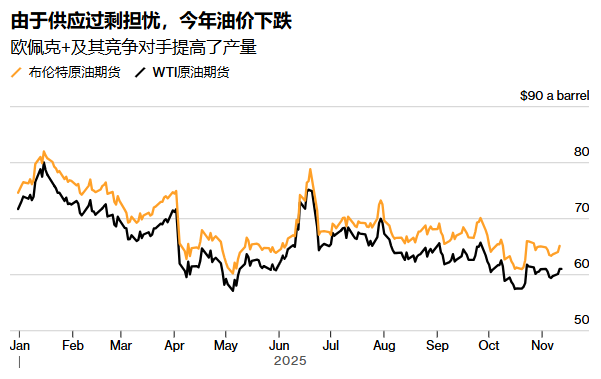
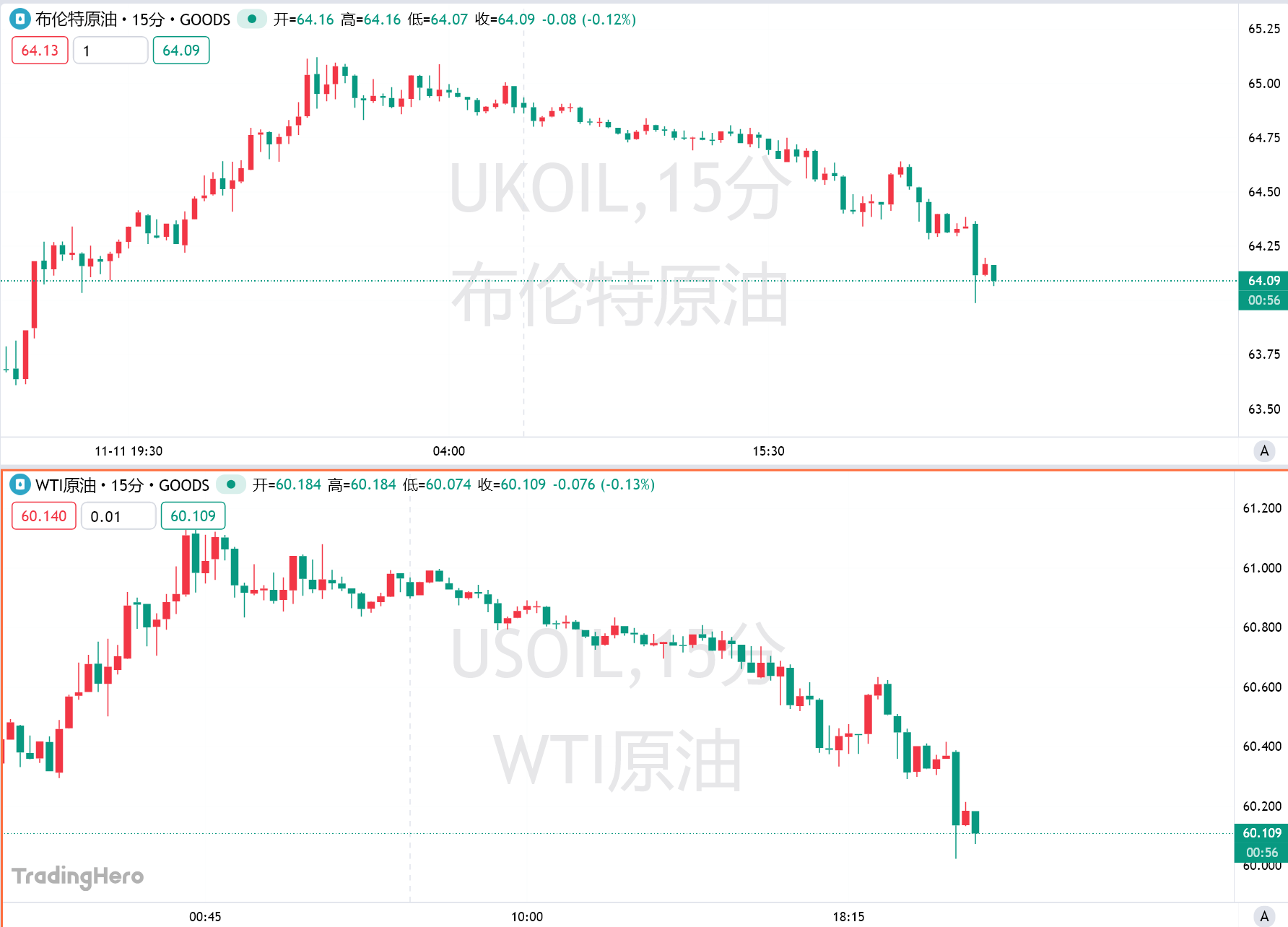
Report Industry Investment Rating - No specific industry investment rating is provided in the given content. Core Viewpoints - The market previously had differences on the issue of oil surplus, but with the release of institutional reports, a consensus on future surplus is gradually reached. Since Q3, oil supplies in the Middle East, Latin America, and Russia have increased significantly, and the problem of oil inventory accumulation will become more prominent in the future [2]. Summary by Related Catalogs Market News and Important Data - The price of light - sweet crude oil futures for December delivery on the New York Mercantile Exchange fell $2.55 to close at $58.49 per barrel, a decline of 4.18%. The price of Brent crude oil futures for January delivery fell $2.45 to close at $62.71 per barrel, a decline of 3.76%. The main SC crude oil contract closed down 3.39% at 451 yuan per barrel [1]. - As of the week ending November 12, the total refined oil inventory at the Port of Fujairah in the UAE was 21.181 million barrels, an increase of 3.204 million barrels from the previous week. Light distillate inventories increased by 1.074 million barrels to 7.877 million barrels, medium distillate inventories decreased by 0.222 million barrels to 3.012 million barrels, and heavy residual fuel oil inventories increased by 2.352 million barrels to 11.012 million barrels [1]. - Crude oil futures extended losses during U.S. trading hours. After OPEC+ predicted an increase in competitors' supply, market concerns about oversupply intensified. The organization maintained its forecasts for oil demand this year and next but raised its estimate of non - OPEC+ production for next year. The IEA said in its annual report that under the existing policy scenario, oil and gas demand may continue to grow until 2050. However, progress in the U.S. government's reopening and the prospect of further interest rate cuts this year limited further price losses of crude oil [1]. - The OPEC monthly report shows that the global crude oil demand growth rate forecast for 2025 is 1.3 million barrels per day (previously estimated at 1.3 million barrels per day), and for 2026 is 1.38 million barrels per day (previously estimated at 1.38 million barrels per day). Despite the OPEC+ production increase agreement, the average crude oil production of OPEC+ in October was 43.02 million barrels per day, a decrease of 73,000 barrels per day from September [1]. - UK Foreign Secretary Cooper announced on the 11th a plan to phase - out the provision of shipping, insurance and other services for Russian LNG exports by UK companies starting in 2026, aiming to cut off Russia's funding from energy exports and end the Russia - Ukraine conflict. This is a new round of sanctions against Russia's energy sector following last month's sanctions on Russian oil companies [1]. Investment Logic - The market previously had differences on the oil surplus problem. With the release of institutional reports, a consensus on future surplus is gradually reached. Although market differentiation due to sanctions still exists, oil supplies in the Middle East, Latin America, and Russia have increased significantly since Q3, and the problem of oil inventory accumulation will be more prominent in the future [2]. Strategy - In the short term, oil prices will fluctuate weakly. In the medium term, a short - position allocation is recommended, and short the calendar spread (long far - month contracts and short near - month contracts, for Brent or WTI) [3].
OPEC与EIA报告加剧供应过剩担忧 油价重挫4%创6月以来最大跌幅
智通财经网· 2025-11-13 00:32
Group 1 - Oil prices continued to decline after a significant drop, with WTI crude falling to $58 per barrel and Brent crude below $63 per barrel, indicating a potential oil surplus [1][3] - OPEC reported that global oil supply exceeded demand in Q3, and the EIA raised its U.S. production forecast for next year from 13.51 million barrels to 13.58 million barrels [1][3] - The WTI spot price spread turned to a futures premium for the first time since February, signaling a bearish pricing pattern due to ample supply [1] Group 2 - OPEC's forecast indicates that global oil supply will match demand next year, contrasting with previous predictions of a supply shortage by 2026 [3] - The IEA's latest report suggests that oil and gas demand may continue to grow until 2050, with oil consumption projected to increase by 13% from 2024 to 2050 under the current policy scenario [3] - Analysts noted that an oversupply of crude oil is suppressing price increases, and OPEC+ agreed to pause production increases in Q1 of next year after gradually lifting production cuts since August [3] Group 3 - The reopening of the U.S. government may boost consumer confidence and economic activity, potentially stimulating oil demand [4]
供应过剩阴影笼罩全球油市 欧佩克将石油市场展望转为过剩
Ge Long Hui A P P· 2025-11-12 15:03
格隆汇11月12日|欧佩克将其对全球石油市场的估计从赤字转为过剩,原因在于美国产量超出预期,而 欧佩克本身也增加了供应。该组织在其最新的月度报告中表示,在此期间,世界石油产量每天超出了需 求50万桶,而一个月前的估计为短缺40万桶。周三发布的报告还指出,欧佩克+联盟上季度产出的原油 量超过了估计所需的量。沙特阿拉伯一直在引导该联盟加速恢复今年被暂停的供应,以求夺回全球市场 份额。但该联盟成员本月首次表现出放缓该战略的迹象,同意在2026年第一季度暂停进一步增产。该组 织援引季节性需求放缓为由,尽管许多分析师警告全球市场将出现显著的供应过剩。展望2026年,欧佩 克的数据确实显示将出现盈余,尽管规模比其他预测机构更为温和。 ...
欧佩克月报大反转:三季度全球油市转为供应过剩
Jin Shi Shu Ju· 2025-11-12 14:05
由于美国石油产量超出预期,而欧佩克自身也加大了供应量,因此欧佩克将其对第三季度全球石油市场的预期从供应短缺转为供应过剩。 欧佩克在最新月度报告中表示,该季度全球石油产量日均超出需求50万桶,而一个月前其预估的是日均短缺40万桶。 该组织位于维也纳的秘书处将三季度非欧佩克+的供应预期上调了89万桶/日,其中超半数增幅来自美国。 这份周三发布的报告还显示,欧佩克+上季度的原油产量超过了其预估的市场需求水平。今年,沙特主导该联盟加快恢复此前暂停的产量,以夺回全球市场 份额。欧佩克+自4月份以来已将其产量目标提高了约290万桶/日,约占全球供应量的2.7%。 周三早些时候,欧佩克秘书处还对国际能源署(IEA)的立场转变表示赞赏。IEA在年度长期报告中承认,石油需求可能在未来数十年内持续增长。 欧佩克表示,近年来一直预测本十年内石油消费将停止增长的IEA,终于"直面现实"。 目前参与供应调整的8个欧佩克+成员国,以及由22个国家组成的完整联盟,将于11月30日举行会议,审议相关产量政策。 本月,该联盟主要成员国首次显现放缓这一策略的迹象,同意在2026年第一季度暂停进一步增产。欧佩克称此举是出于季节性需求放缓,但许多分 ...
特朗普施压奏效!印度五大炼油厂暂停订购俄油
Sou Hu Cai Jing· 2025-11-11 10:13
克普勒数据(Kpler)显示,今年以来,信实工业有限公司(Reliance Industries Ltd.)、巴拉特石油公司(Bharat Petroleum Corp. Ltd.)、印度斯坦石油公司(Hindustan Petroleum Corp. Ltd.)、芒格洛尔炼油石化公司(Mangalore Refinery and Petrochemicals Ltd.)和HPCL-米塔尔能源公司(HPCL-Mittal Energy Ltd.)这五大炼油商,占印度俄罗斯原油进口量的三分之二。 受西方制裁与美印贸易谈判影响,印度12月大幅缩减俄罗斯原油采购,五大核心炼油商未下任何订单。 印度已缩减12月到港的俄罗斯原油采购量,这表明西方制裁和美印贸易谈判正对其采购模式产生重大影响。 据知情人士透露,印度五大核心炼油商尚未为下月下达任何俄罗斯原油订单。通常情况下,下月原油交易需在当月10日前完 成。 作为全球第三大石油进口国,印度此次采购变动发生在特朗普8月将所有印度进口商品关税翻倍至50%、并于上月制裁俄罗斯两 大石油生产商——俄罗斯石油公司(Rosneft PJSC)和卢克石油公司(Lukoil PJSC) ...