
社会消费品零售总额

Search documents
2025年12月份社会消费品零售总额45136亿元,同比增长0.9%
Guo Jia Tong Ji Ju· 2026-01-19 02:28
Core Insights - In December, the total retail sales of consumer goods reached 45,136 billion yuan, showing a year-on-year growth of 0.9% [1] - By 2025, the total retail sales of consumer goods are projected to reach 501,202 billion yuan, an increase of 3.7% compared to the previous year [1] Group 1: Retail Sales Overview - The retail sales of consumer goods excluding automobiles in December amounted to 39,654 billion yuan, with a growth of 1.7% year-on-year [1] - For 2025, the retail sales of consumer goods excluding automobiles are expected to be 451,413 billion yuan, reflecting a growth of 4.4% [1] Group 2: Urban vs Rural Consumption - In December, urban retail sales were 38,429 billion yuan, marking a year-on-year increase of 0.7%, while rural retail sales reached 6,707 billion yuan, growing by 1.7% [2] - By 2025, urban retail sales are projected to be 432,972 billion yuan, a growth of 3.6%, and rural retail sales are expected to reach 68,230 billion yuan, increasing by 4.1% [2] Group 3: Consumption Types - In December, the retail sales of goods were 39,398 billion yuan, with a year-on-year growth of 0.7%, while catering revenue was 5,738 billion yuan, growing by 2.2% [2] - For 2025, the retail sales of goods are anticipated to be 443,220 billion yuan, reflecting a growth of 3.8%, and catering revenue is expected to reach 57,982 billion yuan, increasing by 3.2% [2] Group 4: Retail Formats - In 2025, retail sales from convenience stores, supermarkets, department stores, and specialty stores are projected to grow by 5.5%, 4.3%, 0.1%, and 2.6% respectively, while brand specialty stores are expected to decline by 0.6% [5] - The national online retail sales are projected to reach 159,722 billion yuan in 2025, with a growth of 8.6%, and physical goods online retail sales are expected to be 130,923 billion yuan, growing by 5.2% [5] Group 5: Detailed Retail Data - In December, the retail sales of consumer goods included various categories, with notable growth in categories such as cosmetics (8.8%), sports and entertainment products (9.0%), and communication equipment (20.9%) [7] - Conversely, categories like home appliances (-18.7%), petroleum and products (-11.0%), and automobiles (-5.0%) experienced declines [7]

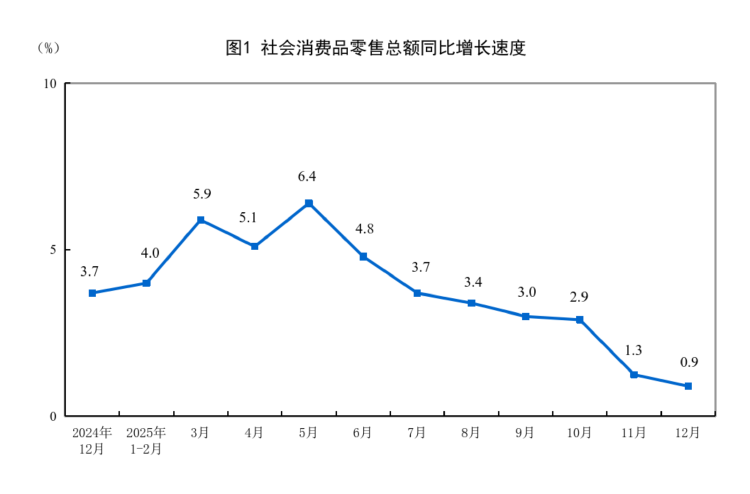
国家统计局:2025年12月份社会消费品零售总额45136亿元 同比增长0.9%
智通财经网· 2026-01-19 02:19
Core Insights - In December, the total retail sales of consumer goods reached 45,136 billion yuan, showing a year-on-year growth of 0.9% [2] - Excluding automobiles, the retail sales of consumer goods amounted to 39,654 billion yuan, with a growth of 1.7% [2] - By 2025, the total retail sales of consumer goods are projected to reach 501,202 billion yuan, representing a year-on-year increase of 3.7% [2] Group 1: Retail Sales Overview - In December, urban retail sales were 38,429 billion yuan, growing by 0.7% year-on-year, while rural retail sales were 6,707 billion yuan, increasing by 1.7% [4] - For 2025, urban retail sales are expected to be 432,972 billion yuan, up 3.6% from the previous year, and rural retail sales are projected at 68,230 billion yuan, growing by 4.1% [4] Group 2: Consumption Types - In December, the retail sales of goods were 39,398 billion yuan, with a year-on-year growth of 0.7%, while catering revenue was 5,738 billion yuan, increasing by 2.2% [4] - By 2025, the retail sales of goods are anticipated to reach 443,220 billion yuan, reflecting a growth of 3.8%, and catering revenue is expected to be 57,982 billion yuan, growing by 3.2% [4] Group 3: Retail Formats and Online Sales - In 2025, retail sales from convenience stores, supermarkets, department stores, and specialty stores are projected to grow by 5.5%, 4.3%, 0.1%, and 2.6% respectively, while brand specialty stores are expected to decline by 0.6% [7] - The national online retail sales are forecasted to reach 159,722 billion yuan in 2025, marking an 8.6% increase from the previous year, with physical goods online retail sales at 130,923 billion yuan, growing by 5.2% [7] - Among physical goods online retail sales, food, clothing, and daily necessities are expected to grow by 14.5%, 1.9%, and 4.1% respectively [7]
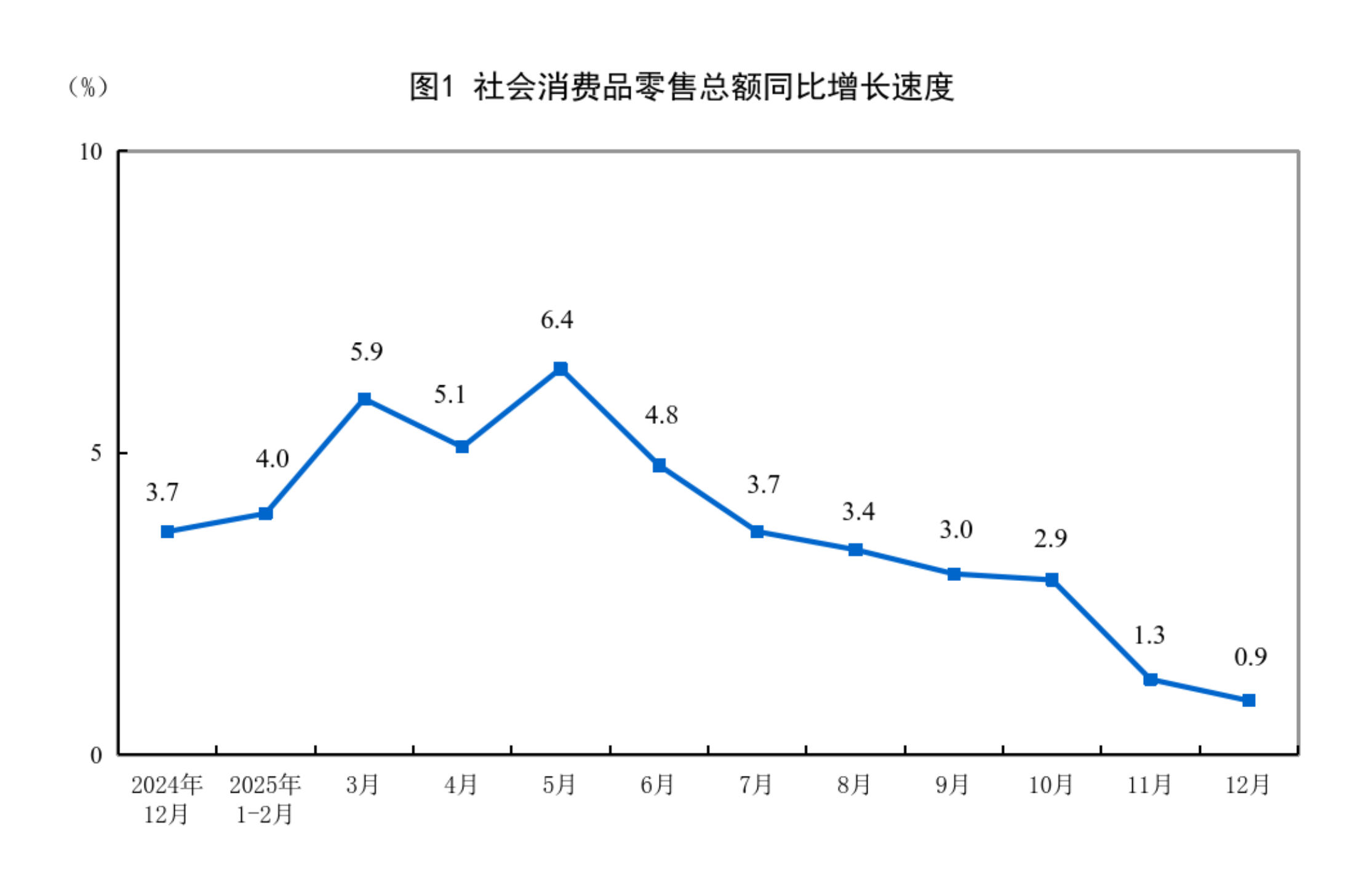
国家统计局:12月份,社会消费品零售总额45136亿元,同比增长0.9%
Mei Ri Jing Ji Xin Wen· 2026-01-19 02:13
每经AI快讯,1月19日,国家统计局发布的数据显示:12月份,社会消费品零售总额45136亿元,同比 增长0.9%。其中,除汽车以外的消费品零售额39654亿元,增长1.7%。2025年,社会消费品零售总额 501202亿元,比上年增长3.7%。其中,除汽车以外的消费品零售额451413亿元,增长4.4%。 ...
国家统计局:2025年社会消费品零售总额501202亿元 比上年增长3.7%
Zheng Quan Shi Bao Wang· 2026-01-19 02:08
Group 1 - The total retail sales of consumer goods in 2025 reached 50,120.2 billion yuan, an increase of 3.7% compared to the previous year [1] - Urban retail sales amounted to 43,297.2 billion yuan, growing by 3.6%, while rural retail sales were 6,823.0 billion yuan, with a growth of 4.1% [1] - Retail sales of goods reached 44,322.0 billion yuan, increasing by 3.8%, and catering revenue was 57,982.0 billion yuan, growing by 3.2% [1] Group 2 - Sales of basic living goods and certain upgraded products showed strong growth, with categories such as communication equipment, cultural and office supplies, sports and entertainment products, home appliances, and food retailing increasing by 20.9%, 17.3%, 15.7%, 11.0%, and 9.3% respectively [1] - The national online retail sales reached 15,972.2 billion yuan, an increase of 8.6% year-on-year, with physical goods online retail sales at 13,092.3 billion yuan, growing by 5.2%, accounting for 26.1% of total retail sales [1] Group 3 - In December, the total retail sales of consumer goods increased by 0.9% year-on-year but decreased by 0.12% month-on-month [1] - Annual service retail sales grew by 5.5%, with significant growth in categories such as cultural and recreational services, communication information services, tourism consulting and leasing services, and transportation services [1]
新华社快讯:2025年全国社会消费品零售总额超50万亿元
Xin Hua Wang· 2026-01-19 02:05
Group 1 - The core viewpoint of the article is that the National Bureau of Statistics reported a growth in retail sales and online retail for the year 2025, indicating a positive trend in consumer spending [1] Group 2 - The total retail sales of consumer goods in 2025 reached 50,120.2 billion yuan, representing a year-on-year growth of 3.7% [1] - The online retail sales amounted to 15,972.2 billion yuan, showing an increase of 8.6% compared to the previous year [1]
国家统计局:12月份社会消费品零售总额45136亿元 同比增长0.9%
Guo Jia Tong Ji Ju· 2026-01-19 02:04
国家统计局:12月份,社会消费品零售总额45136亿元,同比增长0.9%。其中,除汽车以外的消费品零 售额39654亿元,增长1.7%。2025年,社会消费品零售总额501202亿元,比上年增长3.7%。其中,除汽 车以外的消费品零售额451413亿元,增长4.4%。 (文章来源:国家统计局) ...
国家统计局:中国2025年社会消费品零售总额同比增长3.7%
Guo Jia Tong Ji Ju· 2026-01-19 02:04
Core Viewpoint - In December, the total retail sales of consumer goods reached 45,136 billion yuan, with a year-on-year growth of 0.9%. Excluding automobiles, the retail sales amounted to 39,654 billion yuan, growing by 1.7%. By 2025, the total retail sales are projected to reach 501,202 billion yuan, an increase of 3.7% from the previous year, with non-automobile retail sales expected to be 451,413 billion yuan, growing by 4.4% [1][7]. Group 1: Retail Sales Overview - In December, urban retail sales were 38,429 billion yuan, up 0.7% year-on-year, while rural retail sales were 6,707 billion yuan, increasing by 1.7% [3]. - For the entire year of 2025, urban retail sales are projected to be 432,972 billion yuan, a growth of 3.6%, and rural retail sales are expected to reach 68,230 billion yuan, growing by 4.1% [3]. Group 2: Consumption Type Analysis - In December, the retail sales of goods were 39,398 billion yuan, with a year-on-year increase of 0.7%, while catering revenue was 5,738 billion yuan, growing by 2.2% [3]. - By 2025, the retail sales of goods are expected to reach 443,220 billion yuan, an increase of 3.8%, and catering revenue is projected to be 57,982 billion yuan, growing by 3.2% [3]. Group 3: Retail Formats and Online Sales - In 2025, retail sales from convenience stores, supermarkets, department stores, and specialty stores are expected to grow by 5.5%, 4.3%, 0.1%, and 2.6% respectively, while brand specialty store sales are projected to decline by 0.6% [5]. - The national online retail sales are expected to reach 159,722 billion yuan in 2025, growing by 8.6%. Among these, physical goods online retail sales are projected to be 130,923 billion yuan, increasing by 5.2%, accounting for 26.1% of total retail sales [5].
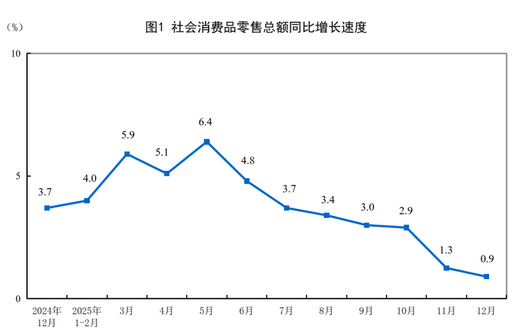
2025年12月份社会消费品零售总额增长0.9%
Guo Jia Tong Ji Ju· 2026-01-19 02:01
Core Insights - The total retail sales of consumer goods in December reached 45,136 billion yuan, showing a year-on-year growth of 0.9% [7] - Excluding automobiles, the retail sales amounted to 39,654 billion yuan, with a growth of 1.7% [7] - For the year 2025, the total retail sales are projected to be 501,202 billion yuan, representing a growth of 3.7% compared to the previous year [7] Group 1: Retail Sales Overview - In December, urban retail sales were 38,429 billion yuan, increasing by 0.7% year-on-year, while rural retail sales were 6,707 billion yuan, growing by 1.7% [3] - For 2025, urban retail sales are expected to reach 432,972 billion yuan, a growth of 3.6%, and rural retail sales are projected at 68,230 billion yuan, with a growth of 4.1% [3] Group 2: Consumption Type Analysis - In December, the retail sales of goods were 39,398 billion yuan, with a year-on-year increase of 0.7%, while catering revenue was 5,738 billion yuan, growing by 2.2% [4] - For 2025, the retail sales of goods are forecasted to be 443,220 billion yuan, reflecting a growth of 3.8%, and catering revenue is expected to reach 57,982 billion yuan, with a growth of 3.2% [4] Group 3: Retail Formats and Online Sales - In 2025, retail sales from convenience stores, supermarkets, department stores, and specialty stores are projected to grow by 5.5%, 4.3%, 0.1%, and 2.6% respectively, while brand specialty stores are expected to decline by 0.6% [6] - The national online retail sales are anticipated to be 159,722 billion yuan in 2025, marking an 8.6% increase from the previous year, with physical goods online retail sales at 130,923 billion yuan, growing by 5.2% [6]
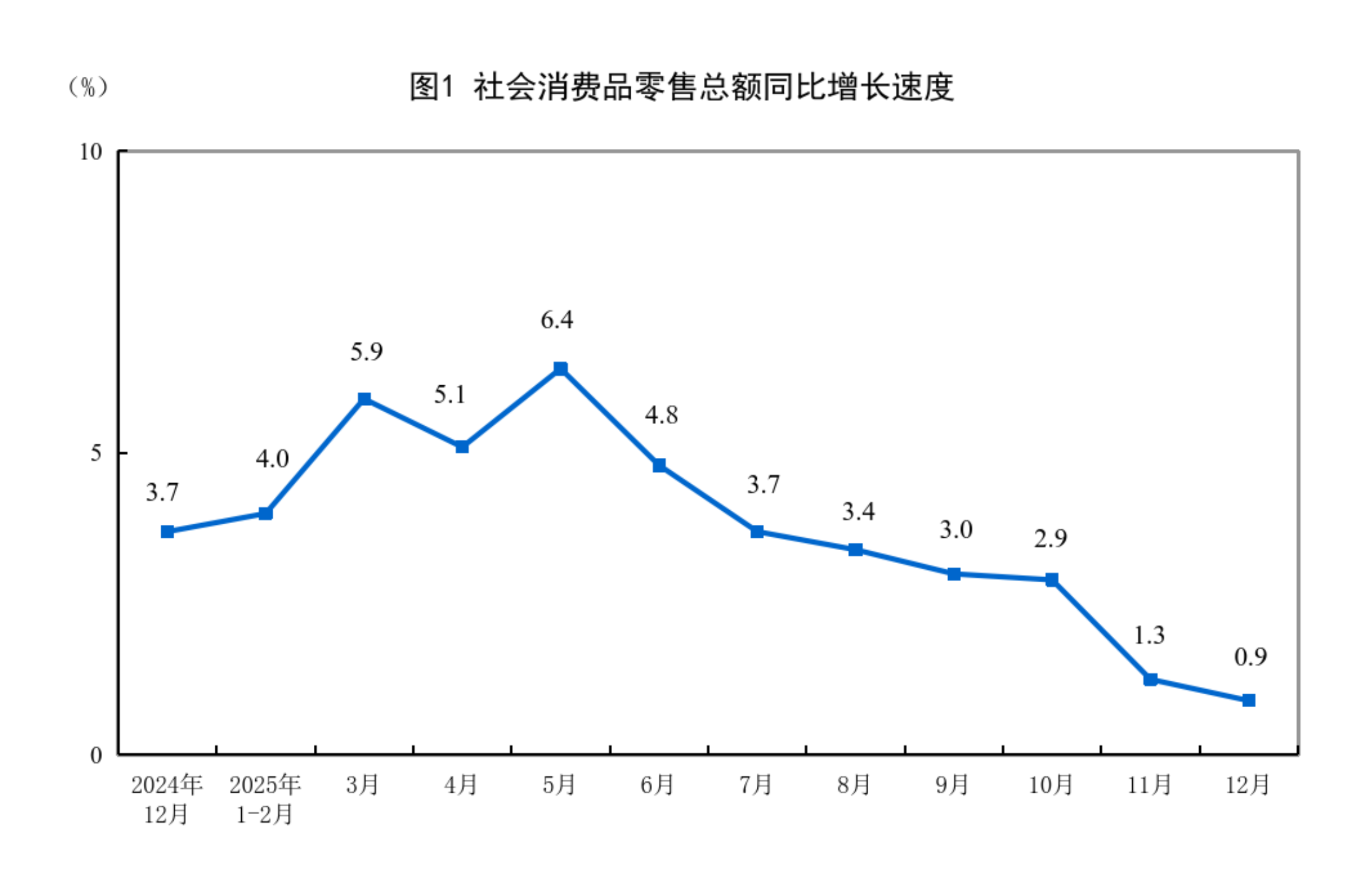
中国12月社会消费品零售总额同比 0.9%,前值 1.3%
Hua Er Jie Jian Wen· 2026-01-19 02:00
市场有风险,投资需谨慎。本文不构成个人投资建议,也未考虑到个别用户特殊的投资目标、财务状况或需要。用户应考虑本文中的任何 意见、观点或结论是否符合其特定状况。据此投资,责任自负。 中国12月社会消费品零售总额同比 0.9%,前值 1.3%。 风险提示及免责条款 ...
2025年经济运行稳中有进 顺利收官
Sou Hu Cai Jing· 2026-01-07 17:15
Economic Outlook - The global economy in 2026 is expected to exhibit a complex system characterized by non-linearity, path dependence, and adaptability, showing high instability but resilience [1] - The "First Financial Chief Economist Confidence Index" for January 2026 is reported at 50.32, indicating a recovery and maintaining a prosperous state [2][3] Inflation and Price Predictions - The average predicted year-on-year CPI growth for December 2025 is 0.8%, while the PPI is forecasted at -2% [5][6] - CPI predictions range from a minimum of 0.5% to a maximum of 0.9%, indicating a slight increase from November's 0.7% [6] - The PPI predictions range from -2.3% to -1.9%, showing a slight improvement from the previous month's -2.2% [6] Industrial and Investment Growth - The predicted growth rate for industrial added value in December 2025 is 4.9%, slightly above the previous month's 4.8% [9][10] - Fixed asset investment is expected to decline by an average of -2.2%, showing a recovery from November's -2.6% [11] - Real estate development investment is forecasted to decrease by -15.8%, with signs of a narrowing decline in transaction volumes [12] Trade and Export Forecasts - The trade surplus for December 2025 is predicted to be $1113.5 billion, remaining stable compared to the previous month [13][14] - Exports are expected to grow by 2.5%, down from 5.9% in the previous month, while imports are forecasted to increase by 0.7% [14][15] Financing and Monetary Policy - New loans are projected to reach 7182.5 billion yuan in December 2025, recovering from the previous month's 3900 billion yuan [15][16] - The total social financing is expected to average 1.8 trillion yuan, lower than the previous month's 2.5 trillion yuan [16][17] - M2 growth is predicted to remain at 8%, consistent with November's figures [18] Policy Directions - Fiscal policy is anticipated to become more proactive, with an increase in the scale of government debt and continued support for local debt initiatives [20][21] - Monetary policy is expected to remain moderately accommodative, with potential for further interest rate cuts and reserve requirement reductions [20][21]