科技自主可控

Search documents
手机销量连续三年斩获国产第一!小米集团领涨,港股互联网沿5日线缓慢爬升,耐心资金抢筹513770
Xin Lang Ji Jin· 2025-11-12 12:27
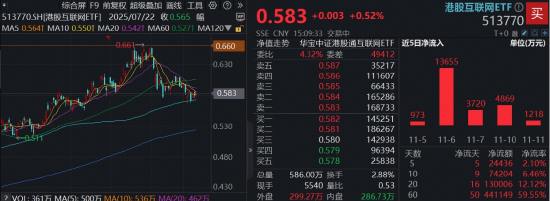
Core Viewpoint - The Hong Kong stock market showed a mixed performance with the Hang Seng Technology Index rising by 0.16%, driven by strong performances from companies like Xiaomi and Tencent, while Alibaba saw a decline of over 2% [1][3]. Group 1: Market Performance - The Hong Kong Internet ETF (513770) experienced a cumulative inflow of 742 million yuan over the past 10 days, with 9 out of 10 days seeing increased investment [3]. - Xiaomi's automotive business exceeded market expectations, with approximately 110,000 units delivered in Q3, indicating a potential shift to profitability [3]. - The overall market sentiment in November is driven by strong fundamentals, with growth-oriented assets in the Hong Kong market showing resilience [3]. Group 2: Upcoming Earnings Reports - Major internet companies are set to release their latest quarterly earnings, with expectations for Tencent's revenue and net profit to grow by 13%, reaching 188.6 billion yuan and 67.9 billion yuan respectively [3]. - Alibaba is projected to report a revenue of 38.52 billion yuan for the quarter, reflecting a year-on-year growth of 30.1%, supported by continued investment in its cloud services [3][4]. Group 3: ETF and Index Insights - The Hong Kong Internet ETF (513770) has a current scale exceeding 11.8 billion yuan, with an average daily trading volume of over 600 million yuan, indicating strong liquidity [7]. - The index that the ETF tracks has a lower valuation compared to other indices, with a price-to-earnings ratio of 24.44, which is significantly lower than the NASDAQ 100 and ChiNext [6]. - The top three holdings in the ETF are Alibaba (18.89%), Tencent (17.01%), and Xiaomi (10.05%), collectively accounting for over 73% of the total holdings [4][5].


科技核心资产月报:科技产业趋势仍在延续-20251110
Bank of China Securities· 2025-11-10 09:20
Group 1: AI Industry Chain - The AI industry chain is entering a period of adjustment, particularly with significant pressure on overseas computing power, but the long-term logic remains clear with a focus on storage chips, domestic computing power, and AI applications [2][9][21] - North American cloud service providers continue to show strong capital expenditure, with Q3 2025 spending reaching $1.67 billion for Microsoft, $2.40 billion for Google, $3.42 billion for Amazon, and $1.88 billion for Meta, reflecting a year-on-year growth of 75.08% [10][12] - The storage cycle is experiencing a steep price increase, with DDR4 1Gx8 3200MT/s chip prices rising by 9.86% week-on-week, and NAND flash wafer prices increasing by 15% to 20% [13][16] Group 2: AI Applications - AI applications are witnessing a reversal of previous difficulties, with significant growth in penetration rates and initial commercial success in vertical applications, as evidenced by a rise in monthly active users to 729 million for mobile AI applications [19][20] - Companies like 360 and Kingsoft have reported substantial increases in net profit growth rates, with 360's growth rising from 17.43% to 78.88% and Kingsoft's from 3.57% to 13.32% [19][20] - The overall performance of AI applications is improving, driven by the acceleration of application penetration and the successful commercialization of vertical applications [21] Group 3: Military Industry - The military industry continues to adjust, with October showing a slight easing in the extent of adjustments, ranking at the bottom among 28 industries in terms of growth [22][27] - The year 2025 marks the end of the "14th Five-Year Plan," while 2026 will begin the "15th Five-Year Plan," indicating potential acceleration in military orders [22] - Key military stocks have shown significant performance, with companies like *ST Dali and North China Long Dragon seeing growth rates of 34% and 31% respectively in October [27][30]
光模块回调蓄力,通信ETF(515880)跌超3.5%,资金逢低买入超20亿元
Mei Ri Jing Ji Xin Wen· 2025-11-10 03:23
Group 1 - The core viewpoint of the article highlights the ongoing pullback in optical modules and the decline of the communication ETF (515880) by over 3.5%, despite significant capital inflows of over 2.4 billion yuan in the past 10 days, bringing its total size to over 11.7 billion yuan, making it the largest in its category [1] - Tianfeng Securities expresses a strong outlook on investment opportunities within the core segments of the computing power industry chain, noting that overseas companies continue to show high demand related to AI, with their financial reports reflecting robust fundamentals [1] - The domestic market is expected to benefit from the continuous development of local computing power, with major companies like Alibaba and ByteDance investing heavily in AI, maintaining a positive outlook on the AI industry and the AIDC industry chain [1] Group 2 - Open Source Securities indicates that with the introduction of the "14th Five-Year Plan" recommendations, the focus on technological self-sufficiency is expected to make the domestic computing power sector a market focal point [1] - The communication ETF (515880) has nearly 50% allocation in optical modules, and the combined allocation of "optical modules + servers + optical fibers + copper connections" exceeds 75%, suggesting a strategic opportunity for investors interested in the core computing power engine [1]
港股科技公司三季报密集披露,资金提前蓄力恒生科技ETF
Xin Lang Cai Jing· 2025-11-10 03:08
Core Viewpoint - The Hong Kong stock market is entering a critical phase for the disclosure of Q3 earnings, with several leading technology companies set to announce their results, focusing on AI technology development and application [1] Group 1: Market Trends - The Hang Seng Technology ETF (513130) has seen a net inflow of 2.131 billion yuan from November 3 to November 7, making it the only ETF in the Hong Kong technology sector to exceed 2 billion yuan in net inflows during this period [1] - The latest scale of the Hang Seng Technology ETF (513130) has surpassed 42.573 billion yuan, with a total of 5.5189 billion shares [1] Group 2: Investment Insights - Huatai Securities indicates that while external disturbances may affect domestic investor sentiment, the sentiment in the Hong Kong market may have already been sufficiently released, suggesting a mid-term value in the technology sector [1] - The Hang Seng Technology Index, closely tracked by the Hang Seng Technology ETF (513130), includes 30 leading companies in the technology sector, with a current P/E ratio of 22.69, which is significantly lower than the Nasdaq's 41.46 and the Sci-Tech 50's 161.34, indicating a potential undervaluation [1] Group 3: Future Catalysts - As Q3 earnings reports from Hong Kong technology leaders are gradually disclosed, the development direction and execution progress of AI narratives are expected to be further confirmed, potentially leading to more catalytic events in the technology sector [1] - The Hang Seng Technology ETF (513130) is recognized as a key tool for investors looking to allocate resources in Hong Kong's technology sector, with over 220,000 account holders as of the latest mid-year report [1]
港股科技公司三季报密集披露,资金提前蓄力恒生科技ETF(513130)
Xin Lang Ji Jin· 2025-11-10 02:56
Core Insights - The Hong Kong stock market is entering a critical phase for the disclosure of Q3 earnings, with several leading technology companies set to announce their results, focusing on AI technology development and application [1] - The Hang Seng Tech ETF (513130) has seen significant capital inflow, indicating strong investor interest despite recent market corrections, with a net inflow of 2.131 billion yuan during the week of November 3 to November 7 [1] - The Hang Seng Tech ETF's latest scale exceeds 42.573 billion yuan, with 5.5189 billion shares outstanding, highlighting its popularity among investors [1] Industry Analysis - Huatai Securities emphasizes that while external disturbances may affect domestic investor sentiment, the Hong Kong market has already experienced sufficient emotional release, suggesting a mid-term value in tech investments [1] - The Chinese AI industry is developing at a different pace compared to the U.S., with ongoing support from the "14th Five-Year Plan" focusing on technological self-sufficiency as a long-term theme [1] - The Hang Seng Tech Index, which the ETF closely tracks, includes 30 leading companies across various sectors such as internet, media, software, automotive, and semiconductors, showcasing its comprehensive representation of the tech sector [1] Valuation Metrics - The latest price-to-earnings (P/E) ratio for the Hang Seng Tech ETF is 22.69, which is significantly lower than the Nasdaq's 41.46 and the STAR 50 Index's 161.34, indicating a potential undervaluation [1] - The ETF is recognized as a valuable tool for investors looking to gain exposure to core assets in the Hong Kong tech sector, supported by its large scale, favorable liquidity, and low fees [1] Investor Engagement - The Hang Seng Tech ETF has over 220,000 account holders as of the latest mid-term report, reflecting its acceptance among investors [1] - The ETF offers advantages such as T+0 trading and a variety of share classes for investors, enhancing its appeal as a strategic investment vehicle in the tech sector [1]
25Q3计算机板块基金持仓复盘
Guotou Securities· 2025-11-09 13:04
Investment Rating - The industry is rated as "Leading the Market - A" with a maintained rating [5]. Core Viewpoints - The report emphasizes that the allocation ratio for the computer sector is on the rise, indicating a favorable investment opportunity. The active management public funds' holding ratio for the computer industry reached 4.46% in Q3 2025, an increase of 1.93 percentage points from Q2 2025 and 2.24 percentage points from Q3 2024. The market capitalization of the computer industry accounts for 5.27% of the total A-share market, suggesting continued low allocation by funds [11][1][2]. Summary by Sections Fund Holdings - In Q3 2025, the top heavy holdings in the computer sector include AI computing power leaders such as Cambricon, Inspur Information, and Sugon, along with notable AI application stocks like Hikvision, Kingsoft Office, and iFlytek. Other significant holdings include financial IT companies and smart driving firms [2][14]. Investment Suggestions - The report continues to advocate for a strong embrace of the AI theme while also focusing on technology self-sufficiency and emerging industries. Key areas of interest include foundational software and electronic measurement instruments, as well as the quantum industry chain and satellite internet [2][16]. Market Performance - The report notes that the computer sector underperformed relative to the Shanghai Composite Index, with a relative decline of 3.16% in the past week. The overall performance of the computer sector was relatively weak, with a weekly decline of 2.08% [17][18][21].
存储芯片景气有望推动扩产,半导体设备ETF(159516)大涨3%
Sou Hu Cai Jing· 2025-11-06 05:47
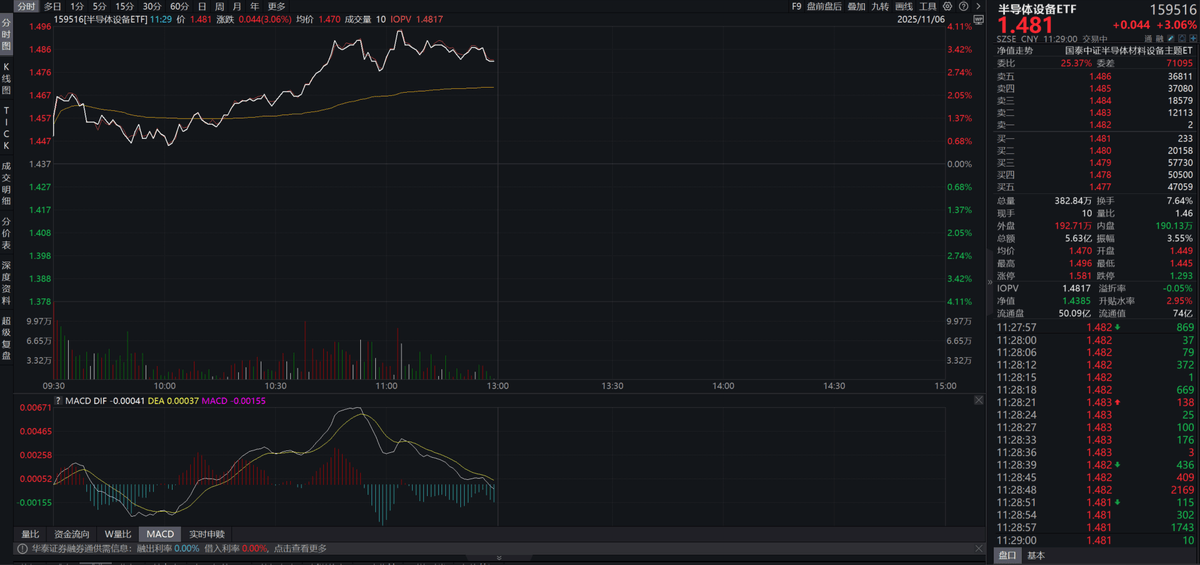
Group 1 - The semiconductor equipment ETF (159516) has seen a significant increase of over 3% on November 6, with a nearly 200% growth in shares since the beginning of the year, reaching a scale of over 7 billion yuan, ranking first among similar products [1][8] - AI servers are driving a new wave of innovation, significantly increasing storage requirements, which is leading to a surge in demand for NAND and DRAM applications in servers, becoming the core engine for global storage market growth [3] - Samsung has paused its October DDR5 DRAM contract pricing, prompting other manufacturers like SK Hynix and Micron to follow suit, resulting in a 25% increase in DDR5 spot prices within a week due to supply chain concerns [3] Group 2 - The "14th Five-Year Plan" emphasizes technological self-reliance, positioning the domestic computing power sector as a market focus, while also supporting the storage cycle and innovation in consumer electronics driven by the AI wave [4][5] - The importance of semiconductor equipment has increased amid intensifying geopolitical tensions, benefiting from both advanced process expansion and storage expansion, presenting investment opportunities in the semiconductor equipment ETF (159516) [6] - The semiconductor equipment ETF (159516) tracks the CSI Semiconductor Materials and Equipment Theme Index, effectively representing the fundamental progress in the equipment and materials sector [6]
中国银河证券:AI应用加速落地 国产软件加速突围
Zhi Tong Cai Jing· 2025-11-06 01:41
Group 1 - The overall performance of the AI sector in October showed a slight decline, with the AI sector index down by 2.28%, while the Shanghai Composite Index rose by 1.85% [1] - The trading volume for the AI sector in October reached 1,617.05 billion yuan, representing a year-on-year increase of 15.23% but a month-on-month decrease of 39.24% [1] - Significant differentiation was observed within the sector, with some core companies in AI applications, such as Kingsoft Office and Hehe Information, experiencing notable gains due to performance and policy catalysts [1] Group 2 - The "14th Five-Year Plan" emphasizes the importance of AI applications, aiming for widespread integration of AI across various sectors by 2027, with a target application penetration rate of over 70% for new intelligent terminals and agents [2] - Future industries such as quantum technology, biomanufacturing, hydrogen energy, nuclear fusion, brain-computer interfaces, embodied intelligence, and sixth-generation mobile communication are expected to become new economic growth points [2] Group 3 - The U.S. plans to impose export controls on key software to China, which may accelerate the domestic replacement of software in China, particularly in areas like EDA and CAD where there has been a historical reliance on imports [3] - The potential export controls could disrupt some companies in the short term, but the Chinese software industry is believed to have the capability to replace these imports, indicating a shift towards domestic software solutions [3]

开源证券2026年度策略会召开!全面解读2026年宏观大势和投资机会
Xin Lang Zheng Quan· 2025-11-05 05:45
Core Viewpoint - The 2026 Annual Strategy Conference of Kaiyuan Securities will focus on macroeconomic trends, the "14th Five-Year Plan" completion, and the "15th Five-Year Plan" initiation, emphasizing high-quality development and investment strategies in the capital market [1][3]. Group 1: Economic Outlook - The chairman of Kaiyuan Securities, Li Gang, highlighted that the "14th Five-Year Plan" has led to a resilient Chinese economy, with the capital market providing robust financial support for the transformation and upgrading of the real economy [3]. - The "15th Five-Year Plan" will prioritize high-level technological self-reliance, modern industrial system construction, and the development of new productive forces, expanding the significance of the capital market [3][4]. Group 2: Research and Services - Kaiyuan Securities aims to establish itself as a leading comprehensive financial service provider for small and medium-sized enterprises, focusing on market-oriented and legal development while preventing financial risks [4]. - The research department has developed a comprehensive research framework covering over 30 areas, enhancing its ability to support national strategies and the real economy [4][6]. Group 3: Macroeconomic Analysis - The chief macroeconomic analyst, He Ning, anticipates that the actual GDP target for 2026 will remain around 5%, with a more proactive macro policy and a potential expansion of the broad deficit scale [7]. - He emphasized the importance of achieving a new balance between supply and demand, with a focus on enhancing service supply and addressing excess capacity [8]. Group 4: Investment Strategy - The strategy chief analyst, Wei Jixing, indicated that the capital market will transition from "asset revaluation" to "profit recovery," predicting a "flat slow bull" market rather than a "sharp peak short bull" in 2026 [10][11]. - The focus on technology as a primary investment theme will continue, with an emphasis on domestic demand and consumption recovery as key drivers for market performance [9][12]. Group 5: Sector-Specific Insights - The fixed income chief analyst, Chen Xi, recommended a focus on short-term bonds, suggesting that the central bank's intentions will stabilize the liability side, while maintaining a neutral duration for long-term bonds [12]. - The conference will also feature discussions on various sectors, including AI computing, chips, humanoid robots, and new consumption trends, providing a comprehensive analysis of investment strategies across different fields [13].
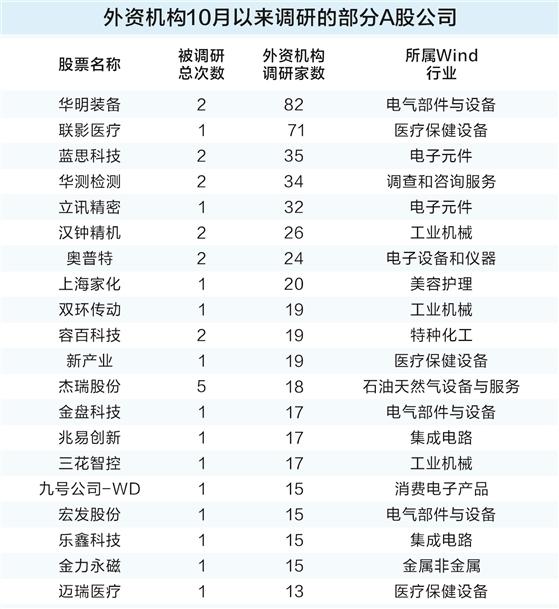
外资10月以来密集调研A股 覆盖309家公司 重视“含科”量
Zheng Quan Shi Bao· 2025-11-04 17:48
Group 1: Foreign Investment Focus - Since October, foreign institutions have conducted research on 309 A-share listed companies, primarily focusing on high-growth industries such as artificial intelligence, industrial automation, new energy, semiconductors, and consumer electronics [1][3] - Notably, 35 companies received attention from more than 10 foreign institutions, indicating a strong interest in companies like Huaming Equipment, United Imaging Healthcare, Lens Technology, and others [3] - Major foreign institutions involved in the research include Goldman Sachs, UBS, and Morgan Stanley, with Goldman Sachs alone researching over 50 A-share companies since October [5][6] Group 2: Company-Specific Insights - Huaming Equipment was the most researched company, with 82 foreign institutions focusing on its Q3 performance and future export orders [3][4] - United Imaging Healthcare attracted 71 foreign institutions, which were particularly interested in its performance in overseas markets and project deliveries [4] - Other companies like Lixun Precision, Han's Laser, and Jereh Group also received significant attention, reflecting a trend towards sectors like industrial machinery and medical equipment [1][3] Group 3: Economic Outlook and Policy Implications - Foreign institutions are optimistic about China's "14th Five-Year Plan," with Goldman Sachs raising its forecasts for China's export growth and GDP growth [2][6] - The focus on building a robust domestic market and enhancing advanced manufacturing capabilities is expected to positively impact A-shares, particularly in sectors related to self-sufficiency and emerging industries [6][7] - Goldman Sachs predicts that China's export volume will grow by 5% to 6% annually over the next few years, contributing to overall economic expansion [7]