美国梦

Search documents
民调显示美国人对“努力致富”失去信心!认为自己很有可能提高生活水平的受访者比例降至25%,创下自1987年有调查以来的最低
Ge Long Hui· 2025-09-02 05:20
Group 1 - The proportion of respondents who believe they are likely to improve their standard of living has dropped to 25%, the lowest since the survey began in 1987 [1] - Over three-quarters of respondents express a lack of confidence that the next generation will have a better life than their own [1] - Nearly 70% of participants believe that the "American Dream," defined as achieving success through hard work, is no longer attainable or never was, marking the highest percentage in 15 years [1] Group 2 - The survey indicates that Republicans are less pessimistic compared to Democrats, reflecting a long-term trend of differing economic outlooks based on the party in power [1]

00后,还有什么时代红利吗?
Hu Xiu· 2025-08-27 11:17
Group 1 - The article discusses the concept of "era dividends" and emphasizes that it is often equated with "development opportunities" [2][4] - It highlights the importance of survival in society before discussing development opportunities, indicating that one must consider the potential downsides of not seizing these opportunities [3][4] - The article reflects on the past, noting that while many believe there was more development space in previous decades, those times also had significant challenges [5][6] Group 2 - The article draws parallels between the experiences of young people in the 1950s America and the current generation in China, particularly the 00s, highlighting the disillusionment with traditional success paths [22][40] - It points out that the 00s generation faces a significant reduction in development space compared to previous generations, making upward mobility through personal effort increasingly difficult [42][43] - The article notes that the 00s generation is burdened with high expectations from their families, which adds to their stress despite living in a materially rich environment [24][26] Group 3 - The article discusses the rise of tutoring classes for the 00s generation, indicating that they spend significantly more time in extracurricular activities compared to previous generations [28][30] - It mentions the financial burden of these tutoring classes and the pressure from both parents and societal expectations, leading to a heavy academic load [30][31] - The article highlights the disconnect between educational achievements and job market realities, with many graduates struggling to find suitable employment despite their qualifications [31][35] Group 4 - The article suggests that the 00s generation is redefining their values and priorities, moving away from traditional paths of home ownership and marriage towards more personal fulfillment [45][50] - It notes that this generation is likely to influence various industries, particularly those related to leisure and lifestyle, as they prioritize experiences over material possessions [54][57] - The article concludes that while the era presents challenges, it also offers opportunities for the 00s generation to explore non-traditional life paths [58][63]

平等是真正的答案么?(下)
伍治坚证据主义· 2025-08-23 23:54
Core Argument - The article discusses the limitations of the theory of equality, suggesting that equality is more of a "luxury" in wealthy and secure societies rather than a universally applicable policy goal [2] Group 1: Historical Context - The United States, despite being the wealthiest and most secure country, is the most unequal among OECD countries, raising questions about the "American exception" [2] - Historical examples of countries that tolerated inequality for wealth include Britain during the Industrial Revolution, China post-reform, and the Roman Empire [3][4] Group 2: Cultural and Structural Factors - The American social contract is based on the promise of future wealth rather than equality, supporting the "American Dream" [5] - Cultural roots in the U.S. hinder the establishment of a redistributive social contract, making it difficult to adopt a Nordic model of equality [6][12] Group 3: Unique American Model - The U.S. model of inequality is sustainable only as long as it maintains its global leadership; other countries cannot easily replicate this model without facing strategic competition [7][8][11] - The U.S. can tolerate inequality due to its technological leadership and global dominance, which provides legitimacy to its system [9][13] Group 4: Lessons for Other Countries - Other nations should not mimic the U.S. model of inequality; instead, they should seek a balance between growth, innovation, and manageable inequality to ensure social stability [10][15]
原来美国那么多人流落街头是有原因的,因为美国有个叫房产税制度
Sou Hu Cai Jing· 2025-07-27 15:35
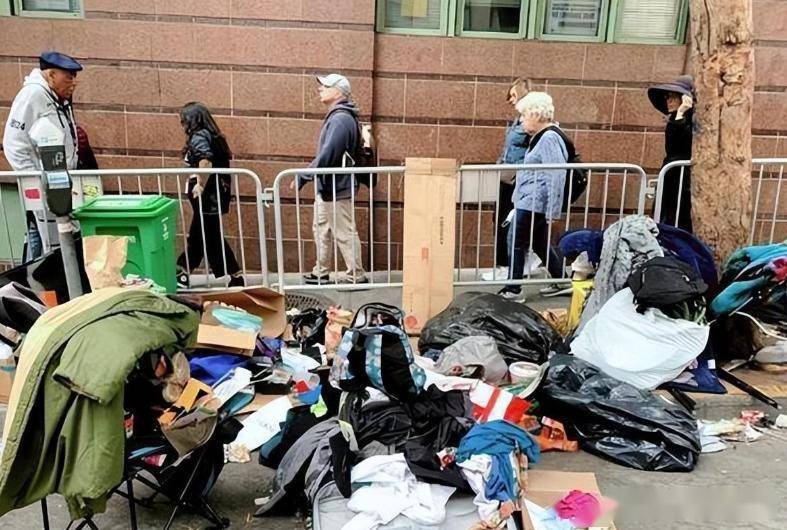
Core Viewpoint - The article highlights the alarming reality of homelessness in the U.S., particularly in California, where many individuals who once owned homes have found themselves living on the streets due to the burdens of property taxes and other financial pressures [3][9]. Group 1: Homelessness Statistics - Over 650,000 people are homeless in the U.S., with nearly 180,000 in California, accounting for about one-third of the national total [3][5]. - In Los Angeles, 23% of the homeless population lost stable housing within a year despite previously having stable jobs and homes [9]. Group 2: Property Tax Burden - Property taxes in the U.S. range from 1% to 1.5% annually, which can become a significant financial burden as property values increase [3][5]. - In 2023, the average home price in San Francisco was $1.44 million, leading to an annual property tax of approximately $18,000 at a 1.25% tax rate [5]. Group 3: Financial Pressures Beyond Property Taxes - Homeowners also face additional costs such as homeowners association fees, maintenance expenses, and high medical costs, with average annual medical spending exceeding $20,000 for American families [7]. - Rising mortgage interest rates, which reached over 7% for 30-year loans, further exacerbate financial strain on homeowners [7]. Group 4: Systemic Issues - The U.S. property tax system effectively transforms homeownership into a continuous financial obligation, where individuals must constantly pay to maintain their housing status [9][13]. - Many individuals, including those who once had stable lives, find themselves unable to cope with the cumulative financial pressures, leading to a cycle of debt and eventual homelessness [7][11].
2025美国最富有的移民:印度裔总人数登顶
Hu Xiu· 2025-07-15 00:32
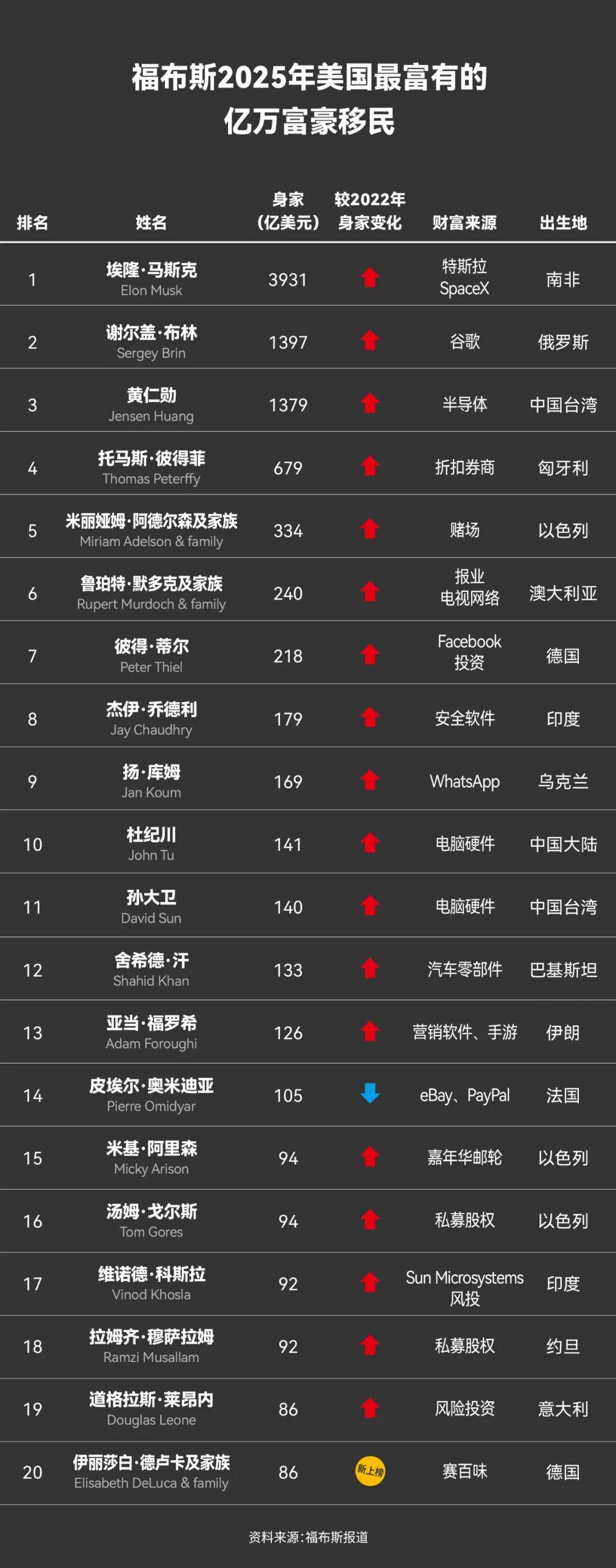
Group 1: Immigrant Billionaires in the U.S. - The number of immigrant billionaires in the U.S. has increased from 92 in 2022 to 125 in 2025, representing a growth of over one-third [2] - Immigrant billionaires account for 14% of nearly 900 billionaires in the U.S., with a total wealth of $1.3 trillion, which is 18% of the total wealth of $7.2 trillion held by all U.S. billionaires [2] - Among the top ten billionaires globally, three are immigrants, including Elon Musk, who is the richest with a net worth of $393.1 billion [3][4] Group 2: Notable Immigrant Billionaires - Elon Musk, born in South Africa, has a net worth of $393.1 billion, having increased by $17 billion since 2022 [4][15] - Sergey Brin, co-founder of Google, is the second richest immigrant with a net worth of $139.7 billion [4][15] - Jensen Huang, co-founder and CEO of Nvidia, ranks third among immigrant billionaires with a net worth of $137.9 billion [5][15] Group 3: Contributions and Perspectives of Immigrant Billionaires - Maky Zanganeh, an immigrant from Iran, emphasizes the importance of seeking opportunities while maintaining core values, which she believes is crucial for success in business [7][8] - Oren Zeev, an Israeli venture capitalist, attributes his success to his unique background, allowing him to think differently from his peers [10] - Noubar Afeyan, co-founder of Moderna, highlights the "immigrant mindset" as essential for achieving success in America, advocating for resilience and hard work [13][14]


巴菲特退休,美国梦不再
Hu Xiu· 2025-07-09 08:28
Group 1 - The article contrasts the American Dream as represented by Forrest Gump and Warren Buffett, highlighting the different paths to success for blue-collar and white-collar workers [1][3] - Buffett's retirement marks the end of an era for American capitalism, which has thrived for 70 years, paralleling the nation's economic journey [4][5] - The article discusses the dual nature of American capitalism, dividing it into the "Cathedral" (representing prosperity) and the "Casino" (representing risk and speculation) [7][10] Group 2 - The "Cathedral" symbolizes the dollar's global purchasing power, while the "Casino" encompasses various markets where investors gamble with their capital [8][9] - The interdependence of the Cathedral and Casino is crucial, with the former being the foundation for the latter's existence [10] - Buffett advocates for continued trade and prosperity, emphasizing that global prosperity benefits the U.S. economy [11] Group 3 - Dalio predicts a historic transformation in the global order, likening it to the changes of the 1930s, with significant implications for monetary, domestic, and international systems [12] - The U.S. national debt has reached alarming levels, exceeding 122% of the economy, raising concerns about sustainability [13][22] - Dalio warns that the U.S. must reduce its deficit to below 3% to avoid a potential economic crisis, while current policies may push it to 7.5% [20] Group 4 - The article highlights the growing political and social divisions in the U.S., which Dalio describes as akin to a civil war, threatening the stability that has historically attracted talent and investment [25][30] - The decline of the middle class due to manufacturing job losses and automation exacerbates wealth and opportunity gaps, leading to political fragmentation [31][30] Group 5 - The article discusses the challenges of globalization for U.S. capitalism, as other nations seek to prioritize their national interests, potentially disrupting supply chains [32][33] - The trade war with China is framed as a strategy to bring manufacturing back to the U.S., but the complexities of global supply chains make this difficult [34][39] - Japan and Europe are exploring ways to assert their financial independence from the U.S., indicating a shift in the global economic landscape [40][41][42] Group 6 - Buffett's recent actions, including significant stock sell-offs and increased cash reserves, suggest a cautious outlook on the future of American capitalism [46] - Dalio emphasizes the need for investors to consider inflation-resistant assets and maintain liquidity in light of geopolitical risks [47]
美国梦新写照:日均造就千名“平民富豪”
财富FORTUNE· 2025-07-03 12:55
Core Insights - The American dream of owning a large house with a white picket fence is fading for many, yet 379,000 new millionaires emerged in the U.S. last year, indicating a shift in wealth accumulation [1][2]. Group 1: Millionaire Growth - According to UBS, over 1,000 new millionaires are created daily in the U.S., with the ultra-high-net-worth population growing by 1.5% [2]. - The U.S. has the highest number of millionaires globally, four times that of China, and surpasses the combined total of millionaires in France, the UK, Germany, Canada, Japan, and Australia [3]. Group 2: Wealth Composition - The surge in millionaire numbers is primarily driven by real estate appreciation, alongside record performance in the stock market [4]. - The "middle-class millionaire" segment, defined as those with assets between $1 million and $5 million, is becoming the main growth driver, holding a total wealth of approximately $107 trillion, which is over four times that of the early 2000s [5]. - In the U.S., real estate and mortgages account for 30% of wealth, while securities and financial instruments make up 37%, highlighting the effectiveness of investment strategies [5]. Group 3: Future Wealth Transfer - An estimated $83 trillion in wealth will be transferred globally over the next 20 to 25 years, with $74 trillion expected to be passed down through generations, suggesting a continued rise in new millionaires [6]. Group 4: Economic Disparities - Despite the increase in millionaires, many Americans face economic challenges, with the top 20% of households holding an average net worth of $4.3 million, representing 71% of national wealth, while the bottom 50% average only $60,000 [7]. - Ordinary Americans are accumulating wealth through insurance and retirement plans, although younger generations have yet to fully embrace these methods [7]. Group 5: Real Estate Investment Advice - Real estate mogul Barbara Corcoran advises potential investors to act quickly in the current market, suggesting that a decrease in interest rates could lead to a surge in property prices [7].


川普欢迎中国留学生,我却想回国了
首席商业评论· 2025-06-15 04:00
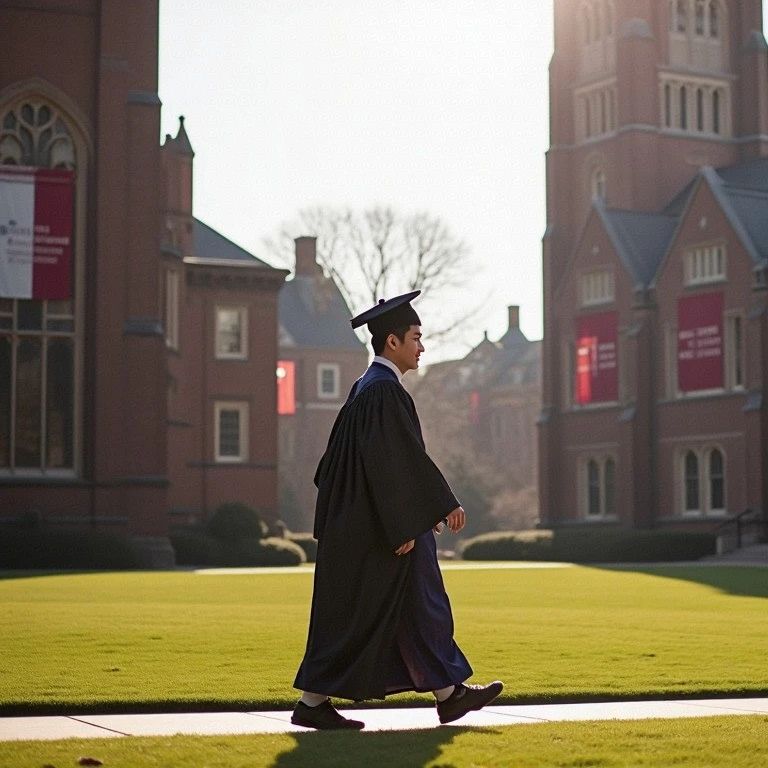
Core Viewpoint - The article discusses the drastic changes in the perception and reality of studying in the United States for Chinese students, highlighting a significant decline in student visa numbers and the challenges faced by those who remain in the U.S. [3][4][8] Group 1: Decline in Chinese Students in the U.S. - As of March this year, the number of Chinese student visas has dropped by 42.5% year-on-year, returning to levels seen a decade ago [4]. - Many students are leaving the U.S. due to a combination of disillusionment and sudden policy changes, with some feeling relieved to return home [3][5]. Group 2: Changing Perceptions of the American Dream - The once idealized view of the U.S. as a land of opportunity has shifted, with students now facing discrimination and job scarcity [8][9]. - The financial burden of studying in the U.S. has increased, with average costs for undergraduate education reaching over 1 million CNY for four years [17][18]. Group 3: Challenges Faced by International Students - International students report difficulties in integrating into American culture, with language barriers and social exclusion being common experiences [21][24][25]. - The political climate, particularly under Trump's administration, has led to increased scrutiny and anxiety among international students regarding their visa status [26][29][31]. Group 4: Employment and Visa Uncertainty - The process of obtaining work visas such as H-1B is fraught with uncertainty, with only a 1 in 3 chance of being selected in the lottery, and Chinese applicants facing even lower odds [39]. - Many students are struggling to secure employment that offers visa sponsorship, leading to a sense of instability and fear of returning to their home country without a degree [36][42][44]. Group 5: Economic and Social Implications - The article highlights the growing trend of students from middle-class families pursuing education abroad, indicating a shift towards a more widespread aspiration for the "American Dream" [18]. - The narrative concludes with a sense of nostalgia for a time when the U.S. was seen as a beacon of hope, contrasting it with the current challenges faced by international students [46][49].
川普欢迎中国留学生,我却想回国了
创业邦· 2025-06-14 12:56
Core Viewpoint - The article discusses the drastic changes in the perception and reality of studying in the United States for Chinese students, highlighting a significant decline in student visa numbers and the challenges faced by those who remain [3][8][10]. Group 1: Visa and Enrollment Trends - As of March this year, the number of Chinese student visas has plummeted by 42.5% year-on-year, returning to levels seen a decade ago [8]. - Many Chinese students are leaving the U.S., with reports indicating that half of a group of students have already "escaped" [7]. Group 2: Financial Burden of Studying in the U.S. - The average cost of studying in the U.S. is around 1 million CNY, with tuition fees for public universities ranging from 40,000 to 62,000 USD per year and private universities costing between 54,000 to 85,000 USD [30][76]. - The total cost for a four-year undergraduate program can reach between 1.04 million to 2.21 million CNY [30]. Group 3: Employment Challenges - Chinese students face significant difficulties in securing employment, with many unable to find jobs and living under the threat of discrimination and expulsion [10][66]. - The probability of obtaining an H-1B visa is only 1 in 3, with Chinese applicants making up just 11.7% of successful applicants, compared to 72.3% for Indian applicants [64]. Group 4: Changing Perceptions of the American Dream - The article reflects on how the American Dream has become less attainable, with many students feeling disillusioned as opportunities diminish and costs rise [74][77]. - The narrative of the U.S. as a land of opportunity is contrasted with the current reality where many students struggle to find jobs and face increasing financial pressures [10][75].

川普欢迎中国留学生,我却想回国了
虎嗅APP· 2025-06-14 09:25
Core Viewpoint - The article discusses the drastic changes in the perception and reality of studying in the United States for Chinese students, highlighting a significant decline in student visa numbers and the challenges faced by those who remain in the U.S. [4][8][41] Group 1: Visa and Enrollment Trends - As of March this year, the number of Chinese student visas has plummeted by 42.5% year-on-year, returning to levels seen a decade ago [4]. - Many Chinese students are choosing to leave the U.S., with reports indicating that half of a group of students have already "escaped" [4][41]. Group 2: Changing Perceptions of the American Dream - The once-promising image of the U.S. as a land of opportunity for students has shifted, with many now feeling marginalized and facing discrimination [8][41]. - The article reflects on the generational differences in perceptions of the U.S., with older generations still holding onto the "American Dream" while younger students are more skeptical [11][41]. Group 3: Financial Burden of Studying in the U.S. - The average cost of studying in the U.S. for Chinese students is around 1 million CNY, with expenses including tuition, living costs, and other fees [17][18]. - The financial strain is exacerbated by the increasing difficulty in securing stable employment post-graduation, leading to a sense of hopelessness among many students [41]. Group 4: Employment Challenges - The job market for international students has become increasingly competitive, with many facing difficulties in obtaining work visas and job offers [35][38]. - The approval rate for H-1B visas for Chinese applicants is significantly lower compared to Indian applicants, creating additional barriers for Chinese graduates [38]. Group 5: Cultural and Social Integration Issues - Many Chinese students report feeling isolated and struggling to integrate into American society, facing both language barriers and cultural differences [24][27]. - Experiences of discrimination and exclusion are common, with students feeling that they are not seen as equals by their peers [26][39].