马克思主义

Search documents
扎根三尺讲台 潜心铸魂育人(最美新时代革命军人风采)
Ren Min Ri Bao· 2025-07-31 22:22
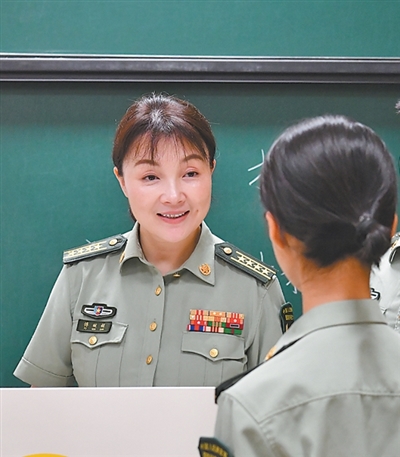
Core Insights - The article emphasizes the importance of effective teaching methods in military education, particularly in the context of political theory courses, to enhance the combat readiness of military personnel [1][2]. Group 1: Teaching Philosophy and Methods - The instructor, Fu Wanjun, advocates for a teaching approach that combines theoretical knowledge with practical application, aiming to produce results that genuinely enhance combat effectiveness [1]. - Fu employs interactive, exploratory, and on-site teaching methods to engage students and stimulate their critical thinking [1][2]. - She actively seeks to understand students' interests and concerns before each semester, ensuring that the curriculum is relevant and engaging [1]. Group 2: Team Collaboration and Course Development - Fu leads a team of over 20 political theory educators in intensive lesson preparation sessions, dedicating significant time to refining teaching materials and addressing challenging topics [4]. - The collaborative effort is described as a rigorous process, akin to a major examination, highlighting the commitment to high-quality education [4]. - Fu emphasizes the dual approach of providing both substantial content and teaching methodologies to empower fellow educators [4]. Group 3: Mentorship and Continuous Learning - Fu's mentorship extends beyond the classroom, as she provides guidance to former students who are now instructors in military units, ensuring they are well-prepared to teach complex subjects [4][5]. - The interaction between Fu and her mentees reflects a commitment to continuous improvement and knowledge sharing within the military education framework [4][5]. - Fu expresses a deep sense of fulfillment in her role as an educator, viewing the ability to inspire and guide students as a source of happiness [5].

深刻认识把握“坚持党的文化领导权”
Jing Ji Ri Bao· 2025-07-30 22:18
Group 1 - The core idea of the articles emphasizes the importance of the Party's cultural leadership as a fundamental aspect of Xi Jinping's cultural thought, which is crucial for the Party and the nation's future [2][7] - The Party's cultural leadership is defined as the leadership, management, and discourse power over ideological work, which shapes the direction and development of culture [3][5] - The necessity of maintaining the Party's cultural leadership is highlighted as essential for consolidating cultural subjectivity and ensuring the Party's guiding role in cultural construction [8][9] Group 2 - The articles discuss the significance of ideological leadership as the foundation for all forms of leadership, asserting that strong ideological appeal and cohesion are vital for the Party's success [4][6] - The Party's role in the cultural construction of socialism is characterized by its strong ideological influence, spiritual cohesion, and value appeal, which are necessary for guiding cultural development [5][6] - The need for continuous cultural innovation and the importance of aligning cultural development with the times and the people are emphasized, advocating for a balance between innovation and adherence to core socialist values [10]
人工智能时代,需要怎样的“好制度”?
Hu Xiu· 2025-07-25 02:26
Group 1 - The article discusses the evolution of economic thought regarding "good institutions," highlighting the shift from Keynesianism to neoliberalism and the implications of this shift on the understanding of capitalism and alternative models like the "Chinese model" [2][4][5] - The 2024 Nobel Prize in Economics was awarded to three American new institutional economists for their research on how institutions form and affect economic prosperity, sparking widespread debate in the domestic academic community [4][2] - The concept of "good institutions" is simplified to "efficient institutions," with historical perspectives from Adam Smith to Marx influencing the discourse on what constitutes a good institution [4][5][6] Group 2 - The article identifies three core questions surrounding the understanding of good institutions: what they are, what goals they should pursue, and how they come into existence [6][8][9] - New institutional economists argue that good institutions should be inclusive economic and political systems, a view that may not necessarily apply to non-Western contexts like China [9][10] - The article critiques the historical narratives constructed by new institutional economists, suggesting that their emphasis on property rights as the cornerstone of economic success overlooks other significant factors [12][13][14] Group 3 - The discussion extends to the challenges posed by artificial intelligence and technological advancements, which may exacerbate issues of unemployment and income distribution, echoing Keynes's concerns [20][27][28] - The article emphasizes the need for a re-evaluation of what constitutes a good institution in light of contemporary economic challenges, particularly regarding short-term issues like employment and income inequality [29][31][34] - It concludes that understanding good institutions requires a focus on both historical context and the evolving economic landscape, advocating for reforms that address the dual concerns of unemployment and inequitable distribution [30][32][34]

《共产党宣言》首版中文全译本展出
Su Zhou Ri Bao· 2025-07-02 00:25
Core Points - The first complete Chinese translation of "The Communist Manifesto," published in August 1920, is now on display at the former site of the Suzhou Independent Branch of the Communist Party of China [1][2] - This edition is a national first-class cultural relic, with only 12 copies known to exist, some of which are damaged or incomplete [1] - The displayed copy is a replica, with the original preserved in the Shaoxing Archives, noted for its good condition and verifiable provenance [1] Summary by Sections - **Historical Significance**: The 1920 translation by Chen Wangdao was published in Shanghai, marking a pivotal moment in the spread of Marxist ideology in China [1] - **Key Figures**: Ye Tiandi, a founder of the Shanghai Socialist Youth League, cherished this copy and used it for Marxist promotion in his hometown after returning due to illness [2] - **Preservation Journey**: The copy was passed down through generations, eventually being handed over to the Party organization in 1991, highlighting its historical importance [2] - **Current Status**: The original is housed in the special collection of the Shaoxing Archives, while the displayed items are replicas authorized for exhibition [2]
纪事|1921年7月,风雨南湖,那一船人
Bei Jing Ri Bao Ke Hu Duan· 2025-07-01 04:41
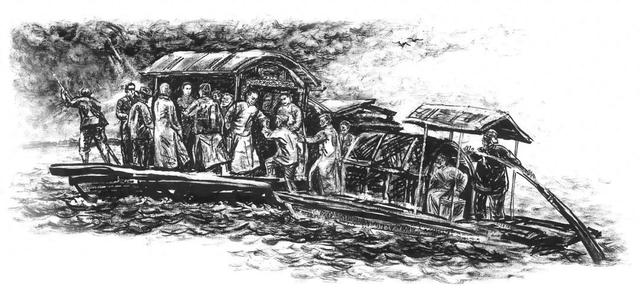
Core Points - The article reflects on the historical significance of the founding of the Chinese Communist Party (CCP) and the choices made by its early members, emphasizing the party's journey from a small group to a major political force in China [1][3][27] Group 1: Historical Context - In 1921, China was at a crossroads, with various ideologies competing for influence among intellectuals, leading to confusion about the country's future [3] - The founding of the CCP on July 23, 1921, involved 13 representatives, marking the beginning of a political movement that would drastically change China [3][28] Group 2: Key Figures - Mao Zedong and He Shuheng were among the early members who traveled to Shanghai to attend the first party congress, which was a pivotal moment in their political careers [5][21] - Li Dazhao and Chen Duxiu were significant figures in the early days of the CCP, with Duxiu being a prominent leader despite not attending the first congress [11][12] Group 3: The First Congress - The first congress was held in a secretive manner at Li Hanjun's residence, where the party's foundational documents were drafted [28][34] - The congress faced internal debates regarding the party's direction, including whether to engage in revolutionary activities or focus on theoretical studies [29][30] Group 4: Outcomes and Legacy - The congress concluded with the election of Chen Duxiu as the party's first general secretary, setting the stage for the CCP's future direction [34] - The early members of the CCP faced various fates, with some later leaving the party or becoming adversaries, illustrating the tumultuous nature of political allegiance during that era [35][36][38]
经济日报社论:永葆党的旺盛生机与活力
Jing Ji Ri Bao· 2025-06-30 23:59
Core Points - The article emphasizes the significance of the Communist Party of China (CPC) in shaping modern China and its historical achievements [1][2] - It highlights the CPC's commitment to self-revolution and maintaining close ties with the people, which has been crucial for its leadership and unity [2][3] - The article discusses the importance of adhering to Marxism and the CPC's ideological foundation to ensure continued progress in the modernization of China [3][4] Summary by Sections Historical Context - The CPC has been integral to the establishment of New China and the happiness of the Chinese people over the past century [2] - The party has navigated various challenges while maintaining its historical initiative and focus on national rejuvenation [2] Ideological Foundation - The belief in Marxism and socialism is described as the political soul of the CPC, essential for its strength and practical effectiveness [3] - The article stresses the need for continuous ideological education and adherence to Xi Jinping's thoughts on socialism with Chinese characteristics [3] Future Directions - The CPC aims to maintain strategic determination and adapt to changing global circumstances to advance Chinese-style modernization [2][3] - The focus is on ensuring the party's strength and unity to achieve new victories in the ongoing historical struggle [2][3]
经典常谈 | 坚持守正和创新相统一
Zhong Yang Ji Wei Guo Jia Jian Wei Wang Zhan· 2025-06-24 00:43
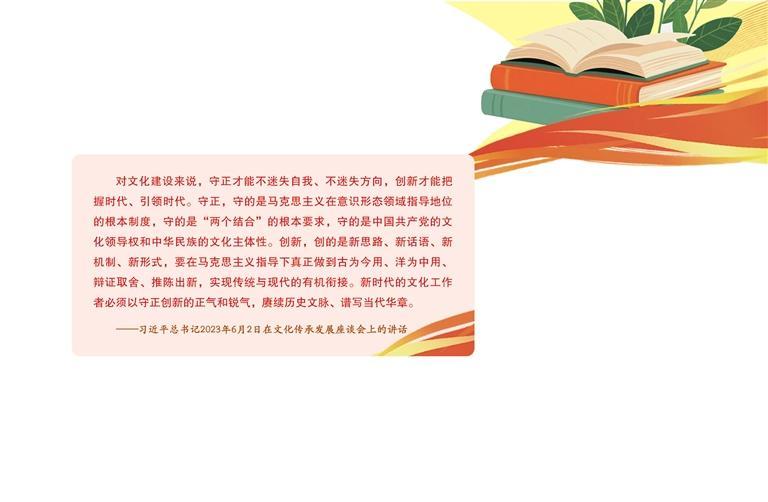
Group 1 - The core idea emphasizes the importance of adapting Marx and Engels' principles to contemporary historical conditions, highlighting the need for scientific theories to align with specific situations [1] - Marx and Engels' early influences stemmed from German classical philosophy, British classical political economy, and French utopian socialism, which they critically inherited and developed [2] - The concept of dialectical materialism was created by Marx as a response to the limitations of previous philosophies, aiming to achieve the goal of "changing the world" [2] Group 2 - Marx and Engels believed that history progresses through a combination of maintaining established principles and innovating, as seen in their works that reflect the necessity of adapting to changing conditions [3] - The inherent unity of maintaining and innovating is evident in Marx's writings, where he critiques capitalism and argues for the inevitable victory of communism based on historical trends [4] - The realization of any theory depends on its relevance to a country's specific needs and cultural context, which has been a guiding principle for the party's development of Marxism over the past century [5] Group 3 - The essence of Marxism is its capacity for continuous development and self-improvement, as it is not a static doctrine but an evolving theoretical framework [6] - The commitment to both maintaining core principles and pursuing innovation is crucial for guiding new practices and achieving breakthroughs in various fields [6]
“系列全球倡议彰显中国的天下情怀”——访约旦共产党总书记法赫米·哈图特
人民网-国际频道 原创稿· 2025-06-23 05:30
Core Viewpoint - The success of China's development represents the rise of a new force on the world stage, inspiring developing countries to seek their own development paths [2] Group 1: China's Development Achievements - Under the leadership of the Communist Party of China, 800 million people have been lifted out of poverty, achieving the UN's 2030 sustainable development goal a decade early, significantly accelerating global poverty reduction [2] - China has made continuous achievements in industrial manufacturing and technological innovation, maintaining stable economic growth over the long term [4] Group 2: Global Initiatives and Cooperation - The global development initiative promotes inclusive growth, the global security initiative advocates for dialogue to resolve differences, and the global civilization initiative emphasizes harmony among different civilizations, reflecting China's commitment to global development [4] - China contributes to global governance through platforms like the BRICS cooperation mechanism and the Asian Infrastructure Investment Bank, assisting developing countries in achieving their development goals [4] Group 3: Jordan's Perspective and Cooperation with China - Jordan faces multiple challenges in security and economic development, and the Jordanian Communist Party aims to unite more people to safeguard national interests and achieve economic independence [5] - Jordan has signed cooperation documents for the Belt and Road Initiative with China, seeking to enhance trade, particularly in chemical products, and welcomes more Chinese investments [5] - Arab countries view China as a reliable partner, appreciating its principles of mutual respect and win-win cooperation, which provide a model for economic independence and transformation [5]

淬炼自我革命锐利思想武器
Zhong Yang Ji Wei Guo Jia Jian Wei Wang Zhan· 2025-06-12 00:50
Group 1 - The core viewpoint emphasizes the importance of ideological construction as a fundamental aspect of the Party's comprehensive strict governance [1][7] - The advanced nature of Marxist parties is rooted in their theoretical superiority, which is guided by scientific theories such as Marxism [2][4] - The Chinese Communist Party (CCP) demonstrates strong practical capabilities under the guidance of advanced ideological theories, maintaining a focus on the people's interests [3][5] Group 2 - The CCP has consistently prioritized ideological construction and theoretical strengthening since its establishment, which has been crucial for its historical mission [5][6] - Xi Jinping highlights that the Party's emphasis on ideological construction and theoretical strengthening has been a key reason for its resilience and growth [7][8] - The establishment of a solid theoretical foundation is essential for the comprehensive strict governance of the Party, serving as a support for its various constructions [8][9] Group 3 - The scientific theories provide a value orientation and methodological foundation for the comprehensive strict governance of the Party, emphasizing a people-centered approach [9][10] - The integration of dialectical materialism and historical materialism into the Party's construction efforts is vital for addressing current challenges and ensuring long-term effectiveness [10]
讲出真理的甘甜味
Ren Min Ri Bao· 2025-06-11 08:19
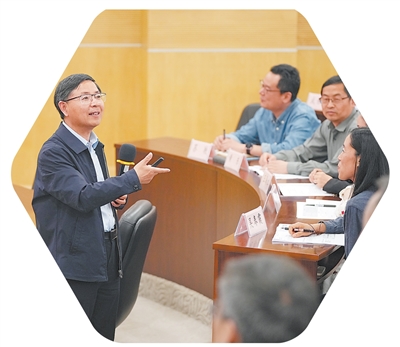
王公龙正在给学员上课。 王公龙(左一)与马克思主义学院教师集体备课。 以上图片均为受访者提供 上海洋山深水港。 王潇珩摄(影像中国) "党校教学要有5层境界:第一层是品德,弘扬正能量,提振精气神;之后依次是信息、知识、思考、方 法。" "一堂高品质理论课,结尾应该收在科学方法,对当下现实有指导性。" ………… 近日,在一堂面向上海党校(行政学院)系统青年教师的教学竞赛培训班上,上海市委党校(上海行政 学院)马克思主义学院院长、教授王公龙将20多年来讲授理论课的经验与心得娓娓道来。 "对我而言,马克思主义是信仰,也是方法。"王公龙说。 因为是信仰,所以"确信自己所做的是正确的事,有一种价值感";因为是方法,所以"能够在快速变化 的世界里把握自己的人生,有一种确定感"。 从事党校教学27年,王公龙一直孜孜以求的,就是把这份真理的甘甜味,让前来听课的干部学员领悟 到,让更多人感受到。 "做有信仰的人,讲课才有人信" 时隔多年,王公龙仍对刚上讲台时的忐忑记忆犹新。 "最怕学员提问,一提问就紧张,那种场景有时甚至会出现在梦中。"那时候,王公龙讲《共产党宣 言》,学员评分并不理想。 怎么办?研读原著。"必须把《共产党宣言 ...