AI算力基建

Search documents
能源转型叠加AI驱动,周期反转步入繁荣期 | 投研报告
Zhong Guo Neng Yuan Wang· 2025-12-24 02:02
Core Viewpoint - The global energy storage industry is entering a new growth cycle, with an expected addition of 438 GWh of new installations by 2026, representing a 62% year-on-year increase. The growth drivers have shifted from solely renewable energy consumption to a combination of "AI computing infrastructure, energy transition needs, and grid congestion" [1][2]. Group 1: Global Market Insights - The global energy storage market is expected to see significant improvements in supply-demand dynamics, transitioning from a destocking phase to a replenishment boom, with some segments of the supply chain experiencing simultaneous increases in volume and price [2]. - In China, the expected installation for 2026 is 250 GWh, a 67% increase year-on-year, with policies shifting from "strong allocation" to "profitability" [2]. - In the United States, the anticipated installation for 2026 is 70 GWh, a 35% increase year-on-year, driven by AI-related demand [2]. - In Europe, the expected installation for 2026 is 51 GWh, a 55% increase year-on-year, with long-term contracts locking in gigawatt-level demand [2]. - Emerging markets are projected to install 67 GWh in 2026, a 91% increase year-on-year, with significant growth in Australia, the Middle East, and Chile [2]. Group 2: Technological and Structural Changes - Energy storage is evolving from merely providing backup power to actively supplying electricity, addressing voltage fluctuations, and becoming a strategic infrastructure for AI data centers [3]. - The mismatch between rapid renewable energy generation and slow grid development is intensifying, making energy storage the only immediate solution to grid congestion [3]. - The U.S. is tightening regulations on supply chains, which will favor companies with localized production capabilities, enhancing their pricing power [3]. Group 3: Lithium Battery Supply and Demand - The lithium battery supply is expected to recover in 2026 after a two-year destocking phase, driven by sustained high demand from AI and energy storage, while supply growth slows due to reduced capital expenditures [3]. - The industry is shifting from price wars to collaborative pricing strategies, leading to a recovery in prices and a redistribution of profits towards upstream materials with high barriers to entry [3]. Group 4: Emerging Technologies - The trend towards solid-state batteries is becoming clearer, with expectations for small-scale production by 2026 and advancements in various battery technologies [4]. Group 5: Investment Recommendations - Investment focus should be on midstream materials experiencing supply-demand reversals, particularly lithium fluoride, lithium carbonate, separators, and electrolyte additives [5]. - Companies with localized manufacturing capabilities and strong ESG frameworks, such as CATL and Sungrow, are recommended for their ability to capture high-profit markets while mitigating tariff risks [5]. - Firms that can integrate solar storage and microgrid solutions into overseas data center supply chains, such as Sungrow and Aters, are also recommended [5]. - Attention should be given to core materials and equipment for solid-state batteries, including lithium anodes and dry-process technologies [5].
领益智造接待107家机构调研,包括睿远基金、光大证券、华泰证券、恒大人寿保险有限公司等
Jin Rong Jie· 2025-12-23 12:05
Core Viewpoint - Linyih Intelligent Manufacturing is focusing on acquiring core technologies and customer resources in the server thermal management sector through its acquisition of Limin Da, as the demand for liquid cooling technology in data centers is increasing due to rising power consumption of enterprise-level commercial server chips and stricter energy efficiency regulations globally [1][2]. Company Summary - Linyih Intelligent Manufacturing (002600) has a current stock price of 15.52 yuan, down 0.43 yuan or 2.70% from the previous trading day, with a total market capitalization of 113.39 billion yuan [1]. - The company ranks 38th in the consumer electronics industry with a rolling price-to-earnings ratio of 49.63, compared to the industry average of 48.15 and median of 50.30 [1]. - As of September 30, 2025, Linyih Intelligent Manufacturing had 539,120 shareholders, an increase of 243,778 from the last count, with an average holding value of 210,300 yuan and an average holding of 13,600 shares per shareholder [3]. Industry Summary - The global capital investment in data centers is expected to grow from approximately 450 billion USD in 2024 to over 3 trillion USD by 2030, driven by the opportunities presented by AI computing infrastructure [2]. - The global market for high-precision thermal management hardware for enterprise-level commercial servers is projected to increase from 200 million USD in 2020 to 4.5 billion USD by 2024, and is expected to reach 33 billion USD by 2029 [2]. - Traditional air cooling solutions are becoming inadequate for thermal management, leading to an accelerated adoption of liquid cooling technologies in data centers [2].


735亿美元市场,散户如何分一杯羹?
Sou Hu Cai Jing· 2025-12-11 07:18
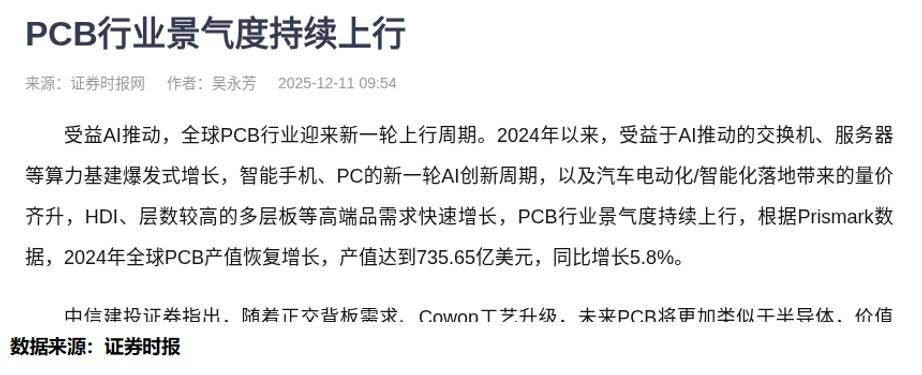
Group 1 - The PCB industry is expected to recover with a projected global output value of $73.565 billion, driven by advancements in AI computing infrastructure, consumer electronics innovation, and automotive intelligence [3] - The industry is anticipated to increasingly resemble the semiconductor sector, with a continuous increase in value [3] - There is a disconnect between market sentiment and the underlying data, highlighting the importance of recognizing market trends and potential risks [4] Group 2 - The current market phase is characterized by volatility, with only 20% of stocks expected to continue rising, while many investors may lose their positions during fluctuations [8] - Historical patterns indicate that the current market is in a second phase of differentiation, following a previous phase of valuation recovery [6] - Quantitative data reveals that significant market movements are often accompanied by institutional "inventory" and "recovery momentum," indicating potential market manipulation [13] Group 3 - Traditional methods of stock selection in the PCB sector may lead to misjudgments, emphasizing the need for a quantitative approach to understand fund behavior [11] - The disparity in institutional participation among different PCB stocks illustrates the essence of market differentiation [19] - Investors are encouraged to adopt a new cognitive framework, focusing on understanding fund language and accepting imperfect conditions in stock performance [20] Group 4 - The industry is projected to grow by 5.8%, prompting the need to identify companies that can outperform the average and those that may be eliminated from the market [21]

洁净室工程投资机会解读
2025-12-08 00:41
Cleanroom Engineering Investment Opportunity Summary Industry Overview - The cleanroom engineering sector is experiencing explosive demand driven by the surge in AI computing power requirements, particularly in advanced process chips, advanced packaging, PCB, and server assembly fields. Data center investments are expected to grow significantly in the coming years [1][2] - The decoupling between China and the US is accelerating capacity transfer, with Taiwanese enterprises relocating to Southeast Asia, further stimulating cleanroom engineering demand, especially in emerging markets like the US and Southeast Asia, which are facing severe labor shortages [1][2] Key Insights and Arguments - Cleanroom investment density per unit area is increasing as production precision requirements rise. The demand for cleanroom construction is driven by risk aversion due to US-China decoupling and the need for AI computing power [1][5] - The electronics industry is the primary contributor to cleanroom demand, accounting for 70%-80%. In capital expenditures for chip wafer fabs, engineering costs represent 20%, with cleanroom systems making up 60% of that [1][7] - The cleanroom industry has high barriers to entry due to complex technology and high customization, leading to deep binding relationships between clients and service providers. Taiwanese service providers are benefiting from the trend of overseas factory construction [1][10] Market Dynamics - The cleanroom engineering sector has shown strong performance this year, driven by changes in both demand and supply. The global demand for AI infrastructure has surged, leading to significant growth in cleanroom engineering [3][4] - The US and Southeast Asia cleanroom markets are in a developing phase, facing severe labor shortages, which has allowed engineering service providers to increase their prices and improve profit margins [4][14] - Despite significant price increases in major stocks, there remains investment potential due to the ongoing demand for higher production cleanliness and the need for new capacity construction driven by AI computing and supply chain security [5][18] Future Growth Sources - The macro trend indicates that smaller process nodes correspond to higher production precision requirements, leading to increased investment density per unit area. The two main short- to medium-term drivers are risk aversion and AI computing demand [8] - The semiconductor self-sufficiency rate in mainland China has room for improvement, and the ongoing relocation of foreign capital will continue to drive market growth. For instance, the cleanroom construction market in mainland China is approximately 50 billion yuan, with potential investments of about 900 billion yuan if Taiwanese companies fully relocate to Southeast Asia [5][8] Competitive Landscape - The cleanroom engineering market can be divided into three tiers, with the first tier serving chip packaging, PCB, precision manufacturing, and data centers. The competition is intense, especially in mainland China, which is transitioning from an emerging to a mature market [11][12] - Key players in the cleanroom engineering sector include Shenghui Integration and Yaxiang Integration, which are positioned to benefit from orders related to factory construction in the US and Southeast Asia [10][15] Investment Recommendations - Focus on companies that can enter emerging markets like the US and Southeast Asia. Shenghui Integration and Yaxiang Integration are highlighted as key investment targets due to their shared technology and customer resources with their Taiwanese parent companies [15][16] - Shenghui Integration is expected to see significant revenue growth starting in 2026, while Yaxiang Integration has already secured multiple major orders and is expanding its business into Southeast Asia [16][18]
暴涨3倍,光模块背后大赢家
Ge Long Hui· 2025-12-06 12:31
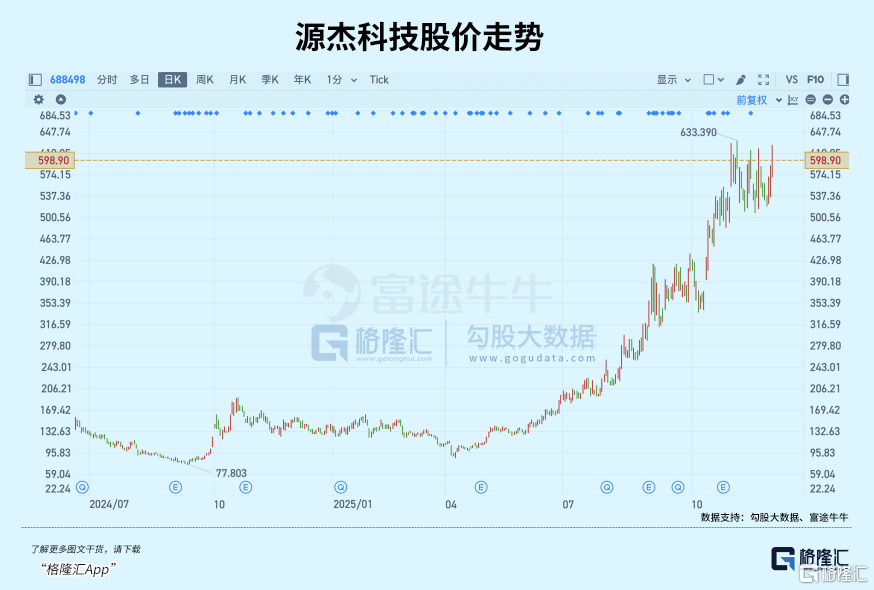
Core Viewpoint - The stock price of Yuanjie Technology has shown exceptional performance in 2025, reaching a peak of 633.39 yuan, marking a year-to-date increase of 348%, surpassing its downstream major client, Zhongji Xuchuang [2][3]. Group 1: Financial Performance - In the first three quarters of 2025, the company's revenue reached 383 million yuan, a year-on-year increase of 115.09%, while net profit attributable to shareholders was 106 million yuan, up 19,348.65% [7]. - The gross margin improved to 54.76%, an increase of 33.42 percentage points year-on-year, primarily due to the growth of high-margin data center products [7]. Group 2: Market Trends and Technology - The demand for AI computing is driving a transformation in interconnect technology, with a shift from traditional copper interconnects to more integrated optical solutions like Co-Packaged Optics (CPO) [12][15]. - The penetration rate of silicon photonics technology in optical modules is expected to rise from 34% in 2023 to 52% by 2029, with the global market for silicon photonics modules in data centers exceeding $3 billion by 2029 [21]. Group 3: Competitive Landscape - The domestic market for 50G and above EML chips is largely dominated by leading companies from the US and Japan, with a localization rate of less than 20% [26]. - Yuanjie Technology's high-end products, such as the 100G EML and CW laser sources, are positioned to benefit from the growing AI market, with significant orders already received [26][33]. Group 4: Strategic Positioning - Since its listing on the Sci-Tech Innovation Board in 2022, Yuanjie Technology has been transitioning from the telecom market to the AI-driven data center market, with data center revenue surpassing telecom revenue for the first time, reaching 51.04% [30]. - The company's vertical integration manufacturing (IDM) model allows for better control over product performance and expansion into overseas markets [28][32]. Group 5: Future Outlook - The company is focusing on increasing its market share in the data center sector, with significant growth in construction projects and new orders indicating a positive trend [33]. - The development of the 200G EML chip is crucial for the company to seize opportunities in the upcoming 1.6T era [35].
“国产GPU第一股”来了,市值突破3000亿
3 6 Ke· 2025-12-05 04:12
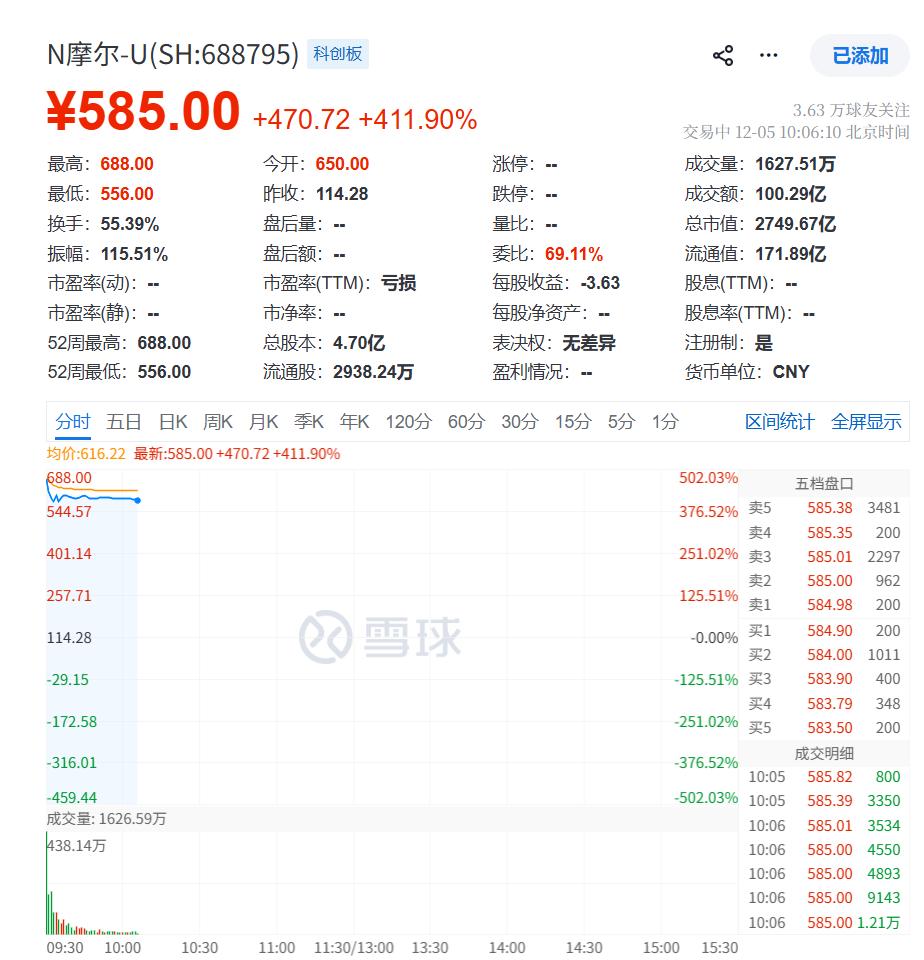
Core Viewpoint - Moore Threads has officially listed on the Science and Technology Innovation Board, becoming the first domestic GPU stock, with a significant market response on its debut, achieving a market capitalization of approximately 305.5 billion yuan at opening [1][2]. Group 1: IPO Highlights - The IPO process for Moore Threads took only 88 days from acceptance to approval, setting multiple records [2]. - The company issued 29,382,386 new shares, raising a net amount of 8 billion yuan, marking the largest IPO scale on the Science and Technology Innovation Board in nearly two years [2]. - The initial offering price was 114.28 yuan per share, resulting in a 2024 diluted static price-to-sales ratio of 122.51 times, which is higher than the industry average but lower than Cambricon's 478.25 times [2]. Group 2: Company Background - Founded in 2020, Moore Threads is led by Zhang Jianzhong, a former NVIDIA executive who significantly increased NVIDIA's market share in China [3][4]. - The company aims to develop domestic GPUs to support AI infrastructure, with a goal of achieving profitability by 2027 [2][11][15]. - Moore Threads has built a strong team by recruiting core engineers from major tech companies like NVIDIA, Intel, AMD, and Microsoft [5]. Group 3: Product Development and Market Position - The company has developed a comprehensive product matrix, including four generations of GPUs, targeting various applications such as AI computing, high-performance computing, and gaming [12]. - Moore Threads' self-developed MUSA architecture allows developers to use a unified development environment across its GPU series, indicating a focus on creating a proprietary computing platform [6]. - The company is currently positioned primarily for domestic market replacement, competing directly with NVIDIA [7]. Group 4: Financial Performance - Moore Threads has shown a trend of increasing revenue, with reported revenues of 46.08 million yuan in 2022, 124 million yuan in 2023, and projected revenues of 438 million yuan in 2024 [12]. - Despite the revenue growth, the company has also reported significant net losses, which are gradually narrowing, with losses of 1.894 billion yuan in 2022 and 1.703 billion yuan in 2023 [12][14]. - The company has committed to substantial R&D investments, with expenditures of 1.116 billion yuan in 2022 and 1.334 billion yuan in 2023, representing a high ratio of R&D costs to revenue [11].
半导体设备ETF(159516)涨超2.7%,行业需求复苏与存储涨价成焦点
Mei Ri Jing Ji Xin Wen· 2025-11-28 02:49
Core Viewpoint - The continuous rise in storage prices is primarily driven by the demand from large tech companies for computing power infrastructure in the AI era, with price increases for general DRAM in Q4 2025 adjusted from 8-13% to 18-23% [1] Group 1: Storage Price Impact - The increase in storage prices is expected to pressure the consumer electronics sector, with anticipated overall smartphone costs rising by 5-7% and the cost of notebook storage exceeding 20% of total costs [1] - The expansion of storage manufacturers is showing structural differentiation, with Samsung and SK Hynix accelerating the construction of 1c DRAM capacity, potentially leading to tighter supply-demand conditions for consumer-grade storage [1] Group 2: Opportunities for Domestic Manufacturers - The rise in storage prices creates a favorable environment for domestic storage manufacturers to expand production, benefiting both original manufacturers and related semiconductor equipment suppliers [1] - The semiconductor equipment ETF (159516) tracks the semiconductor materials and equipment index (931743), focusing on key upstream materials and equipment in the semiconductor industry, reflecting the overall performance of this high-tech barrier segment [1]
半导体设备ETF(159516)涨超1.1%,行业需求复苏与存储涨价受关注
Mei Ri Jing Ji Xin Wen· 2025-11-27 04:34
Group 1 - The core viewpoint of the article highlights the continuous rise in storage prices, with TrendForce adjusting the price increase forecast for general DRAM in Q4 2025 from 8%-13% to 18%-23% [1] - The demand for storage chips is primarily driven by large technology companies building computational infrastructure in the AI era, indicating strong sustainability in demand [1] - The significant increase in storage prices is putting pressure on the consumer electronics sector, with TrendForce predicting a 5%-7% rise in overall smartphone costs next year, and the cost share of notebook storage exceeding 20% [1] Group 2 - There is a differentiation in the expansion structure of storage manufacturers, with Samsung and SK Hynix accelerating the construction of 1c DRAM capacity, potentially leading to tighter supply and demand for consumer-grade storage [1] - The rise in storage prices provides a favorable environment for domestic storage manufacturers to expand production, benefiting both original manufacturers and related semiconductor equipment suppliers [1] - The semiconductor equipment ETF (159516) tracks the semiconductor materials and equipment index (931743), focusing on the upstream materials and equipment sectors of the semiconductor industry, reflecting the overall performance of the foundational support segments of the semiconductor industry [1]
消电ETF(561310)涨超2.9%,电子行业需求复苏与存储涨价受关注
Mei Ri Jing Ji Xin Wen· 2025-11-26 06:08
Core Viewpoint - The continuous rise in storage prices is driven by demand from large tech companies for AI infrastructure, with significant implications for the consumer electronics sector [1] Group 1: Storage Price Trends - TrendForce has revised the price increase forecast for general DRAM in Q4 2025 from 8%-13% to 18%-23% [1] - The demand for storage chips is expected to remain strong due to AI-related infrastructure investments by major technology firms [1] Group 2: Impact on Consumer Electronics - The increase in storage prices may pressure the consumer electronics segment, with an anticipated rise in smartphone costs by 5%-7% next year [1] - The cost share of storage in laptops is projected to exceed 20% [1] Group 3: Market Dynamics - There is a divergence in the expansion strategies of storage manufacturers, with Samsung and SK Hynix accelerating the construction of 1c DRAM capacity, potentially tightening supply for consumer-grade storage [1] - The rise in storage prices creates a favorable environment for domestic storage manufacturers to expand production, benefiting original manufacturers and related semiconductor equipment suppliers [1] Group 4: ETF Insights - The Consumer Electronics ETF (561310) tracks the Consumer Electronics Index (931494), which includes publicly traded companies involved in the design, production, and sales of consumer electronics such as smartphones, home appliances, and wearable devices [1]
盘中一度跌停,工业富联回应网络传言:相关言论不属实
Nan Fang Du Shi Bao· 2025-11-24 14:45
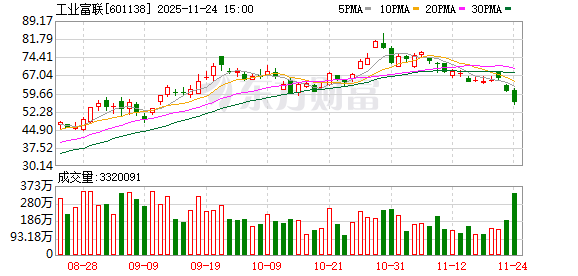
Core Viewpoint - Industrial Fulian's stock price experienced a significant decline due to unfounded rumors regarding its fourth-quarter performance, which the company has officially denied, affirming that its operations and customer demand remain strong [2][3]. Financial Performance - For the first three quarters of the year, Industrial Fulian reported a revenue of 603.93 billion yuan, representing a year-on-year growth of 38.40%, and a net profit attributable to shareholders of 22.49 billion yuan, up 48.52% year-on-year [3]. - The cloud computing segment saw a revenue increase of over 65% year-on-year, driven by the demand for AI cabinet products, with a third-quarter growth exceeding 75% [3]. - The cloud service provider business accounted for 70% of the cloud computing revenue, with a year-on-year increase of over 150%, and a third-quarter growth of more than 210% [3]. - The GPU AI server revenue surged over 300% year-on-year, with a third-quarter sequential growth of over 90% and a year-on-year increase of over five times [3]. Business Segments - The precision components business benefited from the launch of new AI smart terminal products, leading to increased customer demand and sustained growth [3]. - The switch business experienced significant growth due to rising AI demand, with a third-quarter year-on-year increase of 100%, and the 800G switch saw a growth of over 27 times in the same period [3]. Stock Performance - Industrial Fulian's stock price reached a high of 83.88 yuan on October 30, following the release of its third-quarter report, marking a 486% increase from its year-to-date low of 14.30 yuan in April [4]. - As of November 24, the stock closed at 55.94 yuan, reflecting a decline of 7.80%, with a total market capitalization of 1.11 trillion yuan [4].