
BD交易

Search documents
创新药产业趋势已成,进军全球商业化
Tianfeng Securities· 2025-09-23 07:45
Industry Rating - The report maintains an "Outperform" rating for the pharmaceutical and biotechnology industry [1]. Core Insights - The Chinese innovative drug industry has established a trend towards global commercialization, supported by a pyramid structure of leading and quality enterprises, indicating strong sustainability in industry development [2]. - The underlying logic of the current cycle is that Chinese innovative drugs possess global competitiveness, shifting from domestic sales to international licensing and commercialization, thus opening up commercial space and maturing the ecosystem [2]. - The focus on differentiated mechanisms or high clinical value "good molecules" remains a core interest for international buyers, with early data being crucial for entering licensing windows [2]. Current Situation - The Chinese innovative drug industry is entering a phase of realization, driven by support from capital markets, policies, and talent [3]. - The industry has developed self-sustaining capabilities through business development (BD) licensing and drug commercialization [3]. - Comprehensive policy support for "true innovation" has been established, enhancing the industry's growth [3]. Future Outlook - Continued collaboration among academia, industry, and research will enhance the output of first-in-class (FIC) molecules, with China becoming one of the most efficient countries in the drug development pathway [4]. - Higher innovation levels are expected to further unlock commercial value, indicating a promising future for the industry [4]. Investment Recommendations - Focus on global blockbuster products: companies such as BeiGene, Kelun-Biotech, Innovent Biologics, and others are highlighted as key players [5]. - Attention to global best-in-class (BIC) potential companies, including EdiGene, Zai Lab, and others, is recommended [5]. - Domestic blockbuster products and asset values of companies like Hengrui Medicine and others are also suggested for consideration [5].
创新药研究框架深度解析
2025-09-23 02:34
Summary of Key Points from the Conference Call on China's Innovative Drug Industry Industry Overview - The Chinese innovative drug industry is transitioning from a follower to a leader, showcasing significant advantages in R&D efficiency and cost control, particularly in popular technology areas such as bispecific antibodies (双抗) and antibody-drug conjugates (ADC) [1][2][3] - The approval speed of innovative drugs directly impacts market volume and competitive landscape, with early market entry being crucial [1][6] Core Insights and Arguments - **Market Dynamics**: The Chinese innovative drug sector is experiencing a shift in underlying logic, with improved liquidity in the Hong Kong stock market and increased risk appetite expected to boost the pharmaceutical sector, especially innovative drugs [1][8] - **International Recognition**: Chinese innovative drugs are gaining international recognition, exemplified by the $1.25 billion upfront payment for the PD-1 VGF bispecific antibody licensed to Pfizer by 3SBio, marking a significant milestone in outbound business development (BD) transactions [1][9] - **Policy Influence**: Healthcare policies are encouraging differentiated innovation, with diverse payment methods being explored, and the impact of drug price reduction policies being limited [1][4][5] Key Factors Affecting the Industry - **Types of Companies**: The innovative drug sector comprises Big Pharma and Biotech companies, with Big Pharma focusing on commercialization and Biotech emphasizing R&D innovation [1][7] - **Investment Sentiment**: The overall performance of the pharmaceutical sector has been weak from 2020 to 2024 due to investor preference for dividend stocks, but improvements in liquidity and risk appetite in 2025 are expected to enhance the performance of the innovative drug sector [1][8] Challenges and Opportunities - **Global Competition**: As the global source innovation enters a bottleneck, Chinese companies can leverage high efficiency to achieve competitive advantages, particularly in ADC and bispecific antibody fields where they hold significant market shares [1][20][22] - **Market Entry Timing**: The timing of market entry is critical, with first-in-class drugs capturing an average of 45% market share, while subsequent entrants see diminishing returns [1][18] Emerging Trends and Future Directions - **New Drug Development**: The focus on PD-1 bispecific antibodies and ADCs is expected to drive future growth, with several companies poised to launch significant products in the near term [1][31][32] - **Clinical Trial Efficiency**: Chinese companies demonstrate superior enrollment speeds in clinical trials, significantly reducing time and costs compared to international counterparts [1][16] Conclusion - The Chinese innovative drug industry is positioned for substantial growth driven by policy support, international recognition, and advancements in R&D efficiency. The upcoming years are likely to see increased BD activities and successful product launches, contributing to the sector's evolution and competitiveness on a global scale [1][10][32]
创新药牛市没拉动一级市场
Jing Ji Guan Cha Wang· 2025-09-20 14:32
Core Insights - The innovation drug industry is experiencing a dichotomy between a booming secondary market and a struggling primary market for financing [1][2][12] - Despite a surge in stock prices and new IPOs, the primary market remains challenging, with many biotech companies facing prolonged fundraising cycles [1][4][12] - Investors are increasingly cautious, focusing on companies with clear clinical data and commercialization potential [6][8][10] Group 1: Market Trends - Since the beginning of 2025, stock prices of listed innovative drug companies have rebounded, with over 60 companies seeing their stock prices double [1] - A survey indicated that 60% of biotech leaders believe the primary market has improved but remains unsatisfactory, while 33% see no significant change [2] - In the first half of 2025, there were 188 financing events in the domestic innovative drug primary market, a 7.4% year-on-year decline, with total financing amounting to approximately $1.58 billion, down 24.5% year-on-year [2] Group 2: Fundraising Challenges - Founders report difficulties in securing funding, with one entrepreneur needing to engage with over 100 institutions to attract investment [1][4] - The average fundraising cycle for A-round financing has extended to over 20 months for some companies [4] - 89% of biotech companies are currently seeking funding, with 63% reporting that progress is "not smooth" or "very difficult" [5] Group 3: Investor Sentiment - Investors are now more focused on the ability of companies to commercialize their products, moving away from investing solely based on scientific concepts [6][10] - There is a notable shift in investor logic, requiring companies to provide substantial evidence of their ability to meet milestones and achieve commercialization [7][8] - The majority of investors are hesitant to invest in early-stage companies unless there is a clear path to success and established clinical data [10][12] Group 4: Exit Strategies - The current exit environment remains challenging, with 74% of biotech respondents indicating that exit channels are still not smooth [12][13] - Many investors are under pressure to exit previous investments, leading to increased scrutiny and demands for transparency from portfolio companies [13][14] - New exit strategies, such as BD transactions, are emerging, but they are still not widely adopted [14] Group 5: Future Outlook - There is a concern that the current wave of BD transactions may lead to a "gap" in future investment opportunities due to insufficient funding for innovative projects [17] - Investors express cautious optimism about the market, believing that improvements in policy and market conditions could stimulate further investment in the primary market [18] - The long-term success of the industry will depend on fostering a supportive environment for innovation and respecting intellectual property rights [18]
经观头条|创新药牛市没拉动一级市场
Jing Ji Guan Cha Wang· 2025-09-20 05:38
Core Insights - The innovation drug industry is experiencing a dichotomy between a booming secondary market and a struggling primary market for financing [4][16][23] - Despite increased interest from investors, the financing environment remains challenging, with many biotech companies facing long delays in securing funding [3][9][16] Industry Trends - Since the beginning of 2025, stock prices of listed innovative drug companies have rebounded, with over 60 companies seeing their stock prices double [4] - A survey indicated that 60% of biotech leaders believe the primary market has emerged from its lowest point, but conditions are still not ideal [4][9] - In the first half of 2025, there were 188 financing events in the domestic innovative drug primary market, a 7.4% year-on-year decline, with total financing amounting to approximately $1.58 billion, down 24.5% year-on-year [4] Financing Challenges - Many biotech founders report difficulties in securing funding, with one entrepreneur stating that they needed to engage with at least 100 institutions to attract investment [3][9] - A significant portion of biotech companies (63%) reported that financing progress is "not very smooth" or "very difficult" [9] - The primary barriers to financing include high professional barriers and stringent financing conditions, such as onerous agreements [9] Investor Sentiment - Investors are increasingly cautious, focusing on companies' commercialization capabilities rather than just scientific potential [10][11] - There is a noticeable shift in investor logic, with a greater emphasis on achieving milestones and providing clear pathways for success [11][12] - Investors are particularly interested in companies nearing IPO stages, as these represent more immediate opportunities for returns [15] Exit Strategies - The current exit environment remains challenging, with many investors indicating that exit channels are not smooth [16][19] - The pressure for exits is compounded by the need for funds to return from previous investments, which has created a bottleneck in the market [16][19] - Innovative exit strategies, such as BD transactions, are becoming more common, although they often do not lead to complete exits [20] Future Outlook - There is a concern that the current wave of BD transactions may lead to a gap in future investment opportunities due to insufficient funding for new projects [22] - Investors believe that a recovery in the primary market will depend on improved policy and market conditions, as well as successful outcomes in the secondary market [23][24] - The industry faces a potential decline in entrepreneurial activity, with a shift in focus from investing in companies to investing in specific drug pipelines [24]


董事长专访|“BD之王”如何炼成?——专访和铂医药董事长王劲松
Sou Hu Cai Jing· 2025-09-16 00:20
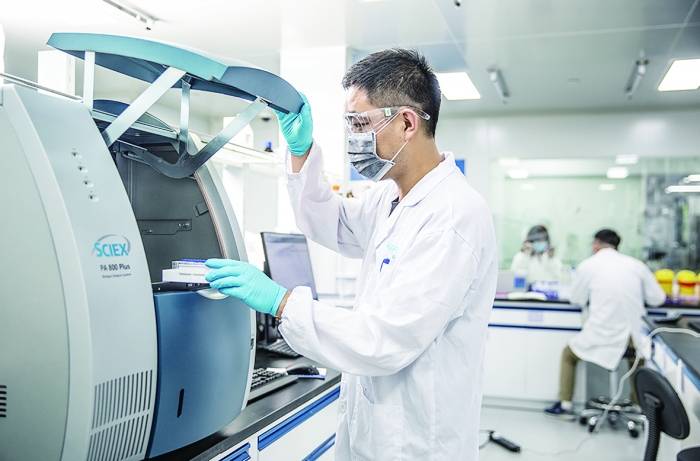
Core Viewpoint - The Chinese innovative drug industry is transitioning from a "fast-follow" model to a more proactive and innovative approach, exemplified by Heptares Therapeutics' strategic acquisitions and partnerships, leading to significant growth and international collaboration [5][9][11]. Group 1: Company Strategy and Growth - Heptares Therapeutics acquired a Dutch biotechnology company to establish a fully human antibody platform, positioning itself for global research and development [5][6]. - The company reported a profit of approximately 523 million RMB in the first half of the year, marking a 51-fold year-on-year increase [6][10]. - Heptares has completed 17 business development (BD) transactions, becoming recognized as the "BD King" in the industry [6][10]. Group 2: International Collaboration and Licensing - In the first half of the year, the total amount of license-out agreements from Chinese innovative drugs exceeded $60 billion, surpassing the total for the entire year of 2024 [7]. - Heptares entered into a global strategic cooperation with AstraZeneca, involving a $175 million upfront payment and plans to establish a joint innovation center in Beijing [7][8]. - The company also signed a global strategic cooperation agreement with Otsuka Pharmaceutical, receiving an upfront payment of $47 million, with potential milestone payments reaching $623 million [7][8]. Group 3: Industry Transformation and Future Outlook - The shift in the Chinese innovative drug industry reflects a fundamental change in the ecosystem, with increased international collaboration and improved intellectual property protection [8][11]. - Heptares is transitioning from a focus on single product licensing to a platform-driven long-term strategic cooperation model, enhancing its capabilities in various therapeutic areas [11][12]. - The company aims to balance international collaboration with the independent advancement of clinically valuable products, ensuring sustainable growth and innovation [12].
“BD之王”如何炼成?——专访和铂医药董事长王劲松
Shang Hai Zheng Quan Bao· 2025-09-15 19:09
Core Insights - The article highlights the rapid growth and strategic evolution of Heptares Therapeutics, showcasing its transition from a "fast-follow" approach to a leading innovator in the Chinese biopharmaceutical industry [4][5][6] Company Overview - Heptares Therapeutics has made significant strides in the biopharmaceutical sector, with a focus on building a fully human antibody platform and expanding its global research footprint [4][8] - The company has achieved a remarkable profit of approximately 523 million RMB in the first half of the year, marking a 51-fold year-on-year increase [5][9] Strategic Partnerships - The company has engaged in 17 business development (BD) transactions, establishing itself as a leader in the Chinese innovation drug sector, with notable collaborations with AstraZeneca [5][6] - A significant global strategic partnership with AstraZeneca was formed, involving a $175 million upfront payment and plans for a joint innovation center in Beijing [6][10] Market Dynamics - The Chinese innovation drug sector has experienced explosive growth, with over $60 billion in license-out agreements in the first half of the year, surpassing the total for 2024 [6][7] - Heptares Therapeutics has successfully transitioned from technology licensing to product collaboration and platform empowerment, achieving financial profitability for the first time in 2023 [9][10] Future Directions - The company is shifting towards a platform-driven model, focusing on long-term strategic collaborations rather than solely on product licensing [10][11] - Heptares plans to continue leveraging international partnerships while also advancing its own clinical and commercialization efforts for high-potential products [11]
券商晨会精华 | 创新药行业进入快速成长期 关注未来6-12个月投资机会
智通财经网· 2025-09-15 00:49
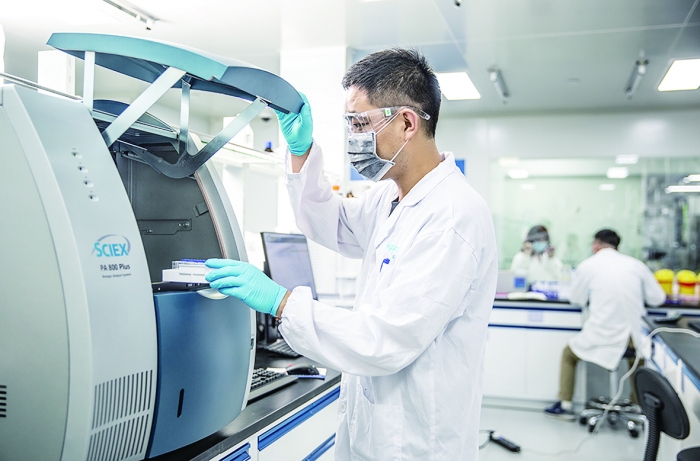
Market Overview - The market experienced a pullback last Friday, with all three major indices closing lower. The Shanghai Composite Index fell by 0.12%, the Shenzhen Component Index by 0.43%, and the ChiNext Index by 1.09% [1] - The trading volume in the Shanghai and Shenzhen markets reached 2.52 trillion yuan, an increase of 83.2 billion yuan compared to the previous trading day [1] Sector Performance - Sectors such as non-ferrous metals, storage chips, and film and television saw significant gains, while large financials, liquor, and gaming sectors faced notable declines [1] Analyst Insights Huatai Securities - Huatai Securities suggests a return to value and growth dynamics, focusing on domestic computing power chains, innovative pharmaceuticals, and robotics [2] - The firm notes that the A-share market has shown resilience after a brief profit-taking phase, with active trading and a positive medium-term outlook for the domestic economy [2] CITIC Construction Investment - CITIC Construction Investment continues to be bullish on the energy storage and lithium battery sectors, highlighting recent price adjustments in Shandong and capacity pricing in Ningxia as positive indicators for investment [3] - The firm emphasizes the importance of monitoring future demand forecasts for 2026 and ongoing policy support for the lithium battery sector [3] Kaiyuan Securities - Kaiyuan Securities indicates that the innovative pharmaceutical sector is entering a rapid growth phase, with Chinese biotech companies expected to maintain stable revenue growth and reduced net losses by mid-2025 [4] - The firm recommends focusing on seven promising innovative drug sectors over the next 6-12 months, which are poised for significant market opportunities [4]


映恩生物-B涨超10%再破顶 进入港股通有望获内资追捧 现金储备充足可支持未来数年研发
Zhi Tong Cai Jing· 2025-09-11 06:03
Group 1 - The core viewpoint of the article highlights that EnGene Biotech-B (09606) has seen its stock price rise over 10%, reaching a new high of 480 HKD, following the announcement of its inclusion in the Hang Seng Composite Index and the Stock Connect program [1] - The inclusion in the Hang Seng Composite Index and the Stock Connect program is expected to enhance the company's investor base and increase trading liquidity [1][1] - The company reported a revenue of 1.23 billion HKD for the interim period, primarily due to upfront payments from licensing agreements, including 50 million USD from Avenzo and 20 million USD from 3SBio [1][1] Group 2 - The company experienced a significant increase in losses, attributed to fair value changes in financial liabilities measured at fair value through profit or loss [1] - The company holds 3.75 billion HKD in cash, which is deemed sufficient to support clinical and early-stage R&D investments for the next 3 to 5 years [1][1] - The collaboration pipeline with BioNTech is progressing steadily, with early-stage molecules expected to show potential [1]
国产创新药对外授权热潮再起--科创创新药ETF上涨4.96%、创新药ETF上涨4.35%点评
Mei Ri Jing Ji Xin Wen· 2025-09-05 14:51
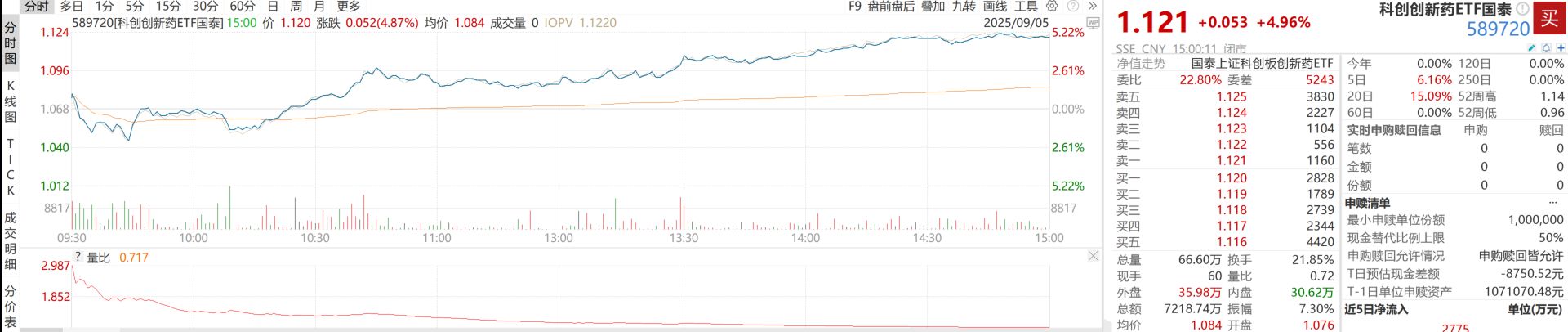
Market Performance - On September 5, the Shanghai Composite Index rose by 1.24% to 3812.51 points, while the Shenzhen Component Index increased by 3.89% [1] - The ChiNext Index saw a significant rise of 6.55%, and the CSI 300 Index increased by 2.18% [1] - A-share trading volume was 2.35 trillion yuan, down from 2.58 trillion yuan the previous day [1] Industry Developments - On September 5, 2025, Hengrui Medicine announced an exclusive licensing agreement with Braveheart Bio for its Myosin small molecule inhibitor HRS-1893, indicating ongoing innovation in China's outbound drug licensing [3] - Wobo Pharmaceutical announced a collaboration with Novartis for its cardiovascular small nucleic acid pipeline, reflecting international recognition of Chinese small nucleic acid drugs [3] - The overall pharmaceutical sector showed marginal improvement in mid-year performance, with revenue and net profit growth rates of 6.9% and 56.1%, respectively, and a gross margin increase to 77.7% [3] Future Outlook - The upcoming industry conferences in September and October are expected to reveal multiple clinical data points, which could act as catalysts for the sector [4] - The World Lung Cancer Conference (WCLC) will take place from September 6-9, featuring 35 presentations from Chinese scholars, highlighting the anticipation for clinical data from domestic new drugs [4] - The innovation drug sector is expected to continue benefiting from favorable policies, including the acceleration of commercial health insurance directory progress and improved liquidity conditions [4][5] Investment Opportunities - The innovation drug sector's growth logic is supported by internationalization efforts such as BD and license-out agreements [5] - The upcoming third-quarter reports for innovation drugs and their supply chain companies are anticipated to provide stronger valuation support [6] - Key catalysts for the second half of the year include policy support, upcoming data releases from major international conferences, and accelerated commercialization of Chinese innovative drugs [7] ETFs and Indices - The Innovation Drug ETF (517110) tracks the innovation drug industry index, covering various segments of drug development, production, and commercialization, which may help mitigate risks associated with single technology failures [8] - The Sci-Tech Innovation Drug ETF (589723) focuses on biotech and has shown stronger rebound performance compared to the broader market, indicating potential for better returns in a favorable market environment [8]
恒瑞医药(600276):BD交易再下一单,将继续增厚公司业绩
CSC SECURITIES (HK) LTD· 2025-09-05 08:46
Investment Rating - The report assigns a "Buy" rating for the company, indicating a potential upside of 15% to 35% from the current price [2][7]. Core Insights - The company has entered into a business development (BD) agreement with Braveheart Bio for the exclusive rights to develop, produce, and commercialize the innovative drug HRS-1893 outside of Greater China, which is expected to enhance its performance significantly [7][8]. - The HRS-1893 drug, a small molecule inhibitor for hypertrophic cardiomyopathy, is currently in advanced clinical trials, with the potential to become a billion-dollar product, given the market success of similar drugs [8]. - The company has successfully completed multiple BD transactions in 2025, with a total potential deal value nearing $15 billion, which is expected to drive revenue growth and enhance profitability [8]. - The projected net profits for 2025-2027 are RMB 10.1 billion, RMB 9.1 billion, and RMB 10.4 billion, respectively, reflecting a year-on-year growth of 59.3%, -9.9%, and 14.5% [11]. - The company is expected to benefit from being included in the Hang Seng Index, which may lead to increased stock price and valuation recovery [8]. Financial Summary - The company’s revenue is projected to grow from RMB 22.82 billion in 2023 to RMB 45.40 billion in 2027, with a significant increase in net profit from RMB 4.30 billion to RMB 10.41 billion over the same period [14]. - The earnings per share (EPS) are expected to rise from RMB 0.68 in 2023 to RMB 1.57 in 2027, indicating strong growth potential [11]. - The price-to-earnings (P/E) ratio is projected to be 45X in 2025, suggesting a reasonable valuation in light of the expected growth [11].
