
粮食安全

Search documents
粮食安全看山东”之莘县:巩固粮食安全“压舱石
Zhong Guo Fa Zhan Wang· 2025-09-25 09:32
Core Insights - Food security is a crucial foundation for national security, and grain storage facilities play a vital role in ensuring food safety [1][2][3] Group 1: Grain Storage Management - The Shandong Xincheng National Grain Reserve has implemented a standardized management system covering all aspects of grain storage, including entry and exit, storage management, safety protection, and personnel assessment [1] - The storage capacity of the reserve has increased from 15,000 tons to 60,000 tons through upgrades and the replacement of old facilities, significantly improving grain quality retention rates [1] - Investment in smart storage technologies has been made, including a seamless data connection with the provincial grain supervision cloud platform [1] Group 2: County-Level Grain Reserves - County-level grain reserves are essential for regional emergency supply, with a total reserve of 10,000 tons achieved by increasing reserves by 5,000 tons in 2018 [2] - A dynamic rotation mechanism for stored grain has been established to ensure freshness and quality, enhancing resilience against market fluctuations and natural disasters [2] Group 3: Quality Control and Agricultural Support - A specialized team conducts regular quality inspections of stored grain, maintaining loss rates below 1%, significantly lower than the industry average [3] - The reserve provides post-harvest services to farmers, helping them reduce losses by approximately 15% through quality testing and storage guidance [3] - Future efforts will focus on stringent food safety measures and enhancing the reserve's contributions to national food security [3]
粮食“卷价格”不如“卷品质”
Jing Ji Ri Bao· 2025-09-24 22:46
Core Viewpoint - The grain industry is shifting from a focus on quantity to quality, emphasizing health and value creation rather than price competition [1][4] Group 1: Current Challenges - The grain industry faces severe challenges due to low-price competition, which harms farmers' income and threatens national food security [2] - Continuous low-price competition may lead to overuse of pesticides and fertilizers, degrading soil quality and compromising grain quality [2] - Grain processing companies are struggling with low profit margins, often caught in a dilemma of operating at a loss or losing market share [2] Group 2: Consumer Trends - Consumer awareness regarding food quality is increasing, with a shift from merely satisfying hunger to seeking nutritious and healthy options [2] - Consumers are willing to pay a premium for products that are branded, traceable, and transparent in their production processes [2] Group 3: Quality Improvement Strategies - Quality improvement should focus on various stages of the grain supply chain, including seed quality, storage, transportation, processing, and branding [3] - Farmers should adopt high-quality seed varieties and eco-friendly farming practices to ensure grain quality from the source [3] - Processing companies need to invest in research and development to enhance nutritional retention and create functional foods [3] Group 4: Collaborative Efforts - Achieving quality improvement in the grain industry requires collaboration among government, enterprises, research institutions, and consumers [4] - Policies should support a quality-based pricing mechanism and promote green agriculture while combating substandard practices [4] - All stakeholders must shift their focus from quantity to a balanced approach of quality and quantity, ensuring that the benefits of quality improvements are shared across the supply chain [4]
加纳粮食产业因库存积压面临崩溃
Shang Wu Bu Wang Zhan· 2025-09-24 17:10
Core Insights - The corn and rice industries in Ghana are facing a severe crisis, with over 100,000 tons of grain from the 2024 harvest still stuck in warehouses [1] - The influx of cheap imports and the smuggling of low-quality grains into the Ghanaian market have led to oversupply, causing farmers to incur significant debts and threatening the survival of local processors [1] - Farmers are selling agricultural products below cost, which undermines domestic food security [1] - As the 2025 harvest season approaches, some corn processors and rice millers have reduced their operations or even closed down [1] - The Ghana Audit Office has called for immediate government action, including strengthening border enforcement to curb smuggling, providing minimum price guarantees for farmers, establishing school feeding programs, and prioritizing local grain procurement by public institutions [1]
中国订单至今为零,巴西收获240万吨订单,美国豆农痛苦喊话特朗普
Sou Hu Cai Jing· 2025-09-24 09:10
Core Insights - The article highlights the significant shift in China's soybean procurement strategy, moving from the U.S. to Brazil due to trade tensions and tariffs imposed by the U.S. government [5][21]. Group 1: Current Market Dynamics - U.S. soybean farmers are facing challenges as China, the largest buyer, has not purchased any soybeans from the U.S. this year, instead placing a large order of 2.4 million tons with Brazil [1][5]. - The U.S. soybean industry is experiencing urgent warnings from farmers about the severe consequences of not being able to export their crops [5][21]. Group 2: Historical Context - The article recounts a historical incident from 2003 when China was manipulated into signing high-priced soybean contracts with U.S. suppliers, only to face a price collapse shortly after due to a sudden change in U.S. agricultural forecasts [9][11]. - This incident led to significant financial losses for Chinese companies, prompting a long-term strategy for improving domestic soybean production and reducing reliance on foreign imports [13][25]. Group 3: Strategic Shifts - China has implemented a three-step strategy to revitalize its domestic soybean industry, which includes preserving soybean farmland, enhancing storage, and promoting domestic soybean production [16][25]. - The country has increasingly turned to South America, particularly Brazil and Argentina, for soybean imports, with Brazil becoming the primary source, accounting for over 70% of imports by 2024 [19][21]. - Additionally, China is developing soybean farms in Russia's Far East to further secure its supply chain and reduce dependency on maritime transport [22][25].


学习新语|跟着总书记脚步,走过四季庆丰收
Xin Hua She· 2025-09-24 08:28
Group 1 - The article highlights President Xi Jinping's continuous engagement with agricultural production across various regions in China, emphasizing his commitment to improving the agricultural sector and rural livelihoods [3][4][6][20]. - Xi's visits include inspecting rice harvests in Heilongjiang, corn growth in Jilin, grape industries in Xinjiang, and vegetable cultivation in Hubei, showcasing a hands-on approach to understanding local agricultural practices [4][6][20][23]. - The President stresses the importance of integrating poverty alleviation with agricultural development, public services, and ecological protection to enhance overall agricultural productivity and quality [7][17][23]. Group 2 - Xi Jinping's emphasis on modern efficient agriculture as a pathway for farmers to achieve prosperity is evident during his visits to various agricultural sites, where he discusses crop yields and market prices with local farmers [10][12][23]. - The article notes Xi's focus on sustainable agricultural practices, such as promoting green development and the use of new technologies in the tea industry, which is crucial for rural revitalization [30][32]. - The President's remarks on the significance of utilizing saline-alkali land for agricultural expansion highlight the strategic importance of land management in ensuring food security for China's large population [41][42].

“粮食安全看山东”之德州军粮食品产业集团:“四分开”改革助力依法管粮
Zhong Guo Fa Zhan Wang· 2025-09-24 06:52
Core Viewpoint - The Shandong Dezhou Military Grain Food Industry Group is advancing the separation of policy and operational functions in local grain and oil reserves through a "four separations" management model, aiming for a deep breakthrough in legal grain management and storage reform [1] Group 1: Reform Implementation - The group is implementing reforms in accordance with the Shandong Provincial Grain and Material Reserve Bureau's directives, with a focus on separating management functions [1] - In May 2023, the group developed a separation implementation plan, and from July, all local reserve grain and oil were managed by Dezhou Financial Grain and Oil Purchasing and Sales Co., Ltd. [1] - The purchasing company signed storage agreements with various entities to ensure the separation of personnel, physical assets, finance, and accounting from commercial operations [1] Group 2: Management Practices - The group emphasizes the "four separations" in management, establishing dedicated departments and ensuring that all personnel are certified [2] - Physical management involves dedicated storage and personnel, ensuring the quantity, quality, variety, and location of reserves are strictly monitored [2] - Financial management operates under a closed-loop system for policy credit funds, with full oversight from the Agricultural Development Bank of Dezhou [2] - The implementation of specialized accounts and accounting methods enhances the safety and compliance of fund usage [2] Group 3: Infrastructure Development - To address grain reserve shortcomings, the group is initiating a high-standard grain warehouse construction project in Dezhou, with a planned investment of 455 million yuan [3] - The project will include facilities for 300,000 tons of grain storage and 5,000 tons of oil storage, along with drying equipment and an information system [3] - The project aims to enhance the green and information management levels of local reserves and is expected to be completed by December 2027 [3] Group 4: Public Awareness and Education - The group is creating a comprehensive food security publicity system through various channels and innovative methods [4] - Annual events like "World Food Security Day" are conducted to educate the public on food security policies and their importance [4] - Online and offline initiatives, including competitions and educational activities, aim to spread knowledge about food storage and conservation practices [4]
“粮食安全看山东”之保龄宝公司:小玉米造就中国功能糖产业领军者
Zhong Guo Fa Zhan Wang· 2025-09-24 05:35
Group 1 - The company, Baolingbao Biotech Co., Ltd., established in 1997, specializes in the production of functional sugar products using corn as raw material and has become a leader in China's functional sugar industry [1] - The company has a comprehensive production capacity of over 1 million tons, with 16 production lines and a workforce of approximately 1,400 employees [1] - Baolingbao is recognized as a national high-tech enterprise and has been the first in China to achieve industrial-scale production of oligosaccharides [1] Group 2 - The company has implemented a rigorous grain safety management system to ensure the quality and safety of corn supply, with a planned storage of 320,000 tons of corn in 2024, averaging 1,000 tons per day [2] - The procurement process is transparent, utilizing mobile apps and WeChat mini-programs to publish purchasing information and ensure timely payment to farmers [2] - The company monitors market prices dynamically to ensure reasonable procurement prices and protect farmers' interests [2] Group 3 - The company has increased investment in storage facilities, with 13 grain storage units and a total storage capacity of 80,000 tons [3] - New storage facilities are equipped with intelligent systems for real-time monitoring of temperature, humidity, and grain conditions, enhancing operational efficiency [3] - Upgrades to existing storage facilities are ongoing to improve automation and smart technology [3] Group 4 - The company focuses on innovation in deep processing of corn, extending the value chain from starch to functional sugars and high-value products [4] - Recent product developments include erythritol, allulose, and DHA, contributing to significant value addition and economic benefits [4] - The company's efforts in deep processing not only enhance its economic performance but also support local agricultural development and food security [4]

“粮食安全看山东”之德州市陵城区:“十六连冠”背后的粮安基石与产业跃升
Zhong Guo Fa Zhan Wang· 2025-09-24 05:04
Core Viewpoint - Food security is a top priority for the country, and Licheng District in Dezhou City, Shandong Province, is committed to ensuring this by implementing strategies to enhance grain production, storage, and industry development, contributing to national food security efforts [1][2][3] Group 1: Production Enhancement - The district focuses on increasing grain production capacity, aiming for a yield of over 1,500 kg per mu through high-standard farmland construction, with the highest yield in the core area reaching 1,790.15 kg per mu [1] - Infrastructure investments are being made to improve irrigation and drainage systems, ensuring stable production and supply [1] - Collaboration with seed companies is accelerating the establishment of modern seed breeding bases to promote high-yield and quality crop varieties [1] Group 2: Storage Management - The district is upgrading storage facilities with an investment of over 50 million yuan to build a new 45,000-ton high-standard granary equipped with smart devices for information management [2] - Current grain reserves can meet the district's food needs for three months, with emergency supplies capable of supporting 5,000 people [2] - Regular emergency drills are conducted to enhance material transportation and supply capabilities [2] Group 3: Industry Development - The district is developing a grain industry cluster by extending the processing chain of wheat and soybeans, led by major companies like COFCO Flour (Dezhou) [3] - The "Zhixuan Licheng" regional brand is being promoted to cultivate competitive grain products, with 984,000 tons of agricultural products supplied to the Beijing-Tianjin-Hebei region [3] - The first phase of COFCO Flour's production facility is set to process 3,000 tons of wheat daily, with an annual capacity of 900,000 tons, expanding to 1.5 million tons in the second phase, addressing farmers' selling issues [3]
黄、红、青、蓝,五彩斑斓!科技赋能点缀神州大地多彩“丰”景
Yang Shi Wang· 2025-09-24 03:56
Core Viewpoint - The article highlights the bountiful harvests across various regions in China during the autumn season, emphasizing the integration of technology in agriculture and the overall improvement in food security. Group 1: Agricultural Achievements - In Jilin Province, the rice planting area exceeds 12 million acres, with a comprehensive mechanization rate of 94.7% for crop farming [5] - In Yunnan's Honghe Prefecture, the use of drones for efficient transportation of rice has transformed traditional harvesting methods, allowing a 40-kilogram bag of rice to be transported in just 3 minutes [7] - The total grain output in China is projected to reach 14.13 trillion jin in 2024, marking an increase of 740 billion jin since 2020, with per capita grain availability surpassing 1,000 jin for the first time [23] Group 2: Diverse Harvests - In Qinghai's Xunhua County, 25,000 acres of chili peppers are being harvested, showcasing a vibrant autumn landscape [10] - In Heilongjiang's Fuyuan, 4,200 acres of cranberries are harvested using a unique "water harvesting" method, contributing to the production of cranberry products [12] - In Jiangxi's Xianjiyan Lake, fishermen are expected to catch 5 million pounds of fish in the autumn of 2025 using large net fishing techniques [14] Group 3: Technological Integration - The rapid development of near-sea aquaculture is evident in Shandong's Yantai, where 40,000 rainbow trout fry are being raised before being transferred to deep-sea cages [17] - The article illustrates a picturesque "autumn harvest painting" in Hubei's Wuhan, where traditional harvesting and drying of crops are celebrated [20] - In Anhui's Yi County, villagers creatively use corn to construct a giant "corn dragon," reflecting the colorful agricultural landscape [21]
“十四五”时期,我国粮食综合生产能力持续提升
Ren Min Ri Bao· 2025-09-24 02:04
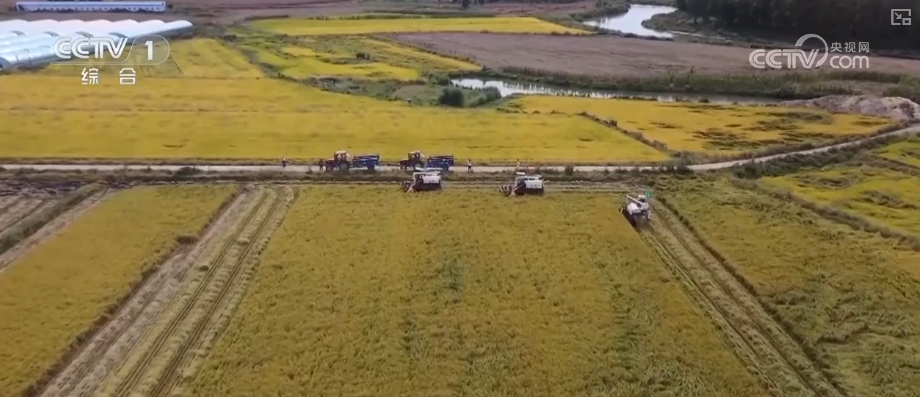
Core Insights - China's grain production has consistently remained above 1.3 trillion jin since the 14th Five-Year Plan, with a projected total output exceeding 1.4 trillion jin in 2024, marking a significant increase of 740 billion jin compared to 2020 [1][3]. Production and Yield - The summer grain harvest this year set a historical second-high record, with early rice yield surpassing 400 kg per mu, and the area for autumn crops showing stable growth [1]. - In Henan, a major grain-producing province, wheat yield is reported at over 1,100 jin per mu, while corn yield is expected to be around 1,200 jin per mu, maintaining levels similar to previous years despite drought challenges [2]. Policy and Support - The central government's policies have prioritized food security, with the implementation of the Food Security Guarantee Law and increased financial support for disaster prevention and production stabilization [3]. - The area of high-standard farmland has exceeded 1 billion mu, and over 80% of winter wheat has irrigation capabilities, enhancing resilience against drought [3]. Technological Advancements - Agricultural technology has significantly contributed to yield increases, with the contribution rate of agricultural technology progress reaching 63.2%, and the average grain yield per mu rising to 394.7 kg, an increase of 12.5 kg compared to the end of the 13th Five-Year Plan [6]. - New agricultural practices, including precision irrigation and the use of advanced machinery, have been widely adopted, leading to improved efficiency and productivity [6]. Sustainable Practices - The implementation of protective farming practices in Northeast China has improved soil health and reduced production costs, with over 1.12 million mu of black soil undergoing protective cultivation [4]. - The promotion of eco-friendly farming techniques has resulted in reduced fertilizer usage and increased profitability for farmers, with green rice fetching higher market prices [4]. Agricultural Workforce - The emergence of new farmers, such as young individuals taking over family farms, is reshaping agricultural practices and ensuring the continuity of grain production [8]. - The cultivation of over 9 million high-quality farmers and the establishment of cooperative farming models are enhancing the agricultural sector's capacity and sustainability [9]. Global Responsibility - China plays a significant role in global food security, producing over 20% of the world's grain with only 9% of the world's arable land and 6% of freshwater resources [10]. - The country has engaged in international cooperation for food security, implementing numerous aid projects in over 30 countries [10].