
货币政策

Search documents
高市早苗胜选无济于事?市场警告:赤字空间已尽,日元仍悬利剑
Jin Shi Shu Ju· 2026-02-09 09:51
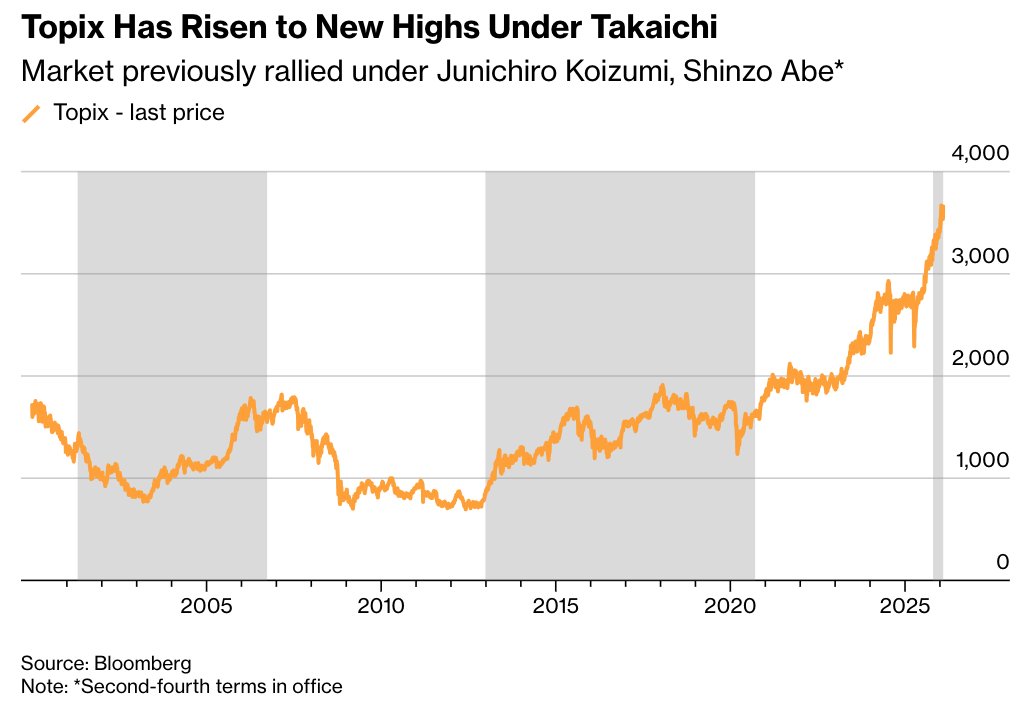
Core Viewpoint - The recent election victory of Prime Minister Sanna Takashi provides her with significant authority to revitalize Japan's economy, but investors are concerned about the limited room for increasing deficits, which could soon pressure bonds and the yen [1][2]. Group 1: Election Impact - Takashi's Liberal Democratic Party won over two-thirds of the seats in the House of Representatives, allowing her to advance her agenda without needing to negotiate with other parties [1]. - The victory was praised by U.S. President Trump, who noted the electorate's dissatisfaction with high living costs, although her expansionary fiscal agenda has raised market concerns [1][2]. Group 2: Market Reactions - Following the election, the Tokyo stock market surged to historical highs, with the Nikkei index rising by 3.9% and the broader Topix index increasing by 2.3% [2]. - The yen, which had depreciated by 6% since Takashi took over the Liberal Democratic Party in October, showed signs of strengthening, while the benchmark 10-year Japanese government bond yield rose by 5.5 basis points to 2.28% [2]. Group 3: Economic Policy Challenges - Analysts emphasize that the focus is not merely on the election results but on the substance, scale, funding sources, and consistency of economic and fiscal policies [2]. - A key challenge for Takashi will be how to manage the commitment to suspend the 8% food consumption tax, which could create an estimated annual revenue shortfall of 5 trillion yen (approximately $32 billion) [5]. Group 4: Monetary Policy Outlook - There is a slight increase in market bets on a potential interest rate hike by the Bank of Japan, reflecting that political stability may clear the way for action [3]. - However, pressure from the U.S. to support the yen could complicate Takashi's approach to monetary policy, as any signals of maintaining the status quo could lead to further yen depreciation [3][4].
自民党历史性胜选压制政治噪音!市场给予“信任红利” 日股飙升、日元及日债走稳
智通财经网· 2026-02-09 08:39
Group 1 - The core viewpoint of the articles highlights that the recent election victory of the Liberal Democratic Party (LDP) led by Kishi Nobuo has resulted in a significant boost in the Japanese stock market, with investors showing increased confidence in the government's fiscal sustainability and policy clarity [1][4] - The LDP and the Japan Innovation Party secured a majority in the House of Representatives, with the LDP winning 316 seats out of 465, granting them a supermajority that facilitates easier legislative passage [1][4] - HSBC's Chief Economist for Asia, Frederic Neumann, noted that the LDP's victory is expected to inject strong momentum into the stock market and support structural reforms that could enhance productivity and corporate profits [1] Group 2 - Market reactions indicate a reduction in political noise, with long-term Japanese government bond yields initially rising but then stabilizing, alleviating concerns of a chaotic sell-off in the bond market [4][7] - Japanese Finance Minister Katayama emphasized that proposed consumption tax cuts would be limited and would not be financed through new debt issuance, contributing to market stability [4] - Analysts believe that the overwhelming victory of the LDP does not imply excessive spending, as the party is relatively fiscally conservative, which is favorable for bond markets and supports the yen [4][7] Group 3 - Following the election, JPMorgan raised its year-end target for the Nikkei 225 index to 61,000, citing enhanced political stability as a key factor [7] - Sectors such as defense and semiconductors are expected to benefit from Kishi's spending plans, indicating potential for further stock price increases [7] - The market remains cautious about the limited fiscal and monetary policy flexibility, with potential volatility in bond and foreign exchange markets if spending plans lack funding sources or inflation pressures rise [7][8] Group 4 - The upcoming special session of Congress in February may focus on the fiscal budget for FY2026, with market attention on whether election momentum translates into concrete policy actions [7] - The relationship between Japan and the U.S. is also a focal point, with Kishi planning to meet President Trump to discuss defense spending and investment commitments [7][8] - Overall, the combination of political stability, policy continuity, and reform options is viewed positively by the market, reinforcing a constructive outlook on Japanese risk assets [8]

宏观经济周报2026年第七周-20260209
工银国际· 2026-02-09 08:23
Economic Indicators - The ICHI Composite Economic Index recorded 100.03, indicating a return to the expansion zone after previous fluctuations[1] - The Consumer Sentiment Index slightly rebounded to 100.09, showing increased consumer activity ahead of spring[1] - The Investment Sentiment Index fell to 99.95, reflecting a temporary slowdown in investment activity[1] - The Export Sentiment Index rose to 100.1, indicating stable external demand and support for overall economic sentiment[1] - The Production Sentiment Index slightly decreased to around 100, reflecting seasonal adjustments in production activities[1] Manufacturing and Services - In January, the Manufacturing PMI was 49.3%, and the Non-Manufacturing Business Activity Index was 49.4%, both down by approximately 0.8-0.9 percentage points from the previous month[2] - The Manufacturing PMI fell into contraction territory, but the Production Index remained in the expansion zone at 50.6%[2] - The High-Tech Manufacturing PMI held steady at 52.0%, indicating resilience in this sector[2] - The Non-Manufacturing Business Activity Index declined due to a significant drop in the construction sector, but the service sector showed strong performance, particularly in financial services[2]
韩央行行长候选人称支持提高房地产税以遏制通胀
Xin Lang Cai Jing· 2026-02-09 06:42
Group 1 - The next potential governor of the Bank of Korea, Lee Seung-hun, advocates for increasing property holding taxes to curb soaring housing prices that could trigger inflation, but he believes it is too early to shift towards a more aggressive monetary tightening policy [1][5] - Lee Seung-hun, previously the senior deputy governor, is seen as a candidate to succeed the current governor, Lee Chang-yong, whose four-year term ends on April 20 [1][5] - He emphasizes the need for stricter government measures on the real estate market to prevent rising housing prices from exacerbating inflation and hindering middle-class families from purchasing homes [1][5] Group 2 - Lee Seung-hun's support for increasing property taxes aligns with President Yoon Suk-yeol's stance, who has urged owners of multiple properties to sell before the government raises property taxes [2][6] - He believes the current exchange rate of the Korean won is reasonable, with the rate against the US dollar at approximately 1465.30, suggesting a fair range between 1400 and 1470 [3][7] - He notes that while the exchange rate may briefly exceed 1500, such a level is unlikely to be sustainable [4][8]
还未上任便遭反击!经济学家怒批沃什“AI降息论”站不住脚
Sou Hu Cai Jing· 2026-02-09 06:24
Group 1 - Kevin Warsh, nominated by Trump to replace Powell, argues that AI will lead to unprecedented productivity gains, allowing the Fed to lower interest rates without triggering inflation [2][3] - A survey of 45 economists indicates that nearly 60% believe AI's impact on prices and borrowing costs will be minimal over the next two years, with expected declines in PCE inflation and neutral rates of less than 0.2 percentage points [2] - Approximately one-third of respondents suggest that the AI boom could even lead the Fed to slightly raise the neutral rate, which is the level where borrowing costs neither stimulate nor dampen demand [2] Group 2 - Warsh must be confirmed by the Senate to take over in mid-May, focusing on AI's impact on productivity, while other economists believe the technology may increase demand and price pressures [3] - The FOMC predicts only one rate cut this year, by 25 basis points, keeping the benchmark rate above 3.25%, significantly higher than the 1% rate suggested by Trump [4] - Warsh's call to reduce the Fed's "bloated" balance sheet may face opposition from other rate setters, as aggressive balance sheet reduction could raise long-term borrowing costs and affect mortgage rates [4] Group 3 - Warsh's dovish stance on short-term rates contrasts with his hawkish position on the balance sheet, raising questions about his leadership of the Fed [5] - Most respondents do not support the Trump administration's goal of relaxing banking regulations, with over 60% indicating that it would have little short-term growth impact but significantly increase the risk of a financial crisis [5]
美联储持谨慎立场 美元指数高位震荡 CME显示3月维持利率不变概率达80.1%
Sou Hu Cai Jing· 2026-02-09 06:19
近期美元指数呈现震荡走势,2月5日上涨0.21%,在汇市尾盘收于97.824;2月6日下跌0.2%,收于 97.633。 市场有风险,投资需谨慎。本文为AI基于第三方数据生成,仅供参考,不构成个人投资建议。 来源:市场资讯 美联储官员近期释放的谨慎政策立场,推动美元指数维持高位震荡态势。 里士满联储主席巴金强调,在通胀完全回落至目标之前,货币政策仍需保持谨慎,以确保劳动力市场的 稳定。美联储副主席杰斐逊表示,他对美国经济前景"谨慎乐观",暗示强劲的生产率增长有望帮助通胀 回落至央行2%的目标水平;当前的政策立场能够很好地应对经济发展。理事库克则指出,美联储必须 在近期将通胀率拉回目标水平,这对于维护其信誉至关重要;目前风险偏向于通胀上行,同时经济前景 不确定性仍处于较高水平。 据CME"美联储观察"数据,美联储到3月维持利率不变的概率为80.1%,到4月维持利率不变的概率为 65.2%。 ...
节后债市或延续节前趋势1.8%或由阻力变支撑
Huafu Securities· 2026-02-09 03:50
1. Report Industry Investment Rating No information provided in the report. 2. Core Viewpoints of the Report - The bond market after the Spring Festival is likely to continue the pre - festival trend, and holding bonds during the holiday may be a better choice. Before the implementation of reserve requirement ratio cuts and interest rate cuts, the risk of significant interest rate adjustments is relatively limited [3][4][14]. - Once the 10 - year Treasury bond interest rate breaks through 1.8%, it may change from a resistance level to a support level [5][14][44]. - The short - term bond market will continue to fluctuate strongly. It is recommended to maintain a certain leverage. There is still room for compression in the spread of 3 - 5 - year Tier 2 and perpetual bonds. If the interest rate breaks through key points, there may be band opportunities for 10 - year policy financial bonds and ultra - long Treasury bonds [5][48]. 3. Summary by Directory 3.1 Post - Festival Bond Market Generally Continues the Pre - Festival Trend; Pre - positioned Monetary Policy and Holding Bonds During the Holiday May Still Be the Better Choice - Historically, the bond market after the Spring Festival generally continues the pre - festival trend. In odd - numbered years, interest rates tend to rise around the Spring Festival, while in even - numbered years, they often fall. The exception was 2022, when the central bank cut interest rates before the festival, and interest rates rose after the festival due to profit - taking sentiment and concerns about credit [3][15][20]. - The adjustment of the monetary policy tone since January may be the reason for the bond market's recovery. The central bank's increased demand for stable credit and reduced concerns about the side effects of M2 and social financing growth have led to a repair of bond market sentiment. The State Council Executive Meeting on February 6 proposed that macro - policies should be implemented ahead of schedule, and subsequent monetary policy may continue to be pre - positioned, with the possibility of earlier reserve requirement ratio cuts and interest rate cuts [22][28][29]. 3.2 The Central Bank Creates a Suitable Monetary and Financial Environment for Government Bond Issuance; Once 1.8% Is Broken, It May Change from a Resistance to a Support - Despite the large net payment scale of government bonds in the week before the festival, the central bank's actions such as over - renewing the 3M repurchase and large - scale 14 - day reverse repurchase injections reflect its intention to maintain liquidity. As long as the central bank's attitude remains unchanged, the capital market around the Spring Festival is expected to remain loose [30]. - The net financing of certificates of deposit (CDs) turned positive last week, mainly due to the decline in maturity volume. If the central bank continues to maintain stable funds, the bank's liability pressure after the festival is expected to be stable [33]. - In January, the central bank's bond purchase scale increased, and large - scale banks' net purchases of Treasury bonds in the secondary market reached a record high. They can be regarded as the stabilizing force when the 10 - year Treasury bond interest rate is above 1.8%. If the interest rate breaks through 1.8%, it may change from a resistance to a support [39][41][44].
早盘直击|今日行情关注
申万宏源证券上海北京西路营业部· 2026-02-09 02:10
Group 1 - The market experienced fluctuations due to liquidity expectations surrounding the US dollar, particularly after Trump's nomination of Kevin Warsh as the new Federal Reserve Chairman, who supports significant balance sheet reduction and emphasizes the independence of the central bank [1] - The A-share market adjusted in response to international market influences, with investor sentiment turning cautious and trading volume significantly shrinking, averaging below 24,000 billion yuan [1] - The major market focus last week was on consumer goods and the new energy sector, with large-cap blue-chip stocks showing relative resilience while small-cap and technology stocks underperformed [1] Group 2 - The Shanghai Composite Index entered a consolidation phase after a period of continuous rebound, characterized by sector differentiation and rapid industry rotation, alongside declining trading volume [2] - The current market phase requires attention to whether the index can maintain its position above the 5-day moving average [2]

铝产业链月报:风险情绪下行,供需季节性弱,铝价震荡向下调整-20260209
Tong Guan Jin Yuan Qi Huo· 2026-02-09 01:50
1. Report Industry Investment Rating No relevant content provided. 2. Core Views of the Report - ADC12 quotes remain high and volatile. Affected by the decline in domestic prices, the import profit margin continues to narrow and once turns into a small loss, weakening the impact of imported sources on the domestic market. Downstream demand is weak, and the enthusiasm for high - price stocking is low, with procurement mainly for rigid demand replenishment [3][4]. - In terms of alumina, there was partial production reduction and maintenance in January, involving a production capacity of about 5 million tons. However, most of these production reductions were mainly for calciner maintenance, and the production capacity will gradually resume. The inventory pressure of alumina plants increases, and the price is under pressure to fluctuate within the range of 2,600 - 2,900 yuan/ton this month [3][33][90]. - For electrolytic aluminum, due to the fermentation of the Wash trade, the US dollar index rebounds, precious metals and copper decline sharply, and funds quickly flow out of the metal sector. The aluminum price is expected to adjust downward in a volatile manner in the short term, with support at 22,500 yuan/ton. In the long - term, there is a supply - demand gap for aluminum, which limits the short - term downward space of the aluminum price and provides long - term upward momentum [3][92]. - Regarding cast aluminum, the scrap aluminum market in the raw material end fluctuates widely following the primary aluminum. The cost support increases, but the supply and demand contract synchronously. It is expected that the recycled aluminum price will adjust at a high level, running within the range of 21,500 - 22,500 yuan/ton this month [4][74][92]. 3. Summary According to the Table of Contents 3.1 Market Review - Alumina prices initially rebounded rapidly but then fell back due to oversupply. At the end of the month, they stopped falling and rebounded slightly, closing at 2,768 yuan/ton, a decrease of 0.36% [10]. - Shanghai aluminum futures rose strongly at the beginning, with the price reaching a new high of 26,185 yuan/ton and closing at 24,560 yuan/ton, a rise of 7.02%. LME aluminum prices also rose, closing at 3,135.5 US dollars/ton, a rise of 4.62% [11]. - Cast aluminum futures followed the primary aluminum price and rose, closing at 22,820 yuan/ton, a rise of 4.42% [12]. 3.2 Macroeconomic Analysis 3.2.1 Overseas - The Fed paused rate cuts in January, and Trump nominated Kevin Warsh as the next Fed chairman, which impacted global asset prices. The US labor market is slowing down, and inflation pressure is gradually easing. The US economy shows strong growth but has structural contradictions. The European Central Bank maintained the benchmark interest rate. The eurozone's inflation pressure eases, the PPI decline expands, and the unemployment rate decreases slightly [16][18][19]. 3.2.2 Domestic - In 2025, China achieved its annual economic target, with GDP growing by 5.0%. In December, industrial production improved, consumption showed structural optimization but was under pressure at the end of the year, and investment was under pressure. Exports were strong, and the CPI and PPI were slightly better than expected. The central bank is expected to maintain a loose monetary policy in 2026 [20][22][24]. 3.3 Alumina Market Analysis 3.3.1 Bauxite - In January, the supply of domestic northern bauxite changed from a slight increase to a slight shortage, and the price decreased. Imported ore supply is expected to increase, and the price is expected to decline [26][27]. 3.3.2 Alumina Supply - In December 2025, China's alumina production was 7.655 million tons, with an overall oversupply. In January, production reduction may increase, and the production is expected to be 7.4 million tons. In 2025, the net export volume of alumina increased significantly, but Russia's demand for Chinese alumina may decrease in the future [28][30]. 3.3.3 Alumina Inventory and Spot - The exchange inventory remained between 150,000 - 160,000 tons in January, and the spot premium gradually declined [31]. 3.3.4 Alumina Cost and Profit - In December 2025, the average fully - taxed cost of the alumina industry decreased. The prices of raw and auxiliary materials mainly declined, resulting in a downward trend in production costs [32]. 3.3.5 Alumina Outlook - Alumina prices are under pressure to fluctuate within the range of 2,600 - 2,900 yuan/ton this month due to factors such as production capacity recovery, inventory pressure, and weakening cost support [33][90]. 3.4 Electrolytic Aluminum Market Analysis 3.4.1 Electrolytic Aluminum Supply - In December 2025, China's primary aluminum production was 3.7846 million tons. In January 2026, it is estimated to be about 3.79 million tons. Overseas production is also expected to increase slightly. In 2025, the import and export volume of primary aluminum both increased [47][50]. 3.4.2 Electrolytic Aluminum Inventory - As of the end of January, the aluminum ingot inventory increased by 137,000 tons, and the social inventory of aluminum ingots + aluminum rods increased by 244,000 tons. The SHFE inventory increased, and the LME inventory decreased [50][51]. 3.4.3 Electrolytic Aluminum Spot - In January, the spot price lagged behind the futures price, with a large discount. The LME 0 - 3 spot discount initially turned into a high premium and then fell back [52]. 3.4.4 Electrolytic Aluminum Cost and Profit - In January, the theoretical average full cost of the electrolytic aluminum industry increased, and the monthly theoretical profit also increased [53]. 3.5 Cast Aluminum Market Analysis 3.5.1 Scrap Aluminum - In December, the import of scrap aluminum increased. The domestic scrap aluminum production also increased, but there were problems in the resource recycling policy. The price of scrap aluminum followed the primary aluminum, and there may be further adjustments [69]. 3.5.2 Supply - In December, the production and operating rate of recycled aluminum alloy decreased. In January, it is expected to continue to decline due to factors such as high costs, environmental protection restrictions, and weak downstream demand. The export of aluminum alloy is expected to increase in January [70][71]. 3.5.3 Consumption - In December 2025, automobile production decreased, while motorcycle sales increased [72]. 3.5.4 Spot and Inventory - As of January 30, the ADC12 spot price increased, and the cast aluminum warehouse receipt inventory decreased [73]. 3.5.5 Outlook - The recycled aluminum price is expected to adjust at a high level, running within the range of 21,500 - 22,500 yuan/ton this month [74][92]. 3.6 Consumption Analysis 3.6.1 Aluminum Processing - In January, the operating rate of most aluminum - processing sectors declined, and it is expected to continue to decline in February [82]. 3.6.2 Domestic Terminal Consumption - In the real estate sector, the completion area decreased, and new construction and investment were under pressure. In the new energy vehicle sector, sales increased, and exports were strong. In the power sector, investment increased, but consumption was weak in December. In the photovoltaic sector, the installed capacity increased, and exports were affected by policies. In the energy storage sector, the installed capacity increased significantly, and the policy is expected to support further growth [83][84][85][86]. 3.6.3 Aluminum Product Exports - In December 2025, the export of unwrought aluminum and aluminum products decreased slightly month - on - month but increased year - on - year. The implementation of the EU CBAM may bring pressure to the export market [87]. 3.7 Market Outlook - Macroscopically, the nomination of the new Fed chairman affects market liquidity expectations. Domestically, policies are expected to be proactive. Alumina prices are under pressure to fluctuate. Electrolytic aluminum prices are expected to adjust downward in the short term and have long - term upward momentum. Cast aluminum prices are expected to adjust at a high level [90][92].
春运出行较为活跃
HTSC· 2026-02-08 15:02
证券研究报告 宏观 春运出行较为活跃 2026 年 2 月 08 日│中国内地 国内周报 一周概览 农历春节对齐后的高频数据显示,春运前五天人员流动量同比景气度较高, 节前工业生产活动同比有所降温,新房和二手房成交同比亦有所回落;港口 高频指标显示 1 月出口或保持较高景气度。上周人民币兑美元汇率升值、国 债收益率趋平,银行间流动性整体偏松;本周重点关注 1 月通胀数据和货币 信贷"开门红"成色。 高频经济活动跟踪 居民出行景气度小幅回落,工业生产与建筑开工和地产成交同比仍偏弱。出 行及消费方面,春运前 5 天(2 月 2-6 日)全社会跨区域人员流动量累计同 比增长 1.9%,其中公路/水路/民航发送旅客数量同比增长 2%/19.8%/5.8%, 而铁路发送客运量同比回落 0.7%;飞猪数据显示,截至 2 月 5 日,春节假 期高星级酒店预订量同比增长近 70%。节前工业生产趋于平淡,焦化/沥青/ 半钢胎企业开工率同比下行 2.6/4.8/6.1 个百分点;建筑开工需求偏弱,建 筑钢材成交量同比降幅走阔至 47.4%,而偏低基数下水泥开工/发运率同比 上行 5.1/1.8 个百分点。出口及物流方面,出口高频 ...