算力

Search documents
前瞻“AI+”应用落地元年:消费电子价格上涨,商业模式有变
2 1 Shi Ji Jing Ji Bao Dao· 2025-12-30 08:07
21世纪经济报道记者冉黎黎北京报道2026年将成为"人工智能+"应用落地元年——这是12月29日举行的 赛迪顾问"2026年IT趋势"发布会上给出的研判。 受访赛迪顾问专家指出,此前人工智能虽已有一些比较好的落地,但"人工智能+"行业应用整体还在探 索阶段,而2026年政府及央国企有望在政务、工业、能源等重点领域加快布局AI应用,率先形成一批 高价值、可复制推广的应用场景示范项目。 从算力来看,赛迪顾问电子信息产业研究中心资深分析师张耀嵘在发布会上介绍,近年来,随着大模型 与行业应用深度融合,算力需求呈现指数级增长。预计2026年中国算力总规模将突破1200 EFLOPS,稳 居全球第二。其中,智能算力作为规模增长的核心引擎,贡献率接近90%。 随着"人工智能+"行动深入推进,算力需求将大幅增长。赛迪顾问预计2026年中国算力总规模将突破 1200 EFLOPS,稳居全球第二。其中,智能算力作为规模增长的核心引擎,贡献率接近90%。与此同 时,相关商业模式也正发生转变,无论是人工智能应用还是算力服务,在2026年,商业模式都有望 从"为技术或功能付费"向"为效果付费"转变。 需要注意的是,2025年8月印发的 ...
赛迪顾问发布2026年IT发展趋势:AI与算力成核心驱动力
Xin Hua Cai Jing· 2025-12-30 05:46
Core Insights - The report by CCID Consulting outlines the development blueprint and transformation directions for the IT industry in China by 2026, focusing on ten key areas including computing power, storage, AI, industrial software, and financial digital transformation [1][2][3]. Computing Power - The demand for computing power is expected to grow exponentially due to the deep integration of large models and industry applications, with China's total computing power projected to exceed 1200 EFLOPS by 2026, maintaining the second position globally, and intelligent computing contributing nearly 90% [1]. - A collaborative model of "cloud centralized training and edge flexible reasoning" will be widely adopted, with super-node architectures overcoming traditional computing cluster bottlenecks, becoming a significant choice for large intelligent computing centers [1]. Artificial Intelligence - The "AI+" sector is anticipated to enter a new phase of typical demonstration and large-scale implementation by 2026, with cloud services accelerating towards AI-native evolution, transitioning from "resource supply" to "intelligent engine" [2]. - High-quality private data sets will become scarce resources, and lightweight AI terminals will serve as crucial carriers for application implementation, driving deep penetration of "AI+" in industries such as automotive and logistics [2]. - The large model market is expected to experience explosive growth, with both deployment and usage volumes increasing significantly, focusing on vertical small models and autonomous collaborative intelligent agents [2]. Industrial Software - The global industrial software market is projected to grow steadily from 2023 to 2025, with a compound annual growth rate of approximately 6.4%, reflecting a balance of stable growth and structural optimization [2]. - By 2026, industrial software is expected to play a vital role in transforming manufacturing from experience-driven to data-driven, enhancing industry efficiency and resource allocation [2]. Financial Digital Transformation - By 2025, the financial industry is expected to undergo a high-quality paradigm shift from "digitalization" to "intelligentization," driven by AI and open API ecosystems, supported by distributed core system restructuring and technological breakthroughs [3]. - IT investment in China's financial sector is projected to continue expanding, with AI reshaping financial technology and generative AI accelerating penetration into vertical financial fields, evolving IT from a supportive tool to a core engine driving financial innovation [3].

华胜天成荣膺三大百强榜单,领航京津冀数字经济与服务新生态
Xin Lang Cai Jing· 2025-12-30 03:38
Core Insights - Huasheng Tiancai has been recognized in three major lists: "2025 Beijing Digital Economy Top 100," "2025 Beijing Service Industry Top 100," and "2025 Beijing-Tianjin-Hebei Service Industry Top 100," highlighting its innovation in the digital economy and service sectors [1][6]. Group 1: Company Achievements - Huasheng Tiancai's inclusion in the top lists reflects its strong capabilities as a benchmark for technological innovation in the capital [1][6]. - The company has established itself as a leading digital innovation service provider, leveraging Beijing's policy advantages and cutting-edge technology resources [5][10]. Group 2: Strategic Initiatives - The company employs an "AI + computing power" approach to solidify its technological foundation, while "AI + scenarios" leads application innovation, and "AI + ecosystem" gathers industrial strength [5][10]. - Huasheng Tiancai has successfully provided comprehensive solutions across over ten industries, including government, finance, education, manufacturing, and energy, aiding clients in digital transformation and intelligent upgrades [5][10]. Group 3: Regional Development - Under the guidance of the Beijing-Tianjin-Hebei collaborative development strategy, Huasheng Tiancai uses its Beijing headquarters as an innovation engine to achieve efficient cross-regional technology transfer in Tianjin and Hebei [5][10]. - The company promotes overall service capability enhancement in the Beijing-Tianjin-Hebei region through standard output, talent cultivation, and ecosystem building [5][10]. Group 4: Future Outlook - Huasheng Tiancai aims to continue its role as an industry leader by increasing research and development investments and accelerating breakthroughs in artificial intelligence, computing power, and big data [5][10]. - The company is committed to contributing to the establishment of a new global digital economy hub [5][10].



20cm速递|加快构建全国一体化算力网,创业板50ETF华夏(159367)上涨0.81%,同类产品最低费率档
Mei Ri Jing Ji Xin Wen· 2025-12-30 03:20
Group 1 - The core viewpoint of the news highlights the significant growth in the computing power sector, driven by the implementation of the "East Data West Computing" initiative, with expectations for a robust performance in the domestic computing industry by 2026 [1] - The China Securities report indicates that since 2025, both Chinese and US tech stocks have performed well, with the computing power sector leading the market gains, suggesting a potential replication of the US stock market's bull run in 2023 [1] - The report emphasizes the urgency for domestic semiconductor equipment and AI chips to develop under overseas restrictions, indicating a trend towards domestic substitution as a major market direction [1] Group 2 - The ChiNext 50 Index selects the top 50 stocks from the ChiNext Index based on market capitalization and liquidity, representing leading companies with strong growth potential in sectors like batteries, securities, and communication equipment [2] - The ChiNext 50 ETF (159367) offers two main advantages: a 20% price fluctuation limit, providing greater trading flexibility compared to traditional broad-based indices, and low management and custody fees of 0.15% and 0.05% respectively, which effectively reduce investment costs [2]

资金关注红利资产,中证红利质量ETF(159209)连续11日获净申购超1亿元
Sou Hu Cai Jing· 2025-12-30 02:35
Core Viewpoint - The preference for dividend assets has increased, with insurance holdings in stocks and securities reaching a record high of 5.6 trillion yuan as of Q3, marking a 1.9 percentage point increase in allocation to 14.9% [14] Group 1: Market Trends - The market risk appetite has significantly improved, and the funding situation has shown signs of recovery, supporting the dividend style investment [19] - The domestic long-term interest rates have fallen to historical lows and have entered a volatile phase, which is favorable for dividend strategies [19] Group 2: Investment Strategies - The focus for future stock selection will be on the stability of the numerator factors, with companies expected to enhance dividend payouts to improve dividend yields or maintain dividend levels, thereby releasing stable dividend expectations [19] - The CSI Dividend Quality ETF (159209) tracks a dividend quality index that includes 50 stocks with stable dividends, high dividend yields, and strong profitability, aiming to balance dividend income and growth [20] Group 3: Industry Distribution - The industry distribution of the CSI Dividend Quality Index is more balanced, with no single industry exceeding 20% representation, excluding bank stocks, and focusing on industries with stable operations and growth potential [11][12]

中长线资金配置需求提升,红利资产“底仓”价值凸显
Sou Hu Cai Jing· 2025-12-30 02:11
Group 1 - The core viewpoint of the article highlights a significant increase in insurance holdings of stocks and securities, reaching a record high of 5.6 trillion yuan as of Q3, with a quarter-on-quarter increase of 1.9 percentage points to 14.9% [15][19]. - The market risk appetite has improved significantly, with a favorable funding environment supporting the dividend style investment strategy, which is expected to focus on the stability of earnings in future stock selection [19][20]. - The CSI Dividend Quality ETF (159209) has seen continuous net subscriptions exceeding 100 million yuan for 11 consecutive days, indicating strong investor interest in dividend-paying assets [1]. Group 2 - The CSI Dividend Quality Index, which tracks 50 stocks with stable dividends and strong profitability, aims to balance dividend yield requirements with growth potential, with no single industry exceeding 20% representation [11][21]. - The current dividend yield of the CSI Dividend Quality Index is 4.09%, compared to a 10-year government bond yield of 1.84%, indicating a favorable investment environment for dividend stocks [7][10]. - The policy environment encourages long-term capital, such as insurance and pension funds, to enter the market, enhancing the capital market's role as a stabilizer [15].

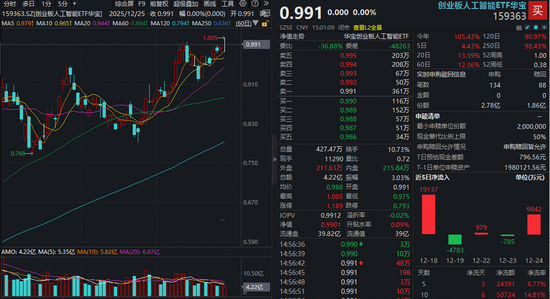
AI应用大催化!Meta数十亿美元收购Manus!创业板人工智能ETF(159363)涨逾1%冲击前高
Xin Lang Cai Jing· 2025-12-30 01:51
Group 1 - The core viewpoint of the news is the significant rise in AI application stocks on the ChiNext board, with notable gains from companies like Hand Information and BlueFocus, which led the market with over 5% increases [1][5] - The ChiNext AI ETF (159363) experienced an increase of over 1%, approaching its previous high, indicating strong market interest in AI-related investments [1][5] - Meta's acquisition of the AI application company Manus for several billion dollars is highlighted as its third-largest acquisition, following WhatsApp and Scale AI, reflecting the growing investment in AI applications [1][5] Group 2 - According to Industrial Securities, overseas computing power is expected to enter a new phase by 2026, with continued investment in computing infrastructure and anticipated growth in demand for optical modules [2][6] - The first ChiNext AI ETF (159363) has a market size exceeding 3.8 billion yuan, with an average daily trading volume of over 600 million yuan in the past month, ranking first among seven ETFs tracking the ChiNext AI index [2][6] - The ETF's portfolio is heavily weighted towards computing power and AI applications, with over 70% allocated to computing power and more than 20% to AI applications, allowing for effective capture of AI market trends [2][6]

信通会议加码6G+算力+AI融合!
Mei Ri Jing Ji Xin Wen· 2025-12-30 01:32
相关ETF:科创50ETF(588000)。 展望后市,野村证券指出未来仍看好三条主线:1)AI算力链持续增长,相对看好谷歌/英伟达以及明年 Meta相关算力需求放量节奏,关注PCB/CCL、光模块板块作为核心受益赛道;2)持续看好国产替代加速 赛道,包括被动元件、模拟芯片等;3)持续看好AI端侧应用落地推动端侧SoC放量。 科创50ETF(588000)追踪科创50指数,指数持仓电子行业69.39%,计算机行业4.88%,合计74.27%,与 当前人工智能、机器人等前沿产业的发展方向高度契合。同时涉及半导体、医疗器械、软件开发、光伏 设备等多个细分领域,硬科技含量高,看好中国硬科技长期发展前景的投资者建议持续关注。 12月29日,科创50ETF(588000)微调,收跌0.14%。盘面上,芯原股份上涨5.71%,寒武纪上涨4.19%, 晶科能源上涨3.85%,中无人机上涨3.61%,芯联集成、天岳先进等涨超2%。 消息面上,全国信息通信监管工作会日前在北京召开,会议强调,要充分发挥需求的导向作用,系统推 进6G技术研发、标准研制和应用培育,深入实施工业互联网和人工智能融合赋能行动。要充分发挥网 络的基础作用 ...
机构:2026年国产算力业绩弹性及投资确定性兼备
Zheng Quan Shi Bao Wang· 2025-12-30 01:17
Group 1 - The core viewpoint is that both Chinese and US technology stocks have performed well since 2025, with the computing power sector leading the market, and there are localized explosive opportunities in models and applications [1] - Looking ahead to 2026, domestic computing power is on the rise, with performance elasticity and investment certainty, potentially replicating the long bull market seen in US stocks since 2023 [1] - The urgency for development in semiconductor equipment and AI chips has increased under overseas restrictions, making domestic substitution a prevailing trend [1] Group 2 - Domestic chip manufacturers have begun to explore solutions such as super nodes to compensate for the performance disadvantages of single cards by leveraging the advantages of multiple cards [1] - The construction of multi-card clusters raises higher demands for the quantity and quality of components, creating greater investment opportunities across the supply chain, particularly in segments like liquid cooling, storage, power supply, optical modules, PCB, and quantum computing [1] - North American computing power is experiencing a rigid expansion in AI model computing demand, with the North American computing power industry chain having mature capacity and technical barriers in server assembly, high-end PCBs, and optical modules, which are core support links for computing infrastructure construction [1] Group 3 - Domestic computing power is forming a complete ecosystem through technological collaboration between AI models and domestic chip manufacturers, with continuous capacity expansion expected to accelerate the penetration of domestic computing power chips into the domestic computing infrastructure supply chain under the dual logic of "self-control + supply chain security" [1]
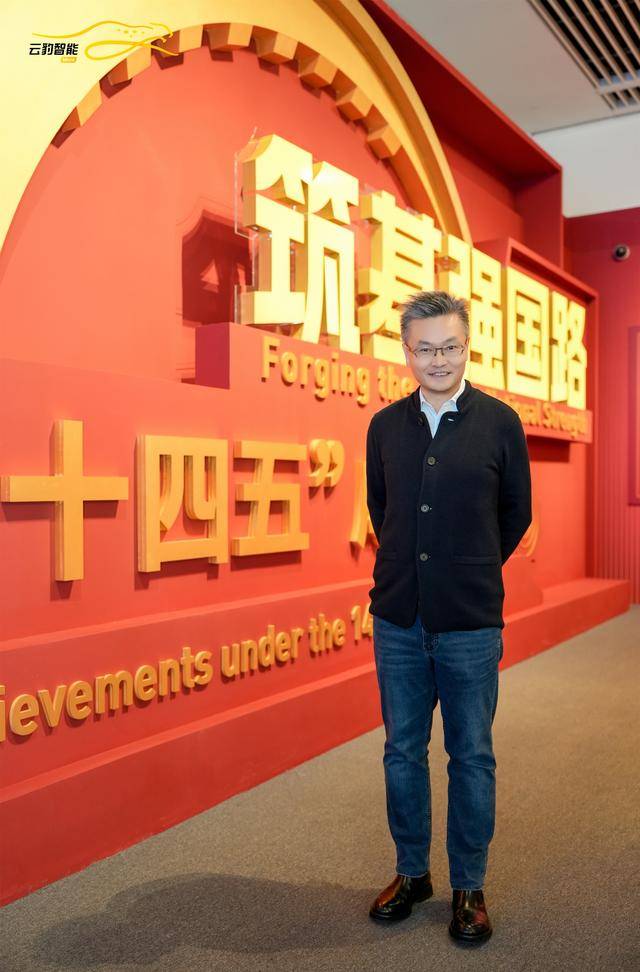
云豹智能创始人萧启阳:算力时代DPU扮演重要角色
Sou Hu Cai Jing· 2025-12-29 22:34
Core Viewpoint - Computing power has become a key variable in competition between nations, with companies like Cloud Leopard Intelligence leading advancements in the DPU chip sector [1] Group 1: Company Overview - Cloud Leopard Intelligence's DPU chip has been recognized for its outstanding performance and is featured in the "Made in China" exhibition, highlighting its significance in the computing power infrastructure [1][9] - The company aims to contribute to China's computing power industry and believes that China's advanced manufacturing will continue to strengthen [1][5] Group 2: Founder Background - Dr. Xiao Qiyang, founder and CEO of Cloud Leopard Intelligence, has a strong academic background with a PhD from Stanford University and experience in high-performance processors and network chips [4] - After co-founding RMI in Silicon Valley, he returned to China to establish Cloud Leopard Intelligence, motivated by the rapid growth of cloud computing and AI [4][5] Group 3: Market Context - Shenzhen is positioned as a key technology innovation center in China, with strong support for semiconductor and AI chip development, creating a favorable environment for startups [5] - The demand for DPU chips is surging due to the evolution of computing power from single servers to interconnected clusters, necessitating efficient data management [6][10] Group 4: Product Features - Cloud Leopard's DPU chip boasts a speed of 400 Gbps, is highly programmable, and offers four times the performance efficiency compared to traditional DPU solutions [8][9] - The DPU chip has been successfully applied in various fields, helping cloud service providers reduce costs and enhance data processing efficiency [8][9] Group 5: Financial and Investment Highlights - As of November, Cloud Leopard Intelligence's valuation exceeded 14 billion yuan, with significant investments from top-tier firms [10] - The company is expected to become the first domestic DPU stock in A-shares, reflecting strong market support for hard technology [11] Group 6: Future Outlook - The company plans to expand its industry chain by establishing a strategic investment department to invest in upstream and downstream companies [12] - Cloud Leopard aims to achieve the highest cost-performance ratio in the DPU market, competing directly with international giants like NVIDIA [11]