
即时零售

Search documents
仓店成为新终端,品牌必须提前占位
3 6 Ke· 2025-11-28 01:03
Core Insights - The core argument presented is that the industry is transitioning from a "traffic war" to a "supply war" in the context of instant retail, emphasizing the need for brands to adapt to the oversupply era to achieve growth [1][4][6]. Group 1: Industry Trends - Instant retail is experiencing a shift where major platforms are investing heavily in supply-side capabilities, moving away from consumer subsidies to focus on supply chain efficiency [1][2]. - The number of Meituan's "Lightning Warehouses" has surpassed 50,000 as of September 2025, with plans to expand to 100,000 by 2027, indicating a significant increase in supply infrastructure [2]. - The competition in instant retail is evolving into a marathon that tests comprehensive capabilities rather than a sprint focused solely on traffic [4]. Group 2: Supply and Demand Dynamics - The logic of instant retail development is centered around supply-demand matching, which is crucial for growth in an oversupply era [10][12]. - Demand can be categorized into general and situational types, while supply can be either standardized or flexible, highlighting the need for brands to adapt their strategies accordingly [12][15]. - The concept of matching is identified as the primary growth principle in an oversupply era, where understanding consumer needs is more critical than merely competing for market share [16][18]. Group 3: Strategic Recommendations - Brands should focus on establishing warehouses as new strategic sales channels, akin to the evolution of traditional retail and e-commerce [7][22]. - A successful strategy involves aligning product offerings with consumer scenarios, ensuring that the right products are available for the right situations [23][24]. - Companies are encouraged to build dedicated teams to manage the unique challenges of instant retail, shifting focus from traditional metrics to warehouse sales [31][32].



朝闻国盛:阿里巴巴-W(09988.HK):闪购减亏在即,AI 叙事持续铺开
GOLDEN SUN SECURITIES· 2025-11-28 00:59
Group 1: Alibaba-W (09988.HK) - Alibaba reported total revenue of 247.8 billion yuan for FY2026 Q2, a year-on-year increase of 5% [4] - The Chinese e-commerce segment generated 132.6 billion yuan in revenue, up 16% year-on-year, while international commerce revenue reached 34.8 billion yuan, growing 10% [4] - Alibaba Cloud's revenue increased by 34% year-on-year to 39.8 billion yuan, with adjusted EBITA of approximately 3.6 billion yuan, a 35% increase [4][5] - Instant retail revenue surged by 60% year-on-year to 22.9 billion yuan, contributing to improved user engagement and customer management revenue [5] - Management indicated that the Capex target of 380 billion yuan over three years may be revised upwards due to high demand for servers [6] Group 2: Dongyangguang (600673.SH) - Dongyangguang is involved in a 100% equity acquisition of Qinhuai Data, with total investment reaching 11.2 billion yuan, of which Dongyangguang contributed 3 billion yuan [2] - The acquisition aims to transition Dongyangguang from a traditional materials supplier to an integrated digital ecosystem service provider focusing on green electricity and computing power [2] - The company anticipates significant revenue growth, projecting revenues of 15.7 billion yuan, 24.5 billion yuan, and 31 billion yuan for 2025, 2026, and 2027 respectively [3]


暴跌85%!马云开始交卷了
Xin Lang Cai Jing· 2025-11-27 22:16
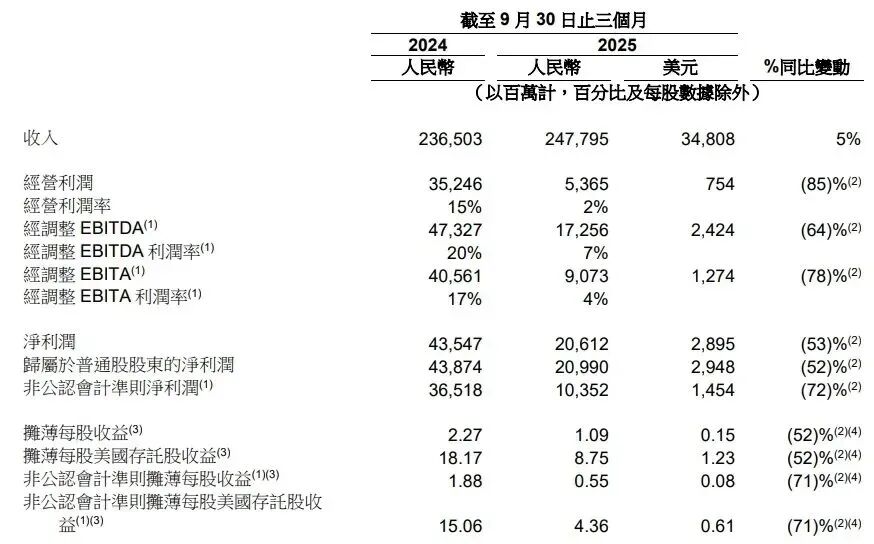
Core Viewpoint - Alibaba is experiencing a "restart year" in 2023, as indicated by its mid-term financial results for the fiscal year 2026, which show mixed performance but also signs of resilience and potential growth in its core e-commerce and AI sectors [1][3]. Financial Performance - Alibaba reported revenue of 247.795 billion RMB for the fiscal year 2026, reflecting a 5% year-on-year increase [2]. - Operating profit decreased significantly by 85% to 5.365 billion RMB, while net profit attributable to ordinary shareholders fell by 52% to 20.990 billion RMB [2]. - The adjusted EBITDA also saw a decline of 64%, indicating challenges in profitability despite revenue growth [2]. E-commerce Business - The Chinese e-commerce segment generated 132.578 billion RMB in revenue, marking a 16% increase year-on-year, showcasing a stable recovery in this core area [4][5]. - Instant retail, particularly through Taobao Flash Sale, has shown remarkable growth, with revenue increasing by 60% [5][6]. - The integration of offline stores into the instant retail model has improved unit economics and user engagement, leading to a return of double-digit user growth on the Taobao app [6][8]. AI Development - Alibaba's cloud intelligence group reported revenue of 398.24 billion RMB, with a year-on-year growth rate of 34%, driven by increased adoption of AI-related products [9][11]. - The launch of the "Qianwen" AI application has gained significant traction, achieving over 10 million downloads within a week and becoming one of the fastest-growing AI applications globally [11][13]. - This strategic shift towards consumer-facing AI marks a departure from Alibaba's previous focus on B2B AI services, positioning the company to leverage its AI capabilities across various consumer applications [14][17]. Industry Trends - The e-commerce sector is undergoing a transformation with the integration of AI, as seen during the recent Double 11 shopping festival, where AI tools significantly enhanced user experience and sales efficiency [18][20]. - However, the rapid adoption of AI has also led to challenges, including issues with product authenticity and the emergence of gray market practices, prompting platforms to implement stricter regulations [28][29]. Conclusion - Alibaba is in a critical phase of transformation, aiming to evolve from a traditional e-commerce company into a comprehensive AI-driven entity, with ongoing challenges and opportunities in both its financial performance and market positioning [29].
阿里巴巴-W(9988.HK)FY26Q2财报点评:电商收入及利润增势稳健 云业务加速增长
Ge Long Hui· 2025-11-27 19:44
Core Viewpoint - Alibaba's FY2026 Q2 performance shows a revenue of 247.8 billion yuan, a 5% increase, but a Non-GAAP net profit of 10.4 billion yuan, a 72% decrease, indicating challenges in profitability despite revenue growth [1] E-commerce - Alibaba's China e-commerce group achieved revenue of 132.6 billion yuan, a 16% increase, with customer management revenue at 78.9 billion yuan, a 10% increase, reflecting a steady improvement in monetization rates [1] - Adjusted EBITA for the e-commerce group was 10.5 billion yuan, a 76% year-on-year decline, primarily due to investments in new instant retail businesses, but excluding these impacts, the core e-commerce EBITA showed single-digit growth [1] Instant Retail - The order structure for instant retail improved, with the loss per order (UE) halving since the peak in July and August, driven by a higher proportion of high-value orders and reduced logistics costs [2] - Non-food categories also saw rapid growth, with orders from Hema and other platforms increasing by 30% month-on-month [2] - The company plans to enhance user experience and focus on high-value customer management, indicating a commitment to long-term investment in instant retail [2] Cloud and AI - The cloud intelligence group reported revenue growth of 28%, exceeding expectations, with AI-related product revenue maintaining triple-digit growth [3] - Adjusted EBITA was 3.6 billion yuan, a 35% increase, with an EBITA margin of 9%, indicating strong profitability in the cloud segment [3] - The company anticipates further capital expenditure beyond the previously set target of 380 billion yuan over three years, driven by robust customer demand [3] Investment Recommendations - The company maintains a strong outlook for its e-commerce core competitiveness, growth potential in instant retail, and long-term growth in cloud and AI businesses, projecting Non-GAAP net profits of 106.9 billion, 166.6 billion, and 201.8 billion yuan for FY2026-2028 [3] - A target price of 185 HKD per share is set, with a "strong buy" rating maintained [3]
阿里巴巴-W(09988.HK):闪购减亏在即 AI叙事持续铺开
Ge Long Hui· 2025-11-27 19:44
Core Insights - Alibaba reported total revenue of 247.8 billion yuan for FY2026 Q2, a year-on-year increase of 5% [1] - Non-GAAP net profit for the quarter was approximately 10.5 billion yuan, a significant decline of 71% year-on-year [1] Revenue Breakdown - **China E-commerce**: Revenue reached 132.6 billion yuan, up 16% year-on-year; adjusted EBITA was about 10.5 billion yuan, down 76% [1] - **International Commerce**: Revenue was 34.8 billion yuan, a 10% increase year-on-year; adjusted EBITA turned positive at approximately 200 million yuan [1] - **Alibaba Cloud**: Revenue grew to 39.8 billion yuan, with a year-on-year growth rate of 34%; adjusted EBITA was about 3.6 billion yuan, up 35% [1] - **Other Businesses**: Revenue totaled 63 billion yuan, down 25% year-on-year; adjusted EBITA was -3.4 billion yuan, with losses widening by 84% [1] Operational Highlights - Instant retail business showed significant growth, leading to a rapid increase in monthly active consumers on the Taobao app; management reported a 50% reduction in losses for Taobao Flash Purchase compared to July-August [2] - AI and cloud services are gaining traction in both B2B and B2C sectors; Alibaba Cloud's market share in China's AI cloud market reached 35.8% in H1 2025 [2] - The Qwen3 model underpins the newly launched Qianwen app, which has seen over 10 million downloads in its first week of public testing [2] Capital Expenditure and Future Outlook - Capital expenditure exceeded 31.5 billion yuan this quarter; management indicated a potential increase in the three-year capex target of 380 billion yuan due to high demand for server orders [3] - The company maintains a "Buy" rating, projecting revenues of 1,053.7 billion yuan, 1,143.6 billion yuan, and 1,269.8 billion yuan for fiscal years 2026-2028, with non-GAAP net profits of 97.4 billion yuan, 133.2 billion yuan, and 170.7 billion yuan respectively [3]
fudi会员商店与京东战略携手,共创“分钟级送达”消费生态
Sou Hu Cai Jing· 2025-11-27 13:10
Core Insights - Fudi has entered a strategic partnership with JD.com, marking its first entry into a third-party instant retail platform, aiming to create a "30-minute fresh living circle" for consumers through the integration of "membership-level quality" and "minute-level delivery" [1][3] Group 1: Strategic Partnership and Value Enhancement - The collaboration allows Fudi to open its membership system to JD.com, facilitating deep resource integration between the two companies [3] - Fudi aims to leverage JD.com's big data analytics to better understand consumer trends and efficiently reach potential members, which is expected to significantly increase its high-quality membership base from over 200 million registered members and 200,000 paying members [3][4] - Starting November 26, users can access Fudi's store on JD.com for fresh product delivery within 5 to 7 kilometers [3] Group 2: Supply Chain and Operational Efficiency - Fudi strengthens its supply chain advantages through this partnership, utilizing JD.com's digital capabilities to gain real-time insights into consumer demand [4] - The integration of over 4,000 SKUs from each store, particularly in fresh products, with JD.com's instant delivery network ensures a dual guarantee of "store quality + minute-level delivery" [4] - This initiative sets a precedent for the deep integration of local membership stores with instant retail, laying a solid foundation for rapid replication nationwide [4] Group 3: Future Expansion and Innovation - Fudi plans to leverage JD.com's logistics network to accelerate its national expansion, starting from successful practices in the Beijing market [6] - The company intends to expand its online product offerings and continuously optimize its product structure and service experience based on online consumer behavior insights [6] - Fudi aims to lead the retail industry towards high-quality development by focusing on supply chain innovation and membership value through a triad business model of "membership system × premium selection × private brand" [6]


硝烟过后,谁才是外卖大战赢家
Di Yi Cai Jing· 2025-11-27 12:34
Core Insights - The report reveals the troubling reality of the food delivery industry, highlighting that while order volumes have increased, actual revenue for merchants has decreased due to aggressive subsidy wars [1][3][10] - The competition among major players in the food delivery market has led to a significant decline in profits for many restaurants, as they struggle to balance between participating in subsidies and maintaining profitability [4][10] Group 1: Industry Dynamics - A study covering over 40,000 merchants indicates that during the peak of subsidy wars, daily order volumes increased by an average of 7%, but actual revenue dropped by approximately 4%, leading to an average profit decline of 8.9% [1][3] - The phenomenon of "substitution effect" is evident, where food delivery is replacing dine-in services, resulting in a decline of over 10% in both order volumes and actual revenue for dine-in services [4][10] - Merchants not participating in subsidies are also affected, as customers shift towards competitors offering subsidies, creating a dilemma for them [4][10] Group 2: Competitive Landscape - The food delivery war began in February 2025 when JD.com announced its entry into the market with a "0 commission" policy, leading to a series of aggressive subsidy initiatives from major players like Meituan and Alibaba [5][6] - By July 2025, Meituan reported a daily order volume exceeding 1.2 billion, while Alibaba's Taobao Flash Purchase reached 80 million orders, showcasing the scale of competition and the financial stakes involved [5][6] - Despite the intense competition, regulatory scrutiny has increased, with the market regulator intervening to address the ongoing subsidy wars [6][10] Group 3: Strategic Implications - The competition is not merely about food delivery but reflects a broader strategy among giants to capture higher-frequency consumer engagement and enhance user activity on their platforms [7][8] - JD.com aims to leverage its supply chain capabilities to support the entire food service industry, while Alibaba focuses on creating synergistic effects within its ecosystem to enhance user experience [13][10] - Meituan is committed to maintaining its delivery network and has initiated plans to support merchants financially, indicating a shift towards a more sustainable business model [9][10] Group 4: Future Outlook - The ongoing battle suggests a shift from zero-sum competition to a more complex ecosystem where companies must innovate beyond subsidies to create sustainable value [12][14] - The industry's future will depend on the ability of these companies to build healthier, more equitable ecosystems that balance efficiency with fairness and short-term gains with long-term value [12][14]
即时零售卖酒:销量大增却降价不多 价格将与经销商看齐?
Nan Fang Du Shi Bao· 2025-11-27 12:30
需要。今年7月起,多个即时零售平台在广东、北京、山东、河南等地,以地方分公司与主要经销商进 行对接洽谈。其中广东方面,南都湾财社记者从广东省酒类行业协会了解到,有平台已经通过协会联系 头部大商进行洽谈,并称已初步达成协议;另外在北京,一家头部酒水流通企业向南都湾财社记者确 认,该公司已经与即时零售平台达成合作协议,并开始小范围"试水"。据了解,虽然即时零售平台与酒 企有直接合作,但是酒水配额的"大头"依然在经销商手中。因此,即时零售平台有"多少货可卖",最终 还是要依托经销商:一方面,平台自营门店有相应的采购需求;另一方面,经销商的仓库、门店等可为 即时零售提供"前置仓"服务——这是即时零售平台提高覆盖面的必要设施。南都湾财社记者注意到,在 即时零售与经销商的合作中,此前"跌跌不休"的产品零售价出现了缓和趋势,例如上述提到的白酒"降 不动价",除了有即时零售补贴减少外,还与经销商、酒企的博弈有关。例如今年"双11"大促期间,茅 台、贵州习酒、五粮液等多个酒企发布"消费警示",直接或间接对线上平台"补贴引流""低价卖酒"等行 为表达不满,这一定程度上遏制了线上平台酒水跌破价。除酒企外,酒商对即时零售平台的产品定 ...
2024超市关店3037家,从沃尔玛到永辉,传统零售的最后挣扎
Sou Hu Cai Jing· 2025-11-27 08:26
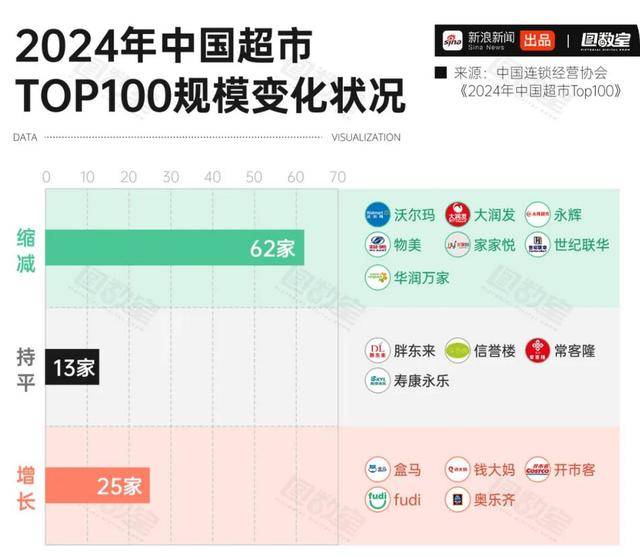
Core Insights - The traditional supermarket industry is facing significant challenges, with major players like RT-Mart, Walmart, and Yonghui closing hundreds of stores, totaling 3,037 closures, averaging 8 stores per day [1][3][25] - Consumer preferences are shifting towards online grocery shopping, with services like Meituan and JD Daojia becoming increasingly popular, leading to a decline in foot traffic at physical stores [5][10][25] - Supermarkets are adapting by transforming stores into fulfillment centers for online orders, but this has resulted in a less appealing shopping experience for customers [7][10][25] Consumer Behavior - Consumers are increasingly reluctant to visit supermarkets due to the inconvenience of travel and long wait times, preferring the convenience of online shopping [3][5] - The perception of supermarkets as a reliable source for fresh produce has diminished, with many consumers now finding online delivery options more appealing [5][10] - Traditional shopping habits are changing, with consumers now focused on efficiency and direct access to desired products rather than browsing [12][15] Supermarket Operations - Supermarkets are reconfiguring their layouts and operations to accommodate online orders, with a significant portion of inventory now designated for online fulfillment [7][10] - The traditional supermarket model, which relied on strategic product placement to encourage impulse buying, is becoming less effective as consumers are more goal-oriented in their shopping [12][15] - Price strategies that once attracted customers are losing effectiveness due to increased price transparency through online comparisons [15][19] Competitive Landscape - New retail formats like Sam's Club and Hema are successfully attracting customers with unique offerings and experiences, such as fresh food and live seafood, contrasting with traditional supermarkets [19][20][25] - Yonghui is attempting to adapt by increasing its online order share and introducing smaller, more focused store formats, but faces challenges in supply chain and digital transformation [23][25] - The retail industry is undergoing a significant transformation, with the survival of traditional supermarkets dependent on their ability to innovate and adapt to changing consumer demands [25][27]


电商品牌非做即时零售不可?
雷峰网· 2025-11-27 07:59
Core Viewpoint - The article discusses the transformation of supply chains in the e-commerce sector, particularly focusing on the rise of instant retail and the establishment of "brand official flagship lightning warehouses" by Meituan, which allows brands to quickly enter the instant retail market with minimal investment [2][3][8]. Group 1: Instant Retail Trends - Brandization is becoming a core trend in the instant retail sector, with many brands establishing official flagship stores on platforms like Meituan's flash purchase service [2]. - Since October, hundreds of brands, including Sony PlayStation and L'Oreal, have entered Meituan's instant retail channel, indicating a shift towards closer consumer engagement [3][6]. Group 2: Sales Performance - During this year's Double 11 shopping festival, brands that joined Meituan's "brand official flagship lightning warehouse" saw sales increase by nearly 400% compared to before the event, with some brands experiencing over tenfold growth [6][11]. - Over 800 brands, including Apple and Huawei, reported sales growth exceeding 100% year-on-year during the same period, highlighting the effectiveness of instant retail channels [6][11]. Group 3: Supply Chain Innovation - Meituan's lightning warehouse model has evolved to support brands in quickly entering the instant retail market without the need for self-built storage facilities, thus reducing entry costs [8][19]. - The "brand official flagship lightning warehouse" model allows brands to maintain their independent identity while benefiting from shared logistics and digital systems provided by Meituan [8][19]. Group 4: Market Potential - The instant retail market is projected to exceed 2 trillion yuan by 2030, indicating significant growth potential as traditional e-commerce channels face stagnation [11][12]. - Instant retail offers high repurchase rates and low return rates, making it an attractive channel for brands seeking growth [12][14]. Group 5: Quality Assurance - Meituan has implemented policies to ensure product quality, including a comprehensive service guarantee plan that covers authenticity and return services for high-value items [19]. - The shift from merely providing products to ensuring quality reflects the evolving consumer expectations in the instant retail space [18][19].
