食品安全

Search documents
合力守护“舌尖上的安全”
Jing Ji Ri Bao· 2025-09-21 21:53
Core Viewpoint - The food industry is undergoing significant transformation driven by new raw materials, technologies, and processes, presenting both opportunities and challenges for food safety management across the entire supply chain [1] Group 1: Industry Innovation - The frequency of new product launches in the food industry has accelerated, with companies introducing new products monthly or even weekly, reflecting a shift towards innovation as a norm [2] - Consumer demand for diverse food options is increasing, with a focus on taste, nutritional content, and health factors, leading to a reshaping of the food supply chain [2] - Companies are responding to market changes by developing new products and exploring new market segments, indicating a shift from capital competition to innovation competition [2] Group 2: Food Safety Challenges - The introduction of new raw materials and products poses new risks for food safety, necessitating updated risk assessment methods [3] - The complexity of modern food safety issues requires the enhancement of national food safety standards, with 126 new standards and amendments released this year to address various safety concerns [3] Group 3: Technological Empowerment - Modern technology is being increasingly utilized to enhance food safety, with companies like COFCO using IoT and big data for predictive analysis in agriculture and smart feeding systems in livestock management [4] - Mengniu has established a comprehensive digital quality management system that allows for rapid traceability of milk products, ensuring transparency from farm to market [4][5] Group 4: Collaborative Governance - Food safety requires collaboration among various stakeholders, including consumers, industry associations, and businesses, to create a robust food safety ecosystem [6] - Platforms like Meituan are investing in centralized kitchens to improve food safety standards for small vendors, enhancing infrastructure and operational transparency [6] Group 5: Supply Chain Cooperation - The establishment of collaborative innovation mechanisms between food safety companies and suppliers is crucial for enhancing food safety levels and ensuring supply chain stability [7] - A digital system for government-business collaboration is recommended to improve targeted risk management and monitoring of food safety [7] Group 6: Community Responsibility - The role of delivery personnel in food safety is emphasized, with initiatives encouraging them to report safety issues, thereby fostering a community-driven approach to food safety [8]
136人入院,含学生89人、学龄前儿童10人!官方通报
证券时报· 2025-09-21 13:05
Group 1 - The core incident involves a suspected food poisoning case in Xishui County, Guizhou, linked to "sandwich" pastries produced by a local food factory, affecting 187 individuals who consumed the product [1][2] - As of September 21, 136 patients are under observation and treatment, with symptoms including fever, abdominal pain, and diarrhea, all attributed to Salmonella contamination [1][2] - The local government has initiated a response, including the establishment of a medical rescue team and a green channel for patient treatment, while also contacting individuals who purchased the affected products for medical checks [1][2] Group 2 - Market regulatory authorities have seized production materials and remaining products from the implicated food factory and its eight self-operated stores, halting their operations [2] - An investigation is underway by health, market regulation, and public security departments, with strict legal actions anticipated against the responsible parties based on the investigation's findings [2]


以马肉冒充驴肉,北京一供货商被刑事追责并惩罚性赔偿80万余元
Xin Jing Bao· 2025-09-21 08:20
Core Viewpoint - A criminal and civil public interest lawsuit was filed against supplier Zhang for selling counterfeit products, resulting in a prison sentence and significant financial penalties [1][4]. Group 1: Case Background - Zhang, a meat supplier for a restaurant, began collaborating with the chef in January 2023, offering kickbacks of 1-2 RMB per kilogram, totaling over 600 RMB monthly [2]. - To increase profits, Zhang started substituting horse meat for donkey meat, which was sold at a higher price, leading to significant financial gains [2][3]. - The restaurant was later found to be selling uninspected donkey meat, resulting in administrative penalties [2][4]. Group 2: Legal Proceedings - The case was transferred to the Stone District Prosecutor's Office in September 2024, where it was determined that the actions violated food safety laws and harmed public interests [4][6]. - The prosecutor's office conducted thorough investigations, revealing that the restaurant purchased uninspected meat worth 807,993.85 RMB from Zhang over a 14-month period [4][6]. - This case marked a precedent for criminal civil public interest lawsuits in Beijing, with prosecutors seeking punitive damages based on the sales amount [4][6]. Group 3: Sentencing and Penalties - On August 20, 2025, the court sentenced Zhang to 18 months in prison (6 months suspended) and imposed a fine of 90,000 RMB [1][6]. - Zhang and the restaurant were ordered to pay over 800,000 RMB in punitive damages and publicly apologize [1][6]. - The case emphasizes the importance of food safety and the legal consequences of violating regulations, aiming to deter similar future offenses [5][6].
40岁云海肴创始人赵晗去世,研一创业,去年已卸任董事长
Jing Ji Guan Cha Wang· 2025-09-19 09:24
Core Viewpoint - The founder of Yunhaiyao, Zhao Han, has passed away, which raises concerns about the future leadership and direction of the company, a leading player in the Yunnan cuisine restaurant sector [1][5]. Company Overview - Yunhaiyao specializes in Yunnan cuisine, particularly known for its steam pot chicken, and has been recognized as one of the top dining establishments in China [1][3]. - The company reported annual revenues exceeding 1 billion yuan in 2020, positioning itself among the top tier of Chinese casual dining chains [1]. - As of now, Yunhaiyao operates 138 stores across 15 provinces and cities in China, with 97% of its locations situated in shopping centers [1][3]. Founder’s Background - Zhao Han was born in 1985 in Kunming, Yunnan, and founded Yunhaiyao while studying at Renmin University of China [1][2]. - He initially faced challenges in establishing the first restaurant due to a lack of experience and the niche market for Yunnan cuisine, leading to early financial losses [2]. Business Strategy and Expansion - The company shifted its business model to focus on expansion within shopping centers, capitalizing on the growth of commercial real estate in China [3]. - Yunhaiyao has adapted its menu to cater to a broader audience, combining traditional Yunnan dishes with popular flavors to appeal to urban consumers [3]. Recent Challenges - Yunhaiyao faced a significant setback due to a food safety incident in Singapore, which resulted in food poisoning among employees of ByteDance, leading to legal repercussions and a fine [4]. - The company is also experiencing brand aging issues, with newer dining concepts gaining popularity among younger consumers [5]. Leadership Transition - Following Zhao Han's passing, the company’s operations are primarily managed by Lu Zhitang, with Zhao's focus shifting to restaurant investments [5]. - In February 2025, the board of directors was restructured, with Zhu Haiqin taking over as chairman and CEO, indicating a shift in leadership and strategic direction [5].

贵州省遵义市市场监督管理局2025年第4期市级食品安全监督抽检信息的通告
Zhong Guo Zhi Liang Xin Wen Wang· 2025-09-19 08:52
Summary of Key Points Core Viewpoint - The recent food safety supervision inspection in Zunyi City revealed that out of 887 samples tested, 41 were found to be non-compliant, indicating potential risks in food safety standards in the region [3]. Group 1: Inspection Results - A total of 887 food samples were collected, with 41 samples failing to meet safety standards [3]. - Non-compliance was noted in various pesticide residues and contaminants, including substances like dichlorvos, imidacloprid, and cadmium [3][4]. - Specific non-compliant products included bananas and sweet potatoes, with pesticide levels exceeding the permissible limits [3][4]. Group 2: Regulatory Actions - The Zunyi Market Supervision Administration has mandated local authorities to conduct immediate investigations and take necessary actions, such as product recalls and removals from shelves [3]. - Legal actions will be pursued against any violations identified during the inspections [3]. Group 3: Non-compliance Details - The inspection identified specific non-compliant substances, including: - Imidacloprid in bananas at levels of 0.13 mg/kg (limit: ≤0.05 mg/kg) [3]. - Cadmium in sweet potatoes at levels of 0.147 mg/kg (limit: ≤0.05 mg/kg) [4]. - Fluoroquinolone residues in meat products exceeding the allowable limits [5][6]. Group 4: Public Health Implications - The findings raise concerns about the safety of agricultural products in Zunyi City, potentially impacting public health and consumer trust [3][4]. - Continuous monitoring and enforcement of food safety regulations are essential to mitigate risks associated with contaminated food products [3].
“你送我检”进市场 守护群众“菜篮子”安全
Zhong Guo Shi Pin Wang· 2025-09-19 07:42
Core Viewpoint - The article highlights a food safety rapid testing initiative organized by the Chongyi County Market Supervision Administration to enhance public participation in food safety and ensure the safety of food supplies for the community [1] Group 1: Event Overview - The "You Send, I Test" food safety rapid testing event was held at the Wenying Township Farmers' Market, aiming to make food safety regulation more accessible and community-oriented [1] - A convenient rapid testing service station was set up, attracting many residents who voluntarily submitted their purchased vegetables and meat for testing [1] Group 2: Testing and Results - Staff utilized rapid testing equipment to conduct free tests for pesticide and veterinary drug residues, providing immediate results to participants [1] - A total of 45 batches of food were tested during the event, demonstrating the efficiency and transparency of the process [1] Group 3: Public Engagement and Education - The event included the distribution of over 120 food safety promotional brochures and featured educational displays on food safety knowledge [1] - The initiative aimed to enhance public awareness of food safety and empower individuals to protect themselves [1] Group 4: Future Plans - The Chongyi County Market Supervision Administration plans to continue the "You Send, I Test" rapid testing activities to establish a new governance model in market regulation, promoting collaboration between the government and society [1] - The goal is to strengthen the safety measures from market to table, ensuring a robust first line of defense in food safety [1]
吉林省吉林市市场监督管理局关于市级食品安全监督抽检 信息的公示(2025年第10期)
Zhong Guo Zhi Liang Xin Wen Wang· 2025-09-19 06:46
Summary of Key Points Core Viewpoint - The Jilin Municipal Market Supervision Administration has publicly announced the results of food safety supervision and sampling inspections, revealing that out of 106 batches of food products tested, 7 batches were found to be non-compliant, highlighting ongoing concerns regarding food safety in the region [2]. Group 1: Inspection Results - A total of 106 batches of edible agricultural products were sampled [2]. - Out of these, 7 batches were identified as non-compliant, indicating a non-compliance rate of approximately 6.6% [2]. - Consumers are encouraged to report any food safety violations by calling the market supervision hotline at 12315 [2]. Group 2: Non-Compliant Products - Specific details of non-compliant products include various agricultural items such as fresh vegetables and fruits, with issues related to pesticide residues [2]. - The non-compliant products were sourced from different vendors across Jilin City, indicating a widespread issue rather than isolated incidents [2]. Group 3: Compliance Encouragement - The administration emphasizes the importance of food safety and encourages consumers to remain vigilant regarding the quality of food products they purchase [2]. - The public announcement serves as a warning to both consumers and vendors about the importance of adhering to food safety standards [2].
山西省寿阳县市场监督管理局2025年第3期食品安全监督抽检信息公告
Zhong Guo Zhi Liang Xin Wen Wang· 2025-09-19 06:44
寿阳县市场监督管理局2025年第3期食品安全监督抽检信息公告 本期公告58批次监督抽检结果,涉及餐饮食品、茶叶及相关制品、炒货食品及坚果制品、豆制品、方便食品、蜂产品、糕点、粮食加工品、肉制品、食糖、 食用油、油脂及其制品、薯类和膨化食品、水果制品、速冻食品、调味品、饮料共16个大类。根据食品安全国家标准,个别项目不合格,即判定为不合格。 其中:不合格样品4批次,合格样品54批次。 不合格样品4批次,具体为: 1、寿阳县文骞干果经销店销售的黄金南瓜子中过氧化值(以脂肪计)超标;检验机构为奥迈检测有限公司。 2、寿阳县小张麻辣拌店(个体工商户)自消毒的碗(自消毒复用餐饮具)中检出阴离子合成洗涤剂(以十二烷基苯磺酸钠计);检验机构为奥迈检测有限公 司。 3、寿阳县小厨味道饭店自消毒的圆盘子(自消毒复用餐饮具)中检出阴离子合成洗涤剂(以十二烷基苯磺酸钠计);检验机构为奥迈检测有限公司。 4、寿阳县小厨味道饭店自消毒的盘子(自消毒复用餐饮具)中检出阴离子合成洗涤剂(以十二烷基苯磺酸钠计);检验机构为奥迈检测有限公司。 合格样品54批次,具体为: 1、餐饮食品8批次,检验项目为苯甲酸及其钠盐(以苯甲酸计)、山梨酸及其钾 ...
海南开展食品安全宣传周活动
Hai Nan Ri Bao· 2025-09-19 01:35
今年全国食品安全宣传周主题为"尚德守法 共享食安"。宣传周期间,全省还将广泛开展主题宣传 活动,包括"你点我检 服务惠民生"活动,进一步动员全社会关心、支持和参与食品安全工作,营造共 建共治共享新格局。 "我们持续推进食品安全全链条监管能力,全面提升食品安全保障水平,全省食品安全形势保持稳 中向好。"海南省市场监督管理局相关负责人表示,下一步,该局将继续坚持关口前移、产管并重、健 全追溯体系,完善新业态新模式监管措施,严把从农田到餐桌的每一道防线,对食品安全违法行为严惩 重处,筑牢食品安全防线。 海南日报讯(海南日报全媒体记者 李梦瑶 刘杰)近日,2025年全国食品安全宣传周海南主场活动在 三亚启动,现场通过"展览展示+互动体验",多形式向市民群众普及了食品安全知识。 ...
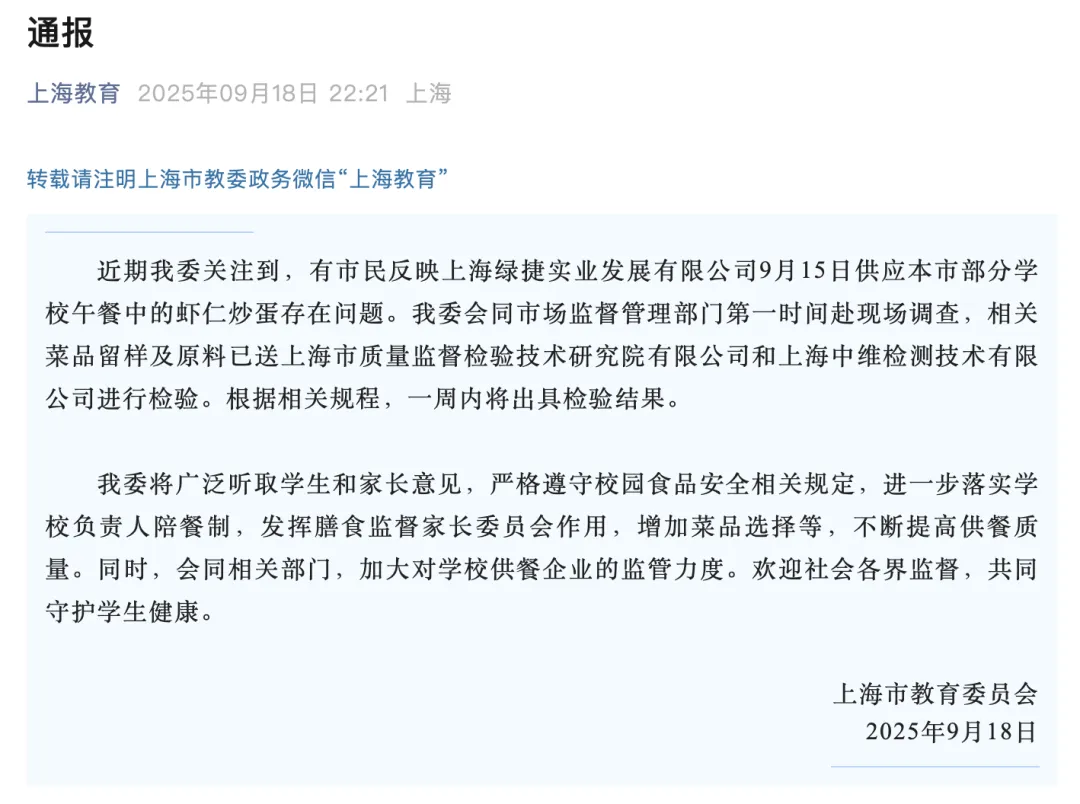
多校午餐发臭 上海通报!涉事公司8月中标70家
Zhong Guo Jing Ji Wang· 2025-09-19 00:45
Group 1 - Shanghai parents reported issues with school lunch shrimp and egg dish, leading to student discomfort and vomiting, prompting urgent withdrawal of the dish [1] - Shanghai Municipal Education Commission is investigating the matter, with samples sent for testing, and results expected within a week [1] - The commission plans to enhance food safety measures, including stricter supervision of school meal suppliers and increased parental involvement in meal oversight [1] Group 2 - Supplier Shanghai Green捷 Industrial Development Co., Ltd. acknowledged complaints about sand in shrimp but stated not all batches were affected and committed to improving food safety [3] - Social media feedback from parents highlighted concerns over high proportions of fried foods, poor taste, and insufficient portions [3] - In August 2025, Shanghai Green捷 secured 70 school meal service contracts, indicating a significant presence in the market [3][4] Group 3 - Shanghai Green捷 has been operating for over 20 years, serving over 500 schools and kindergartens, with daily meal provision exceeding 500,000 [6] - The company’s chairman was previously elected as vice president of the Shanghai Catering and Cooking Industry Association, indicating industry recognition [6] - The company has faced legal issues related to health and safety, and several subsidiaries have been recently deregistered [6]