AI服务器

Search documents
鹏鼎控股2025年中报简析:营收净利润同比双双增长,盈利能力上升
Zheng Quan Zhi Xing· 2025-08-13 22:27
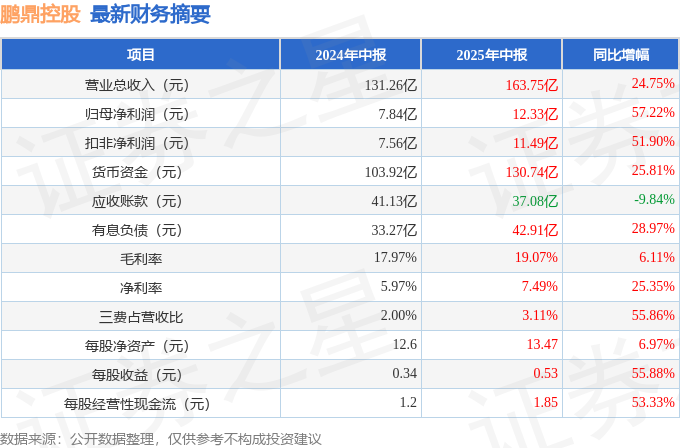
据证券之星公开数据整理,近期鹏鼎控股(002938)发布2025年中报。截至本报告期末,公司营业总收 入163.75亿元,同比上升24.75%,归母净利润12.33亿元,同比上升57.22%。按单季度数据看,第二季 度营业总收入82.88亿元,同比上升28.71%,第二季度归母净利润7.45亿元,同比上升159.55%。本报告 期鹏鼎控股盈利能力上升,毛利率同比增幅6.11%,净利率同比增幅25.35%。 本次财报公布的各项数据指标表现尚佳。其中,毛利率19.07%,同比增6.11%,净利率7.49%,同比增 25.35%,销售费用、管理费用、财务费用总计5.1亿元,三费占营收比3.11%,同比增55.86%,每股净资 产13.47元,同比增6.97%,每股经营性现金流1.85元,同比增53.33%,每股收益0.53元,同比增55.88% | 项目 | 2024年中报 | 2025年中报 | 同比增幅 | | --- | --- | --- | --- | | 营业总收入(元) | 131.26亿 | 163.75亿 | 24.75% | | 归母净利润(元) | 7.84亿 | 12.33亿 | 57.22 ...


奥士康上半年营收同比增长19.43% 泰国工厂产能正在爬坡
Zheng Quan Ri Bao Zhi Sheng· 2025-08-13 06:45
Core Viewpoint - Aoshikan Technology Co., Ltd. reported a revenue increase of 19.43% year-on-year for the first half of 2025, reaching approximately 2.565 billion yuan, but a net profit decrease of 12.79% to about 184 million yuan, attributed to the ramp-up of production capacity and yield at its Thailand factory [1][2] Group 1: Company Performance - The company experienced a revenue growth of 19.43% year-on-year, with revenue reaching approximately 2.565 billion yuan [1] - The net profit attributable to shareholders decreased by 12.79% year-on-year, amounting to about 184 million yuan [1] - The decline in profit is primarily due to the ongoing ramp-up of production capacity and yield at the Thailand factory [1][2] Group 2: Thailand Factory - The Thailand factory is a key support point for the company's global capacity layout, leveraging local resource advantages, favorable policies, and convenient logistics [2] - The factory is currently focused on high-end PCB products for AI servers, AIPC, and automotive electronics, fulfilling overseas orders [2] - The ramp-up cycle for PCB factory capacity typically takes around 12 months, indicating that the Thailand factory is entering a critical phase of capacity release [2] Group 3: Raw Material and Costs - Despite high copper prices, the company has secured sufficient materials in advance and has risk hedging measures in place, minimizing the impact on gross margins for PCB products [2] - The increase in sales expenses by 30.08% year-on-year is attributed to the introduction of new products and the expansion into new markets, including the establishment of a sales team in North America [2]
福斯特(603806):光伏胶膜业务竞争优势领先,电子材料业务有望成为第二增长极
Huafu Securities· 2025-08-13 05:22
Investment Rating - The report maintains a "Buy" rating for the company, indicating an expected relative price increase of over 20% compared to the market benchmark within the next six months [6][19]. Core Insights - The company's photovoltaic film business is currently under pressure due to declining prices in the photovoltaic industry chain, but it remains a leading player globally with significant competitive advantages [2][3]. - The electronic materials segment is experiencing strong growth, particularly in photoresist dry film, which is projected to enter a phase of increased volume and profitability [4]. - The company is expanding its overseas production capacity, particularly in Vietnam and Thailand, which is expected to benefit from the rapid growth in emerging market demand for photovoltaic products [3]. Financial Performance and Forecast - For the first half of 2025, the company anticipates a net profit of 473 million yuan, a year-on-year decrease of 49.05%, primarily due to a decline in sales prices of photovoltaic films [1]. - Revenue projections for 2025 to 2027 are estimated at 15.6 billion yuan, 22.0 billion yuan, and 27.3 billion yuan respectively, with corresponding P/E ratios of 23.5, 16.7, and 13.4 [6][8]. - The company's gross profit margin is expected to improve, with overseas photovoltaic film gross margins significantly higher than domestic margins [3].

三联锻造:主营汽车锻造零部件研发生产和销售
Jin Rong Jie· 2025-08-13 03:51
Core Viewpoint - The company emphasizes that it does not produce battery products and has not disclosed any plans to sell battery-related products, addressing investor concerns about misleading information regarding its performance in the upcoming quarter [1] Group 1: Company Operations - The company primarily engages in the research, development, production, and sales of customized automotive forging components [1] - Its products are used in automotive systems that require high mechanical and safety performance, including power systems, transmission systems, steering systems, and suspension support systems [1] Group 2: Investor Concerns - An investor raised concerns about the company's claims regarding the shipment of AI servers and high-profit batteries, questioning whether these claims were intended to mislead investors [1] - The company responded to the investor's inquiry, clarifying that it does not manufacture or sell battery products and has not made any misleading statements regarding its business operations [1]
芯片ETF领涨,机构:半导体Q3将维持旺季丨ETF基金日报
Sou Hu Cai Jing· 2025-08-13 02:36
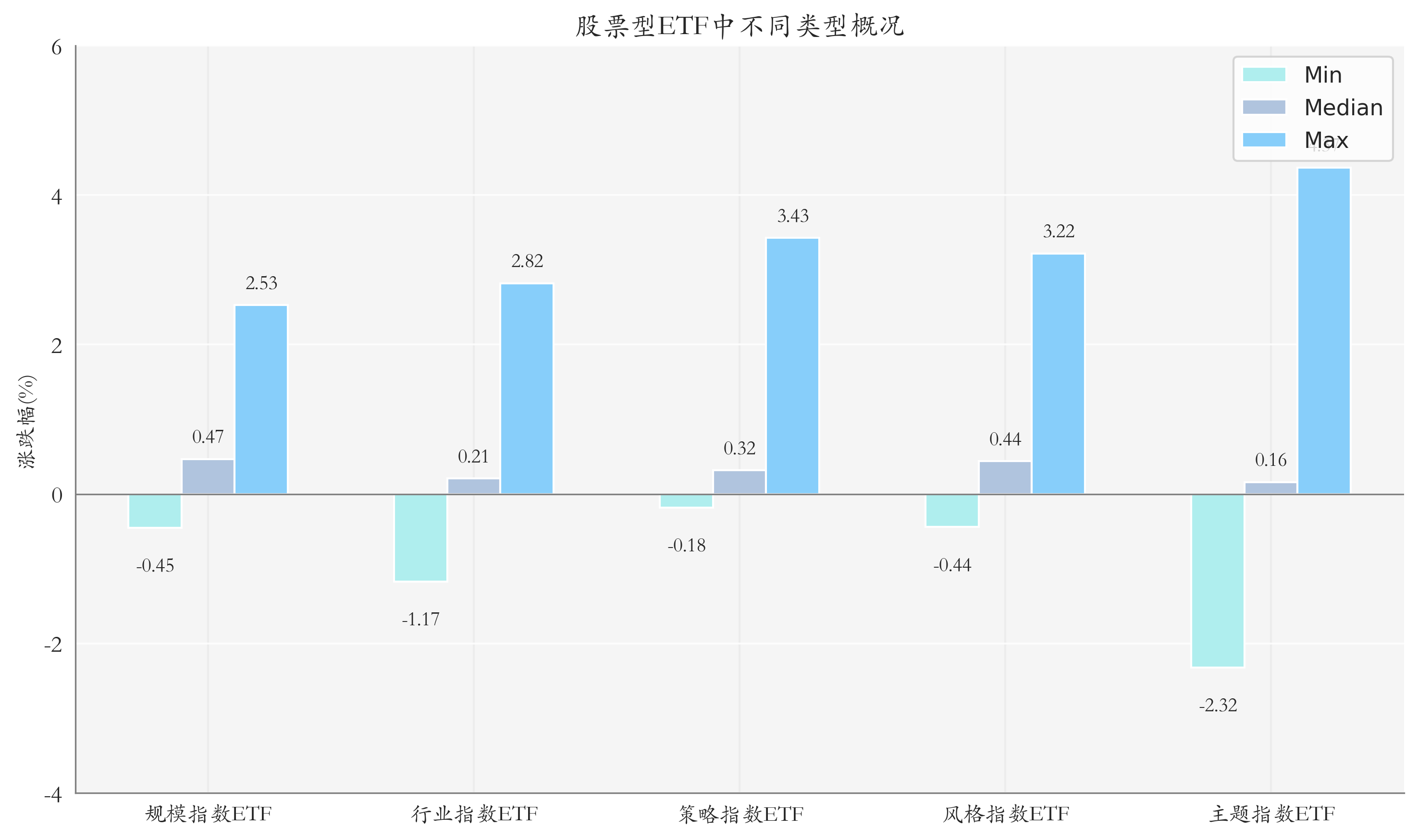
Market Overview - The Shanghai Composite Index rose by 0.5% to close at 3665.92 points, with a daily high of 3669.04 points [1] - The Shenzhen Component Index increased by 0.53% to close at 11351.63 points, reaching a high of 11351.63 points [1] - The ChiNext Index saw a rise of 1.24%, closing at 2409.4 points, with a peak of 2409.4 points [1] ETF Market Performance - The median return for stock ETFs was 0.36%, with the highest performing sector index ETF being the China Tai Investment Integrated Circuit ETF at 2.82% [2] - The top three stock ETFs by return were: - Fortune Shanghai Stock Exchange Sci-Tech Innovation Board Chip ETF (4.37%) - Guotai Junan Shanghai Stock Exchange Sci-Tech Innovation Board Chip ETF (3.71%) - Huatai-PB Shanghai Stock Exchange Sci-Tech Innovation Board Chip ETF (3.58%) [5] - The worst performing ETFs included: - GF Securities CSI Rare Metals Theme ETF (-2.32%) - E Fund CSI Rare Earth Industry ETF (-2.1%) - Harvest CSI Rare Metals Theme ETF (-2.08%) [6] ETF Fund Flows - The top three stock ETFs by inflow were: - Fortune CSI Military Leaders ETF (inflow of 431 million yuan) - Guotai Junan CSI All-Share Securities Company ETF (inflow of 416 million yuan) - Huatai-PB CSI A500 ETF (inflow of 406 million yuan) [8] - The top three stock ETFs by outflow were: - Harvest Shanghai Stock Exchange Sci-Tech Innovation Board Chip ETF (outflow of 1.281 billion yuan) - Guolian An CSI All-Share Semiconductor Products and Equipment ETF (outflow of 800 million yuan) - E Fund ChiNext ETF (outflow of 758 million yuan) [9] ETF Margin Trading Overview - The highest margin buy amounts were for: - Huaxia Shanghai Stock Exchange Sci-Tech Innovation Board 50 Component ETF (785 million yuan) - Guotai Junan CSI All-Share Securities Company ETF (300 million yuan) - Huabao CSI Medical ETF (238 million yuan) [11] - The highest margin sell amounts were for: - Huatai-PB CSI 300 ETF (34.128 million yuan) - Southern CSI 500 ETF (31.9704 million yuan) - Huaxia Shanghai Stock Exchange 50 ETF (14.4899 million yuan) [12] Institutional Insights - Dongwu Securities suggests that the index continues a slow bull trend, with light communication and chips as key focus areas, driven by domestic CPU and GPU activity under self-control policies [13] - Tianfeng Securities anticipates a sustained peak season for semiconductors in Q3, recommending attention to domestic innovation in computing power chips and related sectors [14]
奥士康(002913) - 2025年8月12日投资者关系活动记录表
2025-08-12 14:14
Financial Performance - The company achieved a revenue of 2.565 billion CNY in the first half of 2025, representing a year-on-year growth of 19.43% [3] - The decline in net profit attributable to shareholders is primarily due to initial production challenges in Thailand, affecting profit margins [3] Market and Product Structure - Revenue sources include servers, automotive electronics, base stations, switches, routers, PCs, storage, and consumer electronics [4] - The company is focusing on optimizing product and customer structures to achieve high-quality development [4] Capacity and Production Strategy - The company has established a production capacity layout supported by three core bases in Hunan, Guangdong, and Thailand, promoting efficient operations through integrated design and multi-site manufacturing [5] - A plan to issue convertible bonds of up to 1 billion CNY is in place to expand production capacity, particularly for high-end printed circuit boards (PCBs) [8] AI and Automotive Electronics Development - The company is actively expanding its presence in the AI server PCB market, responding to high demand for high-performance and reliable products [6] - In the automotive sector, the company is enhancing its focus on high-end products related to autonomous driving and electric vehicles, establishing long-term partnerships with renowned automotive brands [7]
供不应求!中芯国际赵海军:关税影响不大,明年预计平稳增长
点拾投资· 2025-08-12 11:00
Core Viewpoint - SMIC's second-quarter financial results showed a revenue of $2.209 billion, a 1.7% decrease quarter-on-quarter but a 16.2% increase year-on-year. However, net profit fell to $133 million, down 19% year-on-year, missing market expectations of $167 million [2][3]. Group 1: Financial Performance - In Q2, SMIC's revenue was $2.209 billion, reflecting a 1.7% decrease from the previous quarter but a 16.2% increase year-on-year [2]. - The net profit for Q2 was $133 million, which is a 19% decline compared to the same period last year, falling short of market expectations [3]. - Following the earnings report, SMIC's AH shares experienced significant declines, with a 3.04% drop in Hong Kong and a 1.30% drop in A-shares [3]. Group 2: Market Outlook and Orders - SMIC's current order volume is in a state of supply-demand imbalance, with demand exceeding supply [7][11]. - CEO Zhao Haijun expressed optimism about the semiconductor industry's growth for this year and next, predicting stable growth unless extreme scenarios occur [5][36]. - Despite external pressures from tariffs, Zhao indicated that the impact on SMIC's revenue would be minimal, estimating it to be less than 10% of customer revenues [12][16]. Group 3: Investment Trends - Despite the challenges, some fund managers increased their positions in SMIC, citing opportunities in domestic semiconductor manufacturing and advanced process breakthroughs [4]. - SMIC remains a favorite among public funds, ranking among the top ten holdings with a market value exceeding 40 billion yuan, although the number of shares held decreased by 11.58% in Q2 [3][4]. Group 4: Strategic Developments - SMIC is focusing on meeting the demands of strategic customers by expanding its product offerings, particularly in power devices and analog chips [20][22]. - The company is also adapting to the growing demand for 8-inch wafers, primarily driven by domestic customers, while maintaining competitiveness in the international market [24][26]. Group 5: Pricing Strategy - SMIC has not actively raised or lowered prices, with ASP (average selling price) expected to rise due to a shift in product mix rather than direct price increases [28][30]. - The company maintains a cautious approach to pricing, ensuring that it does not compromise its market position while responding to competitive pressures [30]. Group 6: Industry Trends - The semiconductor industry is projected to grow steadily, with expectations of a 5%-6% increase in the coming year, driven by AI and other technological advancements [38]. - The demand for networking and storage-related products is expected to remain strong, with significant growth potential in domestic manufacturing of NAND Flash and DRAM [31][33].

日联科技(688531.SH):设备可用于AI服务器产业链中电子制造环节的PCB、PCBA制程和电子元器件的内部缺陷检测
Ge Long Hui A P P· 2025-08-11 07:59
Group 1 - The core viewpoint of the article is that Nichicon Technology (688531.SH) has indicated that its X-ray intelligent detection equipment can be utilized in the electronic manufacturing segment of the AI server industry chain for detecting internal defects in PCBs, PCBA processes, and electronic components [1] - Currently, the sales revenue from related application areas constitutes a small proportion of the company's overall revenue [1]

南亚新材(688519):25Q2归母净利润环比+213%,M8等级高端材料在AI服务器小批量生产
Great Wall Securities· 2025-08-11 06:30
Investment Rating - The report maintains an "Accumulate" rating for the company [6][7]. Core Viewpoints - The company has benefited from significant growth in high-end products, with a 213% quarter-on-quarter increase in net profit for Q2 2025. The first half of 2025 saw revenue of 2.305 billion yuan, a year-on-year increase of 43.06%, and a net profit of 87 million yuan, up 57.69% year-on-year [2][13]. - The company's M8 grade materials are now in small-batch production for AI servers, and the gross margin for copper-clad laminates increased by 1.78 percentage points year-on-year in the first half of 2025 [3][4]. - The company is positioned as a leading domestic copper-clad laminate manufacturer, with a market share of approximately 3.2% globally, and is expected to benefit from the domestic substitution process [6]. Financial Summary - Revenue projections for the company are as follows: 2,983 million yuan in 2023, 3,362 million yuan in 2024, 4,774 million yuan in 2025, 6,180 million yuan in 2026, and 7,591 million yuan in 2027, with growth rates of -21.1%, 12.7%, 42.0%, 29.4%, and 22.8% respectively [1]. - The net profit attributable to the parent company is projected to be -129 million yuan in 2023, 50 million yuan in 2024, 253 million yuan in 2025, 511 million yuan in 2026, and 821 million yuan in 2027, with year-on-year growth rates of -387.9%, 138.9%, 403.6%, 101.7%, and 60.7% respectively [1]. - The company’s return on equity (ROE) is expected to improve from -5.3% in 2023 to 20.7% in 2027 [1]. Product and Market Development - The company has achieved significant sales growth in its main products, with revenue from copper-clad laminates reaching 1.78 billion yuan in the first half of 2025, a year-on-year increase of 41.88% [3]. - The company is expanding its production capacity, with plans to reach nearly 4 million sheets per month by the end of 2025, supported by new factories in Shanghai, Jiangxi, Jiangsu, and Thailand [5]. - The company is actively involved in various high-performance product sectors, including 5G, cloud computing, AI, and automotive applications [3][4].

鸿腾精密午前涨超10%!英伟达GB200系列产品已实现量产爬坡,全球AI服务器OEM/ODM龙头将持续受益
Sou Hu Cai Jing· 2025-08-11 04:20
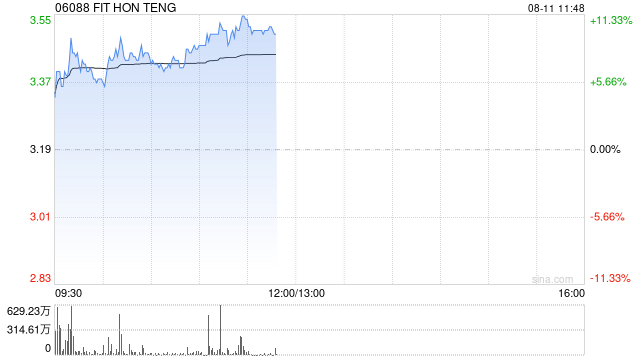
Group 1 - Hongteng Precision (06088) saw a stock price increase of 10.03%, currently trading at HKD 3.51, with a transaction volume of HKD 353 million [2] - Industrial Fulian announced a 39% year-on-year increase in net profit for the first half of the year, with the GB200 series products ramping up production [3] - According to CMB International, issues related to metal connections, liquid cooling leakage, and heat dissipation are being optimized, leading to accelerated production of GB200 since April, with an expected total of 7,000 units in the first half of the year [3] Group 2 - The GB300 series is expected to enter sample production in the second half of the year, with mass production anticipated in the fourth quarter, projecting a total of 20,000 to 25,000 units for both GB200 and GB300 for the year [3] - The global AI server OEM/ODM leaders, including Industrial Fulian as a top-tier supplier for GB200 servers, are expected to benefit, along with component manufacturers such as BYD Electronics and Hongteng Precision for AI server products and connectors [3]