
中特估

Search documents
电投能源涨2.02%,成交额4810.69万元,主力资金净流入158.19万元
Xin Lang Cai Jing· 2025-12-22 01:54
Core Viewpoint - The stock of Electric Power Investment Energy has shown a significant increase in price and trading activity, indicating positive market sentiment and potential growth opportunities for the company [1][2]. Group 1: Stock Performance - As of December 22, Electric Power Investment Energy's stock price rose by 2.02% to 27.82 CNY per share, with a total market capitalization of 62.36 billion CNY [1]. - The stock has increased by 48.14% year-to-date, with a 0.61% rise over the last five trading days, 6.55% over the last 20 days, and 25.48% over the last 60 days [1]. Group 2: Financial Performance - For the period from January to September 2025, Electric Power Investment Energy reported a revenue of 22.40 billion CNY, reflecting a year-on-year growth of 2.72%, while the net profit attributable to shareholders decreased by 6.40% to 4.12 billion CNY [2]. - The company has distributed a total of 11.81 billion CNY in dividends since its A-share listing, with 4.55 billion CNY distributed over the last three years [3]. Group 3: Shareholder Information - As of September 30, 2025, the number of shareholders for Electric Power Investment Energy decreased by 11.29% to 27,100, while the average number of circulating shares per person increased by 12.72% to 82,831 shares [2]. - Among the top ten circulating shareholders, Hong Kong Central Clearing Limited holds 47.24 million shares, an increase of 18.51 million shares compared to the previous period [3]. Group 4: Business Overview - Electric Power Investment Energy, established on December 18, 2001, and listed on April 18, 2007, is primarily engaged in the production, processing, and sales of coal products, thermal power, and electrolytic aluminum [1]. - The company's revenue composition includes aluminum products (55.11%), coal products (30.29%), power products (13.02%), and others (1.59%) [1].

中国国有企业估值的“表象之谜”与“结构真相”|论文故事汇
清华金融评论· 2025-12-21 09:38
Core Viewpoint - The article discusses the valuation differences between state-owned enterprises (SOEs) and private enterprises (PEs) in China, challenging the common belief that SOEs are undervalued. It reveals that SOEs exhibit a structural characteristic of low Price-to-Book (PB) ratios but high Price-to-Earnings (PE) ratios, providing a new perspective on the valuation logic of SOEs and the optimization of the capital market [2][4][6]. Valuation Differences - The discussion on the valuation differences between SOEs and PEs has been ongoing, especially with the introduction of the "中特估" concept. The prevailing narrative in the market suggests that SOEs are undervalued, but this article seeks to explore the reasons behind this perception and whether it is justified [4][5]. - Research indicates that contrary to the domestic view, studies based on East Asian economies often find that SOEs have higher valuations than PEs, highlighting a significant gap between public perception and academic findings [4][5]. Importance of Valuation Issues - The valuation of SOEs is crucial as they play a significant role in national strategy, industrial security, and employment stability. The valuation levels of SOEs affect not only investors' asset allocation strategies but also the efficiency of resource allocation in the capital market and the direction of SOE reforms [5]. Key Findings - The empirical research reveals that SOEs have a PB ratio that is significantly lower by 8.15% compared to non-SOEs, aligning with the common narrative of undervaluation. However, SOEs also have a PE ratio that is higher by 13.44% than non-SOEs, presenting a paradox that challenges the simplistic view of SOE valuation [7][8]. - This duality in valuation metrics suggests that SOE valuation cannot be simply categorized as undervalued or overvalued; rather, it represents a complex picture where different perspectives (asset vs. earnings) yield contrasting results [8]. Structural Perspective - The findings encourage a structural perspective on SOE valuation, suggesting that the valuation logic of SOEs is multifaceted and cannot be captured by a single metric. This approach lays the groundwork for further exploration of the economic logic behind the divergence in PB and PE ratios, such as future excess returns and differences in capital costs [8].


青岛港涨0.12%,成交额1.22亿元,今日主力净流入-211.29万
Xin Lang Cai Jing· 2025-12-19 07:46
Core Viewpoint - Qingdao Port is positioned favorably due to its strategic location and recent developments, including a partnership with Huawei to enhance smart port operations, which may lead to growth opportunities in the shipping and logistics sector [2][3]. Group 1: Company Overview - Qingdao Port International Co., Ltd. is located in Shandong Province and was established on November 15, 2013, with its listing date on January 21, 2019 [6]. - The company primarily engages in the handling of containers, metal ores, coal, crude oil, and provides logistics and port value-added services, with revenue composition as follows: 56.72% from handling and related services, 36.96% from logistics and port value-added services, and smaller percentages from other port-related services [6]. - As of September 30, 2025, Qingdao Port achieved operating revenue of 14.238 billion yuan, a year-on-year increase of 1.86%, and a net profit attributable to shareholders of 4.180 billion yuan, up 6.33% year-on-year [6]. Group 2: Financial Performance - The company has maintained a dividend payout of 13.77 billion yuan since its A-share listing, with a cumulative payout of 6.638 billion yuan over the past three years [7]. - The recent dividend yields for the past three years were 4.80%, 4.74%, and 3.45% respectively, indicating a consistent return to shareholders [2]. Group 3: Market Position and Trends - Qingdao Port is strategically located in the center of the Bohai Sea and Yangtze River Delta port clusters, benefiting from the China-South Korea Free Trade Agreement [2]. - The port is recognized as a key node in the Belt and Road Initiative and is the only comprehensive operator of the world’s seventh-largest port, contributing to its strong operational performance [2]. Group 4: Shareholder and Institutional Holdings - As of September 30, 2025, the number of shareholders for Qingdao Port was 38,300, reflecting an increase of 7.23% from the previous period [6]. - Notable institutional shareholders include the Southern S&P China A-share Large Cap Dividend Low Volatility ETF and Hong Kong Central Clearing Limited, both of which have increased their holdings [8].

中国铝业涨2.09%,成交额7.04亿元,主力资金净流出1731.53万元
Xin Lang Cai Jing· 2025-12-19 02:53
12月19日,中国铝业盘中上涨2.09%,截至10:32,报10.75元/股,成交7.04亿元,换手率0.51%,总市值 1844.23亿元。 资料显示,中国铝业股份有限公司位于北京市海淀区西直门北大街62号,成立日期2001年9月10日,上 市日期2007年4月30日,公司主营业务涉及铝土矿、煤炭等资源的勘探开采,氧化铝、原铝和铝合金产品 生产、销售、技术研发,国际贸易,物流产业,火力及新能源发电等。主营业务收入构成为:销售商品 97.41%,其他业务收入1.56%,提供服务1.03%。 中国铝业所属申万行业为:有色金属-工业金属-铝。所属概念板块包括:债转股、中特估、H股、有色 铝、证金汇金等。 截至9月30日,中国铝业股东户数35.63万,较上期减少2.91%;人均流通股0股,较上期增加0.00%。 2025年1月-9月,中国铝业实现营业收入1765.16亿元,同比增长1.58%;归母净利润108.72亿元,同比增 长20.58%。 分红方面,中国铝业A股上市后累计派现133.58亿元。近三年,累计派现78.23亿元。 资金流向方面,主力资金净流出1731.53万元,特大单买入9172.91万元,占比1 ...

荣盛石化涨2.07%,成交额1.38亿元,主力资金净流入123.54万元
Xin Lang Zheng Quan· 2025-12-19 02:48
Core Viewpoint - Rongsheng Petrochemical's stock has shown a positive trend with a year-to-date increase of 10.11%, reflecting investor interest and market activity [1]. Group 1: Stock Performance - As of December 19, Rongsheng Petrochemical's stock price rose by 2.07% to 9.86 CNY per share, with a trading volume of 1.38 billion CNY and a turnover rate of 0.15%, resulting in a total market capitalization of 98.496 billion CNY [1]. - The stock has experienced a 5.57% increase over the last five trading days and a 0.51% increase over the last 20 days [1]. Group 2: Financial Performance - For the period from January to September 2025, Rongsheng Petrochemical reported a revenue of 227.815 billion CNY, a year-on-year decrease of 7.09%, while the net profit attributable to shareholders was 0.888 billion CNY, reflecting a year-on-year growth of 1.34% [2]. Group 3: Shareholder Information - As of September 30, 2025, the number of shareholders for Rongsheng Petrochemical was 73,700, a decrease of 14.14% from the previous period, while the average number of circulating shares per person increased by 14.80% to 126,986 shares [2]. - The company has distributed a total of 9.4 billion CNY in dividends since its A-share listing, with 3.391 billion CNY distributed over the last three years [3]. Group 4: Institutional Holdings - As of September 30, 2025, Hong Kong Central Clearing Limited was the third-largest circulating shareholder, holding 191 million shares, an increase of 17.0569 million shares from the previous period [3]. - Huatai-PB CSI 300 ETF was the seventh-largest circulating shareholder, holding 51.9743 million shares, a decrease of 2.4058 million shares from the previous period [3].

中国神华涨2.00%,成交额6.86亿元,主力资金净流入5184.77万元
Xin Lang Zheng Quan· 2025-12-18 06:34
Core Viewpoint - China Shenhua's stock price has shown a slight increase of 1.39% year-to-date, with a recent trading price of 40.80 CNY per share and a market capitalization of 810.64 billion CNY [1] Group 1: Stock Performance - As of December 18, China Shenhua's stock rose by 2.00% during the trading session, with a trading volume of 6.86 billion CNY and a turnover rate of 0.10% [1] - The stock has experienced a 1.22% increase over the last five trading days, a 2.86% decrease over the last twenty days, and a 7.37% increase over the last sixty days [1] Group 2: Financial Performance - For the period from January to September 2025, China Shenhua reported a revenue of 213.15 billion CNY, a year-on-year decrease of 16.05%, and a net profit attributable to shareholders of 39.05 billion CNY, down 15.24% year-on-year [2] Group 3: Shareholder Information - As of September 30, 2025, the number of shareholders for China Shenhua reached 209,200, an increase of 29.69% from the previous period, while the average number of circulating shares per person decreased by 23.09% to 79,468 shares [2] - The company has distributed a total of 480.47 billion CNY in dividends since its A-share listing, with 159.94 billion CNY distributed over the last three years [3] - Major shareholders include China Securities Finance Corporation, holding 595 million shares, and Hong Kong Central Clearing Limited, holding 104 million shares, which saw a reduction of 67.33 million shares from the previous period [3]

中国国航涨2.06%,成交额2.60亿元,主力资金净流入1418.24万元
Xin Lang Cai Jing· 2025-12-18 03:16
12月18日,中国国航盘中上涨2.06%,截至10:51,报8.93元/股,成交2.60亿元,换手率0.25%,总市值 1558.14亿元。 资金流向方面,主力资金净流入1418.24万元,特大单买入2296.87万元,占比8.85%,卖出902.12万元, 占比3.48%;大单买入6686.14万元,占比25.76%,卖出6662.65万元,占比25.67%。 中国国航今年以来股价涨12.90%,近5个交易日涨9.84%,近20日涨3.48%,近60日涨10.38%。 资料显示,中国国际航空股份有限公司位于北京天竺空港经济开发区天柱路30号,香港国际机场东辉路 12号中航大厦5楼,成立日期2006年3月27日,上市日期2006年8月18日,公司主营业务涉及航空客运和 航空货运及邮运。主营业务收入构成为:航空客运90.64%,其他4.93%,航空货运及邮运4.43%。 中国国航所属申万行业为:交通运输-航空机场-航空运输。所属概念板块包括:民用航空、中字头、中 特估、证金汇金、央企改革等。 截至9月30日,中国国航股东户数12.91万,较上期减少0.12%;人均流通股0股,较上期增加0.00%。 2025年1 ...

ETF日报:目前养殖业处于典型“弱现实、强预期”阶段,行业产能大趋势已经确立
Xin Lang Cai Jing· 2025-12-15 13:39
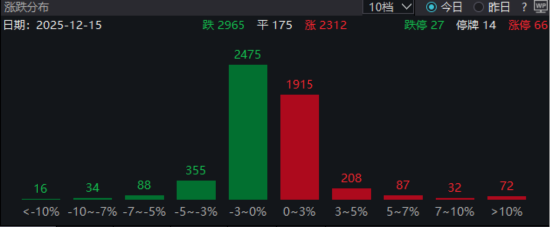
Market Overview - A-shares experienced a downward trend today, with the Shanghai Composite Index closing at 3867.92 points, down 0.55%, and the Shenzhen Component Index at 13112.09 points, down 1.10% [1][11] - Total trading volume in the two markets was less than 1.8 trillion yuan, a decrease from the previous trading day [1][11] - The overall market saw more declines than gains, with non-bank financials rising during the day while electronics and telecommunications sectors led the decline [1][11] Economic and Policy Environment - The current economic and policy environment for A-shares remains positive, with expectations for fiscal spending to support a recovery in total economic demand [3][13] - In the medium term, with the implementation of various growth stabilization measures and loose monetary and fiscal policies, total demand growth is expected to return to an expansionary range, potentially leading A-shares into an upward cycle [3][13] Fixed Asset Investment and Debt Market - Recent data from the National Bureau of Statistics shows that the cumulative year-on-year growth rate of fixed asset investment has dropped to -2.6%, the lowest since 2021, with real estate investment declining over 30% year-on-year in a single month [4][14] - The economic structure continues to exhibit strong supply, weak demand, and low inflation characteristics, which is marginally beneficial for the bond market [4][14] - Although sentiment in the bond market remains weak, signs of stabilization are beginning to emerge, with supply pressures expected to ease in the near term [4][14] - The 10-year government bond yield has surpassed the upper limit of the central bank's acceptable range at 1.85%, with downward momentum expected to outweigh upward pressure [4][14] Livestock Sector - The livestock sector is showing signs of stabilization and recovery, with the industry currently in a "weak reality, strong expectation" phase, and overall capacity trends established [4][14] - In the pig cycle, the number of breeding sows has been continuously reduced due to long-term losses and policy guidance, with supply pressure expected to significantly ease by the second half of 2026 [5][15] - In poultry farming, the supply of white chickens has slightly increased, while yellow chicken supply remains at a low level, likely benefiting from improved domestic demand [5][15] - Investing in livestock ETFs can effectively mitigate risks associated with individual companies and capture the beta returns from the industry's cyclical reversal [5][15] Gold Sector - The gold sector performed well today, with COMEX gold surpassing 4370, and gold ETFs showing increases of 1.37% and 1.28% [6][16] - The Federal Reserve's recent decision to cut interest rates by 25 basis points and initiate reserve management purchases is expected to support gold prices in the medium to long term [6][16][17] - Geopolitical tensions, including the ongoing Russia-Ukraine negotiations and U.S. pressure on Venezuela, continue to create uncertainty that may support gold prices [6][16][17] Dividend and Long-term Investment Strategies - The recent market volatility has led to a cautious investor behavior, with some funds shifting from aggressive to defensive strategies, benefiting dividend stocks as a safe haven [7][17] - Regulatory changes encouraging cash dividends and long-term capital inflows are expected to enhance the demand for dividend assets [7][17][18] - The new "National Nine Articles" and market value management policies are likely to promote stable dividend expectations, benefiting state-owned enterprises and enhancing their valuation [7][18]
日本股市没想到过去10年回报还行
集思录· 2025-12-14 14:17
Core Viewpoint - The article discusses the performance of the Japanese stock market and its relationship with the country's economic growth, highlighting the disparity between stock market returns and GDP growth rates [2][3]. Group 1: Japanese Stock Market Performance - The annualized return of the Japanese stock market over the past 10 years is approximately 7.8% [2]. - Major companies mentioned include Toyota with a market cap of over 2 trillion RMB and a PE ratio of 8.67, Fast Retailing with a market cap of 800 billion RMB and a PE of 39, and others like SoftBank, Mitsubishi, Sony, Hitachi, and Nintendo [2]. - The article notes that the performance of the stock market may not directly correlate with domestic economic growth, as many large companies operate internationally [6][11]. Group 2: Economic Growth Data - Japan's GDP growth rates from 2020 to 2023 show fluctuations: -4.3% in 2020, +2.1% in 2021, +1.0% in 2022, and +1.9% in 2023 [2]. - IMF forecasts for 2024 and 2025 predict GDP growth rates of 0.7% and 0.5%, respectively, citing factors like insufficient domestic demand and an aging population [2][4]. Group 3: Global Economic Context - Japan's share of the global GDP has significantly decreased from 17.7% in 1995 to an estimated 3.6% in 2024, indicating a substantial decline in its economic influence [3][4]. - The article suggests that the stock market's performance may not be a reliable indicator of the overall economy, as evidenced by the contrasting trends in GDP and stock market returns [3][10]. Group 4: Investment Strategies - The article mentions that the Bank of Japan has been actively buying Japanese stocks for over 15 years, contributing to market liquidity [12]. - Notable investors like Warren Buffett have shown interest in Japanese companies, focusing on valuation, fundamentals, and shareholder return mechanisms [7].



中国黄金涨0.50%,成交额1.10亿元,近3日主力净流入-236.81万
Xin Lang Cai Jing· 2025-12-12 08:12
Core Viewpoint - The article discusses the performance and financial metrics of China Gold Group Jewelry Co., Ltd., highlighting its recent stock price movement, market capitalization, and financial results for the year 2025. Group 1: Company Overview - China Gold Group Jewelry Co., Ltd. specializes in the sales and processing of gold jewelry products, including gold and K-gold jewelry [2] - The company is a state-owned enterprise controlled by the State-owned Assets Supervision and Administration Commission of the State Council [3][4] - It is recognized as a central enterprise in China's gold jewelry retail sector, with its main revenue sources being gold products (98.83%), brand usage fees (0.67%), management service fees (0.22%), and K-gold jewelry products (0.13%) [7] Group 2: Financial Performance - For the period from January to September 2025, the company reported a revenue of 45.764 billion yuan, a year-on-year decrease of 1.74%, and a net profit attributable to shareholders of 335 million yuan, down 55.08% year-on-year [7] - The company has distributed a total of 2.52 billion yuan in dividends since its A-share listing, with 1.848 billion yuan distributed over the past three years [8] Group 3: Market Activity - On December 12, the stock price of China Gold increased by 0.50%, with a trading volume of 110 million yuan and a turnover rate of 0.82%, leading to a total market capitalization of 13.507 billion yuan [1] - The main capital inflow for the day was 5.813 million yuan, accounting for 0.05% of the total, with the stock showing no clear trend in major capital movements [4][5]
