
制造业采购经理指数(PMI)

Search documents
11月制造业采购经理指数(PMI)为49.2%
Yang Shi Wang· 2025-12-01 22:33
国家统计局数据显示,11月份,制造业采购经理指数(PMI)为49.2%,比上月上升0.2个百分点,景气 水平有所改善。 从企业规模看,大型企业PMI为49.3%,比上月下降0.6个百分点,低于临界点;中、小型企业PMI分别 为48.9%和49.1%,比上月上升0.2个和2.0个百分点,均低于临界点。 从分类指数看,在构成制造业PMI的5个分类指数中,供应商配送时间指数高于临界点,生产指数位于 临界点,新订单指数、原材料库存指数和从业人员指数均低于临界点。 新订单指数为49.2%,比上月上升0.4个百分点,表明制造业市场需求景气水平有所改善。 生产指数为50.0%,比上月上升0.3个百分点,位于临界点,表明制造业生产总体稳定。 原材料库存指数为47.3%,与上月持平,低于临界点,表明制造业主要原材料库存量继续减少。 从业人员指数为48.4%,比上月上升0.1个百分点,表明制造业企业用工景气度小幅回升。 供应商配送时间指数为50.1%,比上月上升0.1个百分点,表明制造业原材料供应商交货时间略有加快。 转自:央视网 ...
“数”里行间感知信心!投资与消费需求释放 为全年经济良好收官奠定基础
Yang Shi Wang· 2025-12-01 07:22
Group 1: Manufacturing Sector - The manufacturing Purchasing Managers' Index (PMI) for November is reported at 49.2%, showing a 0.2 percentage point increase from the previous month, indicating an improvement in manufacturing sentiment [1] - Both the production index and new orders index have rebounded compared to last month, with the production index reaching the critical point, suggesting improvements in both production and demand [1] - High-tech manufacturing PMI has remained above the critical point for 10 consecutive months, indicating continued growth in related industries [1] Group 2: Small and Medium Enterprises - The PMI for small and medium-sized enterprises has shown varying degrees of recovery, with the small enterprise PMI reaching a six-month high, reflecting a notable improvement in their business conditions [1] Group 3: Market Expectations - The production and business activity expectation index has increased from the previous month, indicating enhanced confidence among manufacturing enterprises regarding recent market developments [3] - Industries such as non-ferrous metal smelting and processing, as well as railway, shipbuilding, and aerospace equipment, have business activity expectation indices above 57%, reflecting optimism in these sectors [3] Group 4: Non-Manufacturing Sector - The non-manufacturing business activity index for November is reported at 49.5%, with a slowdown in overall business activity due to seasonal declines in consumer-related services [5] - Financial activities have shown robust performance, and new momentum industries are operating steadily, with stable optimistic expectations among enterprises [4][9] - The non-manufacturing business activity expectation index is at 56.2%, marking a 0.1 percentage point increase from the previous month and remaining above 56% for two consecutive months [8] Group 5: Economic Outlook - The data indicates that enterprises maintain stable optimistic expectations for future non-manufacturing development, supported by ongoing policy measures and a year-end push in supply and demand, which is expected to release investment and consumption-related demand [9]

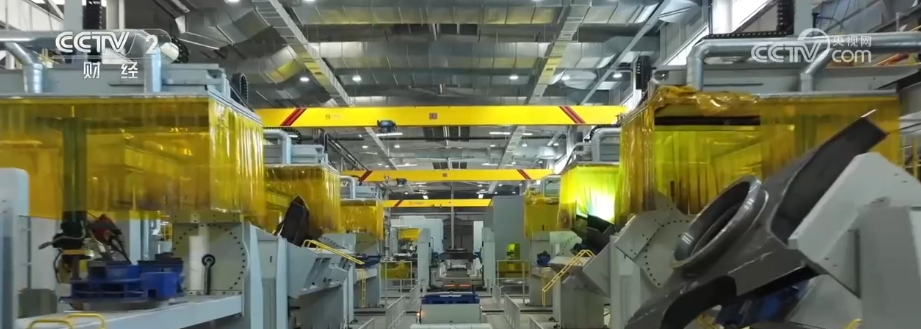
11月份制造业PMI回升至49.2%
Chang Jiang Shang Bao· 2025-12-01 06:41
Core Viewpoint - The manufacturing sector shows signs of improvement with a slight increase in the Purchasing Managers' Index (PMI), while the non-manufacturing sector experiences a decline, indicating mixed economic conditions in China [1][2]. Manufacturing Sector - In November, the manufacturing PMI was reported at 49.2%, an increase of 0.2 percentage points from the previous month, indicating a stable upward trend in manufacturing [1][2]. - Among the 13 sub-indices, production index, new orders index, and new export orders index showed increases, with production index reaching the critical point at 50.0% [2]. - The new orders index rose to 49.2%, reflecting improved demand conditions [2]. Non-Manufacturing Sector - The non-manufacturing business activity index fell to 49.5%, a decrease of 0.6 percentage points from the previous month, suggesting a slowdown in non-manufacturing activities [1][2]. - Service industry activity index also declined to 49.5%, influenced by the end of holiday effects, with certain sectors like real estate and residential services showing weaker market activity [2]. Construction Sector - The construction business activity index improved to 49.6%, up by 0.5 percentage points, indicating a recovery in the construction sector [3]. - The business activity expectation index for the construction sector rose to 57.9%, reflecting increased confidence among construction enterprises regarding future industry developments [3]. Investment Outlook - The release of 500 billion yuan in new policy financial tools in October is expected to stimulate infrastructure and manufacturing investments, contributing to economic stability [3]. - Analysts predict that the acceleration of key projects towards the end of the year, combined with special bonds and policy financial tools, will support investment growth [3].
国家统计局:11月份我国制造业PMI为49.2%
Xin Hua She· 2025-12-01 05:57
新华社北京11月30日电 (记者 王雨萧)国家统计局服务业调查中心、中国物流与采购联合会11月 30日发布数据显示,11月份,制造业采购经理指数(PMI)为49.2%,比上月上升0.2个百分点,景气水 平有所改善。 数据显示,11月份,生产指数和新订单指数分别为50.0%和49.2%,比上月上升0.3个和0.4个百分 点,其中生产指数升至临界点,制造业产需两端均有改善。11月份,大型企业PMI为49.3%,比上月下 降0.6个百分点,景气水平回落;中型企业PMI为48.9%,比上月上升0.2个百分点,景气度有所改善;小 型企业PMI为49.1%,比上月上升2.0个百分点,为近6个月高点,景气水平显著回升。 此外,高技术制造业PMI为50.1%,连续10个月位于临界点以上,相关行业继续保持增长。 数据还显示,11月份,生产经营活动预期指数为53.1%,比上月上升0.3个百分点,制造业企业对近 期市场发展信心有所增强。 ...
《疯狂动物城2》成为中国影史进口动画票房冠军|首席资讯日报
首席商业评论· 2025-12-01 04:29
1.《疯狂动物城2》票房超第一部,成为中国影史进口动画票房冠军 据灯塔专业版,截至11月30日0时,影片《疯狂动物城2》票房已突破16亿,超过第一部《疯狂动物城》 15.40亿的票房成绩,成为中国影史进口动画票房冠军。 2.旧国标电动自行车全面停售 根据官方公告,所有销售的电动自行车产品均必须符合新版强制性国家标准,即《电动自行车安全技术规 范》(GB17761-2024),"旧国标"电动自行车全面停售。该标准于9月1日正式实施,其中生产环节实施时间是 2025年9月1日,当时的新产品已经全面转为新国标。销售环节实施时间是2025年12月1日。新国标明确规定 电动自行车最高设计车速不得超过25km/h,并要求超过25km/h时电动机自动停止动力输出,可有效遏制超 速行驶带来的安全隐患。 3.2025全球开发者先锋大会暨国际具身智能技能大赛12月举行,将首次引入机器人裁判 2025全球开发者先锋大会暨国际具身智能技能大赛将于12月12日至14日在上海张江科学会堂举行。从工业 生产到社会服务、从家庭助理到应急救援、从医疗照护到艺术演绎,本次大赛设置了6大主题赛道、8大场 景赛项,涵盖19个细分赛项,几乎囊括机器人 ...

11月制造业PMI回升至49.2% 小型企业景气水平显著回升
Zhong Guo Jing Ying Bao· 2025-12-01 04:14
Core Viewpoint - The manufacturing sector in China showed signs of improvement in November, with the Purchasing Managers' Index (PMI) rising to 49.2%, an increase of 0.2 percentage points from the previous month, driven by policy support, seasonal production peaks, and a marginal recovery in external demand [2] Group 1: Manufacturing Sector Insights - The production and business activity expectation index rose to 53.1%, indicating increased confidence among manufacturing enterprises regarding market developments [2] - The high-tech manufacturing PMI decreased by 0.4 percentage points to 50.1%, yet it remains in the expansion zone, reflecting strong growth and resilience against shocks [2] - The PMI for small enterprises significantly improved to 49.1%, up by 2.0 percentage points, marking a six-month high and indicating a notable enhancement in economic conditions for these businesses [2][3] Group 2: Small Enterprises Analysis - The recovery in small enterprise PMI is attributed to effective policy support such as tax reductions and financing preferences, alongside a rebound in downstream consumer demand [3] - The rise in small enterprise PMI suggests that inclusive financial policies and tax cuts are effectively stimulating market vitality, which could improve employment and enhance economic momentum [3] - Despite the improvement, small enterprises still face challenges such as insufficient demand and financing difficulties, necessitating ongoing policy support to sustain positive trends [4] Group 3: Construction Sector Insights - The construction sector's business activity index rose to 49.6%, an increase of 0.5 percentage points, indicating a recovery in the industry [4] - The business activity expectation index for the construction sector reached 57.9%, reflecting improved confidence among construction enterprises regarding future industry trends [4] - The marginal improvement in construction PMI is driven by increased infrastructure investment and a slight easing of real estate policies, coupled with seasonal demand increases during winter [4][5]
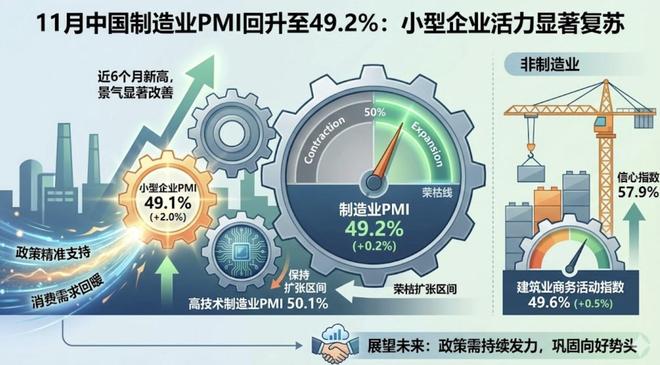
格林大华期货早盘提示:国债-20251201
Ge Lin Qi Huo· 2025-12-01 02:51
Morning session notice Morning session notice 早盘提示 早盘提示 更多精彩内容请关注格林大华期货官方微信 更多精彩内容请关注格林大华期货官方微信 格林大华期货研究院 证监许可【2011】1288 号 2025 年 12 月 1 日星期一 研究员: 刘洋 从业资格: F3063825 交易咨询资格:Z0016580 联系方式:liuyang18036@greendh.com | 板块 | 品种 | 多(空) | 推荐理由 | | --- | --- | --- | --- | | | | | 【行情复盘】 上周五国债期货主力合约开盘集体高开,早盘小幅冲高后回落,午后横向窄幅波动, 截至收盘 30 年期国债期货主力合约 TL2603 上涨 0.05%,10 年期 T2603 上涨 0.03%, 5 年期 TF2603 下跌 0.03%,2 年期 TS2603 下跌 0.02%。 【重要资讯】 | | | | | 1、公开市场:上周五央行开展了 3013 亿元 7 天期逆回购操作,当天有 3750 亿元 逆回购到期,当日合计净回笼 737 亿元。 | | | | | 2 ...
11月份我国制造业PMI小幅回升 市场信心有所增强
Jin Rong Shi Bao· 2025-12-01 02:04
Group 1: Manufacturing Sector Overview - In November, China's Manufacturing Purchasing Managers' Index (PMI) was 49.2%, an increase of 0.2 percentage points from the previous month, indicating an improvement in economic conditions [1] - The production index and new orders index for November were 50.0% and 49.2%, respectively, rising by 0.3 and 0.4 percentage points, with the production index reaching the critical point [1] - The new export orders index increased by 1.7 percentage points to 47.6%, marking the second highest point since April of this year, reflecting strong resilience in exports [1] Group 2: Business Confidence and Expectations - The manufacturing production and business activity expectation index rose by 0.3 percentage points to 53.1%, indicating heightened confidence among manufacturers regarding market developments [2] - Large enterprises' PMI was 49.3%, down 0.6 percentage points, while medium and small enterprises' PMIs were 48.9% and 49.1%, up 0.2 and 2.0 percentage points, respectively, with small enterprises reaching a six-month high [2] - High-tech manufacturing maintained expansion with a PMI of 50.1%, remaining above the critical point for ten consecutive months, while equipment manufacturing and consumer goods sectors saw declines [2] Group 3: Price Trends and Inventory - In November, the purchasing price index and factory price index were 53.6% and 48.2%, respectively, both showing increases from the previous month [3] - The procurement willingness improved, with the procurement volume index at 49.5%, up 0.5 percentage points, while raw material inventory index remained stable at 47.3% [3] - The construction sector showed signs of steady recovery, with the business activity index at 49.6%, a slight increase of 0.5 percentage points, and new orders index rising to 46.1% [3] Group 4: Service Sector Performance - The service sector's business activity index fell to 49.5%, down 0.7 percentage points, indicating a return below the prosperity line [4] - The new orders index for the service sector dropped to 45.6%, reflecting insufficient recovery in market demand [4] - Despite short-term demand disruptions, the service sector's confidence remains supported, with expectations for recovery as policy benefits are released [4]
11月份我国制造业PMI为49.2% 景气水平有所改善
Yang Guang Wang· 2025-12-01 01:09
Group 1 - The manufacturing Purchasing Managers' Index (PMI) in China for November is reported at 49.2%, showing a 0.2 percentage point increase from the previous month, indicating an improvement in economic conditions [1] - The production index and new orders index for the manufacturing sector are at 50% and 49.2% respectively, with increases of 0.3 and 0.4 percentage points from last month, suggesting improvements in both production and demand [1] - The PMI for small enterprises is at 49.1%, up by 2 percentage points, marking a six-month high and a significant recovery in economic conditions [1] Group 2 - The production indices for equipment manufacturing, high-tech manufacturing, and consumer goods manufacturing remain in the expansion zone, while the basic raw materials sector shows an upward trend, indicating stable recovery in manufacturing activities [2] - The production and business activity expectation index is at 53.1%, reflecting a 0.3 percentage point increase from the previous month, suggesting enhanced confidence among manufacturing enterprises regarding market development [2] - Industries such as non-ferrous metal smelting and processing, as well as railway, shipbuilding, and aerospace equipment, have production expectation indices above 57%, indicating a high level of optimism among related enterprises [2]
制造业采购经理指数为49.2%
Ren Min Ri Bao· 2025-11-30 22:20
Core Insights - The manufacturing Purchasing Managers' Index (PMI) in China for November is reported at 49.2%, reflecting a 0.2 percentage point increase from the previous month, indicating an improvement in economic conditions [1] Group 1: Manufacturing Sector Performance - The new export orders index stands at 47.6%, which is a 1.7 percentage point increase from last month, showing a significant rise in demand [1] - The high-tech manufacturing sector's new export orders index increased by over 3 percentage points compared to last month, while the consumer goods manufacturing sector's new export orders index rose by over 2 percentage points [1] - Overall, the new orders index for manufacturing is at 49.2%, up by 0.4 percentage points from the previous month, suggesting a recovery in market demand [1] Group 2: Business Confidence - The production and business activity expectation index is at 53.1%, which is a 0.3 percentage point increase from last month, indicating enhanced confidence among manufacturing enterprises regarding recent market developments [1]