Transformer架构

Search documents
Transformer 在具身智能“水土不服”,大模型强≠机器人强
3 6 Ke· 2025-06-18 11:55
Core Insights - The year 2025 is anticipated to be the "Year of Embodied Intelligence," driven by significant events and advancements in robotics and AI technologies [1] - There is a growing interest and investment in the field of general robotics, but concerns about sustainability and potential market bubbles persist [1] - Experts are exploring the challenges and advancements in embodied intelligence, focusing on the gap between technological ideals and engineering realities [1] Group 1: Industry Trends - A surge in robotics startups and investments indicates a strong belief in the potential of general robotics [1][2] - The transition from multi-modal large models to embodied intelligence is seen as a natural evolution, requiring substantial data and infrastructure improvements [3][4] - Current AI models face limitations in multi-task scenarios, highlighting the need for better adaptability and learning mechanisms [5][6] Group 2: Technical Challenges - The high energy consumption and training costs of large models pose significant challenges for their application in robotics [4][5] - There is a notable gap between the capabilities of large models and the multi-modal sensory systems of robots, complicating their integration [6][7] - The industry is exploring both modular and end-to-end architectures for embodied intelligence, with a shift towards more unified systems [9][10] Group 3: Research and Development - Research is focused on bridging the gap between human, AI, and robotic intelligence, aiming for better collaboration and understanding [16][18] - The current state of embodied intelligence is limited, with robots primarily executing pre-defined tasks rather than understanding human needs [18][19] - Future developments may involve creating systems that can interpret human intentions directly, bypassing traditional communication methods [20][21] Group 4: Future Outlook - Experts believe that achieving true embodied intelligence will require overcoming significant technical hurdles, particularly in understanding and interacting with the physical world [23][24] - The evolution of AI architectures, particularly beyond the current Transformer models, is essential for the long-term success of embodied intelligence [24][25] - The next five to ten years are expected to be critical for advancements in both hardware and software, potentially leading to widespread adoption of household robots [31][32]

一文了解DeepSeek和OpenAI:企业家为什么需要认知型创新?
混沌学园· 2025-06-10 11:07
Core Viewpoint - The article emphasizes the transformative impact of AI technology on business innovation and the necessity for companies to adapt their strategies to remain competitive in the evolving landscape of AI [1][2]. Group 1: OpenAI's Emergence - OpenAI was founded in 2015 by Elon Musk and Sam Altman with the mission to counteract the monopolistic power of major tech companies in AI, aiming for an open and safe AI for all [9][10][12]. - The introduction of the Transformer architecture by Google in 2017 revolutionized language processing, enabling models to understand context better and significantly improving training speed [13][15]. - OpenAI's belief in the Scaling Law led to unprecedented investments in AI, resulting in the development of groundbreaking language models that exhibit emergent capabilities [17][19]. Group 2: ChatGPT and Human-Machine Interaction - The launch of ChatGPT marked a significant shift in human-machine interaction, allowing users to communicate in natural language rather than through complex commands, thus lowering the barrier to AI usage [22][24]. - ChatGPT's success not only established a user base for future AI applications but also reshaped perceptions of human-AI collaboration, showcasing vast potential for future developments [25]. Group 3: DeepSeek's Strategic Approach - DeepSeek adopted a "Limited Scaling Law" strategy, focusing on maximizing efficiency and performance with limited resources, contrasting with the resource-heavy approaches of larger AI firms [32][34]. - The company achieved high performance at low costs through innovative model architecture and training methods, emphasizing quality data selection and algorithm efficiency [36][38]. - DeepSeek's R1 model, released in January 2025, demonstrated advanced reasoning capabilities without human feedback, marking a significant advancement in AI technology [45][48]. Group 4: Organizational Innovation in AI - DeepSeek's organizational model promotes an AI Lab paradigm that fosters emergent innovation, allowing for open collaboration and resource sharing among researchers [54][56]. - The dynamic team structure and self-organizing management style encourage creativity and rapid iteration, essential for success in the unpredictable field of AI [58][62]. - The company's approach challenges traditional hierarchical models, advocating for a culture that empowers individuals to explore and innovate freely [64][70]. Group 5: Breaking the "Thought Stamp" - DeepSeek's achievements highlight a shift in mindset among Chinese entrepreneurs, demonstrating that original foundational research in AI is possible within China [75][78]. - The article calls for a departure from the belief that Chinese companies should only focus on application and commercialization, urging a commitment to long-term foundational research and innovation [80][82].


大模型专题:大模型架构创新研究报告
Sou Hu Cai Jing· 2025-06-06 11:38
Core Insights - The report focuses on innovations in large model architectures, particularly addressing the limitations of the Transformer architecture and exploring industry pathways for improvement [1][2][7] - As model sizes increase, the secondary computational complexity of Transformers (O(n²)) leads to significant power consumption and efficiency bottlenecks in processing long sequences, prompting a demand for innovative solutions [1][2][15] - The industry is currently exploring two main paths for architectural breakthroughs: improvements to the Transformer architecture and exploration of non-Transformer architectures [1][2][7] Transformer Architecture Improvements - Improvements to the Transformer architecture focus on optimizing the Attention mechanism, Feed-Forward Network (FFN) layers, and normalization layers [1][2][18] - Techniques such as sparse attention and dynamic attention are being developed to enhance computational efficiency, while Mixture of Experts (MoE) aims to improve sparse connection efficiency in FFN layers [1][2][18] - LongRoPE and other technologies are enhancing positional encoding to better model long sequences [1][2][18] Non-Transformer Architecture Exploration - Non-Transformer architectures include new types of RNNs (e.g., RWKV, Mamba) and CNNs (e.g., Hyena Hierarchy), as well as other innovative architectures like RetNet and LFM [1][2][7] - RWKV optimizes state evolution through a generalized Delta Rule, while Mamba leverages state space models to enhance training efficiency [1][2][7] - RetNet combines state space and multi-head attention to achieve parallel computation [1][2][7] Industry Trends and Future Directions - The industry is witnessing a trend towards hybrid architectures that combine linear Transformers with non-Transformer architectures, balancing performance and efficiency [2][7] - The current phase is characterized by a peak in traditional Transformer paradigms and an impending wave of architectural innovations, with significant focus on new RNN/CNN theoretical breakthroughs and practical engineering optimizations [2][7] - Companies like ByteDance and Alibaba are accelerating their investments in hybrid architectures, driving the evolution of large models towards higher efficiency and lower energy consumption [2][7]

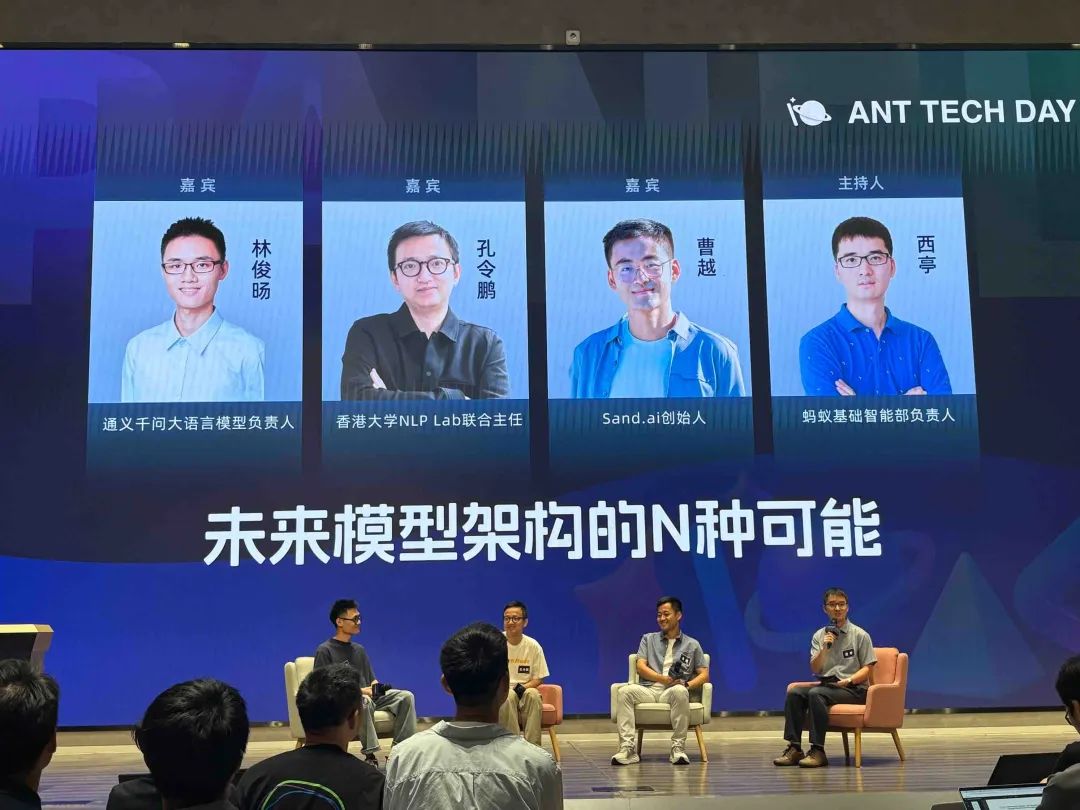
三位顶流AI技术人罕见同台,谈了谈AI行业最大的「罗生门」
3 6 Ke· 2025-05-28 11:59
Core Insights - The AI industry is currently experiencing a significant debate over the effectiveness of pre-training models versus first principles, with notable figures like Ilya from OpenAI suggesting that pre-training has reached its limits [1][2] - The shift from a consensus-driven approach to exploring non-consensus methods is evident, as companies and researchers seek innovative solutions in AI [6][7] Group 1: Industry Trends - The AI landscape is witnessing a transition from a focus on pre-training to exploring alternative methodologies, with companies like Sand.AI and NLP LAB leading the charge in applying multi-modal architectures to language and video models [3][4] - The emergence of new models, such as Dream 7B, demonstrates the potential of applying diffusion models to language tasks, outperforming larger models like DeepSeek V3 [3][4] - The consensus around pre-training is being challenged, with some experts arguing that it is not yet over, as there remains untapped data that could enhance model performance [38][39] Group 2: Company Perspectives - Ant Group's Qwen team, led by Lin Junyang, has faced criticism for being conservative, yet they emphasize that their extensive experimentation has led to valuable insights, ultimately reaffirming the effectiveness of the Transformer architecture [5][15] - The exploration of Mixture of Experts (MoE) models is ongoing, with the team recognizing the potential for scalability while also addressing the challenges of training stability [16][20] - The industry is increasingly focused on optimizing model efficiency and effectiveness, with a particular interest in achieving a balance between model size and performance [19][22] Group 3: Technical Innovations - The integration of different model architectures, such as using diffusion models for language generation, reflects a broader trend of innovation in AI [3][4] - The challenges of training models with long sequences and the need for effective optimization strategies are critical areas of focus for researchers [21][22] - The potential for future breakthroughs lies in leveraging increased computational power to revisit previously unviable techniques, suggesting a cycle of innovation driven by advancements in hardware [40][41]
自动驾驶未来技术趋势怎样?李想:现阶段VLA是能力最强的架构
news flash· 2025-05-07 13:27
Core Viewpoint - The CEO of Li Auto, Li Xiang, discussed the transition of the auxiliary driving system to the VLA architecture, questioning its efficiency compared to potential future architectures [1] Group 1 - VLA architecture is capable of addressing full autonomous driving, but its efficiency as the optimal solution is uncertain [1] - Li Xiang highlighted that VLA is still based on the transformer architecture, which raises questions about whether transformer is the most efficient architecture available [1] - Currently, VLA is considered the most powerful architecture in terms of capabilities [1]

160人卖了217亿,AI应用首个大额套现项目,CEO解密成功秘诀
Sou Hu Cai Jing· 2025-05-06 12:35
Core Insights - AI programming unicorn Windsurf is set to be acquired by OpenAI for $3 billion, marking OpenAI's largest acquisition to date [2] - Windsurf has experienced rapid growth since launching its AI-native IDE product, achieving over 1 million users and an annual recurring revenue (ARR) exceeding $100 million within four months [2][28] - The company emphasizes the importance of a strong sales team, which has grown to over 80 members, surpassing the engineering team in size [2][44] Company Overview - Windsurf was founded four years ago, initially focusing on GPU virtualization and compiler software before pivoting to AI programming [5][6] - The company operates with a lean team of fewer than 160 employees, maintaining a low hiring rate of under 0.6% [3][41] - The company culture encourages high levels of initiative and innovation, rewarding employees who achieve significant results with minimal resources [3][35] Product Development - Windsurf's IDE aims to revolutionize software development by integrating AI capabilities that can rewrite entire code segments, contrasting with traditional IDEs that only provide basic feedback [14][15] - The company has developed a unique capability to understand and modify large codebases, which is a significant competitive advantage [48][49] Market Strategy - Windsurf's market strategy includes targeting large enterprise clients, with partnerships established with major companies like Morgan Stanley and Dell [2][44] - The company recognizes the value of marketing and sales in driving growth, having built a substantial sales team to support its enterprise-focused approach [44][46] Competitive Landscape - Windsurf differentiates itself from competitors like Cursor by focusing on the ability to handle and understand extensive codebases, which is critical for enterprise applications [47][49] - The company utilizes both proprietary and open-source models to enhance its product offerings, ensuring flexibility and efficiency in code editing and retrieval [19][20] Future Outlook - The company believes that as AI continues to evolve, the role of developers will shift towards problem-solving and decision-making rather than routine coding tasks [29][30] - Windsurf aims to enhance the developer experience across various IDEs, not just its own, to maximize its market reach and impact [49]

深度|对话Cerebras CEO:3-5年后我们对Transformer依赖程度将降低,英伟达市占率将降至50-60%
Z Potentials· 2025-04-06 04:55
Core Insights - The article discusses the transformative impact of AI on chip architecture and the evolving demands for hardware solutions in the AI era, as articulated by Andrew Feldman, CEO of Cerebras [2][4]. AI's Impact on Chip Demand - The emergence of AI has created new challenges for chip architecture, particularly in memory bandwidth and data transfer requirements, necessitating a shift in design principles [5][6]. - AI computations primarily involve simple operations like matrix multiplication, but the challenge lies in the massive volume of data that needs to be frequently transferred between memory and processing units [5][6]. Cerebras' Chip Design Philosophy - Cerebras aims to address the unique demands of AI by focusing on a unified architecture that optimizes for training, fine-tuning, and inference, despite the inherent differences in their computational requirements [5][6]. - The company utilizes wafer-scale integration technology to achieve high-speed and high-capacity SRAM layouts, overcoming the limitations of traditional chip designs [6][9]. Market Dynamics and Competitive Landscape - The current market heavily relies on HBM memory technology, which has speed limitations, but alternatives like Cerebras' SRAM offer significant advantages in inference efficiency [9][10]. - The competitive landscape is characterized by a shift towards specialized chips, with Cerebras positioning itself as a leader in inference speed, as evidenced by third-party testing results [11][12]. Future Trends in AI and Chip Demand - The AI market is experiencing a "triple growth" phase, with increases in user numbers, usage frequency, and computational demands, indicating exponential market growth potential [16][17]. - By 2024, the perception of AI will shift from novelty to necessity, leading to a significant increase in market size, potentially exceeding 100 times current levels [19][20]. Infrastructure and Energy Considerations - The AI industry is recognized as a high-energy-consuming sector, raising concerns about the sustainability of energy resources and data center infrastructure to meet future demands [20][21]. - The uneven distribution of energy resources in the U.S. poses challenges for data center construction, with regulatory barriers hindering efficient development [20][22]. Cost Dynamics and Efficiency Improvements - The cost of inference is influenced by data center operational costs, hardware costs, and algorithm efficiency, with significant room for optimization in AI algorithms [23][24]. - The potential for improving chip efficiency and developing more effective algorithms could lead to lower costs and higher performance in the long run [23][24]. Long-term Value and Investment Outlook - The long-term value in the AI sector will depend on the ability to maintain a competitive edge and adapt to evolving market conditions, particularly in hardware and computational capabilities [35][36]. - The current high valuations of model companies may not be sustainable as the market matures and the true commercial value of models becomes clearer [40][41]. Strategic Partnerships and Market Positioning - Collaborations with major clients like G42 have provided Cerebras with critical capabilities and market validation, although reliance on a few large clients presents both opportunities and risks [42][43]. - The decision to go public is driven by the need for transparency and the advantages of being a publicly traded company in attracting large clients [45][46].


湖南95后女博士,力挑谷歌,要造思考时"不发烧"的AI
创业邦· 2025-03-19 09:28
Core Viewpoint - Lu Xi Technology aims to challenge the dominance of the Transformer architecture in AI by developing a brain-like computing ecosystem, introducing the NLM model that significantly reduces energy consumption while enhancing inference efficiency [2][3][4]. Group 1: Company Overview - Lu Xi Technology was founded in 2023 by two women born in the 1990s, marking it as the first domestic company focused on brain-like computing [2]. - The NLM model, launched in 2024, is the first domestically developed large model using a non-Transformer architecture based on brain-like technology [2][12]. - The company has received approval from the National Internet Information Office for its generative AI services and deep synthesis algorithm services [2][12]. Group 2: Technology and Innovation - The NLM model boasts a reduction in energy consumption by over 80% while improving inference efficiency several times compared to traditional models [12][13]. - Lu Xi Technology's brain-like architecture mimics the human brain's neural structure, allowing for efficient computation and storage by activating only relevant neurons [4][12]. - The company is developing a range of products based on the NEURARK brain-like architecture, including foundational models and industry-specific models, to meet diverse market needs [12][15]. Group 3: Market Position and Strategy - Lu Xi Technology aims to break the dependency on NVIDIA chips by developing its own FPGA and ASIC chips tailored for large models [10][12]. - The company collaborates with various state-owned enterprises and industry leaders to deploy its models across multiple sectors, including healthcare and disaster management [15]. - The company is targeting a significant increase in model parameter scale, aiming to reach 600 billion parameters by 2025, which would bring it closer to the complexity of the human brain [16].