
银发经济

Search documents
习近平同韩国总统举行会谈
Yang Guang Wang· 2026-01-06 05:42
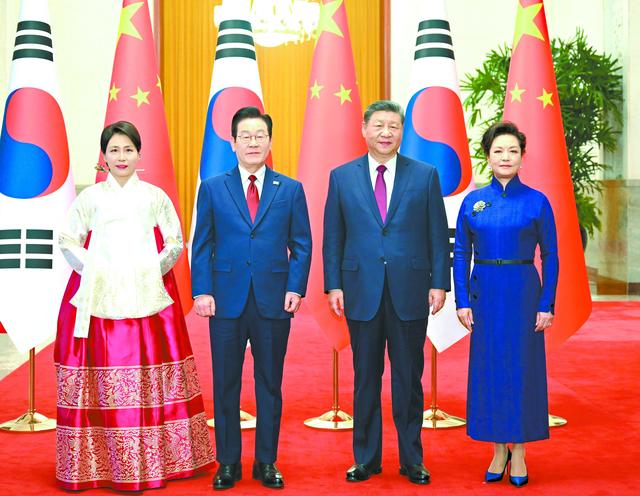
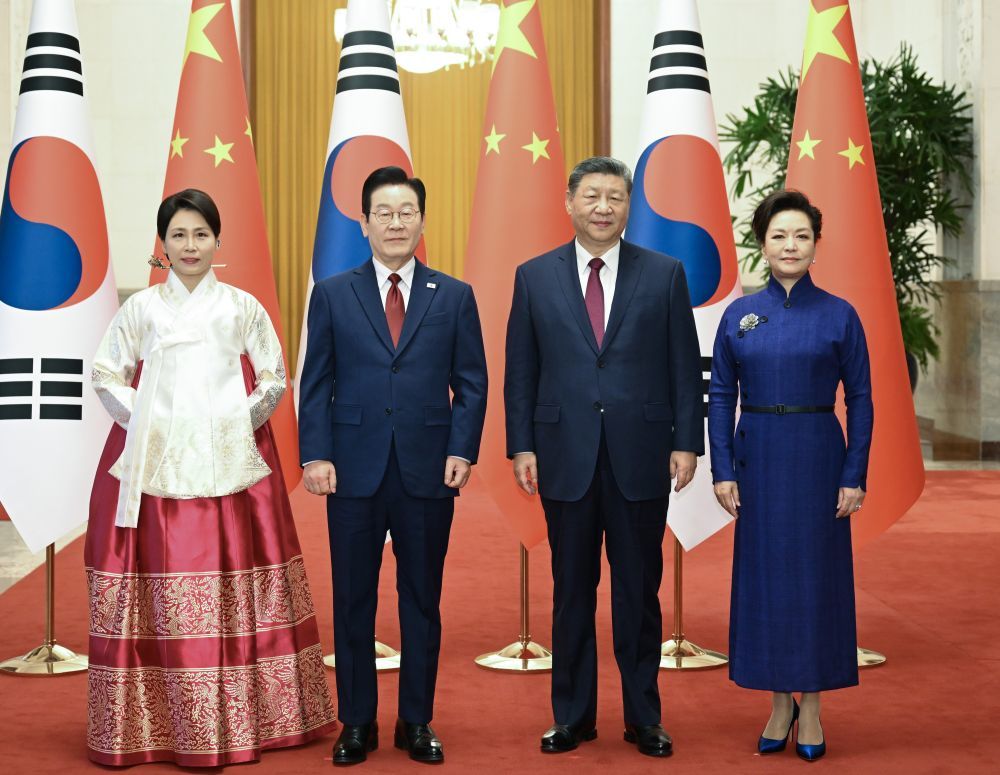
央广网北京1月6日消息(记者马喆)据中央广播电视总台中国之声《新闻和报纸摘要》报道,1月5 日下午,国家主席习近平在北京人民大会堂同来华进行国事访问的韩国总统李在明举行会谈。 两国元首回到检阅台观看仪仗队分列式。 李在明是应习近平的邀请对我国进行国事访问的。 国家主席习近平5日下午在人民大会堂北大厅举行仪式,欢迎韩国总统李在明对我国进行国事访 问。 天安门广场上鸣礼炮21响。 习近平主席夫人彭丽媛出席欢迎仪式。 陪同李在明访华的有总统夫人、副总理兼财政经济部长官、外交部长官等。 中共中央政治局委员、中央外事工作委员会办公室主任王毅等出席。 军乐团奏韩中两国国歌。 李在明在习近平陪同下检阅中国人民解放军仪仗队。 欢迎仪式后,习近平主席同李在明总统举行会谈。 习近平向韩国人民致以诚挚新年祝福。习近平指出,我和李在明总统已两次见面并实现互访,体现 了双方对中韩关系的重视。作为朋友和邻居,中韩应该多走动、常来往、勤沟通。中方始终将中韩关系 置于周边外交重要位置,对韩政策保持连续性、稳定性。中方愿同韩方一道,牢牢把握友好合作方向, 秉持互利共赢宗旨,推动中韩战略合作伙伴关系沿着健康轨道迈进,切实增进两国人民福祉,为地区 ...
中韩元首两月两次见面
Xin Lang Cai Jing· 2026-01-06 05:03
Group 1 - The meeting between Chinese President Xi Jinping and South Korean President Lee Jae-myung on January 5 marks a significant diplomatic engagement, emphasizing the importance of China-South Korea relations and mutual respect for core interests [3][4][5] - Both leaders expressed a commitment to enhance cooperation in various sectors, including technology, environmental protection, transportation, and trade, with 15 cooperation documents signed [6][8] - The discussions highlighted the historical context of cooperation between China and South Korea, particularly in the face of regional challenges, and the need to strengthen economic ties amidst global changes [5][9] Group 2 - The South Korean government aims to leverage this visit as a pivotal moment to restore and enhance bilateral relations, with a focus on economic collaboration and addressing mutual concerns [9][10] - The business forum held in Beijing saw participation from major South Korean corporations, indicating strong interest in deepening economic ties, particularly in emerging technologies like artificial intelligence [7][8] - The establishment of regular meetings between trade ministers from both countries is expected to accelerate negotiations on the second phase of the China-South Korea Free Trade Agreement [9]

李在明今起访问上海
Xin Lang Cai Jing· 2026-01-06 03:04
Group 1: Tourism and Visitor Trends - Korean tourists have become the main group of foreign visitors in Shanghai, particularly during the New Year celebrations, following the implementation of a visa-free policy for South Koreans on November 8, 2024 [1] - Shanghai has emerged as a preferred destination for South Koreans for tourism, education, and business due to its modern infrastructure and inclusive environment [2] Group 2: Historical and Cultural Ties - The historical connection between Shanghai and Korea dates back to the early 20th century, with significant events related to the Korean independence movement taking place in Shanghai [5] - The year 2023 marks the 150th anniversary of Korean independence leader Kim Gu's birth and the 100th anniversary of the establishment of the Korean Provisional Government in Shanghai, highlighting the deep-rooted historical ties [7] Group 3: Economic and Business Relations - South Korean companies, including major firms like Samsung and Hyundai, have established a significant presence in Shanghai, contributing to the region's economic landscape [15] - The Yangtze River Delta region accounts for approximately 40% of South Korea's trade with China, with Shanghai alone representing about 10% of this trade [15] Group 4: Future Cooperation and Development - There is a strong emphasis on enhancing cooperation in technology, digital economy, and cultural industries between Shanghai and South Korea, with potential collaborations in sectors like semiconductors and artificial intelligence [16] - The visit of South Korean President Yoon Suk-yeol is seen as an opportunity to strengthen bilateral relations and promote mutual support between the two nations [16]

走好长护险进阶之路
Jing Ji Ri Bao· 2026-01-06 02:24
Core Insights - The long-term care insurance (LTCI) system in China, referred to as the "sixth insurance," aims to cover all citizens during the "14th Five-Year Plan" period, having already been piloted in 49 cities and benefiting approximately 330 million people [1][2] Group 1: Development and Impact - LTCI has been in trial since 2016, with over 3 million disabled individuals receiving support, resulting in a total fund expenditure exceeding 100 billion yuan, and an average annual reduction in care costs of 12,000 yuan per person [1] - The pilot program has stimulated social capital investment in related industries by over 50 billion yuan during the "14th Five-Year Plan," with more than 8,800 designated service institutions and a workforce of 300,000 care providers, both increasing by over 50% since the beginning of the "14th Five-Year Plan" [1] Group 2: Future Directions and Challenges - The LTCI system is set to transition from pilot to comprehensive implementation, aiming to cover all insured individuals while addressing regional disparities and the need for cross-regional recognition of services [2] - Key focus areas include accurately assessing the needs of disabled individuals, ensuring quality service delivery, and leveraging technology for monitoring and evaluation to prevent fund mismanagement [2] - The development of the long-term care industry will require collaboration among various stakeholders, including enhancing talent training and involving commercial insurance institutions to support families burdened by caregiving responsibilities [2]
市场规模或超6万亿,银发经济重构老年生活新图景
Sou Hu Cai Jing· 2026-01-05 23:21
Core Insights - The article highlights the growing trend of silver economy driven by various factors including smart health care, social interests, emotional companionship, and value realization for the elderly [1] Industry Overview - A series of policies related to elderly care services and the elderly industry are expected to be released by 2025, supporting the robust development of the silver economy [1] - The three core driving forces of silver consumption are elderly care services, health consumption, and cultural entertainment consumption [1] Market Growth - In the first half of 2025, sales revenue for community elderly care services, institutional elderly care services, and home elderly care services increased by 30.4%, 22.6%, and 18.0% year-on-year, respectively [1] - The market size for elderly products in China has grown from 2.6 trillion yuan in 2014 to 5.4 trillion yuan in 2024, with a compound annual growth rate of 7.3% [1] - By 2025, the market size is projected to reach 6.1 trillion yuan, becoming a significant support for the silver economy [1] Technological Integration - New generation information technologies such as 5G, artificial intelligence, big data, and the Internet of Things are deeply integrated and applied in the silver industry, which will further stimulate new vitality in the silver economy [1]
中韩元首两月两次见面,“作为朋友和邻居,中韩应该多走动、常来往、勤沟通”
Huan Qiu Wang· 2026-01-05 23:16
来源:环球 会谈后,两国元首共同见证签署科技创新、生态环境、交通运输、经贸合作等领域15份合作文件。 韩联社5日说,韩中元首时隔两个月再次举行会谈,使韩中关系恢复的趋势更加平稳,预计两国关系将加速得到恢复。李在明在会谈中表 示,"短短两个多月内,韩中两国元首实现互访是史无前例的",可见两国元首间的密切交流已经形成。考虑到过去近10年间韩中关系不太好的 发展趋势,可以说两国关系正在迅速恢复。 " 好邻居千金难换 " 由中国贸促会与韩国大韩商工会议所共同主办的中韩商务论坛5日上午在北京举行,两国政府、工商界代表约400人参加。韩联社称,引人关注 的是,韩企"四巨头"掌门人此次悉数出席,分别是三星电子会长李在镕、SK集团会长崔泰源、现代汽车会长郑义宣、LG集团会长具光谟。 【环球时报驻韩国特派记者 莽九晨 环球时报特约记者 于文 甄翔】1月5日下午,国家主席习近平在北京人民大会堂同来华进行国事访问的韩国 总统李在明举行会谈。习近平向韩国人民致以诚挚新年祝福。习近平指出,我和李在明总统已两次见面并实现互访,体现了双方对中韩关系的 重视。作为朋友和邻居,中韩应该多走动、常来往、勤沟通。中方始终将中韩关系置于周边外交重要 ...
金融助老需要多用“心”
Jing Ji Ri Bao· 2026-01-05 22:12
Core Viewpoint - The recent regulations on cash services for the elderly, disabled, and foreign individuals highlight the need for financial institutions to address the "digital divide" in the aging economy, but merely accepting cash is not enough; more comprehensive services are required to meet the needs of the elderly [1][2]. Group 1: Current Challenges in Financial Services for the Elderly - The financial service needs of the elderly are not fully met due to multiple factors, including a market focus on younger, more digitally adept customers, which leads to a neglect of the elderly's needs in payment convenience and asset planning [2]. - Financial technology advancements have created barriers for the elderly, who struggle with adapting to new devices and learning new systems, making it difficult for them to access financial services [2]. - There is a societal misconception that the financial needs of the elderly are limited to cash transactions and basic savings, overlooking their evolving requirements for more sophisticated financial products and services [2]. Group 2: Recommendations for Financial Institutions - Financial institutions should enhance their physical branches to better serve the elderly, including clear signage and staff trained to assist older customers effectively [2]. - Mobile banking applications should be designed with elderly users in mind, focusing on simplicity and clarity in user interface, as well as providing easy access to customer service [2]. - There is a need for the development of financial products that are transparent, easy to understand, and tailored to the life stages of elderly customers, ensuring they are not confused when making financial decisions [2]. Group 3: Importance of Serving the Elderly - Serving the elderly is not only a social responsibility but also a strategic choice for financial institutions to tap into the growing silver economy [3]. - Financial institutions should integrate age-friendly principles into their product innovation and service processes, rather than viewing them as mere compliance with regulations [3]. - Respecting the elderly by accepting cash is fundamental, but the ultimate goal should be to ensure they are not left behind in the digital age, requiring financial institutions to invest more effort and creativity in their services [3].
市场规模或超6万亿 银发经济重构老年生活新图景
Sou Hu Cai Jing· 2026-01-05 22:03
Core Insights - A series of policies related to elderly services and the elderly industry have been continuously released in 2025, promoting the robust development of the silver economy [1] - The three core driving forces of silver consumption are elderly services, health consumption, and cultural and entertainment consumption [1] Industry Growth - In the first half of 2025, sales revenue for community elderly care services, institutional elderly care services, and home elderly care services increased by 30.4%, 22.6%, and 18.0% year-on-year, respectively [1] - The market size for elderly products in China has grown from 2.6 trillion yuan in 2014 to 5.4 trillion yuan in 2024, with a compound annual growth rate of 7.3% [1] - The market is expected to reach 6.1 trillion yuan by 2025, becoming a significant support for the silver economy [1] Technological Integration - New generation information technologies such as 5G, artificial intelligence, big data, and the Internet of Things are deeply integrated and applied in the silver industry, which will further stimulate new vitality in the silver economy [1]
站在历史正确一边 作出正确战略选择
Si Chuan Ri Bao· 2026-01-05 21:44
把握友好合作方向 ●中方愿同韩方一道,牢牢把握友好合作方向,秉持互利共赢宗旨,推动中韩战略合作伙伴关系 沿着健康轨道迈进,切实增进两国人民福祉,为地区乃至世界和平与发展正向赋能 习近平强调,中韩两国长期坚持"以和为贵""和而不同",超越社会制度和意识形态差异,相互成 就、共同发展。双方应延续这一优良传统,不断增进互信,尊重各自选择的发展道路,照顾彼此 核心利益和重大关切,坚持通过对话协商妥善解决分歧。中共二十届四中全会审议通过"十五 五"规划建议,为未来5年中国发展擘画蓝图,也为世界各国提供广阔机遇。中韩经济联系紧密, 产业链供应链深度互嵌,合作互惠互利,要加强发展战略对接和政策协调,做大共同利益蛋糕, 在人工智能、绿色产业、银发经济等新兴领域打造更多合作成果。双方要增进人员往来,开展青 少年、媒体、体育、智库、地方等方面交往,让正面叙事成为民意主流。 习近平指出,当前世界百年变局加速演进,国际形势更加变乱交织。中韩在维护地区和平、促进 全球发展方面肩负重要责任,有广泛利益交集,应当坚定站在历史正确一边,作出正确战略选 择。80多年前,中韩两国付出巨大民族牺牲,赢得抗击日本军国主义的胜利。今天更应携手捍卫 二 ...
2026年投资策略-重视服务消费布局元年
2026-01-05 15:42
Summary of Key Points from Conference Call Records Industry Overview - The focus is on the service consumption sector, which is expected to be a key area for investment in 2026, driven by structural opportunities in the consumer market and the shift in consumer behavior from basic needs to entertainment and experience-based consumption [1][4]. Core Insights and Arguments - **Consumer Market Dynamics**: The total retail sales are projected to reach 50 trillion, primarily concentrated in goods and dining, showcasing strong resilience [1]. - **Service Consumption Potential**: There is significant potential in service consumption, supported by policies that increase holidays and enhance consumer capacity. The aging population, particularly the 60s demographic, is driving demand for healthcare and wellness services, making the silver economy a growth engine [1][5]. - **Travel Industry Opportunities**: Key areas in the travel industry include duty-free, hotels, scenic spots, and OTA (Online Travel Agency). The OTA sector has exceeded expectations due to supply chain recovery, while the duty-free sector benefits from a rebound in high-end consumption [1][6]. - **Population Dividend**: Four demographic groups (50s, 60s, 90s, and 10s) present new investment opportunities, corresponding to healthcare, silver economy, single economy, and parent-child education [1][7]. - **Technological Impact**: The application of technology is fostering a positive cycle of supply and demand for emerging products, with innovations attracting consumer interest [1][8]. Additional Important Insights - **Hainan Duty-Free Policy**: The ongoing duty-free policy in Hainan is expected to release significant consumption potential, particularly among local residents, and the introduction of domestic goods in duty-free stores is anticipated to drive growth [1][9][10]. - **Hotel Industry Outlook**: The hotel sector is expected to return to healthy growth in 2026, with leading companies likely to improve their valuations and performance due to supply-side improvements [1][11]. - **Tourism Sector Expectations**: The tourism industry is projected to thrive in 2026, supported by increased holiday days and potential service consumption subsidies, with a focus on the silver economy and pilgrimage tourism [1][12]. - **Restaurant Industry Trends**: The restaurant sector is expected to adapt well in a weak economic environment, with opportunities arising from new business lines and improved operational capabilities [1][14]. Investment Strategies - **Social Service Sector**: Investment strategies for 2026 focus on two main lines: incremental markets with marginal changes (duty-free, hotels, silver economy) and stable long-term opportunities in chain businesses and supply chains [2]. - **Education Sector**: The education sector is expected to see growth in vocational and AI education, with policies supporting resource allocation to match demographic structures [3][19]. Recommendations - **Key Companies to Watch**: - **Vocational Education**: Huatu Shanding, China Oriental Education, Action Education - **AI Education**: Duolingo, Kevin Education, TAL Education, New Oriental, Youdao, and Hong Kong-listed Fenbi [20]. This summary encapsulates the critical insights and strategic directions discussed in the conference call, highlighting the potential investment opportunities across various sectors.