
制度型开放

Search documents
专访贸促会研究院赵萍:服务业将是“十五五”高水平对外开放重点
2 1 Shi Ji Jing Ji Bao Dao· 2025-11-03 08:51
从远赴海外洽谈项目的创业者,到接待海外订单的制造工厂,再到关注外资流动的企业家,越来越多人 正切身感受到开放与合作带来的深刻变化——通关更快了,投资渠道更顺了,国际合作机会也更广了。 开放的脚步,已悄然走进日常的经济肌理。 在此背景下,10月28日,《中共中央关于制定国民经济和社会发展第十五个五年规划的建议》(以下简 称《建议》)发布。这份纲领性文件为未来五年的发展指明了方向,在扩大高水平对外开放方面,《建 议》提出,稳步扩大制度型开放,维护多边贸易体制,拓展国际循环,以开放促改革促发展,与世界各 国共享机遇、共同发展。 在对接国际高标准经贸规则方面,应重点在哪些领域进行改革突破?中国应如何通过共建"一带一路"构 建更具韧性的供应链体系?针对相关问题,21世纪经济报道记者专访了中国贸促会研究院院长赵萍。 赵萍长期从事经贸研究工作,重点研究领域包括产业链供应链、国际贸易、电子商务。她曾在中国社会 科学院、商务部国际贸易经济合作研究院工作,担任亚欧对话论坛顾问委员会委员、中国-东盟商务理 事会专家委员会首席专家。 赵萍表示,高水平对外开放需要以服务业为重点,扩大市场准入和开放领域。结合具体行业和领域特 点,落实好 ...
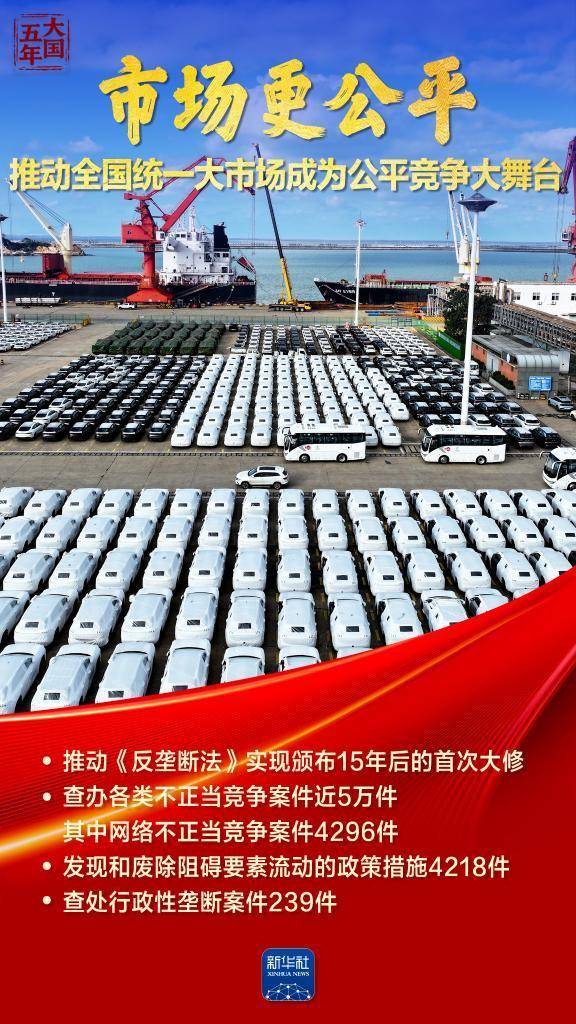
大国五年丨中国市场,铸就公平竞争大舞台
Sou Hu Cai Jing· 2025-11-03 07:40
Core Viewpoint - The article emphasizes the transformation of China's market system, highlighting the establishment of a unified national market that enhances efficiency, openness, and innovation, ultimately benefiting consumers and businesses alike [1]. Group 1: Market Reforms - The revision of the Anti-Monopoly Law marks the first major update in 15 years, with nearly 50,000 cases of unfair competition investigated, including 4,296 cases related to online competition [2]. - A total of 4,218 policies that hinder the flow of production factors have been identified and abolished [2]. - Administrative monopoly cases have been addressed, with 239 cases reported [3]. Group 2: Business Environment - The revision of the Company Law allows for an extended capital contribution period of up to 5 years [5]. - The "one certificate, one license" separation reform has been fully implemented, enabling a streamlined online business registration process [5]. - The electronic business license has been downloaded 370 million times, with over 600 million uses recorded [5]. - The net increase in registered enterprises reached 19.999 million, while individual businesses saw a net increase of 33.946 million [5]. Group 3: Standards and Compliance - Over 13,000 national standards have been newly released, bringing the total to over 47,000, with the average development cycle reduced from 36 months to 16 months [7]. - More than 2,400 national standards in key areas such as artificial intelligence and smart manufacturing have been published [7]. - 15 product categories, including lithium batteries for electric bicycles, have been included in CCC certification management [9]. Group 4: Consumer Protection - A total of 454.1 million illegal product listings were removed from platforms, and 58,000 online stores were ordered to cease operations [11]. - Significant cases in the live-streaming e-commerce sector have been addressed, including major cases like "Three Sheep" and "Northeast Rain Sister" [11]. - Food safety cases numbered 2.2604 million, with high compliance rates for grain, meat, and dairy products maintained over the years [13]. - The drug inspection pass rate remains stable at over 99.4%, with over 200 innovative drugs and 265 innovative medical devices approved [15].

新发展理念看变化丨开放发展赢机遇
Xin Hua She· 2025-11-03 07:20
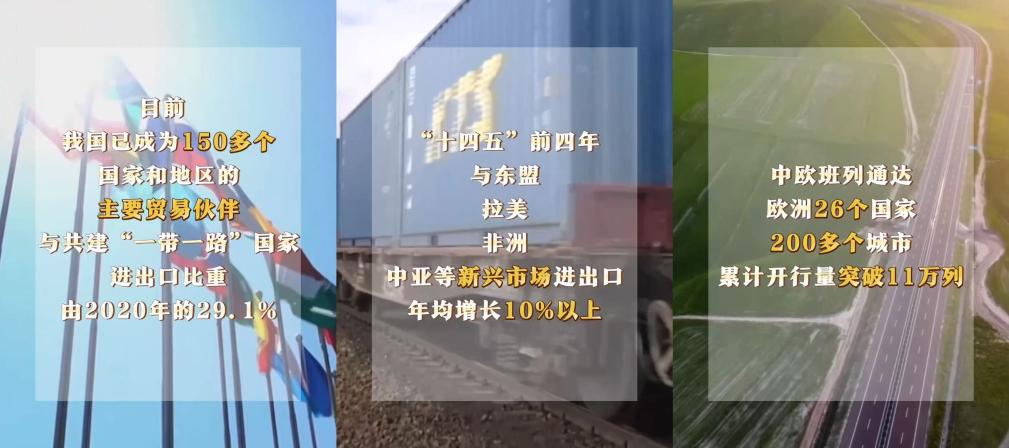
Group 1 - The core idea of the articles emphasizes the importance of the "Five Development Concepts" proposed during the 18th Central Committee's Fifth Plenary Session in 2015, which inject strong momentum into China's high-quality economic development [1] - During the "14th Five-Year Plan" period, China's high-quality development has made new strides and achieved new results under the guidance of the new development concepts [1] - Openness is a distinctive feature of Chinese-style modernization, with accelerated steps towards high-level opening-up and continuous expansion of win-win cooperation during the "14th Five-Year Plan" period [1] Group 2 - China's institutional opening-up is continuously expanding, with pilot free trade zones serving as "experimental fields" for institutional opening-up yielding positive results [3] - The country is committed to creating a first-class business environment characterized by marketization, rule of law, and internationalization [5] - The negative list for foreign investment access has been optimized, with foreign direct investment structure continuously improving, indicating a high-level opening-up dual-track approach [6]
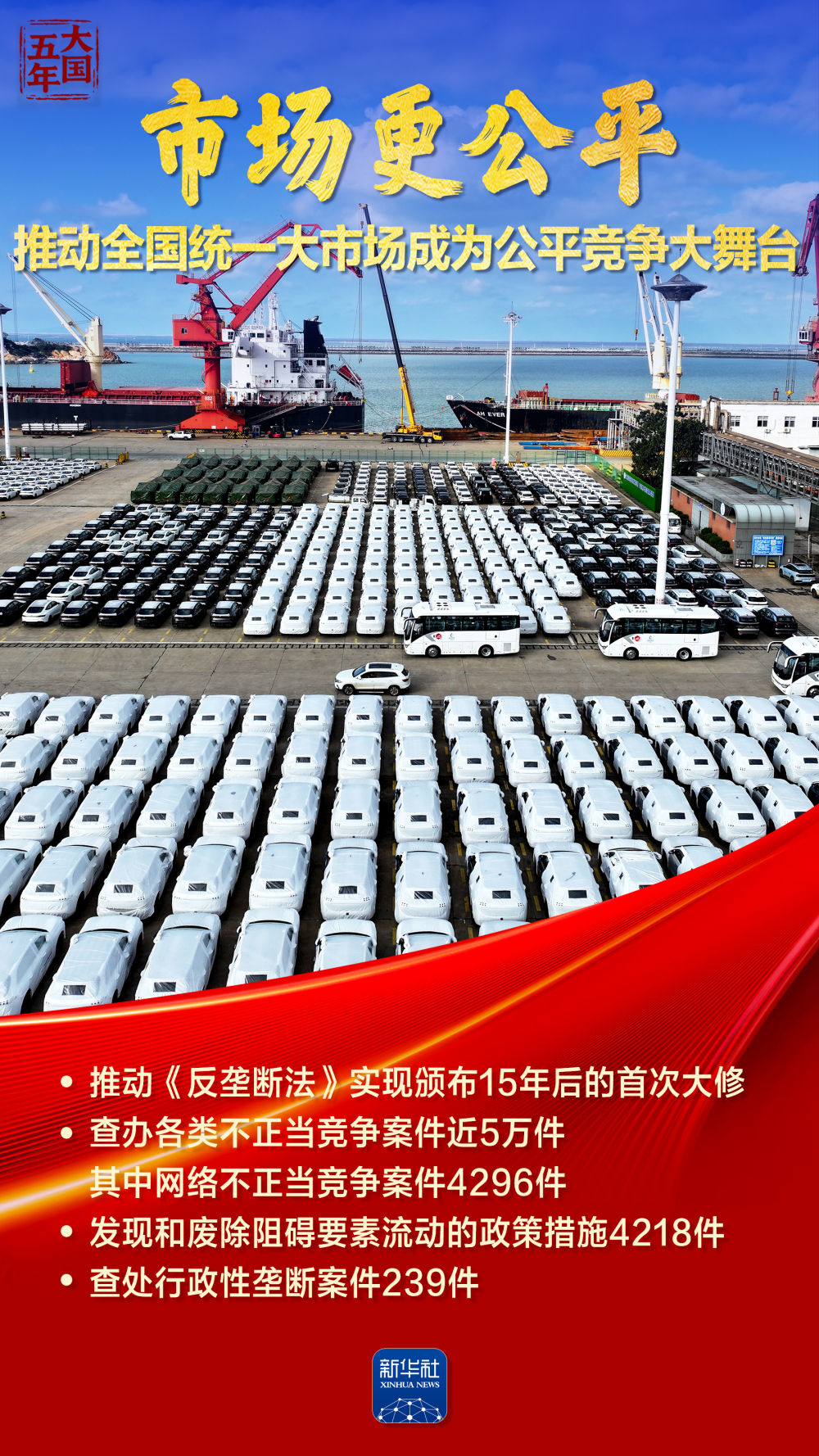
大国五年|中国市场,铸就公平竞争大舞台
Xin Hua She· 2025-11-03 03:24
Core Viewpoint - The article emphasizes the transformation of China's market system, highlighting the establishment of a high-standard market framework and the optimization of the business environment, which collectively enhance market vitality and promote innovation and consumer confidence. Group 1: Market System Development - The establishment of a nationwide unified market facilitates the smooth flow of production factors and enhances the business environment, leading to increased vitality among over a billion market entities [1] - The "14th Five-Year Plan" aims to create a more standardized, efficient, and open Chinese market, reflecting in the innovation enthusiasm and convenience experienced by individuals [1] Group 2: Regulatory and Compliance Measures - The revision of the Anti-Monopoly Law marks a significant update after 15 years, with nearly 50,000 cases of unfair competition investigated, including 4,296 cases related to online competition [4] - The implementation of the "separation of licenses and permits" reform has streamlined the process for starting businesses, with 3.7 billion downloads of electronic business licenses [6] Group 3: Standardization and Quality Control - Over 13,000 national standards have been newly released, bringing the total to over 47,000, with a significant reduction in the average development cycle from 36 months to 16 months [8] - The inclusion of 15 products, including lithium batteries for electric bicycles, into CCC certification management enhances product safety and compliance [11] Group 4: Consumer Protection and Safety - A total of 226.04 million food safety cases have been investigated, maintaining high compliance rates for grain, meat, and dairy products [16] - The drug inspection pass rate remains stable at over 99.4%, with over 200 innovative drugs and 387 children's medications approved for market [20] Group 5: E-commerce and Online Regulation - Platforms have been urged to delete over 4.5 million illegal product listings, with significant actions taken against non-compliant online stores [13][14] - The government has introduced guidelines to enhance compliance management within online trading platforms [14]
早知道:基金业绩比较基准征求意见稿发布;多家车企交付量破纪录
Zheng Quan Shi Bao Wang· 2025-11-03 00:19
(原标题:早知道:基金业绩比较基准征求意见稿发布;多家车企交付量破纪录) 人民财讯11月3日电,国常会:研究深化重点领域改革扩大制度型开放工作;商务部:推动尽快恢复中 日韩自贸协定谈判;商务部回应安世半导体相关问题:将对符合条件的出口予以豁免;基金业绩比较基 准征求意见稿发布;国家知识产权局印发《知识产权促进民营经济发展实施办法》;黄金税收新规发 布,饰品消费直接影响较小;核心设备完全国产化,我国钍基熔盐实验堆建成并首次实现堆内钍铀转 化;新能源汽车"银十"热销,多家车企交付量破纪录。 ...
机器人火炬手“夸父”亮相;安世中国:已建立充足的成品与在制品库存……盘前重要消息一览
证券时报· 2025-11-03 00:07
Group 1 - New stock subscription: Beikang Testing with subscription code 920160, issue price 6.7 CNY/share, subscription limit of 1.2744 million shares [5] - The State Council meeting on October 31 focused on deepening reforms in key areas and expanding institutional openness, aiming to enhance the openness of the commodity market [5] - The Ministry of Finance and the State Taxation Administration announced tax policies regarding gold, exempting VAT for transactions involving standard gold until the end of 2027 [5] Group 2 - The China Securities Regulatory Commission released a draft guideline for the performance comparison benchmarks of publicly offered securities investment funds, aiming to standardize the industry and enhance long-term stable returns for investors [6] - A significant breakthrough in nuclear energy was reported, with China achieving thorium-uranium fuel conversion based on molten salt reactors, marking a shift from uranium dependency [6] - As of October 31, 2025, 5,446 listed companies in China reported improved performance, with a notable emphasis on innovation and high-quality development [8] Group 3 - Anshi China has established sufficient finished and in-process inventory to meet customer demand until the end of the year and beyond, ensuring supply chain reliability [10] - Vanke A is set to receive a loan limit of up to 22 billion CNY from Shenzhen Metro Group [10] - Long-term growth in the new energy vehicle sector is highlighted, with Chang'an Automobile reporting a 36.14% year-on-year increase in sales for October 2025 [10][11]
共绘高质量发展图景——写在第八届进博会即将召开之际
Zhong Guo Jing Ji Wang· 2025-11-02 23:06
Core Points - The eighth China International Import Expo (CIIE) is set to take place in Shanghai, marking an important economic diplomatic event following the Fourth Plenary Session of the 20th CPC Central Committee, showcasing the ongoing partnership between Shanghai and the CIIE [1] Group 1: Service and Logistics Support - Shanghai has implemented a "green channel" for customs clearance, ensuring zero wait time for vessels like the "New Shanghai" carrying Sri Lankan tea, enhancing the efficiency of the CIIE [2] - A total of 16 dedicated channels for exhibitors have been established at Hongqiao and Pudong airports, providing streamlined entry for qualified exhibitors [2] - The event will feature 10 parking lots with 900 large vehicle spaces and an additional 2,000 small vehicle spaces, totaling approximately 5,000 small vehicle parking spots [2] Group 2: Payment and Consumer Services - Shanghai has developed a diverse payment system for inbound consumption, supporting mobile payments, bank cards, and cash, with 66,000 merchants and 96,000 terminals accepting domestic and international card payments [3] Group 3: Open Economy and Trade - During the 14th Five-Year Plan period, Shanghai has leveraged the CIIE as a high-level open platform, enhancing its role as an international trade center and improving its connectivity in domestic and international dual circulation [4] - Shanghai's port trade volume exceeded 11 trillion yuan last year, a 26.5% increase from 2020, with a 5.4% growth in import and export volume in the first nine months of this year [4] Group 4: Regional Impact and Consumption - The CIIE has not only increased import volumes but also optimized the import structure, with the Shanghai trading group achieving a cumulative procurement transaction volume of $56.2 billion over the first seven expos [5] - The Yangtze River Delta region has seen significant collaboration, with nearly 40% of imported goods at Shanghai's port coming from other areas in the region [5] - Shanghai's retail sales of consumer goods have shown a quarterly growth rate exceeding 10% in the third quarter of this year [5] Group 5: Spillover Effects of the CIIE - The Qingpu trading sub-group will host multiple targeted matchmaking and investment promotion events, with 3,712 registered units participating in the eighth CIIE [6] - Shanghai aims to further enhance its role as an open platform during the 15th Five-Year Plan period, contributing to high-level foreign trade expansion [6]
共绘高质量发展图景
Jing Ji Ri Bao· 2025-11-02 22:27
不久前,身披"进博蓝"彩衣的8辆"进博专线"公交车正式发车,将进博元素与都市魅力串联成流动的风 景。第八届中国国际进口博览会即将在上海拉开帷幕,这场党的二十届四中全会后举办的首场重要经济 外交活动,见证着上海与进博会的第八次双向奔赴——上海以优质服务保障护航盛会成功举办,进博会 则为上海高水平开放注入不竭动能。 服务保障更精细 开放能级再跃升 "十四五"期间,上海充分发挥进博会高水平开放平台作用,全力推进国际贸易中心提质升级,开放枢纽 门户功能有效提升,构建国内国际双循环战略链接取得较为明显的成效。 "上海自贸试验区制度型开放80条措施基本落地,其中77项成果向全国推广。临港新片区在离岸贸易、 跨境金融等领域落地一系列制度创新成果。虹桥国际开放枢纽'引进来''走出去'双向开放水平不断提 升,商务会展、国际贸易、综合交通、科创产业等功能优势持续巩固壮大。"华源表示,上海制度型开 放水平得到进一步提升。 10月23日,运载斯里兰卡锡兰红茶的"新上海"轮靠泊外高桥口岸,上海边检部门联合口岸单位开启"绿 色通道",实现"靠泊零等待、到港即作业"。上海外高桥边检站执勤二队队长高尔说:"外高桥边检站落 实上海边检总站8项 ...
高水平对外开放塑造新动能新优势
Bei Jing Ri Bao Ke Hu Duan· 2025-11-02 22:21
Core Viewpoint - The 20th Central Committee's Fourth Plenary Session outlines a grand blueprint for economic and social development during the "14th Five-Year Plan" period, emphasizing the need for high-level opening up and creating a new situation of win-win cooperation [1] Group 1: High-Level Opening Up - The "14th Five-Year Plan" period has seen historic achievements in high-level opening up, laying a solid foundation for Chinese-style modernization, with the economy growing from 103 trillion yuan in 2020 to approximately 140 trillion yuan, contributing around 30% to global economic growth [2][3] - The scale of China's goods trade has continuously surpassed 5 trillion USD and 6 trillion USD, maintaining the world's largest import and export scale for eight consecutive years, while service trade has exceeded 1 trillion USD for the first time [3] Group 2: International Cooperation - The concept of "mutual benefit and win-win" is essential for addressing global challenges such as climate change and public health, combining national interests with global common interests [2] - China's modernization approach rejects historical paths of colonial expansion, opting instead for peaceful development and open cooperation [2] Group 3: Economic Integration - The Belt and Road Initiative has significantly contributed to global connectivity and cultural exchange, enhancing China's integration with the world economy [4] - China is transitioning from a participant in the global economy to a contributor, creating new opportunities for balanced global economic recovery [4] Group 4: Future Strategies - The focus will be on expanding institutional openness, promoting trade and investment liberalization, and building a strong domestic market to enhance the quality and level of trade and investment cooperation [5][6] - The strategy includes implementing a free trade pilot zone enhancement strategy to create new high grounds for reform and opening up, optimizing regional open layouts, and promoting efficient resource allocation [7][8]
开放中国为世界经济提供“稳定锚”(和音)
Ren Min Ri Bao· 2025-11-02 22:21
中国顺应经济全球化和新一轮科技革命大趋势,始终坚持高水平开放,兼顾自身之需与世界之盼,加快 形成更大范围、更宽领域、更深层次对外开放格局,将给世界各国带来更大发展机遇 在亚太经合组织第三十二次领导人非正式会议期间,习近平主席向国际社会介绍中共二十届四中全会通 过了关于制定"十五五"规划的建议,再次明确了中国将继续以高水平对外开放促进深层次改革、推动高 质量发展,不断以中国式现代化新成就为世界各国提供新机遇的坚定意愿。 坚持开放合作、互利共赢是中国式现代化的必然要求。"十五五"规划建议从积极扩大自主开放、推动贸 易创新发展、拓展双向投资合作空间、高质量共建"一带一路"四个方面作出重要部署,每一个维度都展 现了中国与各方共享机遇、共同发展的决心。 中国统筹用好全球要素和市场资源,坚定不移奉行互利共赢开放战略。"十四五"时期,从持续缩减外资 准入负面清单、制造业领域准入限制全部"清零",到22个自贸试验区构建起覆盖东西南北中的"雁阵", 再到海南自贸港即将封关运作……中国开放的广度、力度、深度持续提升。稳步扩大规则、规制、管 理、标准等制度型开放,持续优化营商环境,让中国大市场日益成长为世界大机遇。过去5年,中国累 ...