国产化替代

Search documents
“寒王”股价续创新高!重仓寒武纪9.98%的芯片ETF龙头(159801)盘中涨超3%
Xin Lang Cai Jing· 2025-08-14 05:24
Group 1 - The semiconductor industry continues to strengthen, with the National Securities Semiconductor Index rising by 3.64% as of 11:07 [1] - The second-largest weighted stock, Cambricon (688256), increased by 12.33%, reaching a market capitalization of over 400 billion yuan [1] - Haiguang Information (688041), the third-largest weighted stock, reported a revenue of 3.06 billion yuan for Q2 2025, a year-on-year growth of 41%, and a net profit of 700 million yuan, up 23% year-on-year [1] Group 2 - Other stocks such as Rockchip (603893) rose by 6.04%, with several other stocks also experiencing gains [2] - The leading semiconductor ETF (159801) surged by 3.38%, marking its fourth consecutive increase, with a cumulative rise of 2.52% over the past week [2] - Tianfeng Securities indicates a continued optimistic growth trend in the global semiconductor market, driven by AI, with a bright outlook for Q3 during the semiconductor peak season [2]


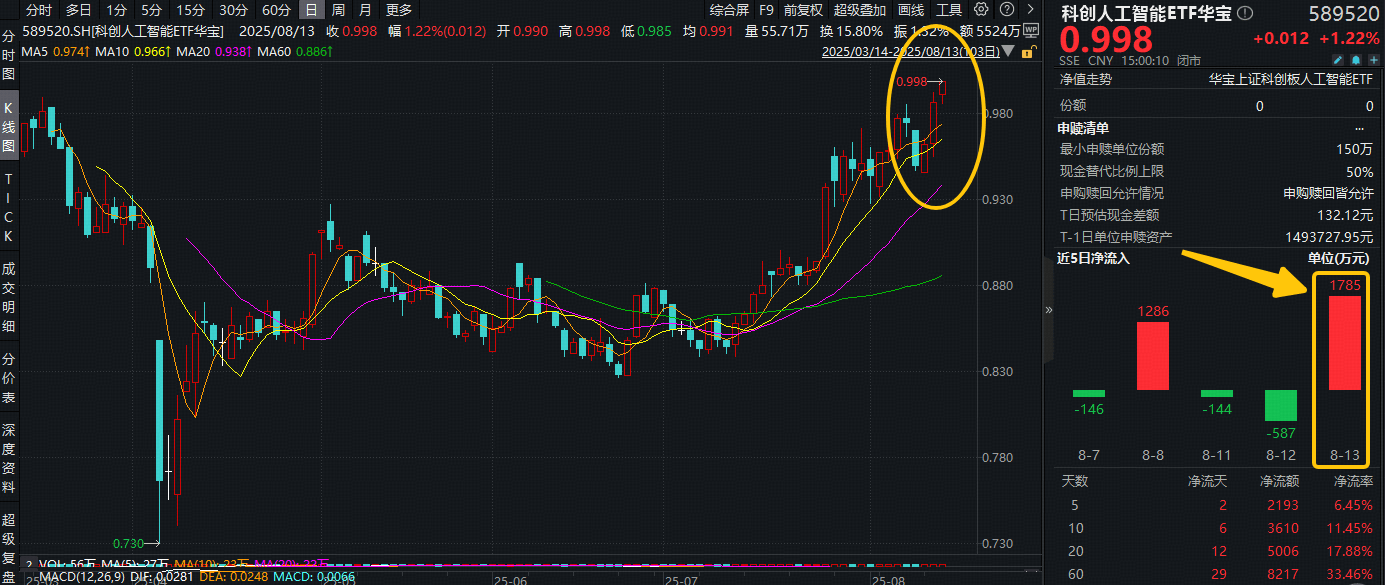
新高又新高!寒武纪炸场!科创人工智能ETF(589520)放量突破上市高点!单日吸金1785万元!
Sou Hu Cai Jing· 2025-08-14 01:27
Core Insights - The semiconductor industry, particularly in AI chips, is undergoing significant transformation driven by rising power consumption and stricter global energy efficiency regulations [1][2] Group 1: Market Dynamics - The stock price of "Hanwang," a leading chip company, reached a new high of 868 yuan, closing at 860 yuan, with a total market capitalization of 359.8 billion yuan and a trading volume of 11.355 billion yuan, ranking fourth in A-share trading [1] - Key factors driving the growth of the computing power industry include potential easing of Nvidia's sales policies to China, explosive capital expenditure growth from North American cloud providers, the release of global AI models, and breakthroughs in domestic computing power supply chains [1][2][3] Group 2: Capital Expenditure Growth - In the first half of 2025, capital expenditures from major North American cloud companies, including Google, Microsoft, Amazon, and Meta, totaled $159.384 billion, reflecting a year-on-year increase of 24.4% and a significant quarter-on-quarter growth [1][2] Group 3: AI Model Releases - The recent release of OpenAI's GPT-5 model, which significantly reduces unit computing costs, along with updates from Google and Anthropic, has intensified demand for computing power [2] Group 4: Domestic Breakthroughs - Domestic companies are making significant technological advancements, with Huawei set to launch a new AI SSD that reportedly reduces AI inference latency by 78% and increases throughput by 67% [2] Group 5: Investment Recommendations - Analysts recommend focusing on three main investment lines: core domestic computing power infrastructure, overseas expansion leaders, and AI application companies with monetization capabilities [3] - The Huabao ETF, which focuses on the domestic AI industry, saw a significant increase in trading volume and capital inflow, indicating strong investor interest in the AI sector [3][5]

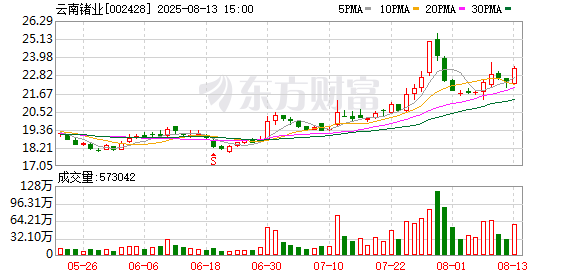
云南锗业:目前公司化合物半导体材料已向国内外多家客户供货
Zheng Quan Ri Bao· 2025-08-13 12:40
Core Viewpoint - Yunnan Zhenye has successfully supplied compound semiconductor materials to multiple domestic and international clients, receiving positive feedback on their performance and is actively pursuing market expansion for more orders [2] Company Summary - Yunnan Zhenye's compound semiconductor materials have been well-received by clients, indicating a strong market demand [2] - The company is focusing on expanding its market presence to secure additional orders [2] Industry Summary - The global compound semiconductor materials market is predominantly concentrated in developed countries such as the US and Japan [2] - Major international companies in the compound semiconductor materials sector include Sumitomo Electric Industries, JX Nippon Mining & Metals, AXT, and Freiberg Instruments, all of which possess strong R&D capabilities, technical reserves, sales channels, and market reputation [2] - The domestic compound semiconductor materials industry in China has been experiencing rapid growth, with a noticeable trend towards localization [2]

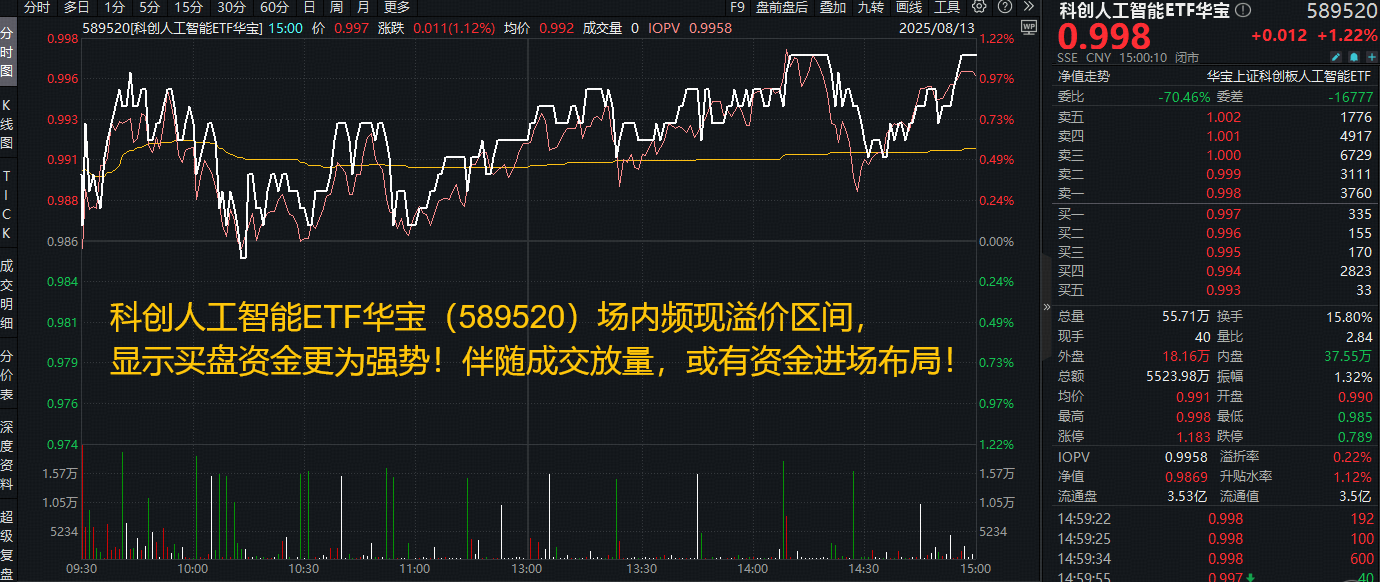
寒武纪跻身A股成交榜TOP4,晶晨股份绩后大涨8%!科创人工智能ETF(589520)拉升1.22%放量突破上市高点
Xin Lang Cai Jing· 2025-08-13 09:37
Group 1 - The core viewpoint of the news highlights the strong rise of domestic AI industry chain investments, particularly through the Huabao Sci-Tech AI ETF (589520), which saw a price increase of 1.22% and a trading volume of 55.24 million yuan, a significant 82% increase compared to the previous period [1] - The ETF has reached a new high in trading volume since its listing, indicating a potential buying signal as it frequently trades at a premium, closing with a premium rate of 0.22% [1] - Key constituent stocks of the ETF include Jingchen Co., which surged over 8%, and other companies like Lexin Technology and Youkede also saw gains, reflecting a positive trend in the semiconductor sector [1][6] Group 2 - In terms of capital flow, the electronics and computer sectors received significant net inflows of 17.23 billion yuan and 10.40 billion yuan, respectively, ranking first and fifth among 31 primary industries [3] - The electronics and computer sectors are the top two heavy-weight industries in the Huabao Sci-Tech AI ETF, accounting for 51% and 36.7% of the index weight as of August 13 [3] - The semiconductor cycle is currently in an upward trend, driven by strong AI demand, with both cloud AI and terminal AI applications expected to accelerate, benefiting domestic semiconductor manufacturers [8] Group 3 - As of August 12, five of the 30 constituent stocks of the Huabao Sci-Tech AI ETF have reported mid-year earnings, all showing year-on-year revenue growth, with Aobi Zhongguang leading at a 104% increase [6][8] - Jingchen Co. reported a revenue of 3.33 billion yuan for the first half of 2025, a 10.42% increase year-on-year, and a net profit of 497 million yuan, reflecting a 37.12% growth [6][8] - The ETF's constituent stocks are strategically positioned across four key segments: application software, terminal applications, terminal chips, and cloud chips, indicating a balanced approach to capitalize on the AI integration trend [9]

深化半导体业务布局,利和兴(301013.SZ)以技术优势构筑未来增长新引擎
Xin Lang Cai Jing· 2025-08-13 08:00
Core Insights - The company has outlined a strategic path focusing on intelligent manufacturing equipment while steadily expanding into the electronic components and semiconductor sectors, viewing semiconductor equipment and precision components as key growth areas for future performance [1][2]. Semiconductor Business Development - The company's expansion into the semiconductor field is based on its long-term technical capabilities in intelligent manufacturing equipment and deep insights into industry trends, focusing on semiconductor testing equipment and precision components [2]. - As of June 30, 2025, the company has invested 16.24 million yuan in R&D, holding 44 invention patents, 143 utility model patents, 28 design patents, 275 software copyrights, and 12 registered trademarks, establishing a strong technical foundation in areas related to semiconductor equipment [2][3]. Market Position and Growth Potential - The company has established a quality management system and service reputation in the intelligent equipment sector, laying the groundwork for entering the semiconductor equipment supply chain [3]. - The semiconductor business has begun to show initial results, with the semiconductor equipment subsidiary generating revenue, marking a transition from R&D to market development and production delivery [3][4]. - The semiconductor equipment components are crucial for the precision and reliability of semiconductor devices, and breakthroughs in technology are expected to drive upgrades in semiconductor equipment, supported by national policies that promote domestic substitution and create a broad market development space [3][4]. Future Outlook - The company is accelerating its semiconductor industry layout to meet the growing product demand from customers, establishing a solid foundation for long-term rapid development [4]. - With the urgent demand for domestic substitution and the surge in chip demand driven by new energy vehicles and artificial intelligence, the semiconductor business segment is expected to exhibit significant growth potential [4].
印度想让三大运营商用“国产设备”,但尴尬的是......
Guan Cha Zhe Wang· 2025-08-13 07:13
Core Viewpoint - The Indian government is emphasizing the urgency of achieving self-sufficiency in the telecommunications sector amid deteriorating relations with the U.S. [1][5] Group 1: Government Policy - The Indian Ministry of Telecommunications (DoT) has requested major private operators Reliance Jio, Bharti Airtel, and Vodafone Idea to submit a roadmap for increasing the use of domestically manufactured equipment [1] - If the operators do not comply voluntarily, the government may issue mandatory directives to enforce compliance within a specified timeframe [1] - The policy aims to impact foreign telecom equipment manufacturers such as Cisco, Nokia, Ericsson, and Samsung [1] Group 2: Industry Response - The three major operators have tentatively agreed to the DoT's request but have stipulated that domestic products must be competitively priced and of comparable quality to foreign products [1][2] - Currently, the use of domestic products by these operators is very limited, primarily due to insufficient production capacity from local manufacturers [6] - Vodafone Idea and Bharti Airtel have been sourcing equipment from Indian companies like Sterlite Technologies and HFCL, but face challenges due to low production volumes [6] Group 3: Geopolitical Context - The new policy comes at a time of heightened geopolitical risks, particularly following the U.S. imposing a 25% tariff on Indian goods, raising the total tariff rate on Indian exports to the U.S. to 50% [5] - There is a growing sentiment in India against U.S. products, with calls for a boycott gaining traction among the public [5] Group 4: Historical Context - This is not the first time the Indian government has pushed for "Make in India" initiatives in the telecom sector, having previously mandated state-owned BSNL to use only domestic equipment, which has led to ongoing difficulties for the company [6] - Experts warn that if private operators are held to the same standards as state-owned BSNL, the entire telecom industry could face significant challenges [6]

印度想让三大运营商用“国产设备”,但尴尬的是
Guan Cha Zhe Wang· 2025-08-13 07:03
Group 1 - The Indian government is pushing for self-sufficiency in the telecommunications sector amid deteriorating relations with the US, highlighting the urgency of the situation [1][3] - The Indian Ministry of Telecommunications (DoT) has requested major private operators, including Reliance Jio, Bharti Airtel, and Vodafone Idea, to submit a roadmap for increasing the use of domestically manufactured equipment [1][3] - If the operators do not comply, the government may issue mandatory directives, which could impact foreign telecom equipment manufacturers such as Cisco, Nokia, Ericsson, and Samsung [1][3] Group 2 - The three major operators have agreed in principle to increase the use of domestic equipment but have stipulated that these products must be competitively priced and of comparable quality to foreign alternatives [1][4] - The Indian government is considering applying the new regulations only to new orders, avoiding additional financial burdens on already strained telecom operators [1][4] - The current use of domestic products by the major operators is minimal, primarily due to the insufficient production capacity of local manufacturers [4] Group 3 - The Indian government has previously attempted to promote the use of domestic products in the telecom sector but faced challenges, particularly with state-owned operator BSNL, which struggled under similar requirements [4] - Industry experts warn that if private operators are held to the same standards as state-owned companies, the entire telecom sector could face significant challenges [4]
浙江力诺:20年专注一杯“老白茶”
Quan Jing Wang· 2025-08-13 05:51
Core Insights - The article highlights the transformation of the manufacturing industry driven by Industry 4.0, emphasizing the integration of new information technologies with manufacturing processes [1] - Zhejiang Lino has made significant contributions to domestic substitution in the valve industry while achieving remarkable growth [1] Company Overview - Zhejiang Lino has been focused on the research, production, sales, and after-sales service of industrial control valves since its establishment in 2004, providing customized solutions for process control systems [4] - Initially, 90% of the company's orders came from the paper industry, but it shifted its strategy in 2008 to penetrate other sectors such as petrochemicals and mining [4] - The company went public on the New Third Board in 2014 and successfully listed on the Growth Enterprise Market in June 2020, with revenue surpassing 500 million yuan in 2018 [4][5] Technological Innovation - Zhejiang Lino has established itself as a "hidden champion" in the industrial automation wave, achieving significant upgrades from technology introduction to independent innovation [5] - The company has a strong focus on R&D, with 107 authorized patents as of the end of 2024, and collaborates with research institutions and universities to enhance its R&D capabilities [11][10] Domestic Substitution Efforts - Control valves are critical in process industries, yet the domestic substitution rate for core components like positioners is below 10% [12] - In 2023, Zhejiang Lino established a subsidiary in Mianyang to tackle key technologies in collaboration with Xi'an Jiaotong University [12] - The company achieved a breakthrough in March 2025 with the mass production of self-developed intelligent positioners, becoming one of the few companies in China to achieve full-chain autonomy in control valves [13] Smart Manufacturing - The company has invested in an 82-acre smart manufacturing base, enhancing production capacity and integrating digital technologies for real-time data feedback [15] - The use of AI digital twin platforms allows customers to monitor workshop dynamics remotely, promoting transparency and trust in the industrial ecosystem [16] Strategic Acquisitions - Zhejiang Lino announced the acquisition of Xuzhou Chemical Machinery Co., which will enhance its full industry chain layout and expand its market share in various sectors [17][18] - The acquisition will enable the company to integrate its product offerings, including control valves and intelligent positioners, across different industrial applications [18] Future Vision - The company emphasizes employee well-being by creating facilities such as reading areas and sports amenities, aiming to foster a positive work environment [19][20] - Chairman Chen Xiaoyu likens the company's long-term strategy to the aging process of white tea, suggesting that patience and focus on core competencies will yield enduring success [22][24]

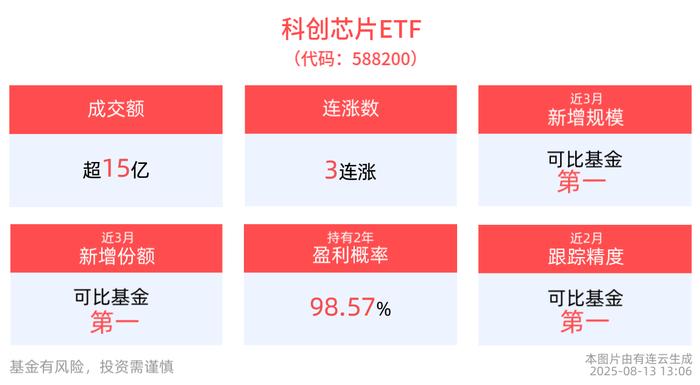
全球半导体增长走势乐观,科创芯片ETF(588200)冲击3连涨,成分股中船特气20cm涨停
Xin Lang Cai Jing· 2025-08-13 05:27
Core Viewpoint - The semiconductor sector in China is experiencing significant growth, driven by AI demand and a shift towards inference computing, with the Sci-Tech Innovation Board Chip Index showing positive performance and the Sci-Tech Chip ETF gaining substantial traction in trading volume and net value [1][4][5]. Group 1: Market Performance - As of August 13, 2025, the Sci-Tech Innovation Board Chip Index increased by 0.90%, with notable gains from stocks such as China Shipbuilding Industry Corporation and Shanghai Hojin [1]. - The Sci-Tech Chip ETF (588200) rose by 0.95%, marking its third consecutive increase [1]. - The ETF recorded a turnover rate of 4.96% and a transaction volume of 1.557 billion yuan, with an average daily transaction volume of 2.474 billion yuan over the past year, ranking first among comparable funds [4]. Group 2: Fund Growth and Performance - The Sci-Tech Chip ETF saw a significant increase in scale, growing by 6.178 billion yuan over the past three months, leading among comparable funds [4]. - The ETF's share count increased by 2.181 billion shares in the last three months, also ranking first among comparable funds [4]. - The net value of the Sci-Tech Chip ETF rose by 78.97% over the past year, placing it first among comparable funds, with a ranking of 107 out of 2954 in the index stock fund category [4]. Group 3: Industry Outlook - IDC predicts that by 2027, the share of inference computing in China's intelligent computing will rise from approximately 41% in 2023 to around 72.6% [5]. - Tianfeng Securities anticipates continued optimistic growth in the global semiconductor market driven by AI, with a focus on domestic substitution amid supply chain risks [5]. - The top ten weighted stocks in the Sci-Tech Innovation Board Chip Index account for 57.59% of the index, with companies like Cambricon and SMIC being key players [5][7].




上海芯片上市公司,终止收购!
是说芯语· 2025-08-13 02:58
Core Viewpoint - The article discusses the recent termination of a significant acquisition deal between Xinxiangwei and Aixiasheng, highlighting the challenges in the semiconductor industry regarding mergers and acquisitions, particularly in the context of rapid technological changes and competitive pressures [4][9][16]. Group 1: Company Overview - Xinxiangwei, established in 2005, specializes in the research, design, and sales of display chips, providing comprehensive solutions in the display chip sector [6]. - Aixiasheng, founded in 2011, focuses on chip design and solutions in the human-computer interaction field, and has received recognition as a national high-tech enterprise [12]. Group 2: Acquisition Attempt - Xinxiangwei planned to acquire 100% of Aixiasheng's shares through a combination of stock issuance, convertible bonds, and cash payments, but the deal was terminated due to a lack of consensus among the parties involved [4][9]. - The acquisition was viewed as a "snake swallowing an elephant" scenario, given Aixiasheng's projected revenues of 782 million yuan and 1.267 billion yuan for 2023 and 2024, respectively, compared to Xinxiangwei's revenues of 480 million yuan and 507 million yuan during the same period [8][9]. Group 3: Financial Performance - Xinxiangwei's revenue for 2024 was 507 million yuan, reflecting a year-on-year growth of 5.61%, but its net profit dropped significantly by 69.41% to 8.4231 million yuan, indicating a pressing need to enhance profitability amid fierce market competition [9]. - In the first quarter of 2025, Xinxiangwei reported a revenue of 150 million yuan, a substantial increase of 49.95% year-on-year, and achieved a net profit of 218.51 thousand yuan, marking a return to profitability [9]. Group 4: Industry Context - The semiconductor industry has seen a surge in merger and acquisition activities, particularly following the release of new regulatory policies aimed at supporting strategic acquisitions in emerging industries [15]. - Despite favorable policies, the semiconductor sector faces significant challenges in executing mergers due to rapid technological advancements and complex negotiations regarding valuations and terms [16].