算力

Search documents
偏振片与法拉第片:隔离器上游缺口
GOLDEN SUN SECURITIES· 2025-12-14 08:22
Investment Rating - The report maintains a "Buy" rating for key companies in the optical communication sector, including Zhongji Xuchuang, Xinyi Sheng, and Tianfu Communication [5][10]. Core Insights - The optical isolator is a critical passive device in optical communication systems, relying on the combination of polarizers and Faraday plates. There is a significant technological dependency and supply gap in the upstream manufacturing of these core components, particularly in high-end Faraday magnetic optical materials, which has become a bottleneck for industry development [1][19]. - The report highlights the low domestic production rate of core materials for polarizers, which are monopolized by Japanese and Korean suppliers, indicating a need for increased localization [3][21]. - The global shortage of Faraday plates is a critical issue, as their complex material growth and precision processing are dominated by a few companies in the US and Japan, leading to supply constraints that hinder the expansion of isolators and high-speed optical modules [4][22][23]. Summary by Sections Investment Strategy - The report suggests focusing on the upstream gaps in isolators, particularly polarizers and Faraday plates, and recommends companies like Zhongji Xuchuang, Xinyi Sheng, and Tianfu Communication for investment [8][24]. Market Review - The communication sector has seen an increase, with optical communication performing particularly well, as indicated by various indices showing significant growth [15][18]. Supply Chain Dynamics - In 2024, China's production capacity for polarizers is expected to account for approximately 73% of the global market, yet the localization rate of core materials remains below 10%, posing challenges to supply chain stability [6][7][24]. Key Companies to Watch - The report identifies several key companies to monitor within the optical communication and related sectors, including Zhongji Xuchuang, Xinyi Sheng, Tianfu Communication, and others involved in the supply chain [8][9][24].


科技大佬为何难逃「币圈引力」?
3 6 Ke· 2025-12-14 02:20
Group 1 - The core point of the article highlights the rising market value of Moole Thread, often referred to as the "Chinese version of Nvidia," which reached 383 billion yuan, a sixfold increase from its initial offering price, amidst the growing interest in AI and computing power [1] - The article discusses the complex relationship between tech giants and the cryptocurrency market, noting that figures like Elon Musk and Sam Altman have engaged with cryptocurrencies, reflecting a broader trend among tech leaders [1][2] - The narrative suggests a metaphorical connection between AI, computing power, and cryptocurrencies, indicating a shared capital link that drives investment and innovation in these sectors [1] Group 2 - Musk's influence in the cryptocurrency space is emphasized, showcasing his ability to manipulate market movements through social media, particularly with Dogecoin and Bitcoin, revealing a dual strategy of leveraging personal influence while maintaining significant cryptocurrency holdings [2] - Altman's involvement in the WorldCoin project illustrates a vision of creating a new cryptocurrency that aims to distribute wealth equitably, highlighting the intersection of AI and cryptocurrency in societal experiments [3] - Nvidia's business model is described as primarily focused on selling hardware for cryptocurrency mining without direct involvement in mining itself, raising questions about the company's transparency regarding the impact of mining on its revenue [4] Group 3 - The article notes that both AI and cryptocurrencies are energy-intensive industries, with a significant demand for computing power and electricity, leading to a convergence of interests among investors and entrepreneurs in these fields [5] - The shift of mining companies towards providing computing power services reflects a strategic pivot in response to market conditions, with companies like CoreWeave and TeraWulf capitalizing on their existing infrastructure [6] - The regulatory environment in the U.S. favors cryptocurrency mining companies due to their established power contracts, allowing them to bypass lengthy approval processes for new AI data centers, thus positioning them as attractive partners for AI firms [7] Group 4 - The article discusses the competitive landscape of the computing power market, highlighting the rapid growth and valuation of companies like Nvidia and Moole Thread, driven by the AI investment boom and domestic strategic needs [8] - The emergence of domestic computing power firms is linked to geopolitical factors, particularly U.S. technology export controls, which have spurred the growth of local companies in response to national strategic demands [8] - The article concludes by noting the uncertainty surrounding policy changes, particularly regarding chip exports to China, which could impact the dynamics of the computing power and cryptocurrency markets [9]
近一个月这些上市公司被“踏破门槛”!算力芯片“双龙头”获机构组团调研,机构来访接待量居前的个股名单一览
Xin Lang Cai Jing· 2025-12-14 01:37
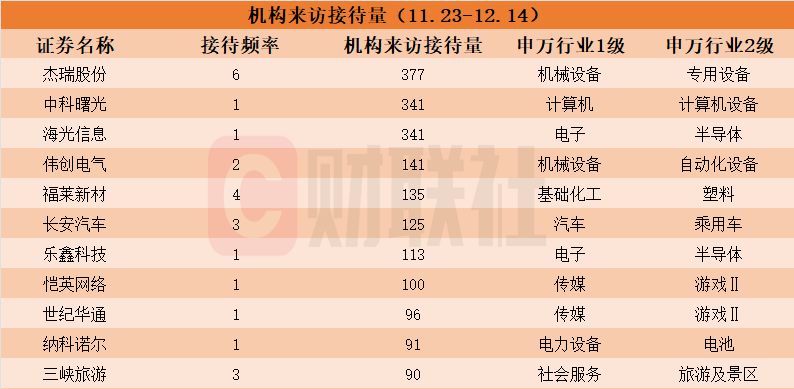
Group 1 - The article highlights that 11 listed companies, including Jie Rui Co., Zhongke Shuguang, and Haiguang Information, have received over 90 institutional visits in the past month, indicating strong investor interest [1] - Haiguang Information and Zhongke Shuguang both had 341 institutional visits, drawing attention due to the termination of their merger plan, yet they plan to maintain independent operations while collaborating on core areas [1][2] - Zhongke Shuguang focuses on CPU and DCU chips, establishing a leading position in domestic core chips, while Haiguang Information emphasizes integrated computing infrastructure and high-end chip design [2] Group 2 - Weichuang Electric, Fule New Materials, and Changan Automobile have also attracted significant institutional interest, with visit counts of 141, 135, and 125 respectively, all linked to their developments in robotics [1][2] - Weichuang Electric is advancing in the robotics field with a comprehensive layout, recently launching various new products including micro motors and intelligent components for mobile robots [3] - Fule New Materials has redefined TPU architecture for robotics, focusing on integrating computing capabilities into electronic skin, enhancing interaction and safety [4] Group 3 - Changan Automobile is strategically developing its robotics business with a "1+N+X" approach, focusing on humanoid robots and various applications across different scenarios [4] - The company aims to integrate the robotics industry supply chain, covering components, software services, and infrastructure, to enhance its smart mobility and automotive robotics offerings [4]


计算机行业周报 20251208-20251212:OpenAIGPT5.2发布!重磅中航信深度发布-20251213
Shenwan Hongyuan Securities· 2025-12-13 13:28
Investment Rating - The report maintains a positive outlook on the computer industry, particularly highlighting the advancements in AI technologies and their implications for enterprise applications [5][6]. Core Insights - OpenAI's release of GPT 5.2 marks a significant improvement in reasoning and professional knowledge capabilities, achieving human expert-level performance in various assessments [7][8][11]. - The Chinese civil aviation information network is positioned as a leader in aviation IT, showing signs of recovery and growth, with a strong market presence [28][39]. - Key company updates include the acquisition activities of Gaon Electronics and the launch of TicNote Pods by Out the Door, indicating strategic expansions in their respective markets [47][51]. Summary by Sections OpenAI GPT 5.2 Release - The GPT 5.2 model has shown substantial improvements in various benchmarks, achieving 70.9% in knowledge work tasks and 86.2% in abstract reasoning tasks, outperforming previous models [8][9][11]. - The competitive landscape among major AI players like OpenAI, Google, and Anthropic is shifting from a focus on parameter size to differentiation in capabilities [7][27]. - The enhancements in reasoning and professional task execution are expected to benefit enterprise-level applications significantly [21][27]. Chinese Civil Aviation Information Network - The company is the largest provider of aviation IT services in China, deeply integrated into the information systems of the civil aviation industry [28][30]. - The recovery in the aviation sector is reflected in the increasing number of flight bookings, with a projected growth in passenger numbers and revenue [39][41]. - The company is expanding its services into the online travel agency (OTA) market, leveraging its existing data infrastructure and customer base [42][46]. Company Updates - Gaon Electronics is in the process of acquiring 100% of Ruicheng Chip Micro and 45.64% of Nengneng Micro, with a total transaction value of 21.74 billion RMB [47][49]. - Out the Door has launched TicNote Pods, a standalone AI recording device, marking a strategic shift towards independent AI hardware solutions [51][52].
计算机行业周报:OpenAIGPT5.2发布!重磅中航信深度发布-20251213
Shenwan Hongyuan Securities· 2025-12-13 13:20
Investment Rating - The report maintains a positive outlook on the computer industry, particularly highlighting the advancements in AI technology and its implications for enterprise applications [5][6]. Core Insights - The release of OpenAI's GPT 5.2 marks a significant improvement in reasoning and professional knowledge capabilities, achieving human expert-level performance in various assessments [7][8]. - The Chinese civil aviation information network is positioned as a leader in aviation IT, showing signs of recovery and growth, with a strong market presence [28][39]. - Key company updates include the acquisition activities of Gaon Electronics and the launch of TicNote Pods by Out the Door, indicating strategic expansions in their respective markets [47][51]. Summary by Sections OpenAI GPT 5.2 Release - OpenAI's GPT 5.2 was launched on December 11, 2025, showcasing substantial improvements in reasoning and professional knowledge tasks, achieving scores of 70.9% in GDPval and 86.2% in ARC-AGI-1 [7][8]. - The competition among large models is shifting from a focus on parameter size to niche differentiation, with OpenAI, Google, and Anthropic each excelling in different areas [5][27]. - The enhanced capabilities of GPT 5.2 are expected to benefit enterprise-level applications, particularly in complex reasoning and planning tasks [21][27]. Chinese Civil Aviation Information Network - The Chinese civil aviation information network is the largest provider of aviation IT services in China, deeply integrated into the industry's information system development [28][30]. - The company has a significant market share, with approximately 95% in the domestic market and around 28% globally, ranking among the top three GDS providers [35][36]. - The recovery of the aviation industry post-pandemic is reflected in the increasing number of flight bookings, with a projected growth in passenger numbers and IT investment in the sector [39][41]. Company Updates - Gaon Electronics announced the acquisition of 100% of Ruicheng Chip Micro and 45.64% of Nengneng Micro, with a total transaction value of 2.174 billion yuan, aimed at enhancing its competitive position in the semiconductor industry [47][49]. - Out the Door launched TicNote Pods, a 4G AI recording headset, marking a strategic shift towards independent AI hardware, which is expected to enhance user experience and operational efficiency [51][55].
A股市场运行周报第71期:分化之下冲高回落,多看少动、耐心等待-20251213
ZHESHANG SECURITIES· 2025-12-13 07:54
Core Insights - The market shows a clear differentiation with a "weak Shanghai, strong Shenzhen" pattern, where most broad-based indices have retreated after reaching highs [1][12][53] - The report anticipates continued market fluctuations within a range due to insufficient strength in heavyweight indices and significant sector divergence [1][4][55] - Suggested investment strategy includes a cautious approach, focusing on sectors that are lagging yet expanding, such as brokerage firms, home appliances, and machinery equipment [1][5][56] Market Overview - Major indices experienced a "weak Shanghai, strong Shenzhen" pattern, with the Shanghai Composite Index, Shanghai 50, and CSI 300 down by 0.34%, 0.25%, and 0.08% respectively, while the Shenzhen Component Index rose by 0.84% [12][53] - The technology and hard science sectors led the gains, with telecommunications rising by 5.92%, while cyclical and consumer sectors showed weakness [15][54] - Daily average trading volume in the Shanghai and Shenzhen markets increased to 2.33 trillion yuan, with a rise in margin trading balances [22][29] Sector Analysis - The report highlights that 9 out of 30 major sectors increased, while 21 decreased, indicating a strong performance in technology and hard science sectors, contrasted by declines in cyclical and consumer sectors [15][54] - Notable sector performances include military, electronics, and machinery, which saw increases of 3.57%, 2.51%, and 1.33% respectively, while coal, oil, and real estate sectors faced declines [15][54] Investment Strategy - The report advises a "wait and see" approach, recommending investors avoid chasing prices and instead set targets based on historical lows of various indices [5][56] - Specific sectors to watch include brokerage firms, which are lagging but expanding, home appliances with a strong historical performance in December, and machinery equipment benefiting from recent positive news [1][5][56] - Individual stocks in the pharmaceutical, consumer, and AI application sectors that are relatively low in price should be monitored, along with those that are lagging above the annual line [5][56]
闪崩7000亿,人工智能泡沫破了?
Sou Hu Cai Jing· 2025-12-13 01:00
Group 1 - Oracle's stock experienced a significant drop, with a decline of 16% on December 11, marking its largest single-day drop since 2001, resulting in a market value loss of approximately $102 billion (around 724.6 billion RMB) [2][3] - The company's stock price closed at $198.85, reflecting a drop of over 10%, with a current market capitalization of $566.9 billion [2] - Earlier in the year, Oracle had a strong performance, reporting a backlog of contracts amounting to $455 billion, which had previously driven its stock price up [3] Group 2 - Oracle's latest financial report for Q2 of fiscal year 2026 showed total revenue of $16.06 billion, falling short of analyst expectations of $16.21 billion; cloud business revenue was $8 billion, a 34% year-over-year increase, but below the expected $8.04 billion [14] - The AI-driven cloud infrastructure revenue surged by 68% year-over-year to $4.1 billion, yet this was not enough to alleviate market disappointment [14] - Oracle's free cash flow was reported at -$13.2 billion, significantly worse than the market expectation of -$5.2 billion, with capital expenditures rising 41% quarter-over-quarter to $12 billion [14] Group 3 - Concerns arose regarding Oracle's financial health, with predictions that its adjusted debt could exceed $300 billion by 2028, as capital expenditures for fiscal year 2026 were raised to $50 billion, an increase of $15 billion from previous estimates [14][15] - The partnership with OpenAI, which involves a $300 billion contract for computing power over five years, raised further concerns about Oracle's ability to meet its financial commitments [15] - The overall sentiment in the market is questioning whether there is a bubble in the AI sector, with opinions suggesting that while there may be small bubbles, the overall potential for AI remains significant [17][19] Group 4 - Major cloud service providers in North America, including Google, Meta, Microsoft, and Amazon, are experiencing stable capital expenditures driven by their own profits, indicating a healthy cash flow and manageable debt levels [23] - The AI business-to-business model is forming a closed loop, with OpenAI projected to reach $13 billion in revenue by 2025, and ChatGPT surpassing 35 million paid users [23] - Predictions indicate that the global AI chip market could exceed $40 billion by 2027, with a compound annual growth rate of over 30% [31]

美联储重启扩表
Ge Lin Qi Huo· 2025-12-12 10:45
1. Report Industry Investment Rating - Not provided in the content 2. Core View of the Report - The global economy is starting to weaken as the US economy slides towards stagflation, and the Fed's restart of balance sheet expansion will have a profound impact on major asset classes [4] 3. Summary by Relevant Catalogs Global Economic Outlook - The Fed cut interest rates by 25 basis points and started buying $40 billion in short - term Treasuries per month, restarting the expansion of its balance sheet [4][5] - The decline in Las Vegas gambling revenue is similar to the early warning signs before the 2008 financial crisis [4] - The US released a new National Security Strategy, adjusting its economic relations with China and aiming to revitalize its economic autonomy [4] - Consumer K - shaped differentiation in the US is intensifying, with high - income consumers' spending remaining resilient while middle - and low - income families are tightening their belts [4] - The official US employment data may be overestimated by 60,000 per month, and the actual employment market may be in negative growth [4] - The US unemployment rate has risen to 4.4%, and the number of initial jobless claims has reached the highest level since September [8] - US employment is declining, with negative growth in the number of new ADP jobs in November and a significant increase in corporate lay - offs [11] - US consumption is weakening, with retail and food sales growing only 0.2% month - on - month in September [14] - US manufacturing prospects are poor, with capital goods imports falling both year - on - year and month - on - month in September, and the ISM manufacturing PMI index continuing to contract in November [17][20] - US inflation is accelerating, with the manufacturing PMI price index and the service PMI price index expanding [23] - The US economy is sliding towards stagflation, with a 0.9% month - on - month increase in the PPI of commodities in September, combined with weakening consumption and declining employment [26] - The eurozone manufacturing PMI contracted again in November, and the eurozone economy was greatly affected by US reciprocal tariffs [29] - The yield of Japan's 10 - year government bonds soared, and the large - scale return of yen carry trades will have a negative impact on US Treasuries, US stocks, and Chinese bonds [31] Asset Allocation - The Fed's purchase of $40 billion in short - term Treasuries per month is positive for precious metals, industrial metals, and Chinese equity assets [34] - Due to the year - end settlement effect, the A - share market may fluctuate and adjust until the end of the year [35] - AI focuses on computing power and electricity, and semiconductor equipment ETFs and grid equipment ETFs are expected to be highly prosperous [38][40] - The US economy sliding towards stagflation and the Fed's restart of balance sheet expansion are strongly positive for gold, which is expected to hit a previous high [42] - The price of silver has reached a new high, mainly due to physical shortages and the remonetization of silver in the post - dollar era [45] - Global copper inventories are continuously shifting to the US, and there is a shortage outside the US. The demand for AI computing power has broken the supply - demand balance of copper, and copper prices are expected to have a major rally [47][50] - The surge in computing power has led to a surge in chip demand, and the semiconductor supply chain is expanding. As chip packaging is the main area of tin consumption, tin demand is expected to surge, and tin is expected to enter a shortage era [54] - The acceleration of the RMB's appreciation is conducive to the accelerated inflow of international capital into China [57]
AI硬件市场大爆发:2025年冲在最前面的10家公司是谁?
和讯· 2025-12-12 09:36
Core Insights - The article emphasizes that AI hardware is not only the main market line for 2025 but also the core increment of the technology cycle for the coming years [2][3] - The Wind hardware equipment index has surged approximately 49% this year, with transaction volume increasing by 83.83% compared to the same period last year, reaching an average daily transaction volume of 271.9 billion yuan [2] Company Rankings - The article presents the top 10 hardware equipment companies based on a comprehensive evaluation of 589 A-share companies, focusing on "R&D innovation, financial health, growth potential, and market performance" [4] - The top 10 companies include: 1. Xinyi Technology (新易盛) - Optical module solutions provider 2. Hikvision (海康威视) - Intelligent IoT solutions provider 3. Zhongji Xuchuang (中际旭创) - High-speed optical module solutions provider 4. ZTE Corporation (中兴通讯) - Network equipment and telecommunications provider 5. Dahua Technology (大华股份) - Video-centric smart IoT solutions provider 6. Shenghong Technology (胜宏科技) - High-precision PCB manufacturer 7. Industrial Fulian (工业富联) - Industrial internet and smart manufacturing service provider 8. BOE Technology Group (京东方) - Display panel leader 9. Yingshi Innovation (影石创新) - Intelligent imaging equipment provider [5][6] Industry Trends - The industry is entering a new phase characterized by "AI/computing power first," with AI being the largest variable and certainty for hardware equipment in 2025 [10] - A "hard technology growth chain" centered around AI computing power is rapidly forming, with leading companies showing high innovation, financial stability, and strong market performance [10][19] - The first-tier companies exhibit a total score above 1600, indicating robust financial health and market competitiveness, while the second-tier companies, scoring between 1400-1600, include both large manufacturers and niche leaders [19][20] Financial Health and Market Performance - The article notes that top companies have a strong financial foundation and market competitiveness, while R&D innovation and growth potential scores are more dispersed, particularly in high-demand sectors like data centers and AI [9][12] - Companies with high R&D scores but poor financial health tend to have lower market performance, indicating a stricter market scrutiny of "stories" and "concepts" [12]





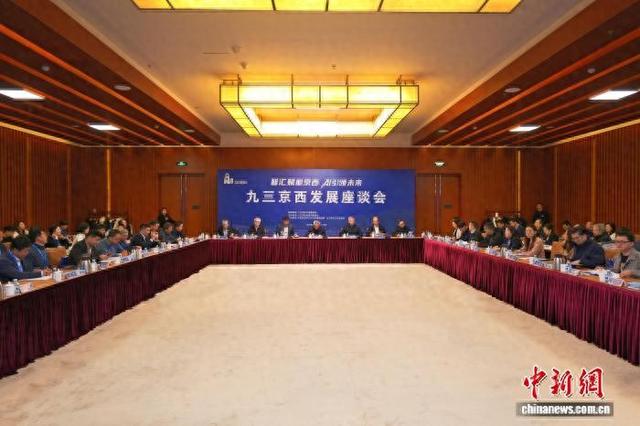
“智汇”九三京西发展座谈会 共商AI时代机遇
Zhong Guo Xin Wen Wang· 2025-12-12 06:20
Core Insights - The meeting emphasized the importance of computing power as a fundamental resource in the AI era, with a focus on transforming the Mentougou District from a traditional mining area to a high-tech industry hub [2][3] - AI is recognized as a strategic technology driving a new wave of technological and industrial transformation, becoming a key direction for national development [3] - Experts highlighted the need for a robust AI infrastructure led by state-owned capital, ensuring safety and security in AI applications [3] Group 1: AI Development and Infrastructure - The meeting discussed the necessity of building a national integrated computing power network to support the growing demand for AI, emphasizing the importance of efficient distributed training and inference optimization [3] - Recommendations were made to create a comprehensive computing infrastructure that is inclusive, user-friendly, efficient, green, and secure, which would empower high-quality economic development [3] - The focus on AI for scientific research was highlighted, suggesting the establishment of platform-based research paradigms utilizing AI [3] Group 2: Local Applications and Innovations - Experts proposed various applications of AI in local contexts, such as expanding autonomous driving demonstration zones and developing smart parking management systems [5] - The use of drones for intelligent mountain patrols and data analysis to uncover hidden routes was discussed, aiming to enhance safety and intelligence in natural environments [5] - The potential of reviving historical railway sites using AI and VR technology was presented as a means to activate local development [5] Group 3: Collaborative Efforts and Future Directions - The meeting resulted in a compilation of over 100,000 words of research findings from experts, which will be organized into actionable lists for implementation [6] - The commitment to a "3+3" comprehensive performance platform was reiterated, showcasing the responsibility of the political party in regional development [6] - The meeting aimed to foster a distinctive path for high-quality development in the Beijing West region, aligning with national strategic goals [6]