加息预期

Search documents
澳币AUDUSD再被点燃!澳洲10月消费创两年最大增幅,央行加息预期全面提前
Xin Lang Cai Jing· 2025-12-04 23:37
Group 1 - Australian household consumption unexpectedly surged, with a 1.3% month-on-month increase in October, reaching AUD 78.4 billion (approximately USD 51.77 billion), the largest growth in nearly two years [1][36][42] - The annual growth rate of household spending accelerated from 5.1% to 5.6%, driven by year-end promotional activities, with significant increases in spending on clothing, footwear, furniture, and electronics [1][36][42] - This strong data has led to a rapid reassessment of interest rate expectations, with a 50% probability now assigned to the Reserve Bank of Australia raising rates in May next year [1][36][42] Group 2 - The Australian economy is experiencing robust growth, with the third-quarter GDP showing the fastest annual growth in two years, and private investment rising significantly [2][43] - Inflation pressures remain high, with the overall inflation rate accelerating to 3.8% in October, exceeding the central bank's target range of 2-3% [2][43] - Consumer confidence has turned optimistic for the first time in four years, complicating the Reserve Bank's task of balancing economic growth and inflation control [2][43] Group 3 - In the U.S., initial jobless claims fell to a three-year low of 191,000, indicating resilience in the labor market despite fluctuations during the Thanksgiving holiday [3][38] - The number of continuing claims slightly decreased to 1.939 million, reflecting a relatively high level consistent with an increase in the unemployment rate from 4.3% to 4.4% [3][38] - The job market is characterized by a "no layoffs, no hiring" stagnation, influenced by reduced labor supply due to immigration policy changes and the impact of artificial intelligence on entry-level job demand [3][38] Group 4 - U.S. companies announced a significant decrease in layoffs in November, with 71,321 job cuts, down 53% from the previous month, although still 24% higher than the same month last year [4][39] - Year-to-date, U.S. employers have announced approximately 1.171 million layoffs, a 54% increase compared to the previous year, while planned hiring has dropped to the lowest level since 2010 [4][39] - The report indicates that while layoffs have decreased, hiring intentions remain low due to economic uncertainties and demand slowdown [4][39]


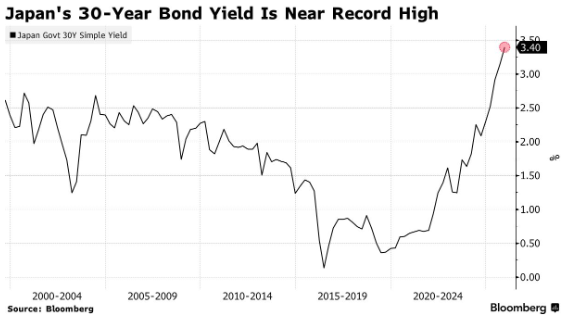
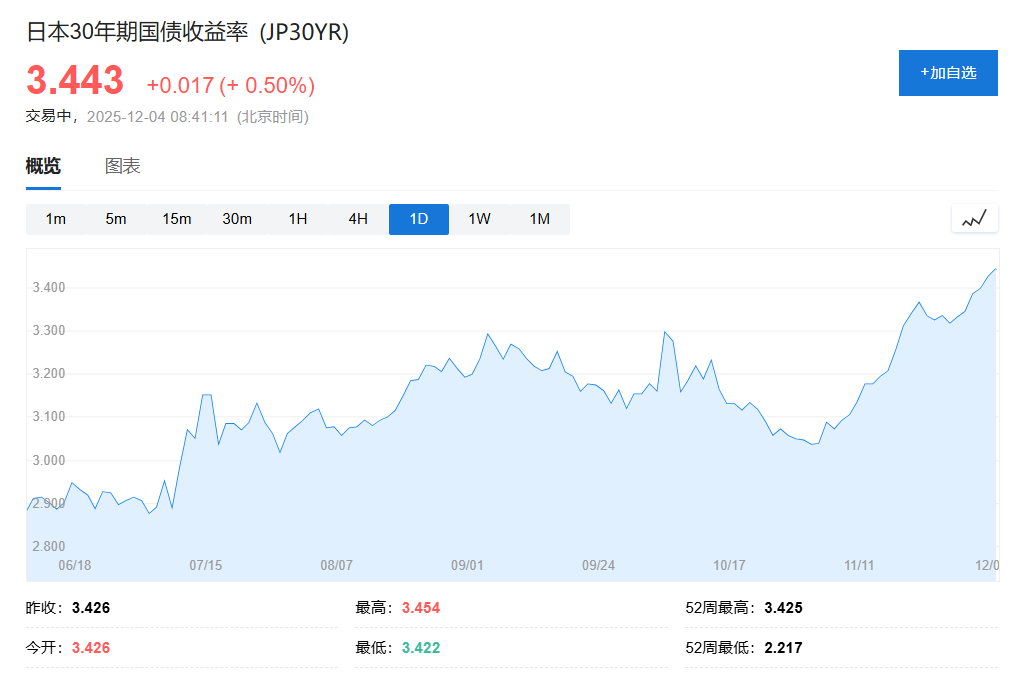
日本30年期国债拍卖需求火爆创4年新高!收益率超3.4%获野村大举买入
智通财经网· 2025-12-04 06:53
Core Viewpoint - The strong demand for Japan's 30-year government bond auction indicates that investors are re-entering the market due to rising yields, providing some relief to a market anxious about potential interest rate hikes [1][2]. Group 1: Auction Results - The bid-to-cover ratio for the 30-year bond auction rose to 4.04, surpassing the previous auction and the average of the past year [1]. - The yield on the 30-year bond decreased by 3 basis points to 3.39% after the auction [1]. - The auction followed a solid 10-year bond auction earlier in the week, where yields reached attractive levels, encouraging buyers [1]. Group 2: Investor Sentiment - Ryutaro Kimura from AXA Investment Managers noted that the strong auction results likely stem from investors finding the yield above 3.4% acceptable for long-term bonds, suggesting a temporary easing of upward pressure on yields [2]. - The auction's tail, which indicates the difference between the average accepted price and the minimum accepted price, was 0.09, down from 0.27 the previous month, signaling solid investor demand [2]. Group 3: Market Reactions - Nomura emerged as the largest buyer, indicating participation from long-term investors [3]. - Other bond yields in Japan continued to rise, particularly short-term bonds sensitive to monetary policy changes, following hawkish comments from the Bank of Japan's governor [3]. - The benchmark 10-year bond yield increased by 3.5 basis points to 1.925%, while the 5-year bond yield slightly rose to 1.40% [3]. Group 4: Future Outlook - Investors are awaiting details on the government's next fiscal year's budget, particularly regarding any plans to reduce the issuance of ultra-long-term bonds [5]. - The government plans to increase short-term bond issuance to fund Prime Minister Kishida's economic initiatives, adding 300 billion yen to the issuance plans for 2-year and 5-year bonds, and increasing treasury bill supply by 6.3 trillion yen [5]. - Kimura cautioned that if overall issuance increases while calls for reduced supply of ultra-long-term bonds are unmet, the yield curve may steepen again [5].
澳大利亚通胀高企 家庭支出激增推升2026年加息预期
Zhong Guo Jin Rong Xin Xi Wang· 2025-12-04 05:22
Core Viewpoint - Despite a slowdown in overall economic growth in Australia during the third quarter, domestic demand remains strong, leading to heightened market expectations for the Reserve Bank of Australia (RBA) to end its easing cycle early and potentially raise interest rates in the first half of 2026 [1][3]. Economic Growth and Consumer Spending - The Australian Bureau of Statistics reported a 1.3% month-on-month increase in household spending for October, marking the largest single-month growth in nearly two years, significantly surpassing the market expectation of 0.6% [1][3]. - Year-on-year growth in household spending rose from 5.1% in September to 5.6% in October, driven by promotional activities and major cultural events [1][3]. - Goods spending increased by 1.7% month-on-month, while services spending grew by 0.8% [1][3]. Inflation and Consumer Price Index - The weighted Consumer Price Index (CPI) for October reached an annual rate of 3.8%, exceeding the previous value of 3.5% and market expectations of 3.6% [1][3]. - The CPI remained flat month-on-month, contrary to expectations of a moderate decline, indicating persistent price pressures with "almost no signs of weakening" [1][3]. Economic Indicators and RBA Policy Outlook - The actual GDP growth rate for the third quarter was only 0.4% quarter-on-quarter (expected 0.7%) and 2.1% year-on-year (expected 2.2%), indicating weaker-than-expected performance [2][4]. - However, private final demand showed strong growth of 1.1% for the quarter, suggesting that the internal economic momentum is still accelerating [2][4]. - The RBA currently maintains the official cash rate at 3.60%, with indicators suggesting the economy is nearing capacity limits, including a labor market at or near full employment and high capacity utilization rates in business surveys [2][4]. Future Interest Rate Expectations - Economists predict that any growth above trend will exert upward pressure on prices and wages, leading the RBA to potentially raise interest rates as early as the first half of 2026 if economic growth accelerates and the labor market tightens further [5]. - The market anticipates that the RBA will keep interest rates unchanged in the upcoming monetary policy meeting, but the focus will be on the policy statement regarding future positions [5].
日本30年期国债标售需求创2019年以来新高,加息预期持续升温
Hua Er Jie Jian Wen· 2025-12-04 04:11
Core Viewpoint - Despite ongoing fiscal concerns in Japan, strong demand for 30-year government bonds has been observed, marking the highest demand since 2019 [1] Group 1: Bond Auction Results - The bid-to-cover ratio for the 30-year bond auction reached 4.04, significantly higher than November's 3.125 and the average of 3.35 over the past 12 months [1] - The tail difference narrowed to 0.09, down from 0.27 last month, indicating more concentrated bidding and stable demand [1] Group 2: Yield Trends - The yield on the 10-year benchmark government bond reached 1.91%, the highest level since 2007 [1] - The yield on the 30-year government bond rose by 2.5 basis points to 3.445%, the highest since its introduction in 1999 [1] Group 3: Interest Rate Expectations - Market expectations for a rate hike by the Bank of Japan have surged, with an 80% probability for a December 19 meeting increase and over 90% for January [4] - The probability for a December rate hike was only 56% a week prior [4] Group 4: Government Bond Issuance Plans - Investors are closely monitoring the government's budget details for the next fiscal year, particularly regarding potential reductions in long-term bond issuance [6][7] - The Japanese Finance Ministry plans to increase short-term bond issuance by 300 billion yen (approximately 1.93 billion USD) to fund economic stimulus measures [7] Group 5: Hawkish Signals from the Central Bank - The hawkish remarks from Bank of Japan Governor Kazuo Ueda have significantly heightened market rate hike expectations [8] - Ueda's comments about the upcoming monetary policy meeting were described as an unusually strong signal [8] Group 6: Economic Outlook - Ueda expressed growing confidence in the economic outlook, suggesting that conditions for policy normalization are improving [9] - He noted that despite recent negative GDP data, the economy is still on a moderate recovery path [9] - Ueda indicated that wage growth is showing initial momentum, which could support a shift away from negative interest rates [10]
澳大利亚经济增长令人失望 给加息预期降温
Xin Lang Cai Jing· 2025-12-03 00:51
政府周三公布的数据显示,截至9月的三个月内,国内生产总值(GDP)环比增长0.4%,低于经济学家 预估的0.7%,也低于上一季度向上修正后的0.7%。按年增长率为2.1%,低于经济学家预估的2.2%。 澳大利亚经济上季度增速出人意料地放缓,给经济潜在实力蒙上阴影,并表明市场可能过早地对加息预 期做出了定价。 政府周三公布的数据显示,截至9月的三个月内,国内生产总值(GDP)环比增长0.4%,低于经济学家 预估的0.7%,也低于上一季度向上修正后的0.7%。按年增长率为2.1%,低于经济学家预估的2.2%。 数据公布后澳元汇率下跌,对政策敏感的3年期国债收益率也随之下滑。货币市场认为, 澳大利亚央行 在2026年底之前维持利率不变的可能性超过50%。而在此次数据公布前,市场预期在明年年底前有一次 加息。 责任编辑:王永生 澳大利亚经济上季度增速出人意料地放缓,给经济潜在实力蒙上阴影,并表明市场可能过早地对加息预 期做出了定价。 数据公布后澳元汇率下跌,对政策敏感的3年期国债收益率也随之下滑。货币市场认为, 澳大利亚央行 在2026年底之前维持利率不变的可能性超过50%。而在此次数据公布前,市场预期在明年年底前有 ...
澳洲央行释放鹰派信号 结构性挑战或推高长期利率
智通财经网· 2025-12-03 00:48
经济学家对未来政策走向看法不一:一部分仍预期明年将降息,另一部分则认为利率将维持不变,还有 观点与市场预期趋同,认为下一步行动将是加息。澳大利亚央行自2月以来已三次维持关键利率不变, 保持其在2023年4月以来的最低水平。由于第三季度通胀持续高于2–3%的目标区间上限,且劳动力市场 依然紧张,央行已转向更为依赖数据的政策立场。 近期多项数据表明经济基本面依然稳健:11月房价继续上涨,第三季度商业投资强于预期,家庭消费也 普遍展现韧性。在此背景下,包括澳大利亚联邦银行和澳大利亚国家银行在内的多家机构经济学家已指 出2026年加息的可能性。 此外,生产率低迷压低了澳大利亚的潜在经济增长水平,这意味着经济走强时通胀可能更快抬头。该结 构性变化也暗示,本轮周期的利率水平或将持续高于以往。 此番言论发布之际,澳大利亚即将公布第三季度国内生产总值数据。市场预期该季度经济环比增长 0.7%,可能创下自2022年底以来最快增速。尽管下周举行的货币政策会议预计将维持利率于3.6%不 变,但政策前景的不确定性正在增加。 布洛克表示,目前难以判断经济是否已超出潜力水平,但她评估认为产出缺口已显著收窄。这意味着若 需求增长超出预期, ...
澳大利亚经济增长令人失望 加息预期降温
Xin Lang Cai Jing· 2025-12-03 00:40
Group 1 - Australia's GDP growth unexpectedly slowed to 0.4% for the quarter ending in September, below the expected 0.7% and the revised previous quarter's growth of 0.7% [1][3] - The annual growth rate was recorded at 2.1%, also lower than the anticipated 2.2% [1][3] Group 2 - Following the GDP data release, the Australian dollar depreciated, and the yield on three-year Australian government bonds declined [2][4] - The market now sees over a 50% probability that the Reserve Bank of Australia (RBA) will keep interest rates unchanged until the end of 2026, contrasting with previous expectations of a rate hike by the end of next year [2][4] - The RBA anticipates that economic growth will approach a "potential" rate of nearly 2% by 2026, supported by lower borrowing costs, stable household incomes, and strong population growth, despite ongoing high inflation and a tight labor market [2][4]
策略师看淡美元12月前景 警示“三重打击”风险来袭
Xin Lang Cai Jing· 2025-12-02 18:44
Core Viewpoint - Analysts warn that the US dollar may face a triple blow in the coming weeks, exacerbating its seasonal weakness [2][7] Group 1: Factors Affecting the Dollar - The dollar may be negatively impacted by a US Supreme Court ruling declaring tariffs illegal and the potential appointment of Kevin Hassett as Federal Reserve Chairman [2][7] - If Japan raises interest rates this month, the yen could strengthen significantly against the dollar [2][10] - Deutsche Bank suggests that stronger economic data from other countries could also pressure the dollar as the year ends [2][7] Group 2: Market Trends and Predictions - December has historically been the worst month for the dollar, as traders often sell dollars to balance returns from other US assets [4][9] - Analysts predict that the dollar could decline by approximately 2% from current levels, potentially returning to third-quarter lows [4][9] - The Bloomberg Dollar Spot Index has risen by 1.5% this quarter, continuing a nearly 1% increase from July to September [5][9] Group 3: Implications of Potential Fed Leadership - The market anticipates that Hassett's leadership at the Federal Reserve could lead to a more dovish policy stance, increasing expectations for rate cuts next year [5][9] - If Hassett is appointed, it could push the dollar to fall below the four-year low of 1.19 against the euro [5][9]

日本10年期国债拍卖:投标倍数上升,12月加息预期近80%
Sou Hu Cai Jing· 2025-12-02 06:15
Group 1 - The core viewpoint of the article highlights strong demand for Japan's 10-year government bond auction, which exceeds the average level of the past 12 months, despite rising market expectations for interest rate hikes [1] - The bid-to-cover ratio for the auction was 3.59, higher than November's 2.97 and the 12-month average of 3.20, indicating robust investor interest [1] - The auction took place following comments from Bank of Japan Governor Kazuo Ueda, who suggested that the possibility of a rate hike later this month is being weighed, with financial conditions remaining accommodative post-hike [1] Group 2 - The swap market indicates an approximately 80% chance of a rate hike at the December 19 policy meeting, with over 90% likelihood for January, a significant increase from just 36% a week prior [1] - The Japanese Ministry of Finance plans to increase short-term debt issuance to fund Prime Minister Fumio Kishida's stimulus plan, raising the issuance of 2-year and 5-year government bonds by 300 billion yen each, and increasing treasury bill supply by 6.3 trillion yen [1]
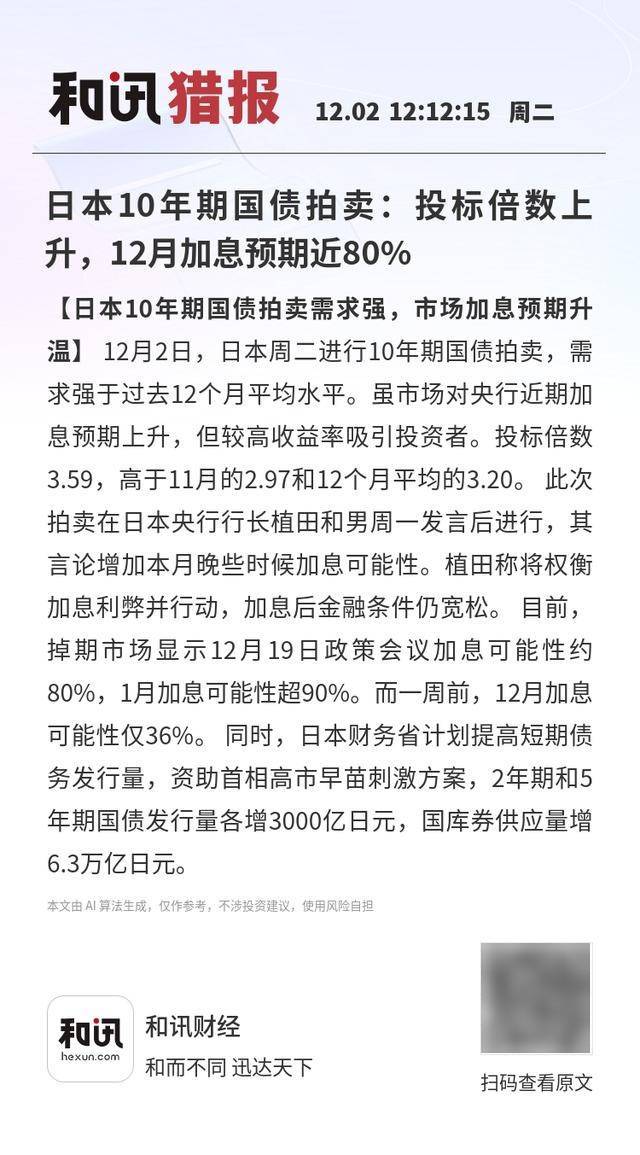
日本10年期国债拍卖需求强劲 市场加息预期升至80%
Sou Hu Cai Jing· 2025-12-02 04:15
格隆汇12月2日|日本周二的10年期国债拍卖需求强于过去12个月的平均水平,尽管市场对央行近期加 息的预期不断上升,但较高的收益率水平仍吸引了投资者。投标倍数为3.59,高于11月上次拍卖的2.97 和12个月平均水平3.20。此次拍卖是在日本央行行长植田和男周一发表言论之后进行的,市场认为他的 言论增加了本月晚些时候加息的可能性。植田表示,日本央行将权衡加息的利弊并采取适当行动,并补 充说即使加息后,金融条件仍将保持宽松。目前,掉期市场暗示12月19日政策会议上加息的可能性约为 80%,而1月份加息的可能性则升至90%以上。相比之下,就在一周前,12月加息的可能性仅为36%。与 此同时,日本财务省计划提高短期债务发行量,以帮助资助首相高市早苗的经济刺激方案,将2年期和5 年期国债发行量分别增加3000亿日元,并将国库券供应量增加6.3万亿日元。 ...