新基建

Search documents
声明:任泽平博士观点
泽平宏观· 2026-01-19 16:24
任泽平博士的观点,网上传来传去,多有谬误,本文一并更正,正本清源。 需要声明,任泽平博士新媒体矩阵号过往所写公司,仅为研究,并非投资建议,公开场合不荐 股。 做有温度、有情怀、有专业的研究,用知识推动社会进步。正心正念,坚持做长期正确的事。 感谢各界以及媒体朋友的关心,一起带着梦想去旅行。 基建"写入2020年政府工作报 - 2 - 1 12 在2020年国内最早倡导新基建,看好新能源和人工 智能。专著《新基建》荣获中组部第五届全国党员培 训创新教材奖。 任泽平 马家讲 连 你们著的《新基建》在第五届全国党员教育培训 教材展示交流活动中被评为创新教材。 中共中央组织部 2021年1月 在2021年12月常州金坛区举办的新能源产业峰会上,提出"当下不投新能源,就像20年前没买 房"。只是在2022年中期新能源大热时被媒体借势炒作上热搜,并非部分网上解读的是2022年 提出的观点。 021年12月,中国汽车工业协会、常州市金坛区人民政府、 法模如十篇安十量店照过留学生经 新能源相关的产业是未来中国经济最有希望的,最具爆发力的领域 下不给新能源 就像20年前沿理服 这是我个人的看法,这是时代的力量,我们每个人不过是 ...

中国经济总量五年“四连跳”现三大趋势
Zhong Guo Xin Wen Wang· 2026-01-19 14:09
随着2025年国内生产总值(GDP)超过140万亿元(人民币,下同),中国经济总量在"十四五"时期已先后迈 上四个十万亿大台阶。五年"四连跳"背后,显现三个趋势。 ——经济底盘更稳,抗风险能力更强。 "四连跳"背后,"新"的特质更加鲜明。 五年里,中国新质生产力稳步成长,创新指数排名首次晋升全球前十,规模以上高技术制造业增加值年 均增长9.2%,人工智能、5G等数字技术蓬勃兴起;能源供应清洁化、低碳化加速,新能源产品市场竞 争力不断增强。 一个突出的例子是,不止"新三样",越来越多中国产品"先进""高端"的属性凸显。2025年,中国规模以 上装备制造业、高技术制造业增加值占规上工业增加值的比重分别达36.8%和17.1%;高技术产品出口 同比增长13.2%,拉动出口增长2.4个百分点。 跨过140万亿大关之后,粤开证券首席经济学家、研究院院长罗志恒预计,2026年中国经济增长的动力 结构将继续发生明显变化,旧动能拖累减弱,新动能拉动增强。 其中,制造业投资将呈现结构优化特征,半导体、工业母机等自主可控领域的资本开支将保持较高增 速。基建投资在"十五五"开局之年有望提速,投向将转向以信息通信网络、重大科技基础设 ...
(经济观察)中国经济总量五年“四连跳”现三大趋势
Zhong Guo Xin Wen Wang· 2026-01-19 11:07
Group 1 - The core viewpoint of the article highlights that China's economy has achieved significant growth, surpassing four major milestones in GDP over five years, with a projected GDP exceeding 140 trillion yuan by 2025 [1] Group 2 - The stability of the economic foundation has improved, enhancing the ability to withstand risks. China's grain production has stabilized at 1.4 trillion jin for two consecutive years, and the manufacturing value added has remained the highest globally for 16 years. By 2025, the service sector's contribution to GDP is expected to rise to 57.7% [3][2] - Domestic consumption is projected to exceed 50 trillion yuan in retail sales by 2025, with final consumption contributing 52% to economic growth, an increase of 5 percentage points from the previous year [3] Group 3 - The quality of development has improved, with a greater emphasis on innovation. China's innovation index has entered the global top ten, and the value added of high-tech manufacturing has grown at an average rate of 9.2% annually [5] - By 2025, the proportion of high-tech manufacturing value added in total industrial value added is expected to reach 17.1%, with high-tech product exports increasing by 13.2% [5] Group 4 - The expanding Chinese economy is creating more opportunities and broader cooperation space. China is expected to import a record 18.5 trillion yuan worth of goods by 2025, providing vast market opportunities for other countries [7] - By 2025, the number of countries and regions trading with China is projected to reach 249, with significant trade volumes across various categories [8]
26年经济有何期待?——12月经济数据解读
陈兴宏观研究· 2026-01-19 09:50
Economic Overview - The national economy achieved a GDP growth of 5% for the year, successfully meeting the target [2][11] - Exports continued to support growth, benefiting from reduced trade disruptions post the China-US Kuala Lumpur Agreement, with strong growth in the electronic and high-tech product sectors [2] - Investment saw a further decline, with all three major investment categories experiencing downward trends, particularly in manufacturing and real estate [2][4] Industrial Production - Industrial production showed signs of recovery, with the industrial added value for December increasing by 5.2% year-on-year [3] - The mining, manufacturing, and electricity sectors reported growth rates of 5.4%, 5.7%, and 0.8% respectively [3] - Exports contributed positively to industrial production, with a year-on-year increase in export delivery value of 3.2% [3] Investment Trends - Fixed asset investment saw a year-on-year decline of 15.1%, with private investment dropping by 17.2% [4] - Real estate investment experienced a significant decline of 35.8%, while manufacturing investment fell by 10.5% [4] - Infrastructure investment also faced challenges, with traditional and new standards showing declines of 15.9% and 12.2% respectively [4] Consumer Behavior - Retail sales growth slowed to 0.9% in December, marking a new low since 2023, influenced by the real estate cycle and consumer debt [7] - Service consumption showed resilience, with a year-on-year growth rate of 5.5%, supported by policy initiatives [7] - Essential consumer goods saw a decline in growth, while discretionary goods showed a narrowing decline [7] Real Estate Market - Real estate sales area saw a year-on-year decline of 15.6%, although the rate of decline improved compared to November [8] - New construction area decreased by 19.4%, while the completion area also faced a decline [8] - Housing prices continued to drop across various city tiers, with both new and second-hand residential prices decreasing [8] Employment and Economic Stability - The urban unemployment rate remained stable at 5.1%, consistent with previous months [11] - Overall, the economy is facing challenges from external uncertainties and ongoing structural adjustments, with a focus on expanding consumption as a key growth strategy for 2026 [11]

——12月经济数据解读:2026年经济有何期待?
Huafu Securities· 2026-01-19 09:06
Economic Performance - In December, the national GDP growth for the year reached 5%, successfully meeting the target[10] - The fixed asset investment in December saw a year-on-year decline of 15.1%, an increase of 3.1 percentage points from the previous month[4] - The manufacturing investment dropped by 10.5%, while real estate investment fell by 35.8%[4] Consumption Trends - Retail sales growth in December decreased by 0.4 percentage points to 0.9%, marking the lowest level since 2023[19] - Service retail sales continued to rise, with a cumulative year-on-year growth of 5.5%, indicating strong resilience in service consumption[19] - The average growth rate of essential consumer goods increased to 3.2%, while discretionary goods saw a decline of 4.4%[22] Industrial Production - The industrial added value in December grew by 5.2% year-on-year, with significant contributions from equipment manufacturing and high-tech industries[11] - The mining, manufacturing, and electricity sectors reported growth rates of 5.4%, 5.7%, and 0.8% respectively[11] Real Estate Market - The sales area of real estate in December experienced a year-on-year decline of 15.6%, although this was an improvement from November[25] - Housing prices continued to decline, with both new and second-hand residential prices showing a widening year-on-year drop[10] Employment and Future Outlook - The urban unemployment rate remained stable at 5.1%, consistent with the previous month and year[26] - The report emphasizes that expanding consumption is crucial for stabilizing growth in 2026, with "new infrastructure" and "energy infrastructure" as potential short-term strategies[26]
声明:任泽平博士观点
泽平宏观· 2026-01-18 16:05
任泽平博士的观点,网上传来传去,多有谬误,本文一并更正,正本清源。 需要声明,任泽平博士新媒体矩阵号过往所写公司,仅为研究,并非投资建议,公开场合不荐 股。 基建"写入2020年政府工作报 - 2 - 1 12 在2020年国内最早倡导新基建,看好新能源和人工 智能。专著《新基建》荣获中组部第五届全国党员培 训创新教材奖。 做有温度、有情怀、有专业的研究,用知识推动社会进步。正心正念,坚持做长期正确的事。 感谢各界以及媒体朋友的关心,一起带着梦想去旅行。 任泽平 马家讲 连 你们著的《新基建》在第五届全国党员教育培训 教材展示交流活动中被评为创新教材。 中共中央组织部 2021年1月 在2021年12月常州金坛区举办的新能源产业峰会上,提出"当下不投新能源,就像20年前没买 房"。只是在2022年中期新能源大热时被媒体借势炒作上热搜,并非部分网上解读的是2022年 提出的观点。 021年12月,中国汽车工业协会、常州市金坛区人民政府、 法模如十篇安十量店照过留学生经 新能源相关的产业是未来中国经济最有希望的,最具爆发力的领域 下不给新能源 就像20年前沿理服 这是我个人的看法,这是时代的力量,我们每个人不过是 ...
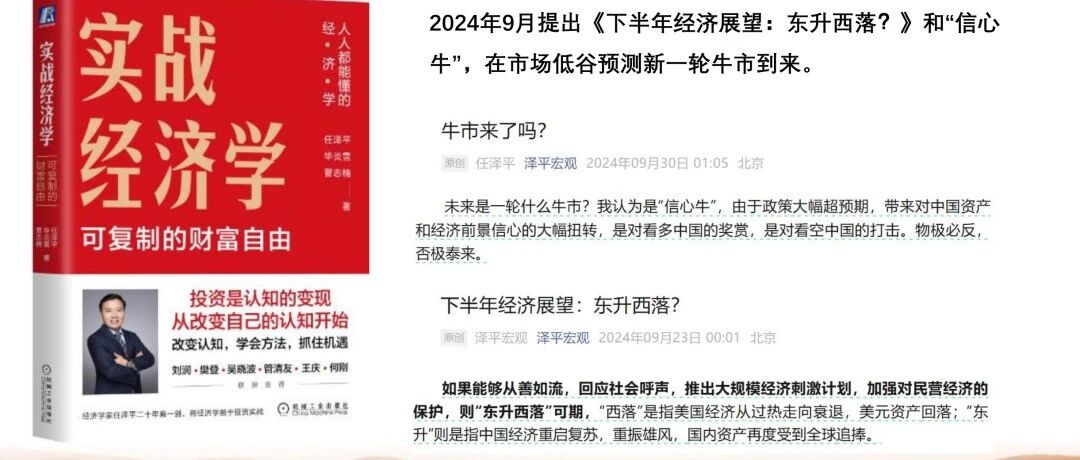
任泽平年度演讲:中国经济十大预测2025
泽平宏观· 2026-01-17 02:42
Core Viewpoint - The article presents ten major predictions for the Chinese economy in 2025, emphasizing the emergence of a new cycle and era, the global interest rate reduction, the fourth technological revolution, and the importance of adapting to new trends and opportunities in various sectors [2][3][4][5][6][7][8][9][10][11]. Group 1: New Economic Cycle and Global Trends - A new economic cycle and era are emerging, encouraging adaptation to new trends and opportunities [2][3]. - The global economy is entering a new interest rate reduction cycle, with significant implications for monetary policy and economic growth [3][40]. - The return of Trump to the White House (Trump 2.0) is expected to create uncertainties, including inflation and trade tensions, impacting global economic dynamics [3][42][44]. Group 2: Technological Revolution - The fourth technological revolution is underway, with breakthroughs in artificial intelligence, renewable energy, commercial aerospace, low-altitude economy, and biomanufacturing [4][55][57]. - AI is expected to experience explosive growth, with applications in image recognition, humanoid robots, AI assistants, and consumer electronics [6][11]. - The low-altitude economy is gaining traction, with potential applications in logistics and urban management, creating a multi-trillion market [8][59]. Group 3: Economic Policies and Domestic Growth - China is initiating macroeconomic easing to boost confidence and economic growth, focusing on new infrastructure and productivity [5][73]. - The government is implementing policies to stabilize the real estate market and promote consumption, with a focus on enhancing the business environment for private enterprises [78][87]. - The emphasis on new infrastructure includes advancements in new energy systems, digital economy, and artificial intelligence, positioning China for future growth [81][84]. Group 4: Globalization and Market Expansion - Chinese enterprises are shifting from export to global expansion, tapping into larger international markets [6][92]. - The rise of successful Chinese companies in overseas markets, such as SHEIN and TikTok, illustrates the potential for growth beyond domestic borders [96][111]. - Southeast Asia is identified as a key target for Chinese companies due to its growing market and favorable conditions for investment [101]. Group 5: Aging Population and Consumer Trends - The aging population presents opportunities in the silver economy, emphasizing the need for policies to boost birth rates and early childhood development [11]. - Consumer behavior is shifting towards interest-based spending, with cultural consumption and local trends gaining popularity among younger demographics [9][30].



浙江交科:公司聚焦“五大业务板块”协同发展
Zheng Quan Ri Bao Wang· 2026-01-16 10:19
Group 1 - The company focuses on five major business sectors: transportation infrastructure, urban construction, comprehensive maintenance, transportation manufacturing, and related industries [1] - The goal is to become a leading enterprise in the new infrastructure sector while actively promoting the development plan for the 14th Five-Year Plan [1] - The company aims to optimize its business portfolio and structure, enhancing its overall development capabilities to promote high-quality growth [1]

普洛斯中国新CEO上任!向市场释放三大信号
21世纪经济报道· 2026-01-16 08:24
Core Viewpoint - GLP has appointed Zhao Mingqi as the CEO of GLP China, a newly established position, to lead logistics, industrial infrastructure, computing centers, new energy, and fund management in the Chinese market, reporting to global CEO Mei Zhimin [1][4] Group 1: Business Strategy and Leadership - The internal promotion of a senior executive reflects GLP's commitment to local talent development and succession planning, emphasizing the importance of business synergy in China's new economy [4][12] - Zhao Mingqi has played a crucial role in driving the rapid growth of GLP's China business since its entry into the market in 2003, including the incubation of new business models in the technology park sector [4][5] Group 2: Infrastructure and Market Position - GLP operates in over 70 cities with a logistics and industrial infrastructure covering 40 million square meters, serving over 2,500 clients, primarily focused on domestic consumption, manufacturing, and import-export trade [6][13] - The company has established 20 data centers across China, providing an IT load of 1.4 GW, and is among the top five service providers in the domestic computing center market [6][10] Group 3: New Infrastructure Initiatives - GLP's new infrastructure assets, including logistics parks and computing centers, are essential for supporting the digital economy, smart manufacturing, and green energy sectors, enhancing efficiency and innovation [7][10] - Recent projects, such as the Shanghai New Northwest Logistics Park, have achieved significant milestones, including a "zero carbon" certification, showcasing GLP's commitment to high standards in new infrastructure [10][9] Group 4: Focus on Domestic Market - GLP's strategy emphasizes deepening its presence in the Chinese market, with nearly 90% of its operational space serving domestic demand, and a client base consisting of 80% local enterprises [12][13] - The company has continuously adapted its warehousing standards to meet the evolving market environment and has actively participated in setting national and industry standards [12][13]

普洛斯中国新CEO上任!向市场释放三大信号
2 1 Shi Ji Jing Ji Bao Dao· 2026-01-16 07:29
Core Viewpoint - GLP has appointed Zhao Mingqi as the CEO of GLP China, a newly established position, to lead logistics, industrial infrastructure, computing centers, new energy, and fund management in the Chinese market, reporting to global CEO Mei Zhimin [1][3]. Group 1: Leadership and Strategic Direction - Zhao Mingqi has been with GLP since its inception in China in 2003 and has played a crucial role in driving the rapid growth of the business and building a strong industrial ecosystem [3][4]. - The appointment of an internal candidate reflects GLP's commitment to local talent development and succession planning, emphasizing the importance of business synergy in the new economy [3][4]. Group 2: Business Development and Infrastructure - Since 2003, Zhao has led the development of innovative industrial parks, catering to the emerging needs of R&D and high-tech enterprises, injecting new growth momentum into GLP's operations in China [4]. - GLP operates logistics and industrial infrastructure across 70 cities, with a total operational area of 40 million square meters, serving over 2,500 clients [4][10]. - The company has established 20 data centers nationwide, providing an IT load of 1.4 GW, ranking among the top five service providers in the domestic computing center market [4][5]. Group 3: New Infrastructure and Sustainability - GLP's core businesses, including logistics parks, computing centers, and new energy facilities, are crucial for supporting the upgrade of China's manufacturing sector and promoting green transformation [5][6]. - The company is committed to high-standard new infrastructure, as evidenced by the recent launch of the Shanghai New Northwest Logistics Park, which has received a "zero-carbon" certification [7][9]. - GLP is exploring the synergy between new energy and computing centers, aiming to transform traditional power consumption models into core collaborators in new energy systems [9][10]. Group 4: Market Position and Future Outlook - GLP's strategic moves indicate a strong belief in the potential of the Chinese market, with nearly 90% of its operational space serving domestic demand [10]. - The company has received backing from top investors like the Abu Dhabi Investment Authority (ADIA), opening new possibilities for capital market actions and further integration of its logistics, data center, and new energy advantages [11].