智慧交通

Search documents
河南省推动2026年第一季度经济发展实现良好开局若干政策措施新闻发布会丨开局就是奋斗 起步就要奋进
He Nan Ri Bao· 2026-01-06 23:30
Core Viewpoint - The government is focusing on enhancing market efficiency and promoting investment, consumption, and production to ensure economic growth in 2026, with specific initiatives outlined for infrastructure, consumer support, and industrial development [2][4][9]. Market Development - The government aims to eliminate barriers to a unified national market by conducting market access evaluations and implementing a comprehensive administrative enforcement mechanism [2]. - Plans include building "four hubs" and creating "three support points" to facilitate resource flow and economic activity [3]. Investment Initiatives - A total of 28 major transportation projects are set to commence in the first quarter of 2026, with an estimated total investment of approximately 800 billion [4][5]. - The government is focusing on enhancing the inland water transport system and developing green low-carbon transportation [4][5]. Consumer Support - The province will issue 2 billion in consumption vouchers to stimulate consumer spending, particularly in key sectors like dining and tourism [6][10]. - A new round of consumer product trade-in programs will be launched, including subsidies for various categories such as automobiles and electronics [6][10]. Industrial Production - The government plans to allocate 5 billion to reward industrial enterprises that operate at full capacity, with additional incentives for those achieving significant revenue growth [8][9]. - A focus on digital transformation and the implementation of over 1,600 industrial technology improvement projects is expected to drive industrial growth [8]. Financial Support - The financial system will support the economy by organizing over 1,000 government-enterprise financial matchmaking events to facilitate funding [11]. - Emphasis will be placed on technology finance and agricultural financial support to enhance productivity and competitiveness [11][12].

济宁高速实现“闭环”,“四纵四横”网成型
Qi Lu Wan Bao· 2026-01-06 08:26
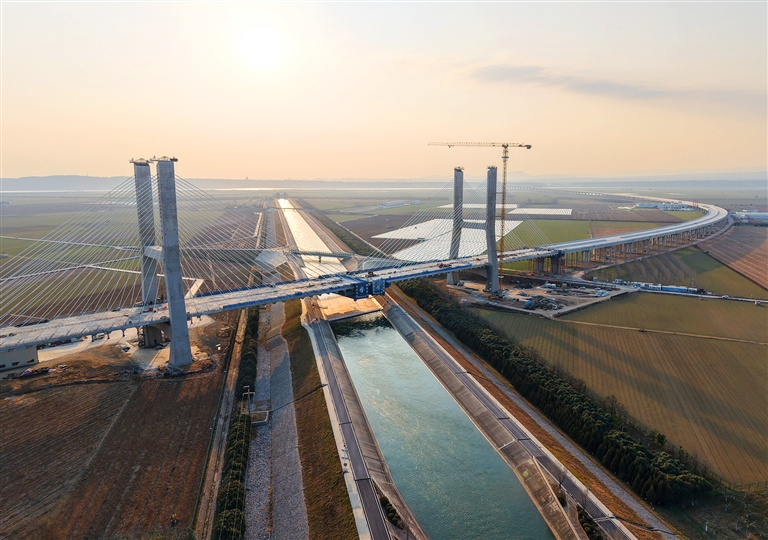
Core Viewpoint - The Jining government is focused on high-quality development of its highway infrastructure, aiming to enhance connectivity and establish a modern transportation network by 2025, which includes completing a closed-loop highway ring around the main urban area and achieving a "four vertical and four horizontal" highway network [1][2]. Group 1: Highway Infrastructure Development - Since the beginning of the 14th Five-Year Plan, Jining has invested a total of 43.5 billion yuan in highway construction, completing 7 projects and surpassing 625 kilometers in total highway length [2]. - The city has improved north-south connectivity by expanding the Jing-Tai and Ji-Guang highways and achieving full connectivity of the Ji-Wei highway, significantly enhancing access to major economic regions [2]. - The completion of the main urban highway ring, which includes the Ji-Zhou, Ji-Shang, Ji-Wei, and Ri-Lan highways, allows for a travel time of approximately 1 hour to reach various counties and cities [2]. Group 2: Service Experience Enhancement - Jining has innovated a "nine major management" model for bridge maintenance and established a "full lifecycle" precise maintenance system to improve highway conditions [3]. - The city is upgrading service areas to create comprehensive service stations with amenities such as showers and laundry, integrating cultural elements into the service area design [3]. - A collaborative mechanism among transportation, police, and highway operation entities has been established to ensure safety and smooth traffic flow on highways [3]. Group 3: Technological Integration and Upgrades - Jining is advancing smart construction sites with digital and intelligent technologies, including real-time monitoring of material mixing at concrete and asphalt plants [4]. - The city has developed "zero-carbon" highways and charging stations, achieving 100% coverage of charging facilities in highway service areas [4]. - Innovative construction techniques, such as automated asphalt paving and the use of drones for inspections, are being implemented to enhance efficiency and quality in highway projects [5]. Group 4: Future Development Plans - The city plans to continue expanding and upgrading its highway network, with expectations to reach a total of 908 kilometers of operational and under-construction highways by the end of the 15th Five-Year Plan [5]. - Projects such as the Yan-Yuan, Dong-Yuan, and Wei-Zhou highways are prioritized for completion, contributing to the establishment of a "six vertical and five horizontal" highway network [5].
长三角议事厅·周报|杭衢高铁牵引“1小时都市圈”向西扩容
Xin Lang Cai Jing· 2026-01-06 07:56
Core Viewpoint - The opening of the Hangzhou-Qiuzhou High-Speed Railway significantly enhances connectivity in the Yangtze River Delta, reducing travel time between Qiuzhou and Hangzhou to as little as 73 minutes, thereby transforming regional collaboration and economic dynamics [1][3][4]. Group 1: Infrastructure Development - The Hangzhou-Qiuzhou High-Speed Railway spans approximately 131 kilometers with a design speed of 350 km/h, facilitating faster travel and improved accessibility [1]. - The railway connects Qiuzhou with the existing high-speed rail network, creating a dual-channel system that enhances travel efficiency between Zhejiang's western regions and Hangzhou [3][4]. - Initial operations will feature 12 daily trains, with plans to increase to 34 trains per day by the first quarter of 2026, making cross-city travel more routine [4]. Group 2: Economic Integration - The railway's opening marks a shift from administrative-driven "mountain-sea cooperation" to market-driven collaboration, allowing industries to connect based on comparative advantages rather than reliance on government initiatives [5]. - The establishment of the Qiuzhou Hai Chuang Park, which has attracted over 140 companies, exemplifies the integration of R&D and production capabilities between Qiuzhou and Hangzhou [5][6]. - Significant investments in lithium battery materials projects in Qiuzhou, totaling nearly 479 billion yuan, highlight the region's growing industrial capacity and its ability to support high-value manufacturing [6]. Group 3: Urban and Regional Development - The Hangzhou-Qiuzhou High-Speed Railway contributes to a new urban network in the Yangtze River Delta, evolving from simple point-to-point connections to a more integrated and sustainable commuting framework [7]. - By 2025, the total investment in the Yangtze River Delta railway construction is expected to exceed 600 billion yuan, with over 2,600 kilometers of new rail lines, enhancing the overall connectivity of the region [7]. - The railway facilitates a shift in the relationship between Qiuzhou and the core areas of the Yangtze River Delta, moving from mere connectivity to deeper integration and collaboration [8].
勇挑大梁积极作为 全力抓好开局起步 为首都高质量发展作出更大贡献
Xin Lang Cai Jing· 2026-01-05 22:49
Group 1: Economic Development and Consumer Demand - The focus is on expanding domestic demand and enhancing consumer investment interaction in Chaoyang District, which is a significant economic and population area [1] - The city aims to leverage platforms like Gaode Map to optimize data and algorithms, promoting local consumption brands and improving transportation services [1] - There is an emphasis on increasing residents' income through various channels and enhancing public services to boost consumer capacity [3] Group 2: Investment and Market Structure - The strategy includes increasing effective investment in technology innovation and emerging industries while revitalizing underutilized resources [4] - The government plans to support private enterprises in major projects to stimulate private investment [4] - There is a commitment to improving the market environment by protecting the rights of private enterprises and enhancing service mechanisms for businesses [4] Group 3: Consumer Experience and Urban Development - The development of urban renewal projects like the Chaoyang Youth Power Center aims to attract young consumers and enhance their experience [2] - The city is focused on creating new consumption scenarios, including digital and trendy consumption, to adapt to changing demographic trends [3] - Plans are in place to promote high-quality supply and expand the variety of goods and services available to consumers [3]
新股消息 | 智慧互通拟港股上市 中国证监会要求补充说明未决诉讼最新进展等情况
智通财经网· 2026-01-05 12:55
Group 1 - The China Securities Regulatory Commission (CSRC) has issued supplementary material requirements for 13 companies, including Wisdom Interconnect Technology Co., Ltd., which is preparing for an IPO on the Hong Kong Stock Exchange [1][2] - Wisdom Interconnect is a leading provider of artificial intelligence technology and spatial intelligent solutions in China, particularly focused on urban traffic management [3] - According to Frost & Sullivan, Wisdom Interconnect ranks fourth in the Chinese smart transportation industry with a market share of 6.6% and first in smart roadside solutions with a market share of 19.3% as of 2024 [3] Group 2 - The global high-precision AI solutions market is projected to grow from RMB 47.7 billion in 2019 to RMB 222.5 billion by 2024, with a compound annual growth rate (CAGR) of 36.1%, and is expected to reach RMB 1,433 billion by 2029, with a CAGR of 42.2% from 2025 to 2029 [3] - The CSRC has requested Wisdom Interconnect to clarify various operational aspects, including its AI model applications, advertising business model, and compliance with foreign investment regulations [1][2]
天龙股份(603266.SH):拟以受让股权及增资形式对苏州豪米波进行投资
Ge Long Hui A P P· 2026-01-04 11:18
Core Viewpoint - The company plans to acquire a controlling stake in Suzhou Haomibo Technology Co., Ltd. through equity transfer and capital increase, aiming to enhance its position in the automotive electronics sector and align with national policies promoting high-end and intelligent manufacturing [1][2]. Group 1: Transaction Details - The company intends to acquire a total of 32.2998% equity in Suzhou Haomibo for a cash consideration of RMB 131.843663 million from several investors [1]. - The company will also invest RMB 100 million to subscribe for an additional registered capital of RMB 7.607985 million, resulting in a total ownership of 33.3333% post-investment [1]. - After the completion of both the equity transfer and capital increase, the company will hold 54.8666% of Suzhou Haomibo, making it a subsidiary included in the company's consolidated financial statements [1]. Group 2: Strategic Implications - This acquisition allows the company to extend its supply chain from automotive components to integrated smart sensing components, leveraging Suzhou Haomibo's expertise in 4D millimeter-wave radar, UWB sensors, and camera fusion technology [2]. - The move is expected to facilitate entry into various application fields such as intelligent driving, low-altitude flight, smart transportation, and robotics, thereby driving industrial upgrades and creating a second growth curve for the company [2]. - The transaction aligns with national policies encouraging the high-end and intelligent transformation of the manufacturing sector, enhancing the company's core competitiveness in the automotive electronics field [2].

天龙股份:拟以受让股权及增资形式对苏州豪米波进行投资
Ge Long Hui· 2026-01-04 11:13
Core Viewpoint - The company, Tianlong Co., Ltd. (603266.SH), is acquiring a controlling stake in Suzhou Haomibo Technology Co., Ltd. through a combination of equity transfer and capital increase, aiming to enhance its position in the automotive electronics sector and align with national policies promoting high-end and intelligent manufacturing [1][2]. Group 1: Transaction Details - The company plans to acquire a total of 32.2998% equity in Suzhou Haomibo for a cash consideration of RMB 131.843663 million from various investors [1]. - Following the acquisition, the company intends to invest an additional RMB 100 million to subscribe for new registered capital of RMB 7.607985 million, resulting in a total ownership of 33.3333% in Suzhou Haomibo post-capital increase [1]. - Upon completion of both the equity transfer and capital increase, the company will hold a total of 54.8666% equity in Suzhou Haomibo, making it a subsidiary included in the company's consolidated financial statements [1]. Group 2: Strategic Implications - This transaction allows the company to extend its supply chain from automotive components to integrated smart sensing components, leveraging Suzhou Haomibo's expertise in 4D millimeter-wave radar, UWB sensors, and camera fusion technology [2]. - The move is expected to facilitate entry into various application fields such as intelligent driving, low-altitude flight, smart transportation, and robotics, thereby driving industrial upgrades and creating a second growth curve for the company [2]. - The acquisition aligns with national policies encouraging the high-end and intelligent transformation of the manufacturing sector, enhancing the company's core competitiveness in the automotive electronics field [2].
天龙股份拟2.32亿元收购苏州豪米波54.87%股权
Zhi Tong Cai Jing· 2026-01-04 08:45
Core Viewpoint - The company plans to acquire a 32.2998% stake in Suzhou Haomibo Technology Co., Ltd. for a cash consideration of 132 million yuan and will also invest an additional 100 million yuan to increase its stake to 54.8666%, making it a controlling subsidiary [1][2] Group 1 - The total cash outlay for the acquisition and capital increase will amount to 232 million yuan, which will allow the company to consolidate Suzhou Haomibo into its financial statements [1] - The acquisition aligns with the company's strategy to extend its supply chain from automotive components to integrated smart sensing components [2] - The company aims to leverage Suzhou Haomibo's expertise in 4D millimeter-wave radar, UWB sensors, and camera fusion technology to enter various application fields such as intelligent driving, low-altitude flight, smart transportation, and robotics [2] Group 2 - This strategic move is expected to drive industrial upgrades and create a second growth curve for the company [2] - The acquisition also responds to national policies encouraging the high-end and intelligent transformation of the manufacturing industry [2] - The company seeks to enhance its core competitiveness in the automotive electronics sector through this acquisition [2]
山东高速集团发布智慧交通建设系列成果 以科技创新驱动数字化转型
Qi Lu Wan Bao· 2026-01-04 07:30
大众报业·齐鲁壹点 记者 王红 实习生 任恩泽 在提升通行效率方面,集团大力推进收费系统智慧化升级。自主研发的智慧云收费系统已在73个收费站 规模化部署,依托"云—边—端"协同技术架构,实现ETC交易成功率99.9%、车辆识别准确率99.99%, 单车通行时间缩短至3秒,整体通行效率提升约35%。京台高速济齐段作为全国首条长距离立体复合智 慧高速,通过构建数字底座、推行准自由流与"预约通行+信用赋能"模式、全面应用数电发票等措施, 构建以"山高慧眼"为核心的AI智能感知体系,实现全路网"空地一体感知、事件主动预警、多方协同管 控"。配套上线的AI智能客服与"一键求援"系统,使平均救援响应效率提升20%以上,进一步保障公众 出行安全。 为支持智能网联汽车产业发展,山东高速在滨莱高速路段建成国内测试里程最长、场景覆盖最全面、环 境最贴近实际的高速公路封闭测试基地。该基地已构建30余种自动驾驶与车路协同测试场景,累计为40 余家车企、科研及检测机构提供测试服务,测试总里程超过2500万公里,有效推动相关技术从实验室走 向规模化应用。 在产学研协同方面,集团与山东大学合作共建齐鲁交通学院,通过"教育链、人才链、创新链 ...

元旦假期出行旺盛 1.8亿、1260万、1.7亿……“流动的中国”活力澎湃
Yang Shi Wang· 2026-01-03 04:41
Group 1 - The core point of the article highlights the significant increase in travel during the New Year holiday, with over 180 million people expected to travel across regions on January 2, marking a 13.4% year-on-year growth [1] - The national railway is expected to send 12.6 million passengers on January 2, which represents an 18.7% increase compared to the previous year [2][6] - The railway departments have planned to add 785 passenger trains to meet the demand, enhancing service in popular directions and times [6] Group 2 - The road transport sector is projected to see over 170 million people traveling on January 2, reflecting a 13% year-on-year increase, primarily driven by short-distance self-driving trips for family visits and local tourism [11][13] - In the civil aviation sector, approximately 1.85 million passengers are expected to be transported on January 2, with a notable increase in inbound and outbound travel at Hainan's airport during the holiday [15] - The total number of inbound and outbound travelers during the New Year holiday is estimated to reach 33,500 [15] Group 3 - The Qingdao North Station has implemented a smart parking management system that enhances the passenger experience by efficiently guiding travelers through a "car-field-person" process [10]