
算力

Search documents
Token需求“通胀”:国产算力是双重受益的“大国重器”
Guolian Minsheng Securities· 2026-03-05 11:27
Investment Rating - The report maintains a "Recommended" rating for the industry, indicating an expected stock price increase of over 15% relative to the benchmark index within the next 12 months [5]. Core Insights - The report emphasizes that the demand for tokens is expected to become a core theme for AI investments this year, with significant opportunities arising from the rapid expansion of inference token demand [8]. - The government work report highlights the importance of computing power as a new infrastructure focus, aiming to enhance the digital economy and AI development through integrated construction, management, and utilization of computing resources [3][4]. - The report notes that domestic computing power is making significant progress, supported by government policies aimed at accelerating development in this sector [8]. Summary by Sections Government Initiatives - The government work report outlines three main directions for computing power: intelligent computing clusters, coordinated computing and electricity, and computing power scheduling, which are crucial for the digital economy and AI [3]. - The emphasis on a unified national approach aims to prevent disorderly construction and promote collaborative development, aligning with the high-quality development needs of the computing power industry [3]. Market Developments - Recent announcements from major companies like Alibaba Cloud and Huawei indicate a growing demand for computing resources, with specific pricing structures for services like video generation [4]. - The introduction of Huawei's TaiShan 950 SuperPoD showcases advancements in computing architecture, promising higher efficiency and reliability in computing power utilization [4]. Investment Opportunities - The report suggests focusing on several key areas for investment, including chip design (e.g., Cambrian, Haiguang Information), advanced wafer manufacturing (e.g., SMIC), and domestic AI computing solutions [8]. - Other recommended sectors include power supply and inductors, as well as domestic AI servers and related components, indicating a broad spectrum of potential investment opportunities within the computing power ecosystem [8].
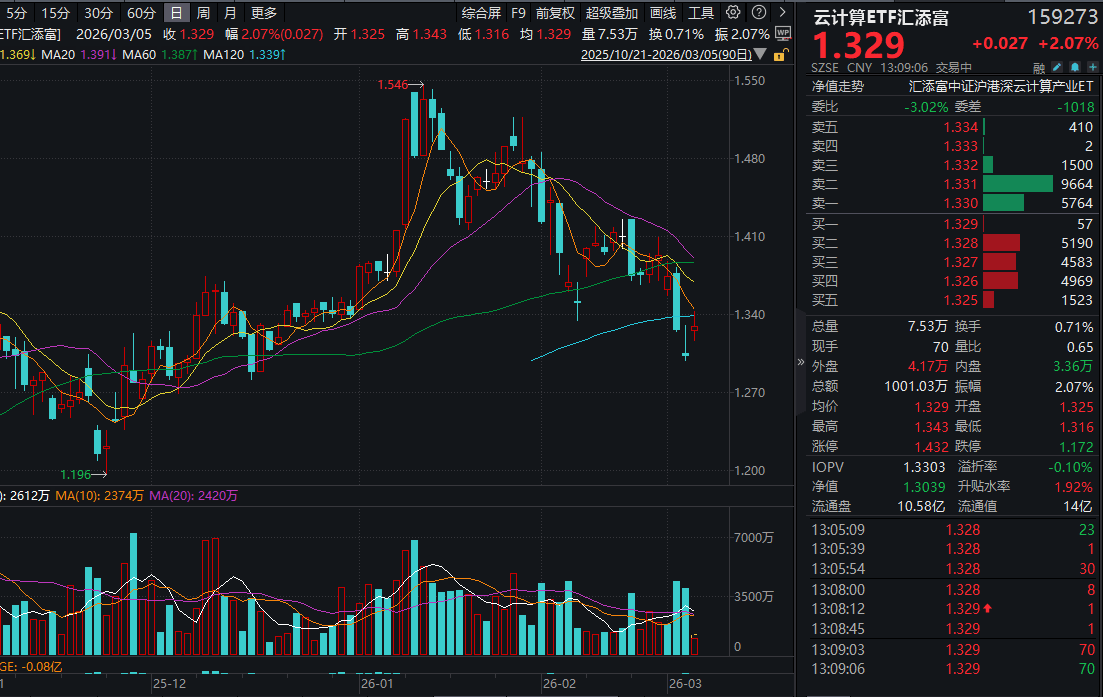
加码40亿,英伟达布局光通信!新易盛大涨超10%,云计算ETF汇添富(159273)大涨超2%!算力需求超预期,如何理解云需求“通胀”逻辑?
Sou Hu Cai Jing· 2026-03-05 06:01
Group 1 - The core viewpoint of the news highlights a strong rebound in the Asia-Pacific stock market, driven by a comprehensive rebound in US stocks and a significant increase in AI computing power, with the "computing power ETF" gaining over 2% [1][3] - Nvidia is increasing its investment in the computing power ecosystem, committing $2 billion to optical technology companies Lumentum and Coherent, which are key suppliers in the AI data center infrastructure [3][5] - The cloud computing ETF Huatai (159273) saw most of its weighted index stocks rise, with notable gains from companies like Xinyi and Zhongji [3][4] Group 2 - Citic Securities notes that the technology sector is experiencing upward pressure on capital expenditure (Capex) due to concerns over capital return rates and cash flow, leading to a shift in focus towards computing power and advanced processes [5][6] - The demand for computing power is expected to continue exceeding expectations in both overseas and domestic markets, with upstream sectors likely to maintain high profitability and price increases [6][8] - The recent iterations of large models from major companies like Google and Alibaba are driving AI inference demand, leading to a price increase in cloud services, marking a shift from price competition to premium monetization [8][9]


英伟达40亿美元押注光通信,创业板人工智能ETF招商涨超3.3%
Jin Rong Jie· 2026-03-05 02:45
Core Insights - NVIDIA plans to invest a total of $4 billion in two major players in the optical communication sector, Coherent and Lumentum, to strengthen its R&D pipeline and supply chain for large-scale AI infrastructure [1][2] - The investment highlights the increasing importance of optical modules in the AI industry, as they are essential for efficient data transmission between GPUs, which are considered the "brains" of AI servers [2] Investment Rationale - The investment logic for optical modules and computing hardware in the AI industry is based on three main points: 1. Increased Ratio and Price Growth: The ratio of GPUs to optical modules is expected to rise from the traditional 1:2 to 1:4 or higher, with speeds rapidly evolving from 400G to 800G and 1.6T, driving both product prices and gross margins higher [3] 2. High Technical Barriers: The development of high-speed optical modules is complex and lengthy, creating a strong competitive moat for leading companies that enter the supply chains of giants like NVIDIA [3] 3. Resonance of Domestic and Global Computing Needs: The demand for computing power and optical communication is surging, driven by both overseas giants expanding data centers and domestic initiatives like "East Data West Computing" [3] Market Dynamics - The value of optical communication as a critical component in computing power is just beginning to be reassessed, indicating a strong growth potential in this sector [4] - The AI sector's growth is reflected in the performance of the ChiNext AI index, which has a high concentration of leading optical module companies, with significant historical performance compared to other AI indices [5]
中信证券:海外与国内算力需求持续超预期 建议关注新技术趋势与国产算力
智通财经网· 2026-03-05 00:26
Core Viewpoint - The report from CITIC Securities indicates that both domestic and overseas demand for computing power continues to exceed expectations, suggesting sustained price increases and a favorable outlook for the technology sector [1] Group 1: Market Overview - The technology sector experienced significant differentiation in February, with CSP and software stocks under pressure. Major companies like Amazon, Microsoft, and Google saw cumulative declines of 17%, 9%, and 2% respectively, reflecting a clear discount on the sustainability of capital expenditures and return paths [1] - The IGV software index dropped by 21.8% during the same period, with notable declines in individual stocks such as Salesforce and AppLovin exceeding 30% [1] Group 2: Factors Influencing Market Sentiment - Despite positive guidance on AI investments and revenues during the 2025 Q4 earnings season, concerns remain about the long-term impact of AI on traditional SaaS value capture [2] - The emergence of Anthropic's new Claude model, showcasing capabilities in autonomous software interface operations, has intensified market worries regarding the sustainability of SaaS pricing power [2] Group 3: Supply Chain Dynamics - The upstream supply chain, particularly components like GPUs, TPUs, and HBM, is experiencing strong demand driven by CSPs increasing their AI capital expenditures. Micron's stock rose by 45.36% in February, while semiconductor equipment and liquid cooling server indices also outperformed [2] - TSMC has raised its 2026 capital expenditure forecast to a range of $52-56 billion, driven by increased demand for storage, advanced packaging, and hybrid integration [2] Group 4: Investment Recommendations - Investors are advised to focus on technology sectors with sustained growth, particularly those driven by dual forces of training and inference in computing power demand. The release of new models like Doubao-Seed-2.0 and Qwen3.5 has led to a surge in training computing power needs [3] - The report highlights the expected price increases across various components in Q1 2026, recommending attention to storage, PCB, and optical fiber sectors [4] Group 5: Upcoming Events - Key upcoming events in March 2026 include the GTC and OFC conferences, which are expected to showcase advancements in computing power technologies and new product releases [5] - The GTC will focus on the Feynman architecture and its 3D stacking capabilities, while the OFC will highlight progress in CPO technology [5] Group 6: Long-term Outlook - The report suggests that the current volatility in U.S. tech stocks is leading to structural undervaluation, particularly in the software sector. The narrative around AI potentially replacing software is causing short-term valuation pressures [6] - Long-term, a rebalancing between Agents and SaaS is anticipated, with SaaS providers expected to deliver enterprise-level solutions that integrate Agent capabilities [6]

策略对话通信-关注美伊冲突的AI要素-相信大光归来
2026-03-04 14:17
Summary of Key Points from Conference Call Industry and Company Involved - The discussion primarily revolves around the **AI and optical communication industry**, with a focus on companies like **NVIDIA**, **Lumentum**, **Coherent**, and **ZTE**. The context includes the impact of geopolitical tensions, particularly the **US-Iran conflict**, on the industry dynamics. Core Insights and Arguments - **Capex Growth**: North American cloud providers are expected to see a **65%-75% year-over-year increase in CAPEX by 2026**, with potential for further growth in 2027, indicating a robust demand for computing power [1][3] - **Investment in Optical Chips**: NVIDIA's investment of **$4 billion in Lumentum and Coherent** aims to address data bottlenecks in GPU clusters, with the share of optical chips in CAPEX projected to rise from **3%-4% to 15%-20%** [1][4] - **Technological Divergence**: There is a clear divide in technology preferences, with chip manufacturers favoring **CPO (Chip-on-Board)** for efficiency, while cloud providers lean towards **NPO (Near-Package Optics)** due to lower maintenance costs and decoupling needs [1][5] - **AI Integration**: AI has deeply penetrated military and various industries, enhancing information processing and operational efficiency, which in turn drives the demand for computing power [3] - **Market Dynamics**: The optical communication sector has seen significant stock price increases in the US, while leading A-share companies have faced a **10% decline** due to geopolitical disturbances, highlighting a potential investment opportunity [2][10] Other Important but Possibly Overlooked Content - **NPO vs. CPO**: NPO is favored for its lower power consumption (10-15W) and ease of maintenance compared to CPO (10W), which has higher costs and lower yield rates. This divergence reflects differing commercial interests between chip manufacturers and cloud providers [5] - **Upcoming GTC Conference**: The **2026 GTC conference** is anticipated to showcase new products, including the **Blackwell line** and **1.6T** solutions, with a focus on various configurations to meet diverse customer needs [7] - **Market Sentiment Shift**: As earnings reports approach, market focus is expected to shift back to companies with strong performance metrics, with **ZTE** and **NewEase** identified as resilient players in the optical communication space [8] - **Stock Recommendations**: **ZTE** is highlighted as a top pick due to its leading position in the optical communication market, particularly in the **1.6T module** segment, and its strong relationships with major clients like NVIDIA and Google [9][10]



荣亿精密(920223):深耕精密零部件,液冷打开新增长曲线
Soochow Securities· 2026-03-04 08:36
Investment Rating - The report gives an "Accumulate" rating for the company, marking its first coverage [1]. Core Insights - The company is deeply engaged in the precision components sector, with a diversified product layout, and is expected to turn profitable in 2026 after initial losses due to investments in liquid cooling and other new business areas [8][10]. - The demand in downstream industries is projected to grow, driven by a recovery in global PC shipments, stable growth in the automotive market, and the increasing need for liquid cooling solutions due to AI advancements [8][10]. - The company is actively expanding its production capacity to meet rising demand, particularly in the liquid cooling segment, which is anticipated to contribute significantly to revenue growth in the coming years [8][10]. Summary by Sections 1. Deep Engagement in Precision Components - The company specializes in the R&D, manufacturing, and sales of precision fasteners, connectors, and structural components, serving industries such as 3C, automotive, communications, and power equipment [8][10]. - The company has a clear and stable ownership structure, with the actual controller holding 62.75% of the shares [15]. - The management team has extensive industry experience, contributing to the company's strategic direction and operational efficiency [17]. 2. Broad Product Applications and Growing Demand - The company’s products are widely used in various sectors, with a significant focus on 3C and automotive applications, and are beginning to penetrate the liquid cooling market [32][34]. - Global PC shipments are expected to rebound, with AI PCs becoming a new growth engine, projected to reach 274 million units in 2025, a 4.3% increase year-on-year [34][36]. - The automotive market is also showing robust growth, particularly in the new energy vehicle segment, which is expected to see sales of 21.42 million units in 2025, a 25% increase [42][44]. 3. Continuous Exploration of New Markets and Capacity Expansion - The company is diversifying its business by expanding into liquid cooling and automotive sectors, with a focus on high-growth areas [55][56]. - The automotive business is expected to achieve significant revenue growth, with a projected increase of 100% in 2025 [62]. - The company plans to invest 100 million yuan to expand its production capacity for liquid cooling components, aiming to enhance operational efficiency and meet increasing demand [64][67]. 4. Profit Forecast and Investment Recommendations - The company is expected to achieve revenues of 4.42 billion yuan in 2025, with a projected overall gross margin improvement from 12.98% to 25.95% by 2027 [68].
财报对比:寒武纪盈利却难服众,沐曦、摩尔仍缺大单
雷峰网· 2026-03-04 00:48
Core Viewpoint - The article discusses the current state of three domestic AI chip companies: Cambricon, Muxi, and Moore Threads, highlighting their financial performance and market expectations amidst a booming AI computing market valued at 600 billion [2][4]. Group 1: Financial Performance - Cambricon reported a total revenue of 6.497 billion, a year-on-year increase of 453.21%, and a net profit of 2.059 billion, marking its first profit since going public [5][6]. - Muxi achieved a revenue of 1.644 billion, with a year-on-year growth of 121.26%, but incurred a net loss of 778 million, although this loss was reduced by 44.53% [5]. - Moore Threads generated a revenue of 1.506 billion, reflecting a year-on-year increase of 243.37%, but faced a net loss of 1.024 billion, with a reduction in losses by 36.7% [5]. Group 2: Market Expectations and Challenges - Despite Cambricon's profitability, the market reaction was lukewarm, as analysts noted that the results fell short of expectations, with market sentiment not fully aligning with the company's performance [4][9]. - Analysts expressed concerns about Cambricon's growth sustainability, citing a decline in profit margins and potential supply chain issues, which could hinder future performance [10][20]. - The emergence of self-developed chips by major clients like ByteDance and Alibaba poses a competitive threat to Cambricon, leading to a decline in its stock price [14][15]. Group 3: Opportunities for Muxi and Moore Threads - Muxi and Moore Threads are positioned to potentially benefit from the demand gap left by Cambricon, but their current market penetration remains limited, primarily serving secondary scenarios and relying on government projects [21][22]. - Both companies are seen as needing to secure significant contracts with cloud service providers to ensure sustainable revenue growth and operational cash flow [23][24]. - Muxi has focused on optimizing its sales strategy towards larger projects, while Moore Threads is leveraging its geographical advantage to secure more government contracts [24]. Group 4: Industry Dynamics and Future Outlook - The AI chip industry is facing new challenges, including the rise of new players and the potential onset of a price war, which could impact profit margins across the sector [25][26]. - The competition is shifting from single-card performance to a focus on comprehensive capabilities, including memory, bandwidth, and system software integration [26]. - The future landscape of domestic AI chips will depend on production capacity, delivery capabilities, and the ability to adapt to market demands [26].

老黄提前锁仓:CPO 大爆发前夜,光模块进入“军备竞赛”
美股研究社· 2026-03-03 12:45
Core Viewpoint - The article emphasizes that NVIDIA's recent investments in optical communication companies Lumentum and Coherent are not merely financial but strategic moves to secure supply chains and production capacity in the AI infrastructure landscape, marking a shift from chip performance competition to upstream supply chain control [2][3][10]. Group 1: NVIDIA's Strategic Moves - NVIDIA has invested $2 billion each in Lumentum and Coherent, along with significant procurement commitments, indicating a strategic blockade in the AI infrastructure [2][3]. - This investment is seen as a proactive measure to avoid past pitfalls experienced with HBM (High Bandwidth Memory), where supply constraints severely impacted profitability [6][10]. - By locking in production capacity, NVIDIA aims to create a "capacity community" with its suppliers, ensuring priority access to critical components as demand for AI capabilities surges [11][20]. Group 2: Market Dynamics and Implications - The article discusses the transition of AI server requirements from GPU manufacturing capacity to data transmission bandwidth and power consumption, highlighting the limitations of traditional electrical interconnects [7][8]. - As AI clusters evolve, the demand for optical interconnects, particularly Co-Packaged Optics (CPO), is expected to grow exponentially, potentially mirroring the explosive demand seen with HBM [17][18]. - The investment by NVIDIA is anticipated to alter the supply-demand dynamics in the optical module market, potentially leading to a seller's market where companies with locked-in capacity will have significant pricing power [21][22]. Group 3: Financial Projections and Market Reactions - Lumentum is projected to see a substantial increase in revenue due to its deepening relationship with NVIDIA, with estimates suggesting a potential doubling of its revenue to around $4 billion [13][14]. - The profitability of Lumentum is expected to improve significantly as AI data center optical modules command higher prices and margins compared to traditional telecom products [14][15]. - The market's response to Lumentum's stock performance reflects investor confidence in the long-term visibility of orders linked to NVIDIA, indicating a shift in valuation dynamics as the demand for optical modules increases [19][26]. Group 4: Future Outlook - The article concludes that NVIDIA's actions signal the beginning of a new phase in the AI power struggle, where the efficiency of data transmission will be as critical as chip performance [23][24]. - The focus for investors should shift from merely GPU manufacturers to upstream companies that are strategically tied to NVIDIA and possess essential optical interconnect technologies [25].
0302脱水研报
2026-03-03 02:51
Summary of Key Points from Conference Call Records Industry or Company Involved 1. **AI Integrated Machines**: The focus is on the domestic AI integrated machine market, particularly the DeepSeek model, with significant developments expected by 2025 [1][3][30]. 2. **Fertilizer Industry**: The report discusses the phosphate chemical industry, particularly the demand for fertilizers as spring approaches [2][17][30]. 3. **Aviation Industry**: The report highlights the progress in China's large aircraft manufacturing, specifically the C919 and C929 models [4][23][30]. Core Points and Arguments AI Integrated Machines 1. **Market Growth**: The domestic AI integrated machine market is expected to flourish, with multiple companies developing DeepSeek integrated machines, marking 2025 as a pivotal year for application [1][3][30]. 2. **China Mobile's Achievement**: On February 28, China Mobile secured its first overseas deployment of the DeepSeek integrated machine, indicating strong market interest and potential for growth [4][30]. 3. **Industry Collaboration**: At least 20 domestic chip manufacturers have partnered with DeepSeek, indicating a shift towards a domestic AI ecosystem that reduces reliance on foreign technologies [7][30]. Fertilizer Industry 1. **Phosphate Resource Scarcity**: The phosphate rock market faces challenges due to years of unregulated mining, leading to declining quality and increasing scarcity of resources [2][17][30]. 2. **Price Trends**: Fertilizer prices, particularly for monoammonium phosphate and calcium phosphate, have seen significant increases, with monoammonium phosphate rising by 9.74% month-over-month [20][21][30]. 3. **Spring Demand**: As the spring planting season approaches, the demand for fertilizers is expected to rise, with production rates increasing to meet this demand [21][30]. Aviation Industry 1. **C919 Production and Delivery**: China Commercial Aircraft Corporation (COMAC) has received nearly 1,500 orders for the C919, with production expected to ramp up to 50 units by 2025 [23][25][30]. 2. **Market Value**: The projected market value for the delivery of 9,323 aircraft over the next 20 years is approximately $1.4 trillion, indicating a robust future for the domestic aviation sector [23][25][30]. 3. **Supply Chain Development**: The domestic supply chain for large aircraft is expected to improve as the localization of materials and components increases, enhancing the overall value of the industry [27][29][30]. Other Important but Possibly Overlooked Content 1. **Macroeconomic Impact on Computing Power**: The decline in computing power is attributed to global economic conditions and underperformance of AI models like GPT-4.5, but the fundamental demand for computing power remains intact [10][12][14][30]. 2. **Emerging Trends in AI**: The report emphasizes the importance of monitoring marginal changes in the computing power industry, as domestic AI development is still in its early stages [13][14][30]. 3. **Investment Opportunities**: The report suggests focusing on emerging growth areas and companies within the data center and AI sectors, indicating potential investment opportunities [16][30].
计算机行业周报:AI大战火热,算力依旧景气-20260302
Shanghai Securities· 2026-03-02 11:58
Investment Rating - The industry investment rating is "Hold" [1] Core Insights - The report emphasizes the ongoing transformation in the AI sector, highlighting that major companies are continuously increasing their investments in AI applications, which are expected to accelerate commercialization [1][2] - The report notes that the computer industry index has underperformed compared to major indices, indicating a relative weakness in the sector [2] Summary by Relevant Sections Recent Market Performance - During the week of February 23 to February 27, the Shanghai Composite Index rose by 1.98%, while the computer industry index increased by only 0.62%, underperforming the Shanghai Composite by 1.36 percentage points [2] AI Model Developments - Google launched its upgraded core model Gemini 3.1 Pro, achieving a significant improvement in reasoning capabilities, scoring 77.1% in the ARC-AGI-2 benchmark, more than double the performance of its predecessor [4] - Alibaba expanded its open-source model offerings, with Qwen3.5-397B-A17B showing impressive performance in complex tasks [4] - Domestic AI model company DeepSeek is set to release its flagship model DeepSeek V4, which supports multi-modal interactions and has enhanced long-text processing capabilities [4] - MiniMax introduced its programming model MiniMax M2.5, which has quickly gained popularity, contributing significantly to token usage on OpenRouter [4] Company Financial Performance - Nvidia reported a 73% year-over-year revenue increase to $68.127 billion for Q4 of fiscal year 2026, with data center revenue growing by 75% [5] - Domestic AI computing leader Moore Threads reported a 243.37% revenue increase to 1.505 billion yuan for 2025, although it still posted a net loss [5] - Haiguang Information anticipates a revenue increase of 62.91% to 75.82% year-over-year for Q1 2026 [5] Investment Recommendations - The report suggests focusing on companies in the computing power sector such as Cambrian, Haiguang Information, and others, as well as AI application companies like Kingsoft Office and iFlytek [6]