
逆周期政策

Search documents
X @外汇交易员
外汇交易员· 2025-07-11 06:26
Economic Stimulus Recommendations - Experts suggest the government should implement additional economic stimulus measures of 1 to 15 trillion RMB (approximately $137 billion to $206 billion USD based on current exchange rates) within 12 months [1] - The stimulus aims to boost resident consumption and mitigate the economic damage caused by US tariffs [1] - The report emphasizes the need for stronger counter-cyclical policies to maintain stable growth [1] Structural Reform Proposals - The report suggests expanding the individual income tax base and simplifying the value-added tax (VAT) structure in the long term [1] - The report highlights the importance of managing risks associated with SME lending to enable banks to lend to more productive sectors [1]
天风证券晨会集萃-20250702
Tianfeng Securities· 2025-07-02 01:03
Group 1 - The report highlights a significant rebound in A-shares, with the CSI 500 and Shenzhen Composite Index rising by 4.3% and 5.22% respectively in June, driven by the second round of US-China negotiations and financial stability measures implemented on May 7 [3] - The report indicates that the central bank is expected to increase monetary easing, with a net withdrawal of 553.9 billion yuan in June, reflecting cross-quarter funding pressures [3] - In the commodities market, non-ferrous metals showed an overall upward trend, while crude oil rebounded significantly, and pork prices remained close to warning levels [3] Group 2 - The report tracks industry profitability, noting that the ROETTM for consumer electronics, white goods, and industrial metals is at a one-year high, while software, banking, and media sectors are at a low [5] - The report assesses industry sentiment, indicating high expectations for ROE growth in biopharmaceuticals, communication equipment, and power equipment, while coal mining and banking sectors show lower sentiment [5][31] - The report predicts a 6.0% year-on-year increase in industrial added value for June, with a PMI reading of 51.0 indicating expansion in manufacturing [6][33] Group 3 - The report discusses the strategic acquisition of Jiangsu Hengyi by Huada Technology, which is expected to enhance the company's performance and optimize its asset structure [14][36] - The company has secured numerous project designations from major automotive manufacturers, with expected total sales of 32 billion yuan from body parts and 31.5 billion yuan from battery box projects [14][37] - The report revises the revenue forecasts for Huada Technology for 2025-2027, estimating revenues of 63.57 billion, 74.82 billion, and 88.29 billion yuan respectively, with a maintained "buy" rating [14][37] Group 4 - The report outlines the implications of including government bonds in the reserve requirement framework, suggesting that this could enhance liquidity but may not directly translate to increased credit supply [38][39] - It emphasizes the need for a significant reduction in the reserve requirement rate before implementing government bond inclusion to stimulate bank asset replacement [39][40] - The report indicates that the current banking environment is characterized by weak credit demand and a tendency towards "fiscalization" in asset allocation [39]

2025年6月PMI点评:外部扰动减弱,内生动能修复
EBSCN· 2025-06-30 07:43
Manufacturing Sector - The manufacturing PMI for June 2025 is 49.7%, up from 49.5% in May, aligning with market expectations[2] - The production index increased by 0.3 percentage points to 51.0%, while the new orders index rose by 0.4 percentage points to 50.2%[5] - Large and medium enterprises showed improved sentiment, with large enterprises' PMI rising to 51.2% and medium enterprises' PMI to 48.6%, while small enterprises' PMI fell to 47.3%[5] Economic Recovery Indicators - External disturbances have weakened, leading to a recovery in new export orders, which continue to rise[3] - High-energy-consuming industries are stabilizing, with their PMI increasing by 0.8 percentage points to 47.8%[15] - The service sector's business activity index slightly decreased to 50.1%, primarily due to the end of holiday effects, but remains in the expansion zone[27] Price and Inventory Trends - The raw material purchase price index rose to 48.4%, and the factory price index increased to 46.2%, both recovering from previous declines[23] - The raw material inventory index increased by 0.6 percentage points to 48.0%, indicating improved production activity[23] Construction Sector - The construction sector's business activity index rose significantly to 52.8%, reflecting a positive trend in housing construction activities[32] - The government is implementing policies to stabilize the real estate market, which is expected to further improve supply-demand dynamics[33]
下半年资产配置:三季度看韧性,四季度看政策落地
Sou Hu Cai Jing· 2025-06-30 03:44
Core Viewpoint - The second half of the year is expected to see a phase synchronization of domestic and foreign policy rhythms, with a focus on structural opportunities in domestic assets [1] Group 1: Economic Outlook - Despite differing economic cycles between China and the U.S., uncertainties from tariff impacts are leading to synchronized policy rhythms in the second half of the year [1] - In the first half of Q3, both domestic and foreign economies are expected to show resilience, with policies focusing on cautious management of expectations [1] - By the latter part of Q3, export pressures in China and increasing pressures in the U.S. are anticipated, with more incremental policies likely to be introduced in Q4 [1] Group 2: Market Dynamics - The U.S. is expected to maintain some resilience in Q3, supporting risk appetite, but uncertainties from tariffs and debt risks may increase market volatility [1] - In Q4, as pressures in the U.S. mount, the likelihood of Fed rate cuts may support risk asset valuations through liquidity [1] - The U.S. fiscal year budget deadline and the expiration of "reciprocal tariffs" in September may lead to significant market fluctuations [1] Group 3: Domestic Economic Conditions - Domestic conditions are expected to remain weak but stable, with infrastructure spending providing upward support in the second half of the year [1] - Export growth is projected to slow down in August, with a neutral year-on-year growth expectation of around 1.5% [1] - Infrastructure funding is expected to increase in the latter half of the year, while real estate policies continue to strengthen [1] Group 4: Asset Allocation - Domestic assets are expected to focus on structural opportunities, with a policy-driven logic becoming more pronounced [1] - Equity markets are anticipated to continue with dividend and growth styles, focusing on undervalued sectors, while commodities will focus on black building materials and agricultural products [1] - Bonds are recommended for low-cost allocation, benefiting from expectations of loose monetary policy in Q4 [1] Group 5: International Market Considerations - International assets should be aligned with the weak dollar theme, while being cautious of volatility spikes [1] - U.S. stocks are expected to experience fluctuations in the first half of Q3, with potential relief from valuation pressures in Q4 due to rate cuts [1] - Non-dollar assets are likely to benefit in a weak dollar environment, while gold and other resource commodities are recommended for long-term strategic allocation [1]
【广发宏观郭磊】6月BCI数据:继续确认的边际变化
郭磊宏观茶座· 2025-06-29 10:29
广发证券首席经济学家 郭磊 guolei@gf.com.cn 摘要 第一, 2025年6月BCI读数为49.3,较前值下行1.0个点。这与前期出来的EPMI数据在指向上一致。6月经济继续确认边际放缓迹象。 第二, 销售和利润前瞻指数同步回落,环比分别下行2.7、2.9个点。我们估计可能和需求端一系列边际变化有关:一是房地产在经历放缓脉冲,6月前28天30城 成交同比为-17.8%;二是从港口集装箱吞吐量和EPMI的6月出口订货指标来看,外需存在放缓特征,可能和海外进口商利用关税平静期补库需求已集中释放有 关;三是"国补"换档、第三批资金待下达期间,家电3C产品等终端销售不排除存在短期扰动。 第三, 企业库存前瞻指数环比上行1.5个点。在销售和利润下降的条件下,逻辑上企业不会主动补库;所以库存上升属于需求放缓带来的被动补库。实际上5月规 上工业企业数据就已经显现出类似特征,在报告《5月企业盈利增速出现调整的原因》中,我们指出"价格回落下拉名义库存;但需求弱于供给、产销率下降导致实 际库存有一定程度的被动上升"。 第四, 企业投资和招工前瞻指数一上一下,投资小幅上行0.1个点,招工下行1.4个点。我们理解投资存在 ...


释放消费增长潜能 专家建议用足逆周期政策
Zhong Guo Xin Wen Wang· 2025-06-26 02:57
Group 1 - The core viewpoint of the articles is that the Chinese government is intensifying policies to boost consumption, as evidenced by the recent guidance from six departments aimed at stimulating and expanding consumer spending [1] - In the first five months of the year, retail sales of consumer goods increased by 5% year-on-year, with May seeing a notable growth of 6.4%, marking the highest monthly growth rate in 2024 [1] - The acceleration in consumption growth is primarily attributed to the "trade-in" policy, which has significantly boosted sales in furniture, communications, and home appliances, all showing growth rates exceeding 20% [1] Group 2 - Experts suggest that to further support consumption growth, it is essential to understand the underlying factors driving consumer behavior, which include GDP growth, primary and secondary distribution, and consumption propensity [1] - The most significant factor influencing consumer growth is GDP growth, while the effects of consumption propensity and distribution are comparatively less impactful [1] - Short-term policies should focus on utilizing counter-cyclical measures to enhance residents' income and expectations, thereby expanding consumption effectively [1] Group 3 - Recommendations for immediate policy actions include pilot programs to encourage childbirth, urban area development, and housing support for migrant workers, which could enhance the consumption propensity of certain demographics [2] - Long-term strategies to boost consumption involve improving social welfare and security levels, which are crucial for increasing consumption propensity over time [2] - Industrial policies aimed at unleashing the potential of the service sector are also highlighted as essential for increasing overall income growth and improving primary distribution, thereby supporting future consumption growth [2]
浙商早知道-20250611
ZHESHANG SECURITIES· 2025-06-10 23:30
Market Overview - The Shanghai Composite Index fell by 0.4%, the CSI 300 decreased by 0.5%, the STAR Market 50 dropped by 1.5%, the CSI 1000 declined by 0.9%, the ChiNext Index decreased by 1.2%, and the Hang Seng Index fell by 0.1% [3][4] - The best-performing sectors on that day were Beauty Care (+1.1%), Banking (+0.5%), Pharmaceutical and Biological (+0.3%), Transportation (+0.2%), and Media (+0.2%). The worst-performing sectors were Defense and Military (-2.0%), Computer (-1.9%), Electronics (-1.7%), Communication (-1.4%), and Non-Bank Financials (-1.1%) [3][4] - The total trading volume in the Shanghai and Shenzhen markets was 1,415.3 billion yuan, with a net inflow of 7.59 billion Hong Kong dollars from southbound funds [3][4] Important Insights Inflation and Economic Policy - In May, the Consumer Price Index (CPI) year-on-year growth was -0.1%, consistent with the previous value and better than market expectations of -0.2%. The month-on-month growth was -0.2%, influenced mainly by falling energy prices [5] - The Producer Price Index (PPI) year-on-year growth recorded -3.3%, slightly below market expectations of -3.2%, with a month-on-month decline of 0.4% due to falling prices of internationally priced bulk commodities [5] Trade Dynamics - In May, China's exports to the United States decreased by 33.6%, primarily due to the high average tariff levels maintained until mid-May when tariffs were officially lowered following negotiations [6] - The market outlook for trade with the U.S. remains pessimistic, but there is potential for a rebound in exports to the U.S. [6]
2025年5月通胀与贸易数据点评:核心通胀保持平稳,贸易出口继续扩张
Chengtong Securities· 2025-06-10 11:29
Group 1: Inflation Data - Core CPI continues to rise, indicating steady internal demand recovery, with a year-on-year increase of 0.6% in May, up 0.1 percentage points from the previous month[7] - Overall CPI in May decreased by 0.1% year-on-year, with energy prices dropping by 6.1%, a decline that expanded by 1.3 percentage points compared to the previous month[7] - Non-food CPI remained stable year-on-year, reflecting a steady performance in consumer prices[7] Group 2: Trade Data - In May, China's exports amounted to $316.1 billion, showing a year-on-year growth of 4.8%, which was below the market expectation of 6.2% and the previous month's 8.1%[14] - Exports to the U.S. fell by 34.5% in May, a decline that widened by 13.5 percentage points from the previous month, despite expectations of recovery due to tariff reductions[14][15] - Exports to Japan and ASEAN countries grew by 6.2% and 14.8% respectively, indicating relative stability in trade with other regions[14] Group 3: Economic Outlook - Signs of weakening consumer momentum are evident, with some policy-supported categories showing price stagnation or decline[6][8] - High inventory levels among U.S. wholesalers and retailers suggest a lack of urgency to replenish stock, impacting China's export dynamics[15] - The need for counter-cyclical policies is emphasized to stabilize expectations and ensure steady economic performance amid external uncertainties[29]
一财首席经济学家调研:中美经贸会谈开启,国内经济景气度回升
Di Yi Cai Jing· 2025-06-08 13:05
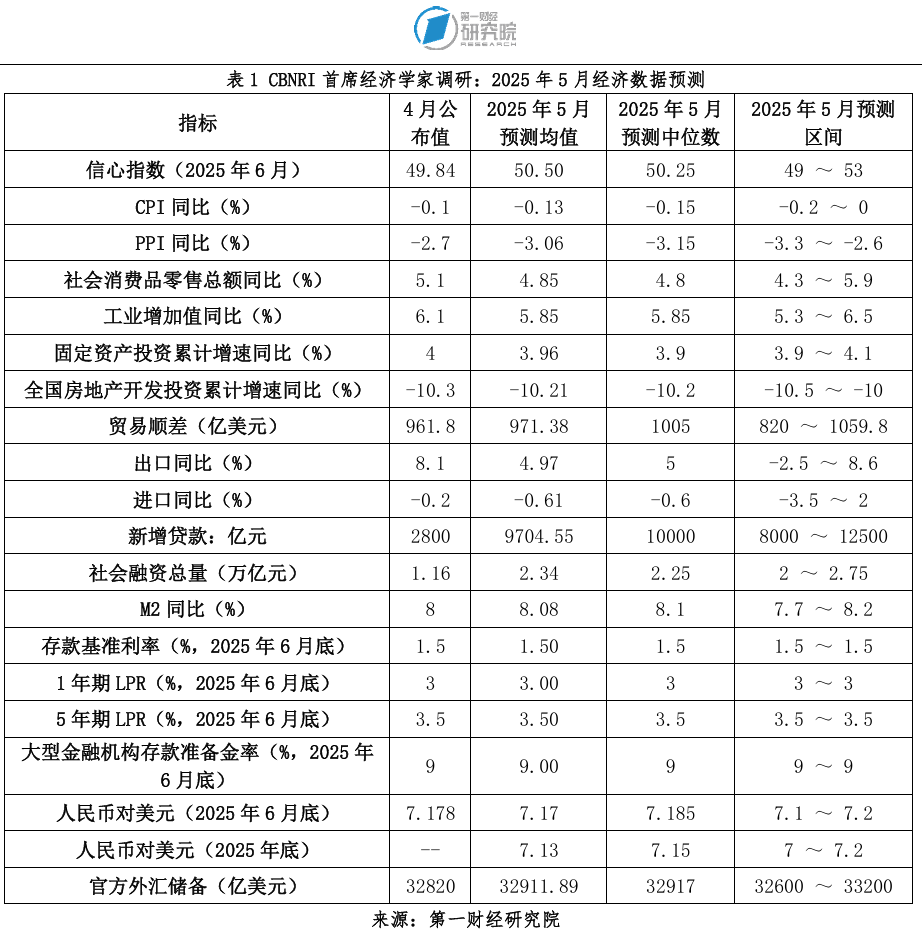
Economic Confidence Index - The economic confidence index for June is reported at 50.50, indicating a return above the neutral line of 50 [1][4][27] Economic Predictions for May - The average prediction for the CPI year-on-year growth in May is -0.13%, while the PPI is predicted to be -3.06% [2][10] - The predicted year-on-year growth for social retail sales in May is 4.85%, down from 5.1% in April [12] - The predicted year-on-year growth for industrial added value in May is 5.85%, lower than the previous month's 6.1% [13] - The predicted year-on-year growth for fixed asset investment in May is 3.96%, slightly lower than the previous month's 4% [14] - The predicted year-on-year growth for real estate development investment in May is -10.21% [16] - The predicted trade surplus for May is $971.38 billion, with exports expected to grow by 4.97% and imports declining by -0.61% [17] Monetary Policy and Financial Data - Economists expect the monetary policy to remain accommodative, with little change anticipated in reserve requirements and interest rates in June [21] - The average prediction for new loans in May is 9704.55 billion yuan, a significant increase from the previous month's 2800 billion yuan [18] - The predicted total social financing for May is 2.34 trillion yuan, higher than the previous month's 1.16 trillion yuan [19] - The predicted M2 year-on-year growth for May is 8.08%, up from 8% in April [20] Exchange Rate and Foreign Reserves - The predicted exchange rate for the RMB against the USD at the end of June is 7.17, with an expected average of 7.13 by the end of the year [22] - The forecast for foreign exchange reserves at the end of May is $32,911.89 billion, with an expected increase to $32,917 billion by the end of the month [23] Policy Outlook - Future macroeconomic policies are expected to maintain a steady and proactive approach, focusing on structural tools to support key sectors like AI and green technology [24][26] - The government is anticipated to accelerate the implementation of existing policies and introduce new measures to stimulate consumption and investment [29][31]
天风证券晨会集萃-20250605
Tianfeng Securities· 2025-06-04 23:43
Group 1: Macro Strategy and Market Overview - The report highlights the uncertainty surrounding Trump's tariff policies, with a recent increase in steel and aluminum tariffs to 50% and a temporary suspension of a previous court ruling against these tariffs, leading to increased uncertainty in trade negotiations [1][16] - In the A-share market, major indices rebounded significantly in May, with the ChiNext and Shenzhen Composite Index rising by 2.32% and 2.94% respectively, driven by a series of stabilizing measures [1][18] - The report notes that the central bank injected 599.8 billion yuan into the market in May, indicating a proactive monetary policy stance amid concerns over liquidity due to accelerated government bond issuance [1][18] Group 2: Fixed Income Market Insights - The fixed income market is experiencing a volatile environment, with a balanced tug-of-war between bulls and bears, and the potential for trading opportunities arising from adjustments in interest rates [3] - Economic data indicates a mismatch in expectations, particularly with external demand showing resilience but not fully compensating for insufficient domestic demand recovery [3] - The central bank's recent actions, including rate cuts, suggest limited room for further easing in the short term, with market dynamics heavily influenced by the ongoing U.S.-China tariff negotiations and economic fundamentals [3] Group 3: Company-Specific Insights - EHang Intelligent (EH) - EHang reported a revenue of 26.1 million yuan in Q1 2025, down from 61.7 million yuan in the same period last year, with a gross margin of 62.4% [8][21] - The company has received operational certification for its EH216-S model, allowing it to expand its commercial operations gradually, including transitioning from isolated airspace to integrated airspace [8][21] - EHang plans to double its production capacity at its Yunfu facility to 1,000 units by the end of 2025, supported by strategic partnerships for a new eVTOL production base [8][22] Group 4: Company-Specific Insights - Bluko Group - Bluko Group, a leading domestic model toy company, achieved a GMV of 1.8 billion yuan in 2023, marking a year-on-year growth of over 170% [4][24] - The company is recognized for its high cost-performance ratio and strong IP recognition, with a projected sales volume of 135 million units for its building block toys in 2024 [6][25] - Bluko's integrated design, production, and R&D system, along with its collaboration with leading third-party manufacturers, has resulted in a gross margin of 52.6% and a high precision in mold production [6][25] Group 5: Company-Specific Insights - Pinduoduo (PDD) - Pinduoduo reported a 10% year-on-year increase in revenue to 95.7 billion yuan in Q1 2025, but its adjusted net profit decreased by 45% to 16.9 billion yuan [9][12] - The company faces intense competition and has increased investments, which may pressure profit margins, necessitating further subsidies to maintain price advantages [9][12] - Despite short-term challenges, Pinduoduo is expected to maintain long-term competitiveness, particularly with its TEMU platform's growth potential in the global e-commerce market [9][12]