
HPC

Search documents
Evolution of HPC to AI - Alex Bouzari, DDN
DDN· 2025-09-18 15:09
Core Message - AI is essentially HPC (High Performance Computing), emphasizing the importance of data in both fields for extracting intelligence and value [1] - DDN (DataDirect Networks) provides the "rocket fuel" or data intelligence infrastructure that enables better, faster, and more accurate insights from massive datasets in real-time [1] - Data intelligence is critical for AI transformation, enablement, and acceleration, requiring the unification, curation, and analysis of distributed data from various sources [1] Challenges and Solutions - Current challenges hindering AI acceleration include GPU scarcity, limited data center space, and insufficient power; a data intelligence framework is needed to alleviate these issues [2] - DDN's solutions focus on delivering more capabilities from existing GPUs, shrinking data center footprint, and lowering power consumption [2] - DDN accelerates data ingestion, freeing up GPU cycles, and optimizing networks to reduce time to insight and enhance value [2] DDN's Technology and Positioning - DDN is the only data intelligence platform deployed internally at NVIDIA, and also supports massive deployments like XAI with over 100,000 GPUs [1] - DDN's new technology, Infinia, is a high-performance, multi-tenancy data intelligence platform that supports multiple protocols and minimizes data movement [2] - DDN's solutions maximize the value from infrastructures deployed at scale in data centers and the cloud, benefiting both HPC and AI applications [3] Market Impact and Growth - DDN powers more than half a million GPUs and has deployments at the exobyte level, demonstrating significant growth and scale [3] - DDN's ability to solve challenges at massive scale translates to bulletproof stability and cost-effectiveness across a broad range of installations [3] - DDN aims to accelerate scientific and business outcomes by handling data at the edge, in data centers, and in the cloud [3]



晶圆代工半年报:晶合集成毛利率优于另外两家 新品导入推动产品结构优化
Xin Lang Cai Jing· 2025-09-18 08:23
Core Viewpoint - The semiconductor industry is experiencing a recovery in 2025, driven by explosive growth in AI technology and domestic consumption subsidies stimulating demand for new devices [1] Group 1: Industry Overview - In Q2 2025, the top ten global foundries generated a total revenue of 41.718 billion, reflecting a quarter-on-quarter growth of 14.6% [3] - TSMC's revenue reached 30.239 billion, with a market share increase of 2.6 percentage points to 70.2%, while other major players saw a decline in market share [1][3] - The competition focus in the foundry market is shifting from "advanced processes" to "advanced packaging," with TSMC holding a significant advantage in both areas [1] Group 2: Company Performance - SMIC, Hua Hong, and JCET showed revenue growth rates of 23.14%, 19.09%, and 18.21% respectively in H1 2025, indicating a recovery in their financial performance [4] - SMIC's gross margin improved by 8 percentage points year-on-year, while Hua Hong and JCET also saw slight increases in their gross margins [4] - SMIC's capital expenditure reached 3.3 billion in H1 2025, maintaining a pace of adding 50,000 12-inch wafers annually [5] Group 3: Product Development - Hua Hong's revenue from power semiconductors grew by 59.3% year-on-year, with its share of total revenue increasing by 7.4 percentage points to 28.5% [5] - JCET is diversifying its product offerings, with significant advancements in OLED, CIS, and logic chip markets, including mass production of 40nm OLED display driver chips [5][6] - The revenue structure of JCET shows a growing contribution from 40nm products, which is expected to enhance profitability [6]



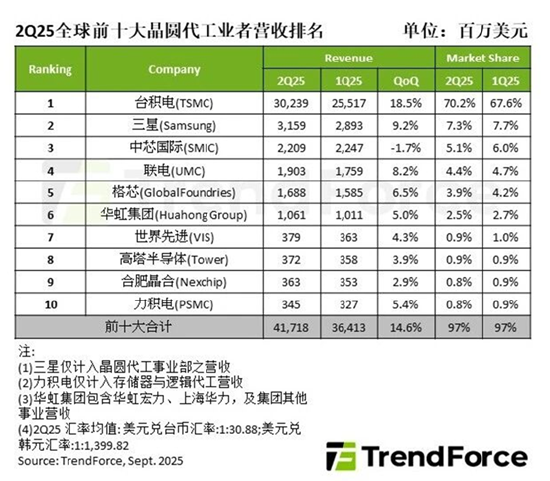
晶圆代工半年报:中芯国际毛利率同比提升8个百分点 营收增速在三家中领先
Xin Lang Cai Jing· 2025-09-18 08:20
Core Viewpoint - The semiconductor industry is experiencing a recovery in 2025, driven by explosive growth in AI technology and domestic consumption subsidies stimulating demand for new devices [1] Group 1: Industry Overview - In Q2 2025, the top ten global foundries generated a total revenue of 41.718 billion, reflecting a quarter-on-quarter growth of 14.6% [3] - TSMC's revenue reached 30.239 billion in Q2 2025, with a market share increase of 2.6 percentage points to 70.2%, while other major players saw a decline in market share [1][3] - The competition focus in the foundry market is shifting from "advanced processes" to "advanced packaging," with TSMC holding a significant advantage in both areas [1] Group 2: Company Performance - SMIC, Huahong, and GlobalFoundries showed revenue growth rates of 23.14%, 19.09%, and 18.21% respectively in the first half of 2025 [4] - SMIC's gross margin improved by 8 percentage points year-on-year, reaching 21.91%, while Huahong and GlobalFoundries also saw slight increases [4] - In Q2 2025, SMIC's capital expenditure was 1.885 billion, a 33.18% increase from Q1, with a capacity utilization rate of 92.5% [5] Group 3: Market Segments - SMIC's revenue in the consumer electronics sector increased by 53.80% year-on-year, while the automotive sector saw a 65.15% increase [6] - The smartphone sector experienced a slight decline of 1.67%, indicating a mixed performance across different market segments [6] - The automotive industry's revenue contribution reached a new high of 9.48%, suggesting a growing importance of this sector [6]

震荡牛市或延续,科技主线能否持续,还有哪些机会?
British Securities· 2025-09-15 02:57
Market Overview - The A-share market is experiencing a volatile bull market, with the Shanghai Composite Index breaking through the previous high of 3888 points, setting a new annual high [2][3][16] - The technology sector remains the main driving force of the market, with expectations for continued performance despite recent fluctuations [2][3][16] - The overall market sentiment is mixed, with more stocks declining than rising, indicating a cautious approach among investors [5][19] Sector Analysis - The technology sector is expected to continue as the main focus, with potential for internal rotation and high-low switches within the sector [2][3][16] - Solid-state batteries and new technologies in the renewable energy sector are highlighted as areas of opportunity, particularly for leading companies with core technology reserves [2][3][16] - The cyclical sectors and high-end manufacturing are seen as key beneficiaries of economic recovery, presenting further investment opportunities [2][3][16] - The brokerage sector is benefiting from increased market activity, with direct profits from brokerage and margin financing businesses [2][3][16] Recent Performance - The three major indices have all reached new highs for the year, indicating a potential continuation of the volatile bull market [3][17] - The PPI in the US decreased by 0.1% in August, easing inflationary pressures and raising expectations for a more accommodative monetary policy from the Federal Reserve [3][17] - Trading volume has rebounded, with total trading exceeding 2.5 trillion yuan, indicating a return to a strong trading environment [3][17] Investment Strategy - For companies with strong fundamentals and clear industry prospects, maintaining positions is recommended [18] - It is advisable to reduce exposure to sectors that have seen excessive gains and high valuations [18] - Attention should be given to second-tier technology leaders, cyclical sectors, and brokerage stocks during market corrections for structural opportunities [18]
台积电_Communacopia + 2025 年科技大会- 关键要点
2025-09-12 07:28
TSMC (2330.TW) Conference Call Summary Company Overview - **Company**: Taiwan Semiconductor Manufacturing Company (TSMC) - **Ticker**: 2330.TW - **Event**: Goldman Sachs Communacopia + Technology Conference 2025 - **Date**: September 8-11, 2025 - **Presenters**: Wendell Huang (CFO), Jeff Su (Head of Investor Relations) Key Industry Insights 1. **Advanced Node Capacity**: - TSMC's advanced node peak capacity is expected to be higher than previous nodes due to increased demand from smartphone and high-performance computing (HPC) sectors [2][3] - N2 technology is projected to contribute 11.5% of wafer revenue in 2026, significantly higher than N3's 5.1% in its first year [3] 2. **N3/N5 Capacity Growth**: - TSMC maintains over 90% tool commonality between adjacent advanced nodes, allowing for flexible capacity adjustments to meet AI demand [2][7] - The company plans to convert capacity from N7 to N5 and N5 to N3 to support strong AI demand, leading to tight capacity in advanced nodes [7] 3. **Advanced Packaging Expansion**: - TSMC is allocating 10-20% of capital expenditures to advanced packaging, which is expected to grow faster than the corporate average [2][8] - Advanced packaging is projected to account for over 10% of revenue in 2025, up from 8% in 2024, with increasing adoption in non-AI applications [8] 4. **Long-term Gross Margin (GM) Target**: - Despite overseas expansion plans, TSMC's long-term GM target of 53%+ remains achievable [2][9][11] - The company plans to mitigate GM pressure through geographical diversification, cost efficiency, and leveraging government support [11] 5. **Revenue Growth Forecast**: - TSMC reaffirms a close to 20% compound annual growth rate (CAGR) for the 2024-2029 period, with potential upside driven by strong N2 demand and tightness in N3 and N5 nodes [12] Financial Metrics - **Market Capitalization**: NT$32.2 trillion / $1.1 trillion - **Revenue Projections**: - 2024: NT$2,894.3 billion - 2025E: NT$3,667.9 billion - 2026E: NT$4,211.2 billion - 2027E: NT$4,873.4 billion - **EPS Projections**: - 2024: NT$45.25 - 2025E: NT$60.36 - 2026E: NT$68.49 - 2027E: NT$77.56 - **Price Target**: NT$1,370.00 (upside of 10.5%) [18] Investment Thesis - TSMC is positioned as a leading global foundry with over 60% market share, benefiting from its technology leadership in AI, 5G, HPC, and EV sectors [13][15] - The stock is rated as a "Buy" due to its attractive valuation and long-term growth prospects [14][15] Key Risks 1. Deterioration in end-demand recovery affecting capacity utilization [16] 2. Slower customer node migrations impacting revenue [16] 3. Delays in 5G penetration affecting semiconductor growth [16] 4. Poor yields or execution leading to profitability issues [16] 5. Increased competition affecting pricing and margins [16] 6. Unfavorable foreign exchange trends or cost increases impacting margins [16] Conclusion TSMC's strong positioning in advanced technology nodes and packaging, along with a robust growth forecast, supports a positive investment outlook despite potential risks associated with market dynamics and competition.
Ask the Experts: Benchmarks That Actually Matter for HPC and AI
DDN· 2025-09-04 14:53
Benchmarking & Performance Evaluation - MLPerf and IO500 are trusted, third-party benchmarks that provide clarity for making informed decisions about AI and HPC infrastructure [1] - These benchmarks simulate real-world workloads to measure speed, scalability, and efficiency [1] - The session aims to equip decision-makers with the knowledge to evaluate storage solutions for AI and HPC environments confidently [1] Key Learning Objectives - Identify the most relevant benchmark results for AI & HPC decision-makers [1] - Understand what MLPerf and IO500 tests entail and their significance [1] - Translate performance and scalability metrics into tangible business outcomes [1] DDN's Position - DDN demonstrates leadership in AI performance, offering benefits to users [1] Expertise - The session features technical experts from DDN, including Joel Kaufman, Jason Brown, and Louis Douriez [1]

联瑞新材(688300):2025年半年报点评:产品结构持续优化,高阶品望快速放量
ZHONGTAI SECURITIES· 2025-09-04 08:39
Investment Rating - The investment rating for the company is "Buy" (maintained) [3][21] Core Views - The company reported a revenue of 5.2 billion yuan in H1 2025, representing a year-on-year growth of 17.1%, and a net profit attributable to shareholders of 1.4 billion yuan, up 18.0% year-on-year [5][6] - The company is focusing on high-performance advanced powder materials, with an increasing revenue share from high-end products, driven by the growing demand in advanced packaging and high-performance electronic circuit substrates [6][5] - The company aims to enhance its market share and competitive strength through continuous R&D and product upgrades, with a projected net profit of 3.1 billion yuan for 2025 [6][5] Summary by Sections Financial Performance - In H1 2025, the company achieved a revenue of 5.2 billion yuan, with a net profit of 1.4 billion yuan, and a non-recurring net profit of 1.3 billion yuan [5] - For Q2 2025, the company reported a revenue of 2.8 billion yuan, a year-on-year increase of 16.4%, and a net profit of 0.8 billion yuan, up 14.9% year-on-year [5] Product Development - The company is focusing on high-end chip packaging and advanced packaging materials, with a notable increase in the revenue share of high-end products [6] - The company plans to issue convertible bonds to raise up to 720 million yuan for projects aimed at enhancing production capacity for high-performance materials [6] Profitability and Valuation - The company's gross margin and net margin for H1 2025 were 40.8% and 26.7%, respectively [6] - The adjusted profit forecasts for 2025-2027 are 3.1 billion, 4.3 billion, and 5.5 billion yuan, with corresponding P/E ratios of 40.7, 29.6, and 23.0 [6][3]

联瑞新材(688300):持续聚焦高端粉体,可转债项目助力成长
Shanxi Securities· 2025-08-28 08:59
Investment Rating - The report maintains a "Buy-B" rating for the company, indicating an expected price increase of over 15% relative to the benchmark index [4][9]. Core Views - The company has shown strong performance in the first half of 2025, with revenue reaching 519 million yuan, a year-on-year increase of 17.12%, and a net profit of 139 million yuan, up 18.01% year-on-year [4]. - The demand for high-performance materials is driving growth, particularly in advanced packaging and high-performance electronic circuit boards, which has led to a steady increase in market share [4][5]. - The company is focusing on high-end powder materials and has launched several new products to meet the growing needs in AI, 5G, and electric vehicle sectors [5][6]. Financial Performance - For the first half of 2025, the company achieved a revenue of 281 million yuan in Q2, with a quarter-on-quarter increase of 16.38% and a year-on-year increase of 17.55% [4]. - The net profit for Q2 2025 was 76 million yuan, reflecting a quarter-on-quarter increase of 14.89% and a year-on-year increase of 19.94% [4]. - The projected net profits for 2025, 2026, and 2027 are 290 million yuan, 340 million yuan, and 390 million yuan, respectively, with corresponding P/E ratios of 50, 42, and 37 [9][11]. Market Trends - The global CCL market is expected to grow at a compound annual growth rate (CAGR) of 9% from 2024 to 2026, with the high-end CCL market projected to grow at a CAGR of 26% during the same period [7]. - The demand for ultra-pure spherical silica is increasing due to its critical role in high-performance circuit boards, which require materials with low dielectric loss to enhance signal integrity [7][8]. Investment Projects - The company is investing 720 million yuan in convertible bonds, with 423 million yuan allocated to high-performance substrate materials and 388 million yuan to high thermal conductivity materials [6]. - The high-performance substrate project is expected to generate sales revenue of 659 million yuan upon reaching full production, while the high thermal conductivity project is projected to achieve 310 million yuan in sales [6].
半导体分析手册系列之一:AI驱动下的晶圆代工新纪元:2025投产股份格局、技术突破与中国力量
Dongxing Securities· 2025-08-28 08:18
Investment Rating - The report suggests a positive investment outlook for the semiconductor foundry industry, particularly driven by AI and automotive electronics demand [5]. Core Insights - The semiconductor foundry industry is experiencing a significant growth phase, with global semiconductor sales expected to exceed $1 trillion by 2030, growing at a CAGR of 9% from 2025 to 2030 [4][39]. - TSMC dominates the foundry market with a 60% market share, while SMIC, Hua Hong Semiconductor, and others are emerging as key players in the Chinese market [47][52][58]. Summary by Sections Industry Overview - Wafer foundry refers to the manufacturing of semiconductor wafers for other IC design companies without engaging in design itself. It is a crucial segment of the semiconductor industry [3][10]. - The industry is characterized by high capital and technology intensity, with significant investments required for advanced process nodes [22][23]. Market Dynamics - The global semiconductor wafer capacity is projected to grow from 31.5 million wafers per month in 2024 to 33.7 million in 2025, with a growth rate of 6% and 7% respectively [4][37]. - The demand for chips is driven by sectors such as AI, HPC, and automotive electronics, leading to increased R&D investments in advanced process technologies [29][39]. Key Players in China - SMIC is a leading foundry in China, achieving significant revenue growth and technological advancements, including the production of 14nm FinFET technology [52][54]. - Hua Hong Semiconductor is recognized for its comprehensive specialty process platform, focusing on various technology segments [58]. - Jinghe Integrated Circuit has achieved global leadership in the LCD driver chip foundry market [65]. Competitive Landscape - The foundry market is characterized by a "one strong, many strong" competitive structure, with TSMC as the clear leader, followed by Samsung and SMIC [47]. - The report highlights the increasing market share of SMIC, which has risen to third place in the global foundry rankings [47][49]. Future Trends - The report anticipates continued growth in advanced processes (28nm and below) and specialty processes, driven by the rising demand for high-performance computing and AI applications [5][39]. - The foundry industry is evolving towards a "Foundry 2.0" model, which includes not only wafer manufacturing but also packaging, testing, and other integrated services [24].
联瑞新材(688300):半导体产业持续迭代 公司高阶球形品需求释放
Xin Lang Cai Jing· 2025-08-28 02:31
Core Viewpoint - The semiconductor industry is entering a prosperous cycle with strong demand growth, particularly for advanced packaging materials and high-frequency copper-clad laminates, driven by rapid developments in AI, 5G, and HPC [1] Group 1: Industry Trends - Global semiconductor sales are projected to reach $346 billion in the first half of 2025, representing an 18.9% year-on-year increase [1] - The advanced packaging market is expected to grow at a compound annual growth rate (CAGR) of 10.7% from 2023 to 2029 [1] - The high-end CCL market is forecasted to have a CAGR of 26% from 2024 to 2026 [1] Group 2: Company Developments - The company plans to raise 720 million yuan through convertible bonds to fund the construction of high-purity spherical silica and high-thermal-conductivity spherical alumina projects [2] - The high-performance spherical silica project aims for a capacity of 3,600 tons, with a construction period of three years, and the first phase is designed for 1,200 tons per year [2] - The high-thermal-conductivity spherical alumina project will have a capacity of 16,000 tons and a construction period of 18 months [2] Group 3: Financial Performance - The company's total expense ratio for the first half of 2025 is 12.57%, down from 14.26% in the same period of 2024, indicating improved cost management [2] - The sales gross margin for the first half of 2025 is 40.84%, a slight decrease of 1 percentage point year-on-year [3] - The projected net profits for 2025 are 316 million yuan, 398 million yuan, and 491 million yuan for the years 2025, 2026, and 2027, respectively, reflecting minor downward adjustments [3]