碳达峰碳中和

Search documents
"十四五"能源创新: 多轮驱动的能源供应体系构建
Xin Hua Wang· 2025-08-14 05:50
Strategic Background - Energy security and green transition are dual challenges faced by the industry, necessitating the establishment of a modern energy system as outlined in the "14th Five-Year Plan" [2] - China's reliance on imported energy is significant, with oil and natural gas dependency rates at 72% and 41% respectively, highlighting the risks associated with external supply uncertainties [2] - The urgency of achieving carbon peak by 2030 and carbon neutrality by 2060 imposes immediate requirements for energy structure adjustment and green transition [2] - There is a growing need for technological self-sufficiency in key energy sectors, as reliance on imported technologies poses risks to the energy industry's development and competitiveness [2] Multi-Wheel Drive Strategy - The "multi-wheel drive" strategy leverages the unique advantages of various energy types, positioning coal as the "ballast stone" for energy security, oil and gas as stabilizers, nuclear energy as a base-load power source, and renewable energy as a growth driver [3][4] - This strategy aims to create a resilient and low-carbon energy supply system through the complementary advantages and collaborative innovation of different energy types [3] Energy Supply System Development - During the "14th Five-Year" period, China is promoting the coordinated development of coal, oil, gas, nuclear, and renewable energy through technological innovation and industrial upgrades [4] - Clean and efficient utilization of coal is emphasized, with initiatives to improve efficiency and reduce emissions through advanced technologies like ultra-supercritical power generation [4] - The oil and gas sector is focusing on increasing reserves and production while optimizing the market system to enhance supply stability and security [4] Nuclear Energy and Renewable Energy - Nuclear energy is being developed safely and orderly, with a focus on cultivating high-end nuclear equipment manufacturing and enhancing safety and economic efficiency through technological innovation [5] - Renewable energy is prioritized for rapid development, with China leading globally in installed capacity for hydropower, wind power, and solar power [6] Technological Innovation and Integration - Technological innovation is crucial for driving energy transition and industrial upgrades, with a focus on integrating energy technology with modern information, new materials, and advanced manufacturing [6][10] - The development of a hydrogen energy industry and improvements in the efficiency and cleanliness of traditional energy sources are also key components of this strategy [6] Future Outlook - The future focus will be on high-quality development of renewable energy, with significant increases in the share of wind and solar power in the energy structure [8] - Traditional energy sources will continue to play a vital role in ensuring energy security, with advancements in clean technology and carbon capture utilization and storage (CCUS) [9] - The integration of energy technology and smart systems will accelerate the intelligent upgrade of the energy system, enhancing efficiency and flexibility [10] - A well-structured energy market will be essential for stimulating innovation and ensuring efficient resource allocation [11]
上海:建立健全碳排放配额总量管理制度
Xin Hua Cai Jing· 2025-08-14 05:26
(文章来源:新华财经) 新华财经上海8月14日电据上海市人民政府网站8月14日消息,上海市人民政府办公厅印发《上海碳市场 全面深化改革行动方案(2026-2030年)》,其中提出,建立健全配额总量管理制度。合理确定碳排放 配额总量,建立健全储备配额调控机制。建立同碳排放总量与强度双控制度相衔接的碳排放配额分配制 度,对碳排放总量相对稳定的行业试点实施配额总量控制,为战略性新兴产业和未来产业预留发展空 间。稳妥有序提高有偿分配比例。发挥配额有偿发放机制的约束激励作用,按照上海碳达峰碳中和目标 推进节奏,分行业设定差异化的有偿发放比例,并根据纳管单位年际间碳排放总量或强度下降情况、减 污降碳协同增效实施情况、能源或碳计量体系建设情况等,设定激励调节系数。到2027年,纳管单位配 额有偿发放比例控制在8%以内;到2030年,配额有偿发放量占配额总量的比例进一步提高。 ...
循“绿”而为 向“新”而进 建行山东省分行以绿色金融为笔绘就齐鲁高质量发展新画卷
Qi Lu Wan Bao· 2025-08-13 01:55
Group 1: Green Finance Initiatives - The Construction Bank of Shandong Province integrates its development into national strategic frameworks, focusing on green finance to support the transformation of the economy and society towards sustainability [1][25] - The bank has provided significant financial support for major infrastructure projects, including a total of 40 billion yuan in fixed asset loans for three Huanghe River crossing tunnel projects in Jinan [7][4] - The bank's innovative financial solutions, such as dynamic interest rate adjustments based on environmental performance, are designed to facilitate the green transformation of traditional industries like aluminum [21][22] Group 2: Infrastructure Development - Jinan has initiated a series of crossing projects over the Huanghe River, with the completion of the Jinan Huanghe Jiluo Road Tunnel, which is a key infrastructure for the city's "northward expansion" strategy [2][4] - The bank has played a crucial role in financing these projects, including a 20 billion yuan basic construction loan and a 20 billion yuan financing lease for the Jiluo Road Tunnel [4] - The Huanggang Road Tunnel project has received 10 billion yuan in funding from the bank, demonstrating its commitment to supporting large-scale infrastructure developments [6] Group 3: Renewable Energy Projects - The bank has approved a total credit of 1.571 billion yuan for the fourth phase of a distributed photovoltaic project, which aims to utilize highway slopes and service areas for solar energy generation [13] - This project is part of a broader initiative to reduce coal consumption and carbon emissions, contributing to the national "dual carbon" goals [13] - The bank's innovative service model has streamlined the funding process, allowing for quicker deployment of financial resources to support renewable energy projects [13] Group 4: Water Supply Improvement - The bank has provided 350 million yuan in credit for the Dongming County Urban and Rural Water Supply Improvement Project, addressing the growing water demand in the region [24] - This project is expected to enhance the water supply for both residential and industrial needs, thereby supporting local economic development [24] - The bank's proactive approach in creating tailored financial solutions has facilitated the timely execution of this essential infrastructure project [24]


拓宽绿色金融路径 铺就高质量发展底色
Bei Jing Ri Bao Ke Hu Duan· 2025-08-12 21:53
Core Viewpoint - The emphasis on promoting green and low-carbon economic and social development is crucial for achieving high-quality development, as highlighted by the Chinese leadership [1] Group 1: Green Finance Development - Agricultural Bank of China (ABC) Beijing Branch has actively implemented new development concepts, focusing on green finance innovation and supporting carbon peak and carbon neutrality goals [1] - As of June 2025, the green credit balance of ABC Beijing Branch exceeded 230 billion yuan, accounting for over 30% of total loans, with investments in clean energy, green transportation, and green manufacturing [1] - The bank aims to create a vibrant and sustainable green financial ecosystem to support the capital's green low-carbon development [1] Group 2: Support for Public Transportation - ABC Beijing Branch has expanded its cooperation with Beijing Investment Group from 2 to over 20 rail lines, providing significant financial support exceeding 60 billion yuan [2] - The collaboration has contributed to improving air quality and beautifying urban environments through enhanced public transportation infrastructure [2] Group 3: Support for Urban Sub-center Development - The Beijing Urban Sub-center is positioned as a national green development demonstration zone, and ABC Beijing Branch has established a "Green Finance Innovation Service Center" to support its development [3] - The bank has provided diversified financial services for key projects in green buildings and clean energy, with a green credit balance exceeding 9 billion yuan as of June 2025 [3] Group 4: Financial Product and Service Innovation - ABC Beijing Branch has innovated financial products and services, including the rapid issuance of "two new" green bonds, which are expected to reduce CO2 emissions by 240,700 tons annually [6] - The bank has established a comprehensive green financial product service system to improve financing conditions for enterprises and support projects aligned with national green transition guidelines [7] Group 5: Commitment to Sustainable Development - ABC Beijing Branch is committed to enhancing its own low-carbon transformation while providing quality financial support to green low-carbon enterprises [7] - The bank promotes green practices internally, including the construction of green branches and advocating for low-carbon operations among employees [7] - The bank's leadership emphasizes the importance of sustainable development and the pursuit of carbon neutrality goals as part of its long-term strategy [8]

国网酒泉供电公司:电力“引擎”驱动新能源产业跑出“加速度”
Zhong Guo Neng Yuan Wang· 2025-08-12 09:44
Core Insights - The establishment of the full vanadium flow battery energy storage project by HuanTai Storage in Guazhou County is significant for addressing local renewable energy consumption challenges and promoting a multi-energy complementary structure [3] Group 1: Project Overview - HuanTai Storage's full vanadium flow battery project is located in the modern high-capacity industrial park at Beida Bridge, with production facilities actively manufacturing batteries for the national renewable energy market [1] - The project was initiated through a strategic partnership with Guazhou County in November 2021, marking a milestone in local energy storage development [3] Group 2: Support and Services - State Grid Jiuquan Power Supply Company has been providing comprehensive support throughout the project, ensuring stable and reliable electricity supply to facilitate efficient operations [3] - The company has implemented 26 major grid optimization adjustments and 67 risk management measures to enhance grid safety and reliability [3] Group 3: Renewable Energy Development - The renewable energy generation in the region has increased by 7.19% year-on-year, supported by coordinated maintenance of 112 renewable energy stations [3] - A dynamic energy efficiency model has been established to enhance grid flexibility, with a demand-side response capacity of 167,000 kW identified through enterprise visits [3] Group 4: Future Focus - The State Grid Jiuquan Power Supply Company aims to continuously optimize the grid structure and improve power supply services to support the growth of green storage enterprises [4] - The company is committed to contributing to carbon peak and carbon neutrality goals while promoting high-quality local economic development [4]
招行发布2021年可持续发展报告 绿色金融进入经营核心议题
Xin Hua Wang· 2025-08-12 06:29
Core Viewpoint - The article emphasizes the urgent need for the banking industry to transition towards green finance in response to China's carbon neutrality goals by 2060 and peak carbon emissions by 2030, highlighting the significant investment opportunities and the strategic initiatives taken by China Merchants Bank (CMB) in this area [1][2][3]. Group 1: Green Finance Strategy - CMB has prioritized green finance as a core business area, elevating its importance in the 2021 sustainability report, reflecting a shift from 11th place in 2020 to the top position in 2021 [1]. - The bank aims for its green project loan growth to exceed the overall growth of corporate loans within the year and to enter the top tier of banks in the People's Bank of China's green finance evaluation within five years [2]. - The report indicates that achieving China's carbon peak and neutrality goals will require investments in the range of trillions of yuan, creating substantial market opportunities for financial institutions [2]. Group 2: Green Financing Policies - CMB plans to implement differentiated credit policies to allocate resources towards low-energy, low-pollution industries while controlling loans to high-pollution sectors [3]. - The bank has issued carbon reduction loans amounting to 6.974 billion yuan in 2021, resulting in a reduction of 1.2152 million tons of CO2 equivalent [4]. - CMB's green loan balance reached 263.842 billion yuan by the end of 2021, with a year-on-year increase of 55.254 billion yuan, representing a growth rate of 26.49% [4]. Group 3: Green Investment and ESG Integration - CMB has actively engaged in green investments, with a focus on retail markets, having sold approximately 17.8 billion yuan in funds related to renewable energy and photovoltaic industries over the past year [6]. - The bank has integrated ESG principles into its investment processes, achieving an MSCI ESG rating upgrade from BBB to A, positioning it among industry leaders [7]. - CMB's subsidiaries are involved in various green financing initiatives, including issuing green bonds and providing innovative financing solutions for renewable energy projects [5][6]. Group 4: Economic Impact of Green Finance - The article highlights that green finance is not merely a response to policy but is viewed as a long-term investment opportunity that can drive economic growth and job creation [8]. - The International Energy Agency predicts that investments in clean energy and infrastructure will triple by 2030, contributing significantly to global GDP growth [8]. - CMB is committed to leveraging financial tools to address climate challenges and support economic transformation towards sustainability [8].

支持实体经济,金融业晒出成绩单
Xin Hua Wang· 2025-08-12 06:28
中国人民银行货币政策委员会日前召开的2022年第一季度例会提出,要稳字当头、稳中求进,强化 跨周期和逆周期调节,加大稳健的货币政策实施力度,增强前瞻性、精准性、自主性,发挥好货币政策 工具的总量和结构双重功能,主动应对,提振信心,为实体经济提供更有力支持,稳定宏观经济大盘。 近期,随着越来越多的金融机构晒出年度经营报告,一张金融业大力支持实体经济的"成绩单"愈加清 晰。 畅通企业融资渠道 如何缓解企业融资难融资贵,是金融机构的必答题。 中国再保险(集团)股份有限公司副总裁庄乾志介绍,中国"一带一路"再保险共同体自去年成立之后, 已有23家保险公司加入,共同为中国企业相关项目提供保险服务。一年多时间,共同体保障的境外项目 总规模超过160亿元,有效防范和化解中国企业"走出去"的境外风险。 面对新冠肺炎疫情的反复,交易所等相关单位也积极行动,助力企业应对风险。3月26日,上海证券交 易所发布通知,宣布免收沪市存量及增量上市公司2022年上市初费和上市年费、增量上市公司2022年股 东大会网络投票服务费、2022年度CA证书服务费等多项费用,同时减免和调降数据中心专线及机柜 费。上海证券交易所就进一步保障市场运行提 ...



研究设立国家低碳转型基金 研究支持碳减排相关税收政策
Xin Hua Wang· 2025-08-12 06:26
《意见》要求,各级财政部门要加快梳理现有政策,明确支持碳达峰碳中和相关资金投入渠道,将 符合规定的碳达峰碳中和相关工作任务纳入支持范围。严格预算管理,不断提升财政资源配置效率和财 政支持碳达峰碳中和资金使用效益。 【纠错】 【责任编辑:柴峥】 具体来看,《意见》表示,加强财政资源统筹,优化财政支出结构,加大对碳达峰碳中和工作的支 持力度。财政资金安排紧紧围绕党中央、国务院关于碳达峰碳中和有关工作部署,资金分配突出重点, 强化对重点行业领域的保障力度,提高资金政策的精准性。中央财政在分配现有中央对地方相关转移支 付资金时,对推动相关工作成效突出、发挥示范引领作用的地区给予奖励支持。 财政部发布《财政支持做好碳达峰碳中和工作的意见》(以下简称《意见》),提出到2025年,财 政政策工具不断丰富,有利于绿色低碳发展的财税政策框架初步建立,有力支持各地区各行业加快绿色 低碳转型。2030年前,有利于绿色低碳发展的财税政策体系基本形成,促进绿色低碳发展的长效机制逐 步建立,推动碳达峰目标顺利实现。2060年前,财政支持绿色低碳发展政策体系成熟健全,推动碳中和 目标顺利实现。 《意见》提出,研究设立国家低碳转型基金,支持 ...
充分发挥财政职能作用 坚决支持实现“双碳”目标
Xin Hua Wang· 2025-08-12 06:26
Core Viewpoint - The implementation of carbon peak and carbon neutrality is a significant strategic decision made by the Central Committee of the Communist Party of China, emphasizing the need for financial support to achieve these goals [1][2][3]. Group 1: Financial Department's Role - The financial department has a political responsibility to support the carbon peak and carbon neutrality goals, aligning with the central government's decisions [2][3]. - The financial sector is crucial in promoting a green and low-carbon development path, which is essential for sustainable development and addressing environmental constraints [3][4]. - The financial department must enhance its political judgment and execution capabilities to effectively implement the central government's policies [2][4]. Group 2: Principles for Financial Support - The approach to achieving carbon peak and carbon neutrality should balance current needs with long-term goals, emphasizing a strategic and systematic perspective [5][6]. - Financial policies must be tailored to local conditions, avoiding both high-emission projects and abrupt carbon reduction measures [6][7]. - The effectiveness of financial spending should be prioritized, ensuring that funds are allocated to key areas that support carbon neutrality [7][10]. Group 3: Key Actions for Implementation - Financial support should focus on precise and orderly spending, addressing challenges in energy transition and promoting renewable energy [10][11]. - Tax policies should incentivize ecological protection and innovation while imposing constraints on environmentally harmful practices [11][12]. - Market mechanisms should be utilized to direct resources towards green and low-carbon sectors, enhancing the role of social capital in supporting sustainable development [12][13]. Group 4: Accountability and Collaboration - There is a need for clear accountability within the financial system to ensure effective policy implementation at all levels [14]. - Collaboration among various departments is essential to streamline efforts towards achieving carbon peak and carbon neutrality [14][9]. - Continuous training and education for financial personnel on carbon neutrality policies are necessary to enhance their capabilities [14].
智库要览丨“中国绿”持续照亮全球能源未来
Sou Hu Cai Jing· 2025-08-12 04:59
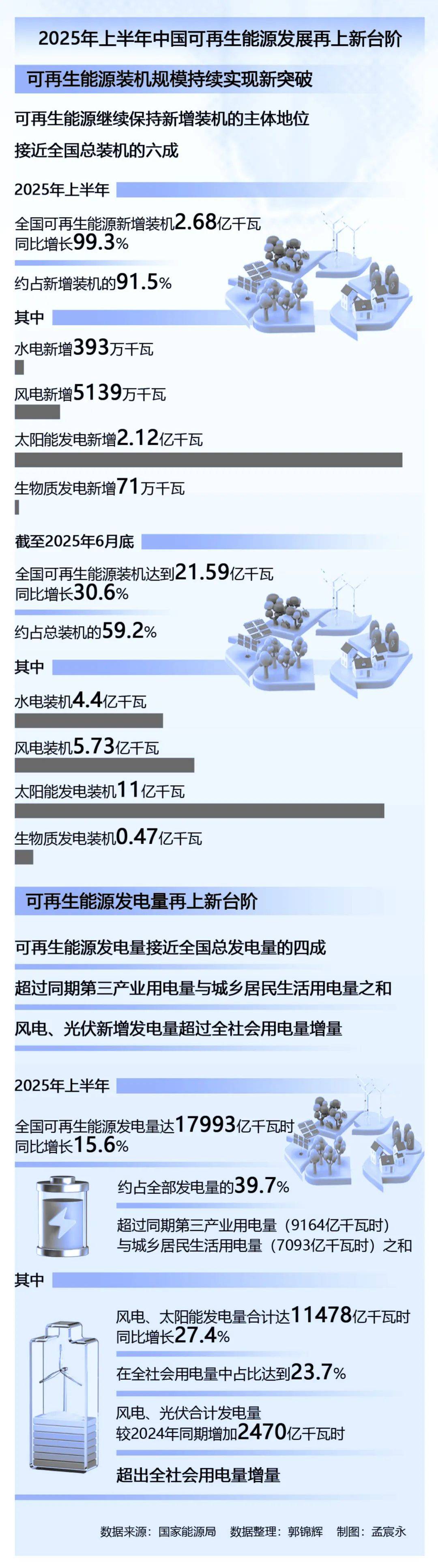
Group 1: China's Green Energy Transition - China is leading the global green and low-carbon energy transition, with significant growth in renewable energy installations in 2025 [1][30] - By the end of June 2025, China's renewable energy installed capacity reached 2.159 billion kilowatts, accounting for approximately 59.2% of total installed capacity [10][21] - In the first half of 2025, renewable energy installations totaled 268 million kilowatts, a year-on-year increase of 99.3%, with wind and solar power contributing significantly [9][20] Group 2: Renewable Energy Cost Competitiveness - The International Renewable Energy Agency reported that renewable energy helped avoid $467 billion in fossil fuel expenditures globally in 2024, confirming its cost-effectiveness [3][25] - The levelized cost of electricity (LCOE) for new utility-scale onshore wind projects was $0.034 per kWh, making it the cheapest renewable energy source [3][26] - The total installed cost (TIC) for solar photovoltaic technology is projected to drop to $388 per kilowatt in the next five years [3][26] Group 3: Global Energy Market Restructuring - The global energy market is undergoing significant restructuring due to rising geopolitical risks and the need for energy security, with countries reevaluating their energy strategies [2][5] - Six structural changes are identified as reshaping the energy market, including the impact of Middle Eastern conflicts on oil prices and the push for LNG diversification [5][6] - The International Energy Agency forecasts a slowdown in global natural gas demand growth in 2025, followed by an acceleration in 2026 [7][8] Group 4: Energy Storage and Technological Advancements - China's new energy storage industry is transitioning from early commercialization to large-scale development, with significant increases in installed capacity [18][19] - The average storage duration for new energy storage projects in China has increased to 2.3 hours, reflecting advancements in technology [19][34] - The integration of artificial intelligence in energy management is expected to enhance efficiency while also increasing energy consumption [6][27] Group 5: Future Projections and Challenges - By the end of 2025, non-fossil energy generation capacity in China is expected to reach approximately 240 million kilowatts, accounting for about 61% of total installed capacity [20][21] - The rapid expansion of renewable energy brings challenges such as volatility in generation, insufficient storage facilities, and limited grid capacity [16][31] - The report suggests building a multi-layered, diversified energy supply system to mitigate energy security risks [17][32]