通用人工智能(AGI)

Search documents
华为发布《智能世界2035》报告:展望十大技术趋势将如何塑造我们的未来
Sou Hu Cai Jing· 2025-09-18 12:00
Core Insights - Huawei released two reports, "Intelligent World 2035" and "Global Digital Intelligence Index 2025," outlining the technological evolution path for the next decade [3] - The reports predict a 100,000-fold increase in global computing power by 2035, transforming computing from a specialized tool to a universal social infrastructure [3][25] - The vision emphasizes a human-centered intelligent world, reshaping production methods, lifestyles, and the progress of civilization [3] Group 1: Ten Key Technological Trends - Trend 1: General Artificial Intelligence (AGI) will transition from laboratory to industrial application, with AI expected to handle complex decision-making tasks by 2035 [5][6] - Trend 2: A disruptive change in computing architecture will occur, with a projected 100,000-fold increase in total computing power [7][8] - Trend 3: A fundamental shift in data storage paradigms will take place, with AI storage capacity demand expected to grow 500 times by 2035 [9][10] - Trend 4: The scale of communication networks will increase dramatically, expanding from 9 billion people to 900 billion intelligent entities [11][12] - Trend 5: Energy systems will achieve intelligent management, with renewable energy generation surpassing 50% [13][14] - Trend 6: Interaction methods will evolve to multi-modal experiences, enhancing immersive engagement [15][16] - Trend 7: Health management will shift from treatment to prevention, with chronic disease prevention rates projected to exceed 80% [17][18] - Trend 8: Home robots will become standard, with over 90% of households expected to own smart robots [19][20] - Trend 9: Autonomous driving will redefine travel experiences, with L4+ level autonomous driving becoming widespread [21][22] - Trend 10: Software development will enter a human-machine collaboration era, significantly improving development efficiency [23] Group 2: Computing Revolution - By 2035, total computing power is expected to increase by 100,000 times, necessitating breakthroughs in multiple technology layers [25] - Innovations in computing architecture, such as integrated storage and optical computing, will overcome traditional limitations [25][26] - New computing paradigms, including neuromorphic and quantum computing, will provide superior solutions for specific scenarios [27][28] Group 3: Storage Upgrade - Data will become the "new fuel" driving AI development, with AI storage capacity demand projected to grow 500 times by 2035 [29] - Storage architecture will shift from "data storage" to "data service," enabling intelligent storage systems to understand data content [29] - Data management will transition from manual to intelligent management based on metadata [30] Group 4: Energy Transition - Energy will become a core element limiting AI's rapid development, with renewable energy generation expected to exceed 50% by 2035 [32] - AI will act as the "smart brain" of energy systems, optimizing energy distribution and usage [32] - Infrastructure will evolve towards distributed energy systems, enabling flexible scheduling and sharing of energy resources [32] Group 5: Health Transformation - AI will drive a paradigm shift in healthcare from "passive treatment" to "active prevention," with chronic disease prevention rates projected to exceed 80% [33] - Health prediction models based on multi-modal data will provide personalized prevention recommendations [33] - AI-assisted diagnostics will enhance healthcare efficiency and resource allocation [33] Group 6: Home Life and Enterprise Transformation - The penetration rate of smart home robots is expected to exceed 90%, transforming household tasks and experiences [36] - AI-driven autonomous decision-making will reshape production paradigms, with AI application rates reaching 85% by 2035, potentially increasing labor productivity by 60% [36] - Supply chain management will become more intelligent, with real-time demand forecasting and automated production adjustments [36] Group 7: Challenges and Considerations - The report highlights several core challenges in technological development, including the need for breakthroughs in physical world interaction and energy constraints [38] - Data security and privacy protection will face new challenges, necessitating a balance between data utilization and protection [38] - Ethical considerations in technology will require the establishment of new norms and standards for human-machine collaboration [38] Group 8: Insights and Outlook - The report envisions a future of human-machine collaboration and intelligent inclusivity, where technology evolves from a tool to a decision-making partner [39] - The transformation will require a reevaluation of the relationship between humans and technology, focusing on innovation and top-level design [39] - The competition in the future will extend beyond technology to include vision and hypothesis, with forward-thinking entities likely to lead in the intelligent civilization era [39]

AI 浪潮下的产业变革与投资机遇解析——对话国投瑞银基金经理马柯
Sou Hu Cai Jing· 2025-09-18 06:41
Core Insights - The article emphasizes that artificial intelligence (AI) is a driving force behind global industrial transformation, comparable to the internet boom from 1995 to 2000 [1] - It discusses the investment opportunities and risks associated with the AI industry, highlighting the current phase of development and future potential [1] AI Development Stages - AI's path to artificial general intelligence (AGI) is divided into five stages, with the industry currently transitioning from the "reasoner stage" to the "agent stage" [3][4] - The first stage involves chatbots like GPT-3.5, which have limited productivity enhancement [3] - The second stage, where the industry currently resides, shows improved reasoning capabilities and reduced costs [4] - Future stages include the "innovator stage" and the "intelligent organization stage," which are feasible due to ongoing improvements in model capabilities [4] North American AI Industry Progress - Key advancements in North American AI companies include periodic model iterations every two years, leading to reduced training and inference costs [5] - Competitive dynamics among firms drive rapid advancements in model capabilities [5] - By 2025, a consensus on the commercial value of generative AI is expected, indicating a healthy profit cycle for AI applications [5] China's AI Development - China is narrowing the gap with international leaders through "system-level innovation and hardware-software collaboration" [6] - In computing power, China is leveraging cluster technology and software capabilities to compensate for hardware shortcomings [6] - The open-source domain in model development benefits from vast data resources and a strong talent pool [7] - Rapid penetration of AI applications is evident as domestic tech giants increase their investments [8] Capital Market Reflections - The AI industry's transformation is reflected in the capital market, with the A-share electronic sector's market value surpassing the banking sector for the first time [9] - By August 2025, the electronic sector's market value is projected to reach 11.54 trillion yuan, indicating a shift towards technology innovation [9] - Numerous AI-related companies have emerged with market values exceeding 100 billion yuan, showcasing the high growth potential of the AI sector [9] Market Characteristics and Investment Opportunities - The current AI industry is likened to the early mobile internet era, with similarities in macroeconomic conditions, liquidity, technological trends, and policy directions [10][11] - Initial market characteristics include a divided funding structure, reasonable valuations, and a lack of excessive market enthusiasm [11] - The "AI+" trend is expected to drive efficiency improvements, business model innovations, and reshape competitive landscapes across industries [12] Investment Strategy - Investment opportunities in the AI industry are identified along the "computing power - energy chain - application" dimensions [13] - Focus areas include overseas and domestic computing power sectors, energy supply for AI infrastructure, and applications in existing and new scenarios [13][14] - The strategy emphasizes prioritizing cost-effectiveness and identifying undervalued assets with strong growth potential [14] Economic Outlook and Asset Allocation - Optimism regarding the macroeconomic environment is based on diminishing negative impacts from the real estate sector and supportive government policies [15] - The attractiveness of equity assets is highlighted due to low yields in fixed income and real estate markets, alongside reasonable valuations in the AI sector [16] - The ongoing shift towards emerging industries is expected to enhance the profitability of listed companies, making equity investments more appealing [16] Future Configuration Strategy - The investment strategy will continue to focus on the "AI+" theme, emphasizing core segments of the AI industry and exploring integration opportunities with traditional sectors [17][18] - Long-term trends indicate that AI will significantly transform industries, with substantial growth potential and reasonable valuations in the current market [18]

智能世界2035
Sou Hu Cai Jing· 2025-09-17 19:02
Core Insights - The report "Intelligent World 2035" by Huawei outlines a vision for a smart world by 2035, focusing on technological leaps, all-scenario applications, and sustainable development [1] - It identifies ten core trends in technology, including the evolution of AI from execution tools to decision-making partners, the transformation of software development through human-machine collaboration, and the anticipated 100,000-fold increase in computing power demand by 2035 [1][7][30] Technological Trends - The report highlights the need for AI to transition into the physical world, emphasizing the importance of experience, concepts, and actions in forming a world model [1][28] - AI agents are expected to evolve into cognitive entities capable of planning and collaborating, marking a shift from mere information processing to active decision-making [18][29] - A significant breakthrough in computing architecture is anticipated, moving beyond the von Neumann model, which will enable new paradigms in computing [1][30] Application Scenarios - In healthcare, the focus will shift from treatment to comprehensive health management, with AI expected to prevent over 80% of chronic diseases [1][31] - Education will leverage intelligent companions and twin teachers to provide personalized learning experiences at scale [1][7] - The logistics sector will see AI optimizing transportation, warehousing, and quality control, enhancing operational efficiency [1][19] Sustainable Development - The report emphasizes the ethical use of AI, advocating for the establishment of safety and ethical frameworks to ensure equitable access to technology and to bridge the digital divide [1][10][31] - Renewable energy sources are projected to surpass fossil fuels by 2035, with AI playing a crucial role in managing energy networks through token management [1][30][31] Industry Implications - The integration of AI into various sectors, such as finance, manufacturing, and urban management, is expected to drive paradigm shifts, enhancing productivity and reducing operational costs [1][19][31] - The anticipated rise of intelligent agents will lead to the creation of a new ecosystem where AI collaborates with human expertise to tackle complex industry challenges [19][20] Future Outlook - The report envisions a future where intelligent systems are deeply integrated into daily life, transforming homes, workplaces, and cities into interconnected, responsive environments [1][23][31] - It calls for a collaborative effort across industries and nations to develop reliable AI systems that prioritize human welfare and environmental sustainability [1][10][24]

AI时代,我们仍然需要真实的人吗?
3 6 Ke· 2025-09-17 12:08
Core Insights - The article discusses the launch of the AI-native game "Whispers from the Star" by miHoYo founder Cai Haoyu, exploring the future of AI interaction and its implications for human relationships with technology [1][31] - It raises questions about the definition of success in gaming and the potential for AI to fulfill emotional needs as human loneliness increases over time [1][31] Group 1: Game Overview and Reception - "Whispers from the Star" allows players to interact with the AI character Stella through various means, but it has not achieved significant success, with more people finding the concept novel rather than enjoyable [1][3] - The game requires an internet connection due to the nature of LLM operations, leading to potential disconnections and interruptions in gameplay [1][3] Group 2: Human-AI Interaction - The article highlights a trend where players, particularly women, engage with AI in a manner similar to traditional gaming, often sharing their interactions on social media [3][4] - The interaction with AI is seen as a form of role-playing, where players seek to fulfill emotional or functional needs through their AI companions [3][4] Group 3: Emotional and Social Implications - The potential for AI to replace human relationships is discussed, with the argument that while AI can simulate companionship, it lacks the ability to truly offend or challenge human expectations, which is a fundamental aspect of human interaction [7][10] - The article suggests that AI's inability to replicate the nuances of human relationships may lead to a reliance on AI for emotional support, but it also emphasizes the irreplaceable nature of human connections [7][10] Group 4: Future of AI in Gaming - The emergence of AI-driven games like "Oasis AI Minecraft" showcases the evolving landscape of gaming, where AI can generate gameplay based on player actions, potentially transforming game development processes [22][24] - The discussion includes the ongoing debate about the limits of AI technology and the quest for AGI (Artificial General Intelligence), highlighting differing approaches by companies like Google and OpenAI [25][27] Group 5: Societal Perspectives on AI - The article concludes that society's relationship with AI is complex, with varying perceptions ranging from viewing AI as a tool to a source of emotional comfort [29][30] - It poses a thought-provoking question about whether increased interaction with AI could alter how humans perceive and interact with each other in the future [30][31]

来自MIT最强AI实验室:OpenAI天才华人研究员博士毕业了
3 6 Ke· 2025-09-17 07:05
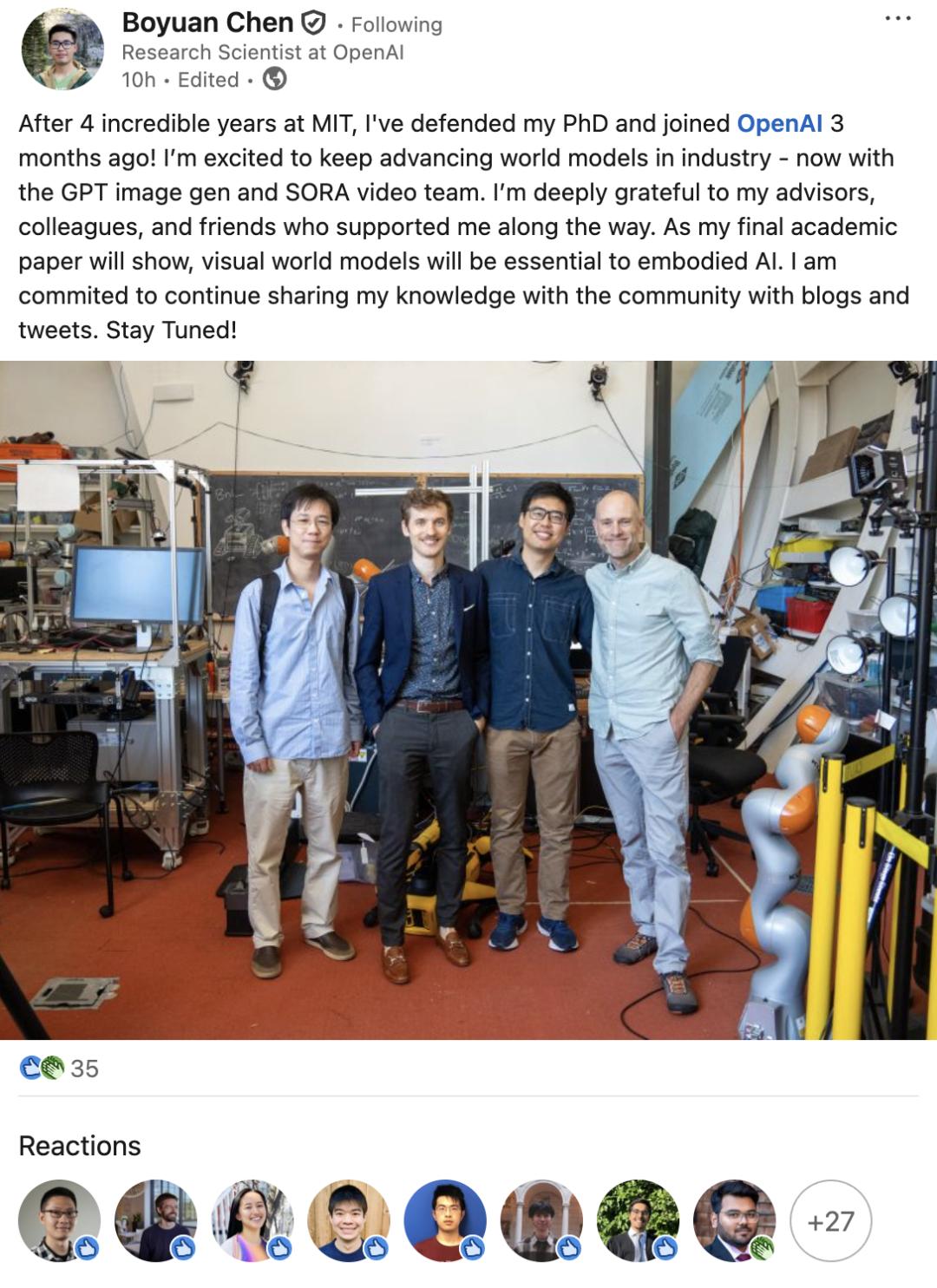
Core Insights - The article highlights the achievements of Boyuan Chen, a Chinese researcher at OpenAI, who recently completed his PhD at MIT in under four years, focusing on world models, embodied AI, and reinforcement learning [1][5][7]. Group 1: Academic Background and Achievements - Boyuan Chen holds a PhD in Electrical Engineering and Computer Science from MIT, with a minor in philosophy [7][24]. - He has been involved in significant projects at OpenAI, including the development of GPT image generation technology and the Sora video generation team [5][1]. - During his time at Google DeepMind, he contributed to the training of multimodal large language models (MLLM) using large-scale synthetic data [7][10]. Group 2: Research Focus and Future Aspirations - Chen emphasizes the importance of visual world models for embodied intelligence, believing that integrating these fields will enhance AI's understanding and interaction with the physical world [4][7]. - He expresses optimism about the future of embodied intelligence, predicting it will be a key technology for the next century and hopes to witness the emergence of general-purpose robots [17][20]. - OpenAI is reportedly increasing its efforts in robotics technology, aiming to develop algorithms for controlling robots and hiring experts in humanoid robotics [20].
智能世界2035_华为
华为· 2025-09-17 05:13
Group 1 - The rapid development of AI technology marks a new era in the technological revolution, indicating that the creation and application of knowledge are no longer solely human privileges [4] - Current AI applications are primarily focused on AI assistants with question-and-answer capabilities, which are often viewed as "black boxes" [4] - The potential for AI applications in industrial and service sectors remains largely untapped [4] Group 2 - The report "Intelligent World 2035" outlines a vision for AI development, exploring how technological integration will drive the transformation of industrial and service intelligent systems [5] - It highlights the potential applications of AI in various sectors, including healthcare, education, smart homes, smart cities, and business innovation [5] - The report discusses the synergistic effects of AI with other innovative technologies and the social and economic impacts of this transformation [5] Group 3 - Achieving the vision of AI development faces numerous technical challenges beyond general artificial intelligence [7] - The construction of intelligent systems is disrupting traditional systems engineering, requiring a combination of traditional ICT models and data-driven AI technologies [7] - A balance must be achieved between the correctness of system design and resilience during operation, with ongoing updates for continuous evolution [7] Group 4 - The vision presented in the report is broad and ambitious, contrasting with the approaches of tech giants that rely on machine learning and large-scale development [8] - Realizing this vision requires unprecedented technological breakthroughs and global collaboration [8] - The report emphasizes the importance of open ecosystems and international cooperation in advancing technology in the complex and transformative field of AI [9] Group 5 - The report identifies three key opportunities for the future of AI: more effective perception of the world, smarter model algorithms, and more efficient computing chips [11][12][13] - The integration of physical and digital worlds is essential for the evolution of general artificial intelligence (AGI) [11] - The development of new computing paradigms, such as quantum computing and neuromorphic chips, is crucial for achieving significant advancements in AI capabilities [13] Group 6 - The report outlines ten major technological trends that will shape the evolution of intelligent technology and the restructuring of social forms over the next decade [16] - These trends are interconnected and collectively form a complex ecosystem that supports the large-scale, real-time, and reliable interaction and decision-making of intelligent agents [17] - The report emphasizes the need for collaboration between technical experts and industry specialists to address the unique complexities of various sectors [18] Group 7 - The future intelligent world will require a sustainable energy foundation, with intelligent technology integrated into energy network management [18] - The report stresses the importance of ethical guidelines to ensure fairness, transparency, and accountability in AI algorithms [23] - The development of a dynamic regulatory framework for AI is essential to balance innovation and safety [23]
华为发布!未来十年十大技术趋势
Zhong Guo Zheng Quan Bao· 2025-09-17 04:58
未来十年十大技术趋势 《智能世界2035》报告展望了未来十年十大技术趋势。 趋势一:AGI(通用人工智能)将是未来十年最具变革性的驱动力量,但仍需克服诸多核心挑战,方能 实现AGI奇点突破。因此,走向物理世界是AGI形成的必由之路。 趋势二:随着大模型的发展,AI智能体将从执行工具演进为决策伙伴,驱动产业变革。 趋势三:开发模式迎来变革,人机协同编程成为主流。人类将更专注于顶层设计和创新思考,而把繁琐 的编码执行工作,交给高效的AI来完成。 趋势四:交互方式正从图形界面转向自然语言,并向着融合人类五感的多模态交互演进。用户通过语 音、手势等方式与数字世界互动,获得深度沉浸的体验。 趋势五:手机App正从独立的功能实体,转变为由AI智能体驱动的服务节点。用户只需给出指令,AI智 能体将调用相关服务节点,为用户提供极致体验。 9月16日,华为发布《智能世界2035》系列报告,展望了未来十年的关键技术趋势以及这些技术对教 育、医疗、金融、制造、电力等行业带来的改变和影响。 华为认为,AGI(通用人工智能)将是未来十年最具变革性的驱动力量。华为还预测,2035年全社会的 算力总量将增长10万倍。 趋势八:2035年数 ...
蚂蚁AI,有了新叙事
Sou Hu Cai Jing· 2025-09-17 04:58
Core Insights - The article discusses the recent developments of Ant Group at the 2025 Inclusion Bund Conference, highlighting its focus on AI applications for both consumers (AI to C) and businesses (AI to B) [4][9][13]. Group 1: AI to C Developments - Ant Group showcased its AI applications aimed at enhancing daily life, including the AI health assistant AQ, which can identify over 50 skin diseases through a simple photo [14][18]. - The launch of gPass, a trusted connection framework for smart glasses, aims to expand the capabilities of AI in payment systems, enhancing user experience with features like "look and pay" [5][19]. - The R1 robot, introduced by Ant's Lingbo Technology, demonstrated its culinary skills, indicating the company's commitment to integrating AI into various service sectors, including healthcare and hospitality [24][25]. Group 2: AI to B Innovations - Ant Group is redefining its business model with a focus on "results as a service," allowing clients to pay based on the actual business outcomes generated by AI applications [32][34]. - The introduction of the Tbox super intelligent agent enables users to generate professional reports in minutes by coordinating over 20 expert AI agents, marking a shift from traditional software delivery to collaborative outcomes [27][28]. - Ant's digital employee teams are designed to enhance operational efficiency for SMEs, reportedly improving productivity by approximately 70% and reducing operational costs by 35% [29][30]. Group 3: Strategic Vision and Future Directions - Ant Group's CEO emphasized the company's strategic shift towards AGI (Artificial General Intelligence), aiming to leverage AI technologies to improve everyday life and business operations [12][36]. - The company is actively pursuing partnerships and collaborations to scale AI applications across various sectors, including energy, data, and healthcare [34][46]. - Ant Group's ongoing investments in AI infrastructure and applications are expected to solidify its position in the rapidly evolving AI landscape, focusing on practical implementations rather than merely technological advancements [47][48].
小米自研芯片,拆解曝光
半导体行业观察· 2025-09-17 01:30
Core Viewpoint - The article highlights the significant advancements in the semiconductor industry, particularly focusing on Xiaomi's high-end smartphone, the Xiaomi 15S Pro, which is set to launch in May 2025, featuring a 3nm processor designed in China, amidst the backdrop of US-China tensions and the growing investment in general artificial intelligence (AGI) [2][3]. Group 1: Xiaomi's Product Launch - Xiaomi is celebrating its 15th anniversary in 2025 by launching several commemorative models, including the Xiaomi 15S Pro, which will be released six months after the flagship Xiaomi 15 series [3]. - The Xiaomi 15 series is expected to feature Qualcomm's self-developed 3nm Snapdragon 8 Elite processor, while the Xiaomi 15S Pro will utilize Xiaomi's own 3nm chip [3][13]. Group 2: Technical Specifications - The Xiaomi 15S Pro features a dual-layer internal circuit board divided into three sections: processor board, communication board, and terminal/IMU board, with a triple-camera setup, each with a 50MP CMOS image sensor from different manufacturers [5]. - The device integrates both imported and self-developed chips, particularly in camera, power, and battery systems, showcasing Xiaomi's rapid development in these areas [8][10]. Group 3: Chip Development - Xiaomi's XRING O1 processor, manufactured using 3nm technology, includes a 10-core CPU, 16-core GPU, 6-core NPU, and 3-core ISP, indicating a competitive edge over Qualcomm and MediaTek [17]. - The article notes that Xiaomi has been investing in semiconductor research and development for nearly a decade, evolving from entry-level processors to high-end solutions [21]. Group 4: Market Position and Future Outlook - As a major consumer of advanced chips, China is increasingly recognized in the semiconductor landscape, with Xiaomi's development of its own chips positioning it favorably in the market [2]. - Xiaomi's strategic move to develop proprietary chips is seen as a preparation for potential expansion into robotics and automotive sectors, indicating a long-term vision beyond the smartphone market [17].


两架小鹏飞行汽车相撞坠机!官方回应:间距不足发生接触,人员安全;刘强东喊话王兴:企业家不应该变成仇人;余承东自曝坚持要造旅行车
雷峰网· 2025-09-17 00:35
Key Points - The article discusses significant personnel changes at Shanjite Technology, including the departure of key technical partners and executives, raising concerns about the production and sales of their AI glasses [4][5] - An incident at the Changchun Airshow involved two XPeng flying cars colliding and crashing, with one passenger injured [7][8] - SAIC's executive criticized the marketing strategies of smartphone brands entering the automotive industry, emphasizing the need for long-term strategies [10][11] - The former chairman of Borante Robotics was dismissed amid ongoing losses and controversial salary proposals [12] - Huawei's Yu Chengdong defended the decision to produce a travel car despite internal opposition, citing market potential [15][16] - Liu Qiangdong emphasized the importance of maintaining healthy competition among entrepreneurs, urging against personal animosities [18] - Ford plans to lay off up to 1,000 workers at its German plant due to declining demand for electric vehicles [32][33] - Chery Automobile is set to launch an IPO with a target valuation of HKD 140 billion, aiming to raise between USD 1.5 billion to USD 2 billion [22]