
双碳目标

Search documents
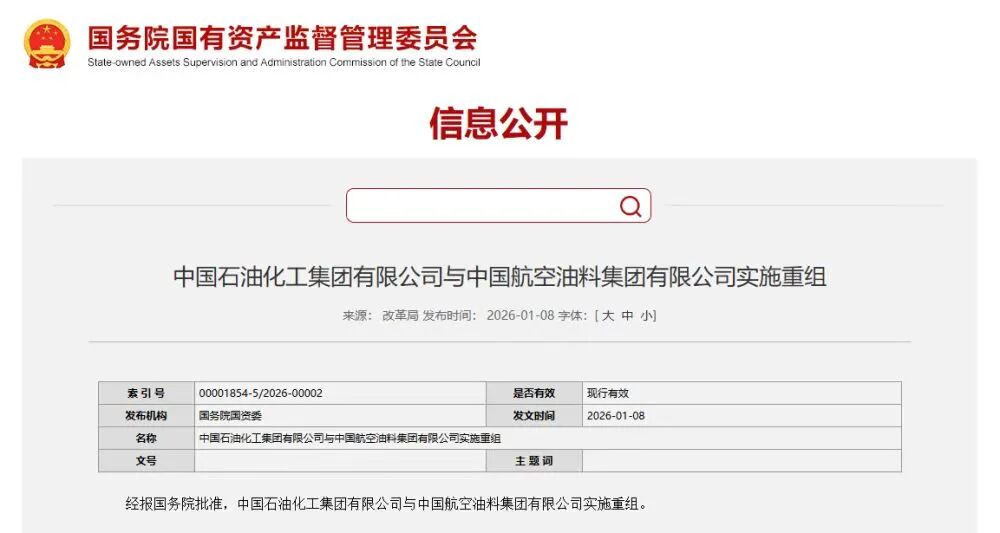
大消息!两大央企重组
Zhong Guo Zheng Quan Bao· 2026-01-08 10:36
Group 1 - The core point of the news is the restructuring between China Petroleum & Chemical Corporation (Sinopec) and China Aviation Oil Group, which has been approved by the State Council [1][3] - The restructuring is expected to create significant strategic complementarity and synergy, enhancing the overall market competitiveness of both companies [5] - After the restructuring, Sinopec can leverage China Aviation Oil Group's distribution network to expand its market share in aviation fuel and achieve integration of production and sales [5] Group 2 - China Aviation Oil Group is the largest aviation fuel procurement, transportation, storage, testing, sales, and refueling service provider in Asia, serving 258 transportation airports and 454 general airports in China [4] - The restructuring is anticipated to provide China Aviation Oil Group with more stable upstream resource supply, enhancing its bargaining power in the international aviation fuel market [5] - The restructuring aligns with China's "dual carbon" goals, as the civil aviation sector is a key area for achieving these targets, with sustainable aviation fuel (SAF) being a critical path for emissions reduction [6][7] Group 3 - Sinopec has been actively developing renewable energy technologies, with sustainable aviation fuel being a key focus area, having produced China's first bio-aviation fuel in 2022 [7] - The collaboration between Sinopec and China Aviation Oil Group in green energy transition is expected to reshape the competitive landscape of the traditional energy market and have a profound impact on the green transformation of China's aviation industry [7]


驻红桥区企业天津水泥院斩获2025年天津市知识产权创新创业大赛一等奖
Zhong Guo Fa Zhan Wang· 2026-01-08 09:58
Group 1 - The "Research and Development of Integrated Technology for Purification of Industrial Emission Pollutants and Solid Waste Disposal" project by Tianjin Cement Industry Design and Research Institute won the first prize at the 2025 Tianjin Intellectual Property Innovation and Entrepreneurship Competition, highlighting the strength of local enterprises in intellectual property innovation and green low-carbon technology [1][2] - The project focuses on "turning waste into clean materials" and addresses the dual challenges of industrial emission gas treatment and solid waste disposal through an innovative "waste-to-waste + collaborative governance" desulfurization and denitrification technology path [2] - The project team has developed over 30 invention patents and established a complete technical system based on 13 authorized core patents, achieving breakthroughs in utilizing various hazardous and solid wastes to produce high-performance purification materials [2][3] Group 2 - Tianjin Cement Institute has a strong focus on green environmental protection and has accumulated substantial technical reserves in low-carbon environmental equipment and collaborative solid waste disposal [3] - The recognition of the project not only reflects its technological innovation and commercial value but also demonstrates the company's commitment to an innovation-driven development strategy [3] - The innovation practices of Tianjin Cement Institute represent a microcosm of Tianjin's efforts to deeply integrate innovation and industry, supported by initiatives such as forming innovation alliances and establishing intellectual property trading platforms [3]

广东电力交易中心董事长黄远明解读《电力中长期市场基本规则》
Zhong Guo Dian Li Bao· 2026-01-08 05:46
电力中长期市场迈向高质量发展新阶段 ——《电力中长期市场基本规则》解读 广东电力交易中心党委书记、董事长 黄远明 《电力中长期市场基本规则》(下称"新规则")的出台,是深化电力市场化改革的关键一步,是贯彻落 实党的二十届四中全会关于构建高水平社会主义市场经济体制的精神在能源领域的具体实践,标志着我 国电力市场体系从初步建成迈向高质量发展的新阶段。新规则为全国各省及区域电力市场探索试点前沿 机制、破解能源优化难题、助力新型电力系统建设提供了顶层制度保障,为实现"双碳"目标及"十五 五"发展注入强劲的市场动力。 一是聚焦能源结构转型,担当新型电力系统的稳定器。针对未来新能源占比高、发电出力不确定性强、 主体合同调整需求大的特点,新规则通过丰富交易时序、提出连续开市、优化分时量价形成,引入合同 灵活调整等机制,使中长期市场成为管理不确定性、平抑风险的有效工具,提升电力系统的可靠性和稳 定性。此外,规则整合了绿色电力交易专章条款,鼓励数年绿电交易,促进绿色价值兑现,护航新能源 产业健康发展。 二是聚焦市场建设阶段深化,筑牢全国统一市场的基石。电力市场从"省为实体"逐步走向"全国统一市 场",同时现货市场全面铺开对中长 ...
君正集团20260107
2026-01-08 02:07
Summary of Junzheng Group Conference Call Company Overview - Junzheng Group operates primarily in the energy chemical and chemical logistics sectors, being a leading player in the domestic calcium carbide and chlor-alkali industries with capacities of 2.4 million tons for calcium carbide, 800,000 tons for PVC, and 550,000 tons for caustic soda [4][5] - The company has also established a new industrial chain including 3 million tons of coking capacity, 550,000 tons of methanol, 300,000 tons of BDO, and 120,000 tons of PTMEG [4] Financial Performance - For the first half of 2026, Junzheng Group reported revenues of 12.6 billion yuan, with the energy chemical segment contributing 9.3 billion yuan and the chemical logistics segment contributing 3.4 billion yuan [2][5] - The net profit attributable to shareholders was 1.92 billion yuan, with 1.5 billion yuan from the energy chemical segment and slightly over 400 million yuan from the logistics segment [2][5] - The company has a strong dividend policy, having distributed a total of 14.5 billion yuan in dividends over 14 years, representing 45.7% of net profit [3][16] Cost Advantages - Junzheng Group benefits from significant cost advantages due to self-generated electricity, with 1,185 MW from thermal power and 450 MW from solar power, generating 9.1 billion kWh annually [2][6] - The depreciation costs for major production facilities have been completed, providing a cost advantage of over 100 yuan per ton of product [2][6] Industry Dynamics - New capacity for calcium carbide, PVC, and caustic soda is limited due to policy restrictions, with expected annual growth in PVC demand driven by strong export growth, particularly from India [2][8] - The chlor-alkali supply-demand situation is expected to improve, aided by a potential increase in real estate demand in the U.S. due to interest rate cuts [2][8] Environmental Policies - The dual carbon goals are impacting high-energy-consuming products like calcium carbide, with signs of production cuts in the BDO industry [9][10] - The trend towards mercury-free production in PVC is gaining traction, with Junzheng Group testing mercury-free catalysts since 2022, although this requires capital investment and may increase production costs [12][14] Future Investments - Junzheng Group signed a framework agreement for wind-solar hydrogen production with an initial investment of approximately 2.5 billion yuan [2][16] - The logistics segment plans to invest no more than 6.4 billion yuan to build 20 chemical tankers, expected to be completed between 2026 and 2027 [2][16] Market Outlook - The profitability of the industry is currently under pressure, with many PVC companies reporting losses as of November, although there are signs of price recovery in the commodity market [17]

电石-氯碱行业交流
2026-01-08 02:07
Summary of Industry Conference Call on Calcium Carbide and Chlor-alkali Industry Industry Overview - The conference discussed the calcium carbide, chlor-alkali, and PVC industries, focusing on recent policy changes and market dynamics in China, particularly in Shaanxi and Inner Mongolia regions [1][3][4]. Key Points and Arguments Policy Changes - Shaanxi Province has introduced a differentiated electricity pricing policy targeting "restricted" and "eliminated" enterprises, aiming to drive industrial restructuring and technological upgrades. The impact on the national market is expected to be limited due to the low capacity share (approximately 10%) and low operating rates [1][4]. - The policy classifies "restricted" enterprises as those with outdated technology or non-compliance with safety and environmental standards, while "eliminated" enterprises are those hindering carbon neutrality goals [5][6]. - Inner Mongolia has implemented a policy to phase out calcium carbide furnaces below 30,000 kVA, with existing furnaces being medium to large-sized, thus having a lower impact on energy consumption and pollution [7]. Industry Performance - The calcium carbide industry has a total capacity of 40.58 million tons in 2025, with an operating rate of 72%-73%. New capacity additions are limited, reducing the likelihood of supply tightness [3][9]. - The PVC industry has a total capacity of 29.93 million tons, with an operating load rate of nearly 78%. Although 1.1 million tons of capacity is expected to exit, new capacity additions are anticipated to exceed this figure [2][9]. - The chlor-alkali industry has a total capacity of 49.88 million tons, with an operating rate of about 88%. Significant new capacity is expected in 2026, estimated at around 4.2 million tons [10]. Market Dynamics - PVC exports are benefiting from domestic oversupply, increased international demand, and supportive policies such as the Belt and Road Initiative. The suspension of India's anti-dumping policies also supports exports [13]. - The relationship between PVC and real estate remains strong, with emerging applications having limited impact on overall demand [13]. - The chlor-alkali sector is performing well, with minimal impact from market exits due to its overall profitability [8]. Technological Developments - The development of mercury-free PVC production methods is ongoing, with costs increasing by approximately 150 RMB compared to traditional methods. The future of this technology depends on its economic feasibility and international agreements [14]. Additional Important Insights - The differentiated pricing policy is not a new requirement but an adjustment based on local conditions, with limited external impact due to the small share of total capacity [4]. - The long-term impact of the policy on market sentiment may be significant, but the actual fundamental effects are expected to be limited [4]. - The industry is more reliant on market-driven mechanisms for optimization rather than forced government interventions, allowing for a natural process of elimination and upgrade [8].
从一罐气到一度电 山西晋城:金融助力绿色低碳转型探索
Jin Rong Shi Bao· 2026-01-08 02:04
Core Viewpoint - The development of the coalbed methane industry in Jincheng is significantly supported by green finance policies, which have created a favorable environment for the industry's growth and transformation [1][4]. Group 1: Industry Development - The coalbed methane industry in Jincheng has seen substantial growth, with the surface utilization of coalbed methane increasing from 3.59 billion cubic meters to 5.48 billion cubic meters, and the city achieving a gasification rate of over 95% [4]. - Jincheng is recognized as the largest anthracite production base in China, possessing abundant coalbed methane resources, which are crucial for the city's energy transition [4]. - The city has constructed a total of 12,000 wells, making it a national demonstration base for coalbed methane exploration and utilization [4]. Group 2: Technological Innovation - The company has developed a waste heat recovery power generation technology that enhances the overall energy conversion rate to over 80%, while controlling nitrogen oxide emissions to internationally advanced levels [3]. - The traditional method of burning coalbed methane directly has been replaced by power generation, which is more economical, efficient, and environmentally friendly [3]. Group 3: Financial Support - The Industrial and Commercial Bank of China (ICBC) Jincheng branch has provided 100 million yuan in working capital loans to the company, addressing the financial pressures associated with the long investment cycles and technology-intensive nature of the coalbed methane industry [4][5]. - Financial institutions in Jincheng have issued a total of 2.88 billion yuan in loans for carbon reduction and technology transformation projects, supporting the local energy revolution [5]. - The People's Bank of China Jincheng branch has actively engaged with local energy strategies, creating tailored financial support plans and facilitating communication between banks and enterprises [5].
【人民网】中国科学家“点毒成金”:让硫化氢废气变身“双料资源
Ren Min Wang· 2026-01-08 01:55
Core Viewpoint - The development of a new technology for the efficient and clean treatment of hydrogen sulfide (H2S) has been achieved by a team led by Academician Li Can from the Dalian Institute of Chemical Physics, which is recognized as a leading international solution in the energy and chemical industry [1][2]. Group 1: Technology Development - The "off-site electro-catalytic complete decomposition of hydrogen sulfide to produce hydrogen and sulfur technology" has been successfully developed, addressing the challenge of scaling up the decomposition of H2S [2][3]. - This technology decouples chemical reactions and charge transfer, allowing for the oxidation of H2S to sulfur and proton reduction to hydrogen to occur separately in a reactor, enhancing safety and reliability [2][3]. Group 2: Industrial Application - The team has initiated the first industrial demonstration project in the coal chemical sector, utilizing H2S as a byproduct from a methanol production facility [3]. - The demonstration plant has a capacity of 100,000 cubic meters per year and has achieved complete conversion of H2S, with sulfur purity exceeding 99.95% and hydrogen purity exceeding 99.999% [3]. Group 3: Environmental and Economic Impact - The technology offers a new pathway for the complete elimination and resource utilization of H2S, contributing to ecological protection and dual resource recovery of hydrogen and sulfur [4]. - If implemented using renewable energy sources, the technology could recover approximately 730,000 tons of clean low-carbon hydrogen annually from the 8 billion cubic meters of H2S processed in China, representing 40% of the planned green hydrogen production capacity by 2030 [4].

趋势研判!2025年中国安徽省电力行业装机规模、发电规模、尖峰负荷、绿电交易量及未来发展趋势分析:市场化机制持续完善,绿色交易规模提质扩容[图]
Chan Ye Xin Xi Wang· 2026-01-08 01:14
Core Insights - Anhui Province's electricity sector is a core industry supporting the province's and the Yangtze River Delta's energy security, characterized by its foundational, public utility, and energy transition leadership roles [1][5] - The province has implemented a series of policies to enhance market trading systems and pricing mechanisms, stimulating market vitality and ensuring power supply-demand balance [1][5] - Despite a diverse power generation structure, Anhui has been designated as a red alert area for power supply-demand from 2022 to 2024 due to rising demand, with peak load characteristics becoming prominent [1][5] Industry Overview - The electricity sector in Anhui encompasses the production, transmission, distribution, and consumption of electric energy, providing power security for economic and social development while supporting the "Wangdian East Send" energy allocation function [2][5] - The power generation types in Anhui include thermal, hydro, wind, solar, biomass, and new energy storage, with thermal power primarily relying on coal [3][10] Policy Analysis - Anhui has introduced several targeted policies to promote high-quality development of renewable energy and optimize electricity trading rules, including the "Implementation Plan for Market-oriented Reform of Renewable Energy Grid Price" and "Implementation Rules for Long-term Electricity Trading" [5][6] - These policies aim to enhance the electricity market trading system and pricing mechanism, facilitating the transition to a clean, low-carbon, safe, and efficient new power system [5][6] Supply and Demand Analysis - As a key energy supply hub in East China, Anhui's electricity supply structure is continuously optimized, with thermal power as the base supply source and wind and solar as core incremental clean energy [5][6] - The province has faced a persistent power supply gap due to rising demand, with peak load reaching 63.54 million kilowatts in 2024, a year-on-year increase of 13.36% [6][11] Current Development Status - Anhui's renewable energy installed capacity has rapidly expanded, with a total installed capacity of 142 million kilowatts by November 2025, of which renewable energy accounts for 52.2% [7][8] - The province has established a multi-source power supply system, with significant improvements in grid support capabilities, including the completion of a robust 500 kV grid network [8][10] Market Operation Status - Anhui is a pilot province for the national electricity spot market, with significant progress in market-oriented reforms, including the transition to continuous settlement operations by the end of 2024 [11][12] - The green electricity trading scale reached 10.9 billion kilowatt-hours in 2024, ranking fifth nationwide, with a target to exceed 12 billion kilowatt-hours in 2025 [12][14] Future Development Trends - The electricity sector in Anhui will focus on green low-carbon transformation and high-quality development, with an emphasis on optimizing energy structure and expanding renewable energy capacity [14][15] - Market mechanisms will continue to improve, with the formal operation of the spot market and the enhancement of green electricity trading systems [15][16] - The integration of new energy into the market will be a core direction for industry transformation, promoting the development of new business models and enhancing the synergy between energy supply and demand [16][17]

高质量钢材需求增加,拉动高品质焦炭的需求,价格弹性或更充分释放
Sou Hu Cai Jing· 2026-01-08 01:06
据智通财经消息,1月7日,焦炭期货主力合约触及涨停,涨幅8%,报1773元/吨。 焦炭期货涨停,即是一众大宗商品"集体冲高"大背景下的表现,也是焦炭行业自身周期性的体现。 当前,钢铁行业需求稳定,而焦炭库存偏低,市场对补库预期强烈,进一步推升涨价预期。 考虑到2025年12月,焦炭价格已经历三轮提降,叠加需求端的稳定,焦炭价格具有"企稳反弹"的动力。 长期看,随着"双循环"发展格局推进和基建的持续投入,对高质量钢材的需求增加,直接拉动了对高品 质焦炭的需求。但在供给端,2026年"环保限产"、"查超产"、"控能耗"将持续约束产能,并为焦煤价格 提供相对稳固的底部支撑,预计全年国内焦煤产量将同比小幅收紧。 展望后市,随着钢铁行业的逐步复苏和房地产政策的调整,焦煤需求有望迎来改善。考虑到2025年煤价 V型翻转过程当中,焦煤价格反弹幅度(从2025年6月底至11月反弹46.6%)大于动力煤(同期 33.8%),随着需求复苏,未来焦煤的价格弹性或更充分释放。 具体到A股市场,在"双碳"目标指引下,煤炭产业正经历从传统能源向清洁高效利用的转型。随着政策 支持力度持续加大,企业转型成效显著,行业集中度不断提升,有利于煤 ...
中国煤科范韶刚:打造卓著品牌,推动智能技术与煤炭产业深度融合
Zhong Guo Xin Wen Wang· 2026-01-08 00:50
Core Viewpoint - China Coal Science and Technology Group aims to build a clean, low-carbon, safe, and efficient modern energy system by integrating intelligent technology with the coal industry, while ensuring national energy security and promoting technological progress in the industry [1] Group 1: Brand Development and Strategy - The State-owned Assets Supervision and Administration Commission (SASAC) has been promoting brand building among central enterprises, identifying "brand" as a key element of core competitiveness for state-owned enterprises [1] - China Coal Science and Technology Group emphasizes value creation and strategic implementation, integrating brand development with corporate reform, production operations, and technological innovation [1] - The company focuses on "innovation leading" and "quality reliability" as core values of its brand, striving to forge a strong brand identity [1] Group 2: Product Innovation and Industry Coverage - The company has developed several flagship products, including the "China Coordinate" coal sea dragon, a world-first 10-meter-level intelligent coal mining machine, and the longest 727-kilometer coal transportation pipeline in Shaanxi [2] - China Coal Science and Technology Group aims to address practical production challenges for clients through technological innovation, offering a comprehensive product matrix that covers the entire coal industry chain [2] - The company has cultivated a culture of craftsmanship throughout the coal industry, implementing comprehensive quality management and fostering innovation capabilities [2] Group 3: Strategic Goals and Technological Development - In alignment with national strategic needs and the "dual carbon" goals, China Coal Science and Technology Group will continue to strengthen core technology research and develop new productive forces in the coal sector [3]