
避险资产

Search documents
金价早盘继续大涨走高,黄金趋势转向短期看涨方向
Sou Hu Cai Jing· 2025-11-11 05:58
经过整整41天的政府停摆,美国参议院终于在当地时间周一(11月10日)达成关键协议,定于当晚启动 一系列8项表决,其中最后一项就是通过短期政府资金法案,预计将以微弱优势过关。这场罕见的周日 深夜会议,以60比40票艰难推进法案,正式宣告"重开政府"进入倒计时。一旦参议院通过,法案将立即 移交众议院,议长迈克·约翰逊放话:最快周三就能表决。 展望后市,黄金的前景一片光明。到今年年底,金价可能在每盎司4200美元至4300美元之间徘徊,而明 年第一季度,每盎司5000美元仍是一个合理目标。这一乐观预期建立在持续的降息路径、经济不确定性 和地缘贸易摩擦之上。尽管股市在AI相关股(如英伟达上涨5.8%、Palantir大涨8.8%)带动下跳涨 1.54%,标普500收于6832.43点,纳斯达克上涨2.27%,但黄金作为多元化资产的地位无可动摇。政府停 摆结束将释放部分经济压力,但数据缺口和美联储分歧将持续发酵,黄金将在低利率与避险双轮驱动 下,继续闪耀。投资者应密切关注美国政府如果结束停摆后将公布的非农就业等关键数据,以及美联储 官员讲话和市场对12月会议预期变化。 周二(11月11日)亚市早盘,现货黄金延续隔夜涨 ...

黄金价格多少一克?11月11日黄金价格
Sou Hu Cai Jing· 2025-11-11 04:31
Core Insights - The gold price has surged significantly, with domestic gold jewelry prices exceeding 1300 yuan per gram, driven by weak U.S. economic data and rising expectations of Federal Reserve interest rate cuts [1][7]. Group 1: International and Domestic Market Trends - As of 11:50 AM, international gold prices showed strong performance, with London spot gold at $4136 per ounce and U.S. gold at $4146 per ounce, reflecting a 0.74% increase from the previous trading day [3]. - Domestic gold prices also rose, with spot gold reaching 952.66 yuan per gram, silver at 11.6 yuan per gram, and platinum at 364.9 yuan per gram, indicating a "volume and price increase" trend in the market [3]. Group 2: Brand Jewelry Price Increases - The domestic gold retail market experienced a widespread price increase, with major brands adjusting their prices upward. Notably, Lao Feng Xiang and Lao Miao gold reached 1310 yuan per gram, up 37 yuan from the previous day [5]. - Other brands such as Chow Tai Fook, Chow Sang Sang, and King Fook reported prices of 1308 yuan per gram, with daily increases ranging from 29 to 32 yuan [5]. - China Gold and Jin Da Fu reported prices of 1300 yuan and 1301 yuan per gram, respectively, both seeing increases of around 30 yuan [5]. Group 3: Market Influences and Consumer Guidance - The recent rise in gold prices is primarily influenced by global economic expectations and monetary policy directions, with future price movements to be monitored based on international economic data and Federal Reserve policy updates [7]. - For ordinary consumers, the cost of purchasing gold jewelry has increased, suggesting a need for rational planning based on individual needs [8]. - For investors, the appeal of gold as a safe-haven asset has grown, although caution regarding short-term volatility is advised [8].
中信证券大类资产2026年策略:风险资产的性价比料仍强于避险资产
Xin Lang Cai Jing· 2025-11-11 01:27
Core Insights - The core viewpoint of the article emphasizes that the macroeconomic themes for 2026 will revolve around economic recovery, rising inflation, and the cessation of monetary easing [1] Group 1: Economic Outlook - Economic recovery will determine the direction of asset allocation [1] - Producer Price Index (PPI) and liquidity will dictate the timing of asset allocation [1] - Changes in the risk-return characteristics of assets will inform tactical responses [1] Group 2: Asset Allocation Strategy - Risk assets are expected to maintain a stronger cost-performance ratio compared to safe-haven assets for 2026 [1]

中概股大爆发,阿特斯太阳能狂飙15%,小鹏汽车涨13%
2 1 Shi Ji Jing Ji Bao Dao· 2025-11-10 15:47
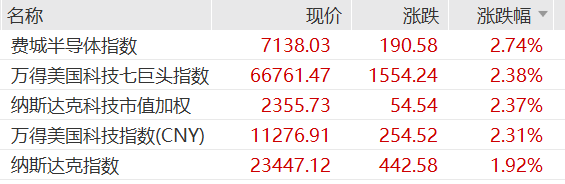
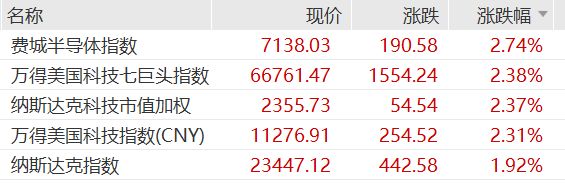
Market Overview - US stock indices opened higher, with the Nasdaq Composite Index rising approximately 2% and the Philadelphia Semiconductor Index increasing over 2.7% [1] - Major tech stocks showed strong performance, with Micron Technology up over 7% and Nvidia, TSMC rising over 3% [3] Semiconductor Sector - The Philadelphia Semiconductor Index reached 7138.03, up 190.58 points, reflecting a 2.74% increase [2] - Notable stock movements included Micron Technology at 254.63 (+7.02%), AMD at 247.21 (+5.85%), and TSMC at 295.51 (+3.14%) [3] Chinese Stocks - The Nasdaq China Golden Dragon Index rose over 2.2%, with significant gains in stocks such as Canadian Solar (+15.52%) and Xpeng Motors (+13.12%) [4][5] European Market - European stock markets experienced broad gains, with Italy's MIB Index up over 2% and Germany's DAX Index increasing over 1% [6] Gold and Commodities - Spot gold and NYMEX gold prices touched $4100 per ounce, marking a 2.1% increase for spot gold [6] - Predictions for gold prices by the end of 2025 range from $4200 to $4600 per ounce, with varying estimates for 2026 [8] Cryptocurrency Market - The cryptocurrency market rebounded, with Bitcoin reaching $106,000 and Ethereum at $3,579.72, reflecting increases of 2.17% and 1.46% respectively [9] - The total liquidation in the crypto market reached approximately $295 million, with nearly 120,000 traders liquidated [9]

中概股大爆发,阿特斯太阳能狂飙15%,小鹏汽车涨超13%,黄金一度突破4100美元
2 1 Shi Ji Jing Ji Bao Dao· 2025-11-10 15:31
Market Performance - The US stock market opened higher with all three major indices rising, particularly strong performance in technology stocks, with the Nasdaq Composite Index up approximately 2% [1] - The Philadelphia Semiconductor Index increased by over 2.7%, while the Nasdaq Technology Index rose by 2.37% [2] - Notable stock movements include Micron Technology rising over 7%, AMD up 4.8%, and SanDisk surging over 10% after announcing a 50% increase in NAND flash memory contract prices [2][3] Chinese Stocks - The Nasdaq Golden Dragon China Index rose over 2.2%, with significant gains in Chinese companies such as Canadian Solar up over 15%, Xpeng Motors up over 13%, and Baidu increasing nearly 4% [2][3] European Market - European stock markets experienced broad gains, with Italy's MIB Index rising over 2% and major indices like France's CAC40 and Germany's DAX both increasing by over 1% [3] Commodity Prices - Gold prices reached $4100 per ounce, marking a 2.1% increase, while silver prices rose over 3% [4][5] - Predictions for gold prices by the end of 2025 range from $4200 to $4600 per ounce, with varying estimates for 2026 [5] Cryptocurrency Market - The cryptocurrency market rebounded, with Bitcoin reaching $106,000 and Ethereum surpassing $3,600, reflecting significant trading volume increases [6] - Approximately 119,698 traders were liquidated in the past 24 hours, with a total liquidation amount of $295 million [6]
中概股大爆发,阿特斯太阳能狂飙15%,小鹏汽车涨超13%,黄金一度突破4100美元
21世纪经济报道· 2025-11-10 15:24
Market Performance - The US stock market opened higher with all three major indices rising, particularly strong performance in technology stocks, with the Nasdaq Composite Index up approximately 2% and the Philadelphia Semiconductor Index up over 2.7% [1] - Notable stock movements include Micron Technology rising over 7%, AMD up 4.8%, and Nvidia and TSMC both increasing by over 3% [2][3] - The Nasdaq China Golden Dragon Index increased by over 2.2%, with significant gains in stocks such as Canadian Solar up over 15% and XPeng Motors up over 13% [2] Commodity Market - Gold prices reached $4100 per ounce, marking the first increase since October 27, with a daily rise of 2.1% for spot gold and 2.07% for NYMEX gold [4] - Predictions for gold prices by the end of 2025 range from $4200 to $4600 per ounce, with varying estimates for 2026, indicating a potential for significant volatility in the short term [6] Cryptocurrency Market - The cryptocurrency market rebounded, with Bitcoin reaching $106,000 and Ethereum surpassing $3,600, reflecting a substantial increase in trading volume and a significant number of liquidations in the market [6][7] - The total trading volume for Bitcoin was reported at $93.446 billion, showing a 55.56% increase over the previous 24 hours [7] Corporate Developments - Burger King China has been sold, with shareholders from Mixue Ice City and Pop Mart taking over, indicating a shift in ownership within the fast-food sector [8] - The market for real estate is seeing a push for the sale of existing homes, with various regions advancing this initiative [8]

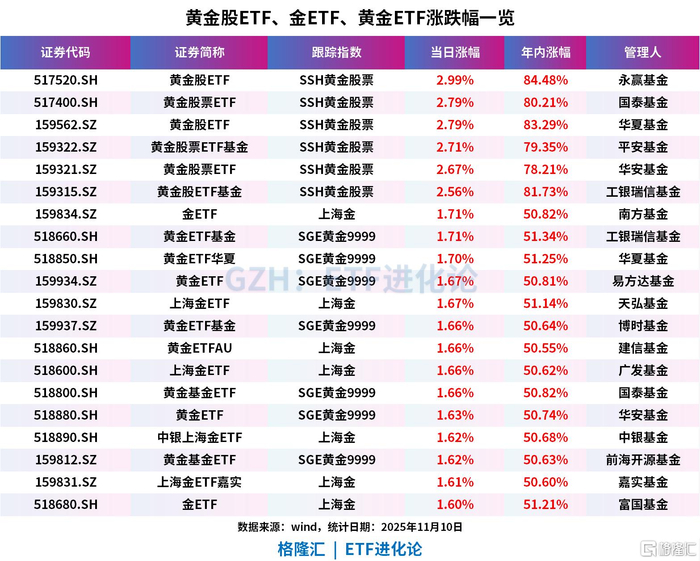
黄金股ETF、上海金ETF、黄金ETF上涨,黄金主题ETF年内吸金1066.7亿元
Ge Long Hui A P P· 2025-11-10 14:35
Core Insights - Spot gold prices surged by 2.00%, currently at $4081.45 per ounce, with gold-related ETFs and stocks also experiencing significant gains [1] - As of November 7, A-share market saw a net inflow of 106.67 billion yuan into 20 gold-themed ETFs [3] Group 1: Gold ETFs and Market Performance - Gold ETFs are anchored to physical gold, reflecting price fluctuations and supporting T+0 trading [7] - The average daily trading volume in the gold market reached a historical high in October, with a daily average of $561 billion, a 45% increase month-on-month [7] - Global gold ETFs saw a net inflow of $8.2 billion in October, increasing total assets under management by 6% to a record high of $503 billion [7] Group 2: Domestic Gold ETF Growth - Domestic gold ETFs increased their holdings by 79.015 tons in the first three quarters of 2025, a 164.03% year-on-year increase [8] - As of September 30, domestic gold ETF holdings reached 193.749 tons [8] Group 3: Central Bank Gold Reserves - China's central bank has increased its gold reserves for 12 consecutive months, with a total of 7.409 million ounces as of the end of October [8] - Since 1996, gold's share in central bank reserves has surpassed that of U.S. Treasury bonds, indicating a shift towards gold as a safer reserve asset [9] Group 4: Investment Returns Comparison - An investment of $10,000 in gold in January 2000 would have grown to approximately $127,000 by October 2025, with a compound annual growth rate of 10.4%, outperforming the S&P 500's growth to over $77,000 at 8.3% [9]
金荣中国:现货黄金表现强劲,盘中最高测试4053.34美元/盎司
Sou Hu Cai Jing· 2025-11-10 07:22
基本面: 周一(11月10日)亚盘时段,现货黄金开盘后表现强劲突破上周震荡区间,盘中最高测试4053.34美元/盎司并守住涨幅,目前暂交投于4044美元附近。上周 五金价上涨0.6%,成功收复4000整数关口。美元指数的意外走软成为首要推手,上周五美元下跌0.15%至近一周低位,这使得以美元计价的黄金对持有其他 货币的投资者而言变得更加便宜,吸引了大量海外买盘涌入。同时,美国政府关门的不确定性如阴霾般笼罩市场,显著提升了黄金的避险属性,而华尔街股 指即将录得大幅周度跌幅,进一步放大了这一效应。科技股为主的纳斯达克指数上周五录得七个月来最大单周跌幅,投资者对人工智能股票涨势可持续性的 担忧情绪升温,推动资金从风险资产重新转向黄金这一传统避险天堂。 周五美元指数收报99.55,较前一交易日下跌0.15%,盘中曾创下一周新低至99.40。这一跌势直接降低了黄金的相对成本,让欧元区、日元区等非美元持有 者更容易入手黄金,推动金价反弹。美元疲软的背后,是美国经济数据的不确定性以及美联储政策预期的微妙变化。交易员们原本期待的月度非农就业报告 因政府关门而推迟发布,只能转向私营部门数据,这些数据显示10月份就业岗位意外减少 ...

近30年来全球央行黄金持有量首超美债!黄金价格从年初到现在整体上涨近50%,相较十年前上涨约300%
Ge Long Hui· 2025-11-10 03:28
Core Insights - The share of the US dollar in global central bank reserves is declining, while gold is increasingly being reallocated by many countries [1] - Gold prices have risen nearly 50% since the beginning of the year and approximately 300% over the past decade [1] - Central banks are increasing their gold holdings as a response to a breakdown in the consensus on global reserve safety, making gold a necessary choice to mitigate dollar reserve risks [1] - Emerging market central banks have become the main force in gold purchases, positioning gold as a more reliable reserve option [1] - By the second quarter of 2025, the total value of global central bank gold reserves is expected to exceed the value of their US Treasury holdings for the first time [1] - Gold is replacing US Treasuries as a preferred safe-haven asset in the eyes of many countries [1]

近30年来全球央行黄金持有量首超美债
Ge Long Hui· 2025-11-10 03:11
格隆汇11月10日|据央视,观察黄金市场变化时,注意到一个现象:美元在各国央行储备中的占比出现 下滑趋势,而黄金则被越来越多国家重新配置。最新统计显示,自1996年以来,黄金首次在各国央行储 备中的占比超过了美债。黄金价格从年初到现在整体上涨近50%,相较十年前上涨约300%。各国央行 增持黄金,是出于对全球储备安全共识的打破,黄金成为降低美元储备风险的必然选择。同时,新兴经 济体的央行已成为购金的主要力量,黄金成为更可依赖的储备选项。2025年第二季度,全球央行黄金储 备总值首次超过其持有的美债规模。黄金正在替代美债,成为各国眼中的优势避险资产。 ...