
大模型

Search documents
港股开盘 | 恒指高开0.87% 自动驾驶走强 小马智行-W(02026)等涨超3%
智通财经网· 2026-01-23 01:35
Group 1 - The Hang Seng Index opened up by 0.87%, and the Hang Seng Tech Index rose by 0.96%, with strong performance in the autonomous driving sector and active tech stocks like Alibaba and JD.com [1] - Dongwu Securities believes that the Hong Kong stock market is in a trend of oscillating upward, but faces short-term challenges due to differing views on overseas factors, particularly regarding the U.S. AI tech earnings reports [1] - Guolian Minsheng Securities is optimistic about the revaluation of China's AI sector, supported by a solid industrial catalyst timeline, with significant model releases expected in early 2026 from major companies like Google and Meta [1] Group 2 - Morgan Stanley anticipates that the upward momentum in A-shares and Hong Kong stocks will continue until the Lunar New Year, with Hong Kong stocks expected to outperform A-shares [2] - Guojin Securities notes that as the domestic economy recovers and major overseas economies shift to accommodative monetary policies, the valuation advantages of Hong Kong stocks will become more pronounced [2] - Guojin Securities also predicts significant improvements in liquidity for the Hong Kong market by 2026, suggesting that the valuation recovery trend is likely to continue [2]
百度大模型“上新”
Shang Hai Zheng Quan Bao· 2026-01-22 12:15
Core Insights - Baidu has officially launched the Wenxin 5.0 model, which features a parameter count of 2.4 trillion and utilizes a native multimodal modeling architecture, enabling comprehensive understanding and generation across text, images, audio, and video [2][3] Group 1: Model Performance - Wenxin 5.0 surpasses models like Gemini-2.5-Pro and GPT-5-High in language and multimodal understanding, positioning itself in the top tier globally [2] - The model's image and video generation capabilities are comparable to specialized models in vertical fields, indicating a leading position in the global market [2] Group 2: Technical Innovations - Unlike many industry models that use post-fusion multimodal approaches, Wenxin 5.0 employs a unified autoregressive architecture for native multimodal modeling, allowing for joint training of diverse data types [2] - The model incorporates a large-scale mixed expert structure with ultra-sparse activation parameters, activating less than 3% of parameters, which enhances inference efficiency while maintaining robust capabilities [3] Group 3: Development and Community Engagement - The "Wenxin Mentor" program has expanded to include 835 experts from various sectors such as technology, finance, culture, education, and healthcare, providing guidance on logic, depth, creativity, and value alignment for the model [3][4] - Wenxin 5.0 has achieved significant recognition, ranking first in domestic text and visual understanding categories on the LMArena global model competition platform, with a score of 1460, surpassing models like GPT-5.1-High [4]


航天软件:公司产品支持大模型标准接入,依托MCP、A2A等新一代协议重构PLM智能内核
Zheng Quan Ri Bao Wang· 2026-01-22 11:16
Core Viewpoint - The company is enhancing its product capabilities by integrating large model standards and utilizing new generation protocols to create an intelligent digital backbone throughout the product lifecycle [1] Group 1: Product Development and Integration - The company's products support the integration of large model standards, enabling seamless integration of multi-source heterogeneous systems at the semantic level [1] - By leveraging protocols such as MCP and A2A, the company aims to reconstruct the PLM intelligent core [1] Group 2: Business Intelligence and Efficiency - The deployment of intelligent agents in scenarios such as planning generation, design platforms, and process writing transforms data connectivity into direct business intelligence [1] - This approach empowers the entire product development and production process to reduce costs and increase efficiency [1]

要看懂2025年,这是你无法避开的41篇文章丨36氪年度精选
36氪· 2026-01-22 11:08
Group 1 - The core theme of 2025's business narrative revolves around "war" and "turbulence," particularly highlighted by the epic competition in the food delivery market, where major players like Alibaba, Meituan, and JD engaged in fierce price wars, leading to a significant merging of e-commerce and food delivery boundaries [2][4] - The global narrative shifted from "connection" to "disconnection" due to tariff wars, impacting cross-border e-commerce sellers and manufacturing industries, prompting them to seek survival strategies within supply chain gaps [2][28] - A new generation of Chinese hardware companies, such as DJI and Anker, is successfully penetrating the European and American markets, showcasing a trend of smaller firms achieving significant market impact through unique products and rapid execution [2][9] Group 2 - The Shanghai Composite Index surpassed 3900 points, marking a new high in nearly a decade, while Starbucks' sale in China for 10 billion USD signified the end of the era of foreign premium pricing [3] - The passing of Zhong Qinghou and the succession of his daughter Zhong Fu Li highlighted the complexities of generational transitions in business ownership, particularly in state-owned enterprises [3][5] - The listing of Bawang Tea Princess on NASDAQ amidst a generally cold consumer market provided a significant "non-consensus" example, illustrating the potential for success even in challenging conditions [3][29] Group 3 - The article on the unexpected epic internet war in 2025 details how major companies in the food delivery sector engaged in fierce competition, betting their financial resources and reputations [4] - The narrative of generational succession in companies like Wahaha reveals the intricate dynamics of ownership and control, especially following the death of a founding figure [5] - The report on Starbucks' 13 billion USD sale in China explores the factors leading to this significant transaction, questioning how a leading brand with no competitors reached a point of sale [6][7] Group 4 - The hardware industry is experiencing a renaissance, with new Chinese players leveraging top-tier supply chains and unique speed to capture global markets, marking a shift in the perception of this traditionally less glamorous sector [9][10] - The article on the rise of domestic bag brands illustrates a significant trend in the market, with brands like Shanshiyou Song achieving top rankings in e-commerce, indicating a strong movement towards brand localization [51] - The analysis of the AI application landscape highlights the shift towards application-level competition as foundational capabilities mature, with a focus on global expansion and practical business models [23][62]

幻觉率不到3%,王小川把医生版的DeepSeek免费了
机器之心· 2026-01-22 11:00
Core Viewpoint - Baichuan Intelligent has launched the Baichuan-M3 Plus model, marking a significant breakthrough in AI applications in the medical field, enhancing medical problem reasoning capabilities in real-world scenarios [1][3]. Group 1: Model Performance and Features - The M3 Plus model achieves unprecedented accuracy in medical scenarios, significantly improving reasoning efficiency and crossing critical thresholds for AI usability in healthcare [3][29]. - The model employs Fact-Aware Reinforcement Learning (Fact-Aware RL), which allows for the verification of AI-generated medical judgments against authoritative sources, thus reducing hallucination rates to the lowest globally [6][7]. - M3 Plus has a hallucination rate of only 2.6%, which is over 30% lower than GPT-5.2 and surpasses current industry benchmarks [10][18]. Group 2: Trust and Reliability in AI - Trust remains a significant barrier for AI adoption in healthcare, as many existing AI models produce seemingly professional but often incorrect information [5][16]. - Baichuan Intelligent has introduced "Evidence Anchoring" technology, ensuring that every medical conclusion generated by the AI can be traced back to specific evidence in original research or guidelines, achieving over 95% accuracy in citation matching [16][18]. Group 3: Accessibility and Cost - Baichuan has launched the "Haina Baichuan Plan," offering free access to the M3 Plus API for all service providers to medical professionals, aiming to promote the widespread adoption of AI tools in clinical settings [20][22]. - The cost of deploying M3 Plus for all clinical doctors in China is estimated to be around 100 million yuan annually, which Baichuan is willing to cover to foster ecosystem development [23]. Group 4: Engineering and Optimization - The M3 Plus model has undergone extensive engineering optimization, reducing API call costs by 70% compared to its predecessor while maintaining model performance and reliability [24]. - The Gated Eagle-3 decoding framework enhances prediction accuracy without significantly increasing computational costs, allowing for dynamic filtering of external information [24][25]. Group 5: Industry Context and Future Outlook - The year is seen as pivotal for AI in healthcare, with numerous significant developments indicating that the medical field is becoming a core application area for AI technology [30][32]. - Baichuan's strategy focuses on integrating AI directly into hospital core departments, positioning itself as a "second brain" for doctors rather than merely a health assistant [32][33].
百度文心5.0正式版上线,模型参数达2.4万亿
Xin Lang Cai Jing· 2026-01-22 08:53
Core Insights - Baidu has officially launched the native full-modal large model Wenxin 5.0, which features 2.4 trillion parameters and utilizes native full-modal unified modeling technology [1] - The model supports multi-modal understanding and generation capabilities, allowing for input and output of text, images, audio, and video [1] - Individual users can experience the model through the Wenxin app and the Wenxin Yiyan official website, while enterprises and developers can access it via Baidu's Qianfan platform [1]
Cowork很重要
小熊跑的快· 2026-01-22 08:33
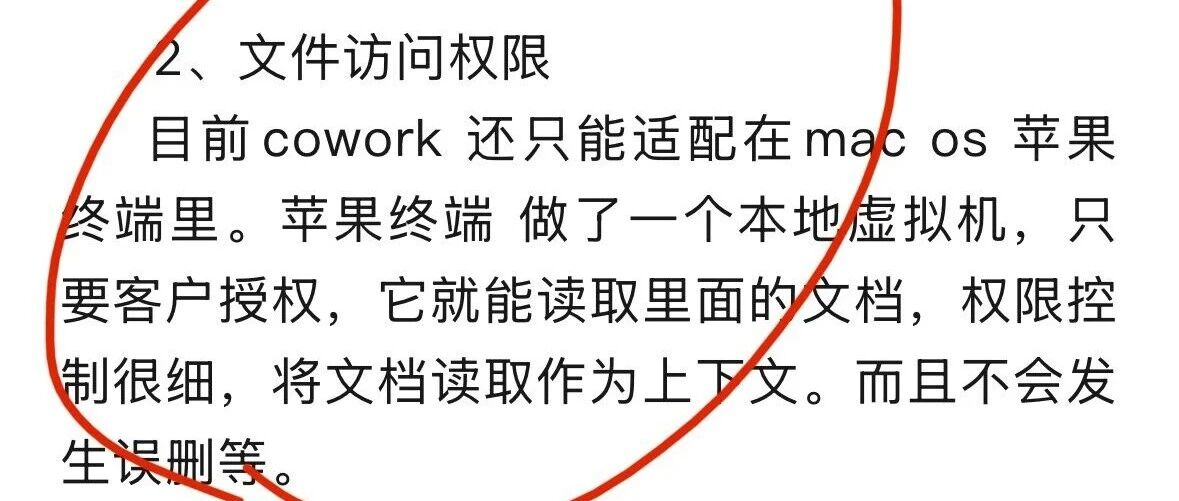
Core Insights - The article discusses the emergence of Cowork, a product by Anthropic, which integrates AI into the development process, making it accessible to non-programmers [3][4]. Group 1: Product Features - Cowork allows users to perform tasks without needing programming knowledge, as it automates the execution of commands through Claude Code [4]. - Users can grant Claude access to specific folders on their computers, enabling it to perform tasks such as organizing files, writing reports, and creating spreadsheets based on screenshots [4]. - The AI operates autonomously, planning and executing tasks while providing progress updates to the user [4]. Group 2: Market Potential - A recent meeting with a U.S. AI expert indicated that Cowork is expected to gain significant traction in the coming months due to its core virtualization technology [5]. - The article suggests that virtualization is a foundational technology for cloud services, implying that many data center operators already possess the necessary infrastructure [5].
分化盘整,黄金再创新高
Ge Long Hui· 2026-01-22 05:10
Market Performance - The three major indices experienced a slight increase, with the Shanghai Composite Index rising by 0.16%, the Shenzhen Component Index by 0.76%, and the ChiNext Index by 0.85% [1] - Over 2,900 stocks in the two markets saw gains, with a total trading volume of 1.63 trillion yuan [1] Sector Performance - The consumer sector collectively weakened, with notable declines in the liquor and tourism hotel sectors; Li Qun shares fell by 5.16%, and other companies like Yonghui Supermarket, Jiuhua Tourism, and Jinhui Liquor saw declines exceeding 4% [3] - The coal sector also faced a downturn, with Dayou Energy dropping nearly 8% [3] - Other sectors such as dairy, cement, and electricity followed suit in terms of declines [3] Emerging Trends - Precious metals concepts continued to surge, with Hunan Silver achieving two consecutive trading limits [3] - The chip industry chain saw expanded gains, with over ten stocks including Huatians Technology, Longxin Zhongke, and Zhizheng shares hitting the daily limit [3] - Lithium mining concepts experienced a rebound, with companies like Shengxin Lithium Energy and Dazhong Mining reaching the daily limit [3] Notable News - Alibaba's Qianwen derivative model surpassed 200,000, becoming the first open-source large model to achieve this milestone globally; the Qianwen series models have been downloaded over 1 billion times, averaging 1.1 million downloads per day [3] - Spot gold prices rose to $4,830 per ounce, increasing by 1.5% within the day and over 10% for the month [3]

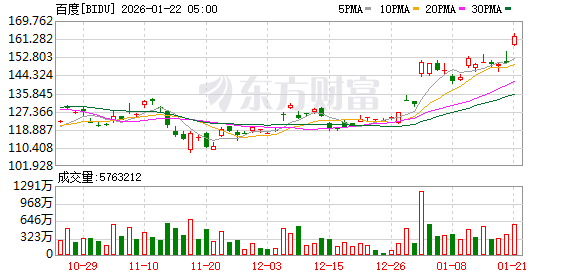
港股异动丨发布文心大模型5.0正式版!百度涨超4%重上160港元,创近3年新高
Ge Long Hui A P P· 2026-01-22 04:44
Core Viewpoint - Baidu Group's stock price increased by 4.6% to HKD 160.9, reaching a new high since February 2023, following the official release of its Wenxin Model 5.0 [1] Group 1: Product Development - Baidu officially launched the Wenxin Model 5.0, which is based on native multimodal modeling and features 2.4 trillion parameters [1] - The new model supports understanding and output of various types of information, including text, images, audio, and video [1] - Wenxin Model 5.0 is now available for use on Baidu's Qianfan platform, and has been integrated into other Baidu AI products such as Wenxin Yiyan, Baidu Huibo Xing, and Wenxin Assistant [1]
港股百度集团盘中涨逾4%,文心大模型5.0正式版发布
Xin Lang Cai Jing· 2026-01-22 04:27
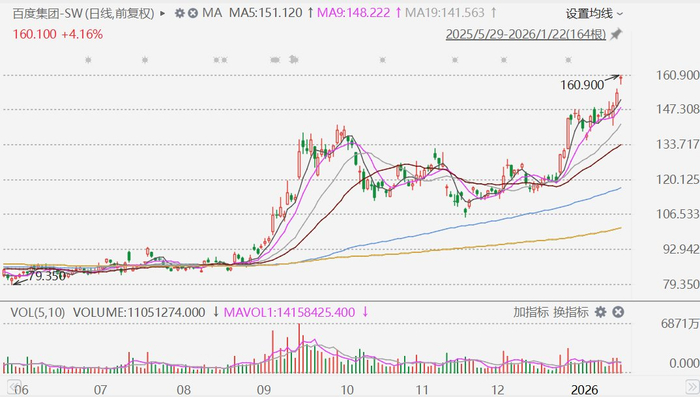
Core Viewpoint - Baidu Group (09626.HK) has seen its stock price increase by over 4% following the official release of its Wenxin Model 5.0, which features a native multimodal architecture and boasts 2.4 trillion parameters, enabling it to understand and output various types of information including text, images, audio, and video [1][1]. Group 1 - Baidu officially launched the Wenxin Model 5.0 today [1] - The model is based on a native multimodal architecture [1] - It has a total of 2.4 trillion parameters [1] Group 2 - The model supports understanding and output of multiple information types: text, images, audio, and video [1]
