经济数据

Search documents
长假消费增势良好 -20251010
申银万国期货研究· 2025-10-10 01:09
Group 1 - The consumption market during the National Day and Mid-Autumn Festival holidays showed strong growth, with total domestic travel expenditure reaching 809 billion CNY, an increase of 108.19 billion CNY compared to the same period in 2024 [1] - Daily sales revenue in consumption-related industries increased by 4.5% year-on-year, with goods and service consumption growing by 3.9% and 7.6% respectively [1] - The market for digital products and automobiles experienced rapid growth during the holiday period [1] Group 2 - Precious metals maintained a strong performance during the holiday but saw a significant decline afterward, likely due to profit-taking from a rapid short-term increase [2] - Geopolitical tensions eased with the announcement of a ceasefire agreement between Israel and Hamas, which may have influenced market sentiment [2] - Concerns over the U.S. fiscal deficit and debt continue to drive demand for gold as a safe-haven asset, with central banks, particularly in China, increasing their gold reserves [2] Group 3 - The U.S. stock indices experienced a decline, while the first trading day after the National Day holiday saw a positive opening for stock indices, led by the non-ferrous metals sector [3] - The financing balance decreased by 34.06 billion CNY to 2.37839 trillion CNY as of September 30 [3] - The domestic liquidity environment is expected to remain loose, with increased allocation to equity assets by residents and potential inflows of external capital due to anticipated interest rate cuts by the Federal Reserve [3] Group 4 - The double coke market showed fluctuating trends, with inventory levels remaining stable despite a significant increase in social inventory due to the holiday [4] - The increase in inventory was primarily driven by rebar, and there are concerns about the market's acceptance of high-priced resources post-holiday [4] - Upcoming policy expectations related to "anti-involution" are anticipated to provide support for prices in the double coke market [4] Group 5 - The industrial sector for small and medium enterprises in China showed stable economic performance in the first eight months of the year, with an increase in value-added output of 7.6%, outperforming large enterprises by 3.3 percentage points [8] - The development of specialized and innovative small and medium enterprises has been particularly strong, with a year-on-year increase of 8.7% in value-added output [8] Group 6 - The National Development and Reform Commission announced measures to regulate price competition and maintain a fair market price order, emphasizing the need for businesses to adhere to fair pricing principles [9]


海内外事件跟踪20251007:十一假期不能错过的事
Tianfeng Securities· 2025-10-07 08:57
Report Industry Investment Rating Not mentioned in the report. Core Viewpoints The report comprehensively analyzes overseas and domestic macro - dynamic trends during the National Day holiday. Overseas, the US government shutdown, economic data fluctuations, and changes in market expectations for the Fed's interest rate cuts are the main focuses. Domestically, A - shares show a structural market, and the bond market maintains an oscillating pattern. Meanwhile, the National Day holiday sees a significant increase in cross - regional passenger flow, a boost in the tourism market, and a stable performance in the movie market [12][5][6][7][8]. Summary by Directory 1. Overseas Macro - dynamic Tracking 1.1 Overseas Assets: Equity Rallies, Gold Hits New High - During the National Day holiday, the expectation of two more Fed rate cuts this year strengthened, leading to a decline in the 2Y US Treasury yield. The US government shutdown pushed up the term spread, and gold prices soared to a record high. OPEC+ considering increased production in the next three months caused oil prices to fall. - Global major stock indices mostly rose. The S&P 500, Dow, and Nasdaq increased by 1.19%, 0.82%, and 1.49% respectively in the week up to October 6. - In the commodity market, gold, silver, and copper prices rose, while oil prices fell. The US dollar slightly increased, and the euro and yen against the US dollar declined [13][15]. 1.2 Overseas Politics: Focus on the US Government Shutdown - The US federal government shut down on October 1 due to the Senate's rejection of the Republican's temporary appropriation bill. The probability of this shutdown lasting until October 15 or later is 70%. - The government shutdown may impact GDP through consumption, business operations, and government spending. Historical data shows that previous shutdowns led to a decline in GDP growth rates [19][22][23]. - Other political hot - spots include new US tariffs, the Trump administration's plan to end the Gaza conflict, and the Supreme Court's ruling on the Fed official's dismissal [24]. 1.3 Economic Data: US Employment and PMI - US JOLTS job openings in August were higher than expected, with an increase mainly in healthcare and accommodation & catering, and a significant decline in construction and the federal government. - US ADP employment in September was significantly lower than expected, with a decrease of 32,000 people, the largest decline since March 2023. - The US ISM manufacturing PMI in September was slightly higher than expected, but new order demand was weak. The ISM services PMI was significantly lower than expected, with a sharp decline in business activity and new orders [27][29][34]. 1.4 Fed: Market Rate - cut Expectations Strengthen - Fed officials had different stances during the holiday. Logan and Goolsbee were hawkish, while Milan was dovish. - Market expectations for two more rate cuts this year strengthened. As of October 3, the probability of 25bp rate cuts in October and December was 86.3%, up from 65.4% a week ago [37][38][39]. 2. Domestic Macro - dynamic Tracking 2.1 Domestic Assets: A - shares' Structural Market, Bond Market Maintains Oscillating Pattern - In late September, A - shares were led by the technology - growth sector. The Shanghai Composite Index, Shenzhen Component Index, ChiNext Index, and STAR 50 Index all rose. Looking ahead, A - shares will continue the structural market driven by policies and liquidity. - The bond market is in an environment where negatives outweigh positives, with interest rates likely to oscillate. Short - term bonds are stable, while ultra - long - term bonds are weak [41]. 2.2 National Day Passenger Flow: Cross - regional Passenger Volume Hits a New High - During the first half of the 2025 National Day and Mid - Autumn Festival holiday (up to October 4), the cross - regional passenger volume reached about 1.25 billion person - times, a 5.7% increase from the previous year, with a daily average of over 310 million person - times [6]. 2.3 National Day Tourism: Travel Radius Further Expands - The 8 - day holiday boosted both domestic and outbound tourism. Long - distance outdoor consumption demand was evident, and outbound tourism continued to heat up. For example, bookings for trips to Russia increased nearly three - fold after the visa - free policy, and the top 10 popular outbound destinations included Japan, Thailand, etc. [7][47]. 2.4 Off - line Consumption: National Day Movie Market Remains Stable - As of 17:28 on October 6, the total box office (including pre - sales) of the 2025 National Day movie season exceeded 1.5 billion yuan, slightly lower than last year. The average ticket price decreased, and the market remained stable due to price concessions and diversified supply [8][50].
Former Boston Fed President Rosengren: The Fed will have to rely on 'noisier' data during shutdown
Youtube· 2025-10-06 11:55
Economic Data Impact - The government shutdown has paused the release of all economic data, including crucial jobs and inflation reports, which the Federal Reserve relies on for monetary policy decisions [1][2] - The absence of federal economic data is creating challenges for the Fed, making it difficult to assess the labor market accurately [2][3] Labor Market Indicators - Initial claims and the ADP report indicate a weaker labor market, but these data points are considered noisier and less reliable than the comprehensive reports from the Labor Department [3][6] - The unemployment report is incomplete without the unemployment survey, limiting the Fed's ability to gauge the actual unemployment rate [5][6] Stock Market Reactions - The stock market appears to be reacting positively to the government shutdown, possibly due to expectations of lower interest rates, despite ongoing concerns about inflation [8][9] - Core PCE inflation was reported just under 3% before the shutdown, and there is an expectation that it may trend upward [9] Bank Mergers and Regulatory Environment - Fifth Third's planned acquisition of Comamera for over $10 billion is indicative of a changing regulatory environment and a trend towards regional bank mergers to achieve economies of scale [10][11][12] - The potential for larger regional banks raises concerns about financial stability and the implications of having "too big to fail" institutions [14] Economic Outlook - The government shutdown could shave a few basis points off GDP, compounded by the uncertainty surrounding government employee layoffs and buyouts [15][16] - The overall economic impact may be more significant due to low consumer confidence and the potential for reduced spending [17]
How to read the economy during a government shutdown so you can invest wisely
MarketWatch· 2025-10-03 16:07
Core Insights - The absence of a jobs report and limited economic data creates uncertainty in the market, making it challenging for investors to gauge the economic landscape [1] Group 1 - The lack of recent economic indicators complicates the decision-making process for portfolio management [1] - Investors are encouraged to make informed moves despite the unclear economic signals [1]
宏观经济分析报告:为何核心CPI与经济数据存在“温差”
Capital Securities· 2025-09-30 12:07
Group 1: Core CPI Analysis - The core CPI for January to August 2025 increased by 0.9%, aligning with the same period in 2021 and exceeding levels from 2022 to 2024[10] - Excluding the impacts of household appliances and gold jewelry, the core CPI growth would drop to 0.4%, consistent with the average over the past five years[16] - The rise in household appliance prices is attributed to consumption subsidy policies like "old-for-new" exchanges, while gold jewelry prices reflect increased demand for hedging and value preservation[16] Group 2: Economic Context - Despite the core CPI's increase, the current economic conditions differ significantly from the strong performance observed in 2021, with service sector PMI remaining below 2021 levels prior to July[10] - Specific categories contributing positively to the CPI include clothing (0.02%), living goods and services (0.13%), healthcare (0.14%), and other goods and services (0.32%), while housing and transportation prices lag behind 2021 figures[17] - The CPI for household appliances has shown significant growth since March 2025, driven by policy-induced demand, contrasting with stable prices in household services[23] Group 3: Risks and Considerations - The analysis acknowledges potential estimation biases and insufficient information, indicating that the findings should be interpreted with caution[24] - The report emphasizes that the CPI's strong performance is primarily driven by policy stimuli and external demand factors rather than intrinsic economic growth[16]
期货市场交易指引:2025年09月30日-20250930
Chang Jiang Qi Huo· 2025-09-30 02:14
Report Industry Investment Ratings - **Macro Finance**: Bullish on the medium to long - term for stock indices, recommend buying on dips; hold a neutral stance on treasury bonds and maintain a wait - and - see approach [1][5] - **Black Building Materials**: Adopt a range - trading strategy for coking coal and rebar; recommend buying on dips for glass [1][7][8] - **Non - ferrous Metals**: Advise cautious trading before holidays for copper; suggest buying on dips after a pullback for aluminum; recommend a wait - and - see approach or shorting on rallies for nickel; adopt a range - trading strategy for tin, gold, and silver [1][11][15] - **Energy and Chemicals**: Expect PVC, caustic soda, styrene, rubber, urea, and methanol to trade sideways; anticipate wide - range fluctuations for polyolefins; recommend an arbitrage strategy of shorting the 01 contract and going long on the 05 contract for soda ash [1][20][22][31] - **Cotton Textile Industry Chain**: Expect cotton and cotton yarn to trade sideways; anticipate narrow - range fluctuations for PTA; expect apples to trend slightly upwards and jujubes to trend slightly downwards [1][34][36] - **Agricultural and Livestock**: Recommend shorting on rallies for pigs and eggs; expect wide - range fluctuations for corn; anticipate range - bound oscillations for soybean meal; expect oils to trend slightly upwards [1][38][45] Core Views - The overall futures market presents a complex situation with different investment strategies recommended for various sectors. Positive factors such as monetary policy easing, industry growth, and technological breakthroughs support the stock index market, while uncertainties in factors like macro - policies, supply - demand relationships, and international trade impact other sectors [1][5][11] Summary by Categories Macro Finance - **Stock Indices**: With the support of positive factors such as moderately loose monetary policy, stable growth in the non - ferrous metals industry, and breakthroughs in the solid - state battery field, the market was active on Monday. The A - share market has been in a sideways trend since September, showing a technology - driven structural market. In the medium term, factors like Fed rate cuts, improved Sino - US relations, and the prosperity of emerging sectors are expected to drive the market upwards. It is recommended to buy on dips [5] - **Treasury Bonds**: Yields rose on Monday, and the curve steepened. The spread between policy - bank bonds and treasury bonds widened. The central bank emphasized policy implementation in the third - quarter meeting minutes, and there is uncertainty about the implementation of incremental monetary policies in the fourth quarter. It is advisable to maintain a wait - and - see approach [5] Black Building Materials - **Double - Coking Coal**: Multiple factors have boosted market sentiment, leading to a "Golden September" in the coal industry. Coal prices have risen across the board, and the procurement rhythm has accelerated. It is expected to trade sideways [7] - **Rebar**: On Monday, rebar futures prices were weak. The current valuation is low, and the demand is weak. It is necessary to focus on the demand in October. It is recommended to wait and see or engage in short - term trading before the holiday [7] - **Glass**: Last week, glass futures first declined and then rose. Spot prices increased, and inventories decreased. The demand for real - estate construction in October provides weak support, and there are positive expectations from domestic macro - news and environmental policies. It is recommended to buy on dips [9] Non - ferrous Metals - **Copper**: The Grasberg mine accident has led to a long - term increase in the copper price center. In the short term, the price has fallen due to profit - taking, but it is expected to be strong. It is recommended to trade cautiously before the holiday [11][12] - **Aluminum**: The price of bauxite has declined, and the production of alumina and electrolytic aluminum is stable. The demand has entered the peak season, and inventories have decreased. It is recommended to buy on dips [11][12] - **Nickel**: The price of nickel ore is firm, and the supply of refined nickel is in surplus. The price of nickel iron has limited upside, and the demand for stainless steel is weak. It is recommended to short on rallies [16] - **Tin**: The supply of tin ore is tight, and the downstream semiconductor and photovoltaic industries are recovering. It is recommended to trade within a range [17] - **Gold and Silver**: The market's expectation of Fed rate cuts has increased, and precious metals are expected to be supported. It is recommended to trade within a range [17][19] Energy and Chemicals - **PVC**: The cost is at a low level, the supply is high, and the demand is weak. The export support may decline, and the overall supply - demand situation is still weak. It is expected to trade sideways in the short term [21] - **Caustic Soda**: The upstream inventory has increased, and the demand from downstream industries has increased. It is expected to trade sideways, and attention should be paid to downstream inventory replenishment and export conditions [23] - **Styrene**: The cost is under pressure, the supply is abundant, and the demand is limited. It is expected to trade weakly within a range [26] - **Rubber**: The raw material supply is expected to increase, and the market trading is light before the holiday. It is expected to trade sideways [27] - **Urea**: The supply has increased, the agricultural demand is scattered, and the inventory has accumulated. It is recommended to pay attention to the support level and arbitrage opportunities [28] - **Methanol**: The supply has recovered, the demand from the main downstream industry has increased, and the inventory has decreased. It is expected to be supported in the short term [29] - **Polyolefins**: The supply has increased, the demand has improved, and the inventory has decreased. It is expected to trade within a range, and the LP spread is expected to widen [30] - **Soda Ash**: The price has been driven up by glass, and the inventory has decreased. The output of Yuanxing's second - phase project is expected to increase, and it is recommended to adopt an arbitrage strategy [32] Cotton Textile Industry Chain - **Cotton and Cotton Yarn**: The global cotton supply and demand situation has changed, and the current spot market is firm, but there is pressure on future prices. It is recommended to prepare for hedging [34] - **PTA**: The conflict in Russia and Ukraine has increased, and the international oil price has risen. The cost and supply - demand relationship are in a game, and the price is expected to fluctuate narrowly [34][35] - **Apples**: The price of early - maturing apples is firm, and it is expected to trend slightly upwards. Attention should be paid to factors such as terminal market transactions and weather [36] - **Jujubes**: The growth of jujubes in Xinjiang shows differences, and the market is currently quiet. It is expected to rebound after a decline [36] Agricultural and Livestock - **Pigs**: The spot price is weak, and the supply is expected to increase in the short and medium terms. It is recommended to short on rallies and pay attention to arbitrage opportunities [38][39] - **Eggs**: The short - term egg price is under pressure, and the long - term supply pressure is still large. It is recommended to short on rallies and pay attention to factors such as chicken culling and environmental policies [40][41] - **Corn**: The supply of new crops is expected to ease the tight supply situation of old crops. It is recommended to take a short - term bearish view and pay attention to the listing rhythm of new crops [42][44] - **Soybean Meal**: The supply is expected to be loose in the fourth quarter, and the price is under pressure in the short term. It is recommended to reduce long positions on rallies and hold on dips [44][45] - **Oils**: The negative impact of the Argentine tariff event has ended. The palm oil inventory is expected to slow down its accumulation, and there are supply gaps in domestic rapeseed oil. It is recommended to wait and see in the short term and pay attention to arbitrage opportunities [47][50]
印尼矿难推升铜价,有色金属整体维持震荡
Chang Jiang Qi Huo· 2025-09-29 05:19
Group 1: Investment Ratings and Core Views Report Industry Investment Ratings - Not provided in the document. Report's Core Views - The impact of the Grasberg mine accident in Indonesia on copper supply and prices is long - term, and copper prices are likely to rise. Aluminum prices are expected to decline in the short - term but can be considered for long - positions at low prices. Zinc prices will maintain a weak oscillation. Lead prices will oscillate in the short - term and may face pressure after the holiday. Nickel and stainless steel prices are in a state of oversupply in the medium - to - long term, and short - positions can be held at high prices. Tin prices are expected to be supported and should be traded within a range. Industrial silicon, polycrystalline silicon, and other products need to pay attention to policy and market supply - demand changes. Carbonate lithium prices are expected to be supported in the short - term, but the impact of mining rights issues needs to be watched [2][4]. Group 2: Metal - Specific Summaries Copper - **Price Movement**: This week, copper prices soared and then fell back from high levels. The Grasberg mine accident led to a short - term increase in prices, but the impact is long - term. Short - term prices may continue to oscillate at high levels, with support at 80,500. - **Supply and Demand**: The accident at the Grasberg mine in Indonesia will reduce production by about 270,000 tons in 2026. Domestic refineries are in a high - maintenance period, and inventory has decreased slightly. - **Market Factors**: High copper prices have weakened domestic consumption, and the Fed's interest - rate cut rhythm is uncertain. Macro factors are strong overseas and weak domestically. - **Investment Advice**: Before the holiday, it is recommended to trade cautiously and closely monitor changes in domestic and foreign inventories [2]. Aluminum - **Price Movement**: Aluminum prices fell from high levels. Guinea's bauxite prices decreased, and alumina prices weakened. - **Supply and Demand**: Alumina production capacity increased, and electrolytic aluminum production capacity also increased slightly. Downstream demand entered the peak season, and inventory decreased significantly. - **Investment Advice**: It is recommended to go long at low prices, and for alumina, it is advisable to wait and see [2]. Zinc - **Price Movement**: Zinc prices oscillated weakly last week. - **Supply and Demand**: Zinc concentrate supply is abundant, and refinery profits are high, resulting in high refined zinc production. Terminal consumption in the peak season recovered limitedly, and downstream enterprises maintained just - in - time procurement. - **Investment Advice**: It is expected that zinc prices will maintain a weak oscillation, and it is recommended to trade with a short - bias within the range [2]. Lead - **Price Movement**: Lead prices oscillated after rising from low levels. - **Supply and Demand**: Supply decreased due to enterprise shutdowns and maintenance, and inventory decreased to a four - month low. However, the post - holiday supply is expected to increase. - **Investment Advice**: In the short - term, lead prices may continue to oscillate, and it is recommended to trade within the range of 17,000 - 17,300 [2]. Nickel - **Price Movement**: Nickel prices rose and then fell last week. - **Supply and Demand**: Nickel ore supply may be abundant, refined nickel is in surplus, and nickel - iron price increases are limited. Stainless steel production is high, and inventory has increased. - **Investment Advice**: In the medium - to - long term, nickel supply is in surplus. It is recommended to hold short - positions at high prices, and stainless steel should be traded within a range [4]. Tin - **Price Movement**: Tin prices oscillated within an upward channel. - **Supply and Demand**: Tin ore supply is tight, and downstream consumption in the semiconductor and other industries is recovering. Inventory is at a medium level. - **Investment Advice**: It is recommended to trade within the range of 260,000 - 280,000 yuan/ton and pay attention to supply resumption and downstream demand [4]. Industrial Silicon - **Price Movement**: Industrial silicon prices oscillated widely. - **Supply and Demand**: Production increased slightly, and inventory increased. The production of polycrystalline silicon also increased slightly, and the photovoltaic industry's production schedule may decline in October. - **Investment Advice**: It is recommended to trade with a long - bias in the short - term or wait and see [4]. Carbonate Lithium - **Price Movement**: Carbonate lithium prices oscillated horizontally. - **Supply and Demand**: Domestic supply and demand are in a tight balance, and South American imports may supplement supply. Downstream demand in the energy - storage sector is good. - **Investment Advice**: It is recommended to wait and see or trade cautiously, and pay attention to the impact of mining rights issues in Yichun [4]. Group 3: Macro - Economic Data 9/22 - 9/28 Week - China's September LPR remained unchanged, with the one - year at 3% and the five - year at 3.5%. - The eurozone's September consumer confidence index improved, and the comprehensive PMI exceeded expectations. - The US September Markit manufacturing and service PMI declined, but the second - quarter GDP growth was revised upwards to 3.8%. The August core PCE price index was in line with expectations [13][17][19]. 9/29 - 10/5 Week - Forecast data for various economic indicators such as the eurozone's economic sentiment index, China's official PMI, and the US consumer confidence index are provided, but the actual values are not announced [22].
海外宏观周报:美国政府关门风险上升-20250929
Ping An Securities· 2025-09-29 02:36
Group 1: U.S. Economic Policy - The risk of a U.S. government shutdown is increasing, with Trump canceling a meeting with Democratic leaders and the House planning to reconvene only on October 1[1] - The U.S. has confirmed a 15% tariff on EU cars and parts starting August 1, and new tariffs on various imports, including 50% on kitchen cabinets and 100% on patented drugs, effective October 1[1] - The U.S. second-quarter GDP growth was revised up to an annualized rate of 3.8%, significantly higher than the previous estimate of 3.3%[1] - Initial jobless claims fell by 14,000 to 218,000, the lowest level since mid-July, and well below the market expectation of 235,000[1] Group 2: Global Economic Indicators - Eurozone's September manufacturing PMI fell to 49.5, below the neutral mark, while services PMI rose to 51.4, exceeding expectations[1] - Japan's Tokyo core CPI rose by 2.5% year-on-year in September, indicating stable inflation pressure[5] - The CME FedWatch data shows an 87.7% probability of a 25 basis point rate cut in October, with an average expected policy rate of 3.59% by the end of 2025[1] Group 3: Market Reactions - Global stock market optimism has decreased, with precious metal prices rising due to the increased risk of a U.S. government shutdown[10] - The S&P 500 index fell by 0.3%, while the Dow Jones and Nasdaq dropped by 0.1% and 0.7%, respectively[12] - The dollar index rose by 0.55%, closing at 98.19, while major non-U.S. currencies declined against the dollar[19]
本周重磅日程:又逢中国黄金周,美国政府“闹关门”,非农数据“说不准”
Xuan Gu Bao· 2025-09-29 00:30
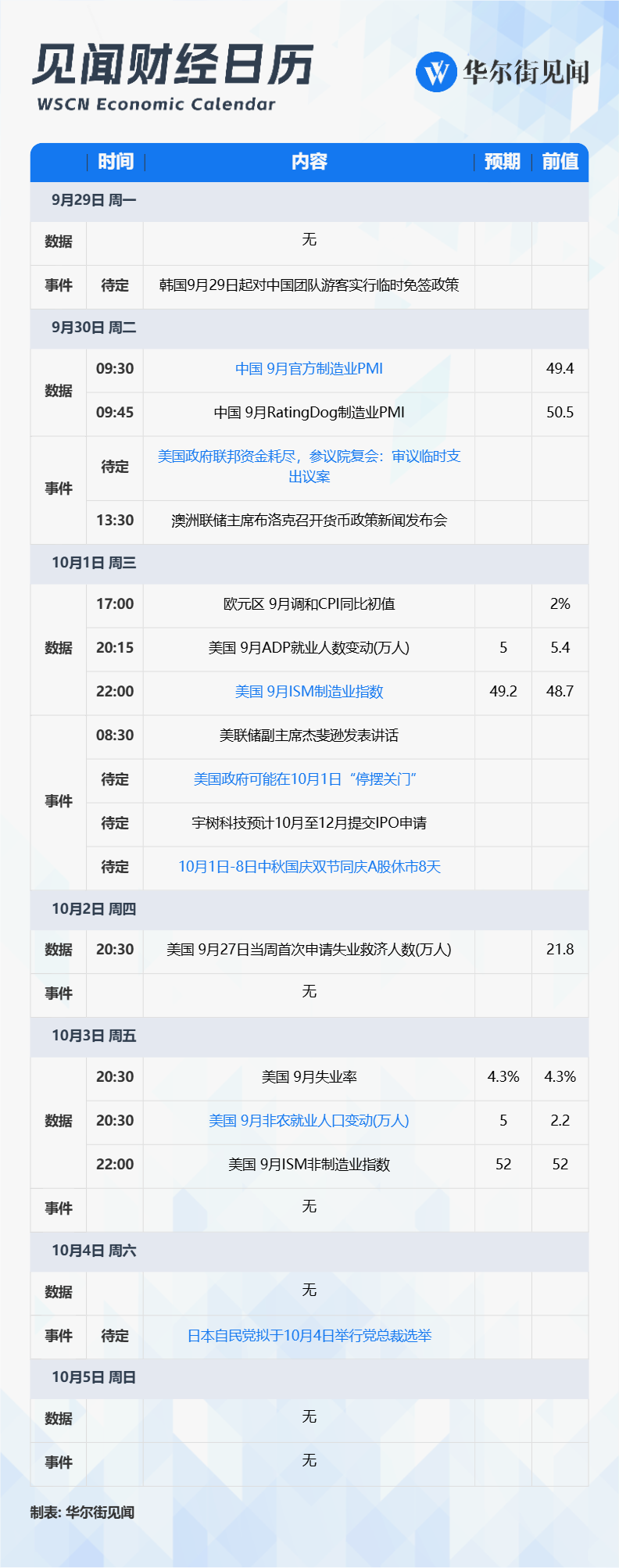
Economic Events - South Korea will implement a temporary visa waiver policy for Chinese group tourists starting September 29, lasting until June next year [16] - The US government is facing a potential shutdown on October 1 if Congress does not act to pass a temporary spending bill [11][12] - The US will release key economic data including the September non-farm payroll report, which is crucial for assessing future interest rate paths [6][8] Manufacturing and Employment Data - China's official manufacturing PMI for September will be released on September 30, with expectations of returning to expansion after August's reading of 49.4 [9] - The US ISM manufacturing PMI for September will also be published, following a contraction in August with a reading of 48.7 [7] - The ADP employment data for September will be released, with August's figure showing an increase of only 5.4 thousand, below market expectations [8] Market Impact - A government shutdown could delay the release of important economic data, increasing market uncertainty and potentially affecting GDP growth [12] - The upcoming holiday period in China, with an 8-day market closure, is expected to boost domestic tourism, with significant increases in travel bookings compared to last year [14]

Weekly Jobless Claims Less Than Expected
ZACKS· 2025-09-25 16:05
Economic Data Summary - Q2 GDP was revised up from +3.3% to +3.8%, marking the strongest quarter of growth since Q3 2023 [2] - Consumption increased significantly from +1.6% to +2.5%, indicating a stronger appetite among U.S. consumers [3] - The Price Index rose by 10 basis points, with headline inflation at +2.1% and core inflation at +2.6% [3] Job Market Insights - Initial Jobless Claims fell to 218K, down 17K from estimates and 64K lower than two weeks ago, reaching the lowest level since mid-summer [4] - Continuing Claims rose slightly to 1.926 million, remaining below 1.94 million for the third consecutive week [5] Manufacturing and Trade Data - August Durable Goods Orders increased by +2.9%, significantly better than the prior month's -2.7% and the consensus estimate of -0.5% [6] - The Advanced U.S. Trade Balance for August showed an improvement to -$85.5 billion from -$102.8 billion [7] - Advanced Retail Inventories remained unchanged, while Advanced Wholesale Inventories decreased to -0.2% [7] Market Expectations - Existing Home Sales for August are forecasted at 3.96 million, a decrease from July's 4.01 million [8] - Costco is expected to report fiscal Q4 results with a projected earnings growth of +12.8% year over year and +8.1% revenue growth [9]