
美联储政策路径

Search documents
杨华曌:市场避险情绪减缓 日内现货黄金价格涨跌走势分析操作建议
Xin Lang Cai Jing· 2026-02-20 14:47
Core Viewpoint - Gold prices remain stable around $5000 as geopolitical tensions in the Middle East increase demand for safe-haven assets due to the U.S. President setting a 10-15 day negotiation deadline with Iran [1][3] Economic Indicators - Upcoming U.S. GDP, PCE, and PMI data are anticipated to influence the Federal Reserve's policy direction, with the market closely monitoring these indicators [1][3] Technical Analysis - The daily chart indicates that gold continues its upward trend, remaining above key moving averages, with an overall bullish structure intact [1][3] - Short-term moving averages are in a bullish arrangement, suggesting strong trend momentum [1][3] - MACD is above the zero line, with momentum bars expanding, while RSI is in the 60-70 range, indicating potential for further upward movement without being in overbought territory [1][3] - Key resistance levels are identified at $5025 and $5050; a breakout above these levels could open new upside potential [1][3] - Support levels are noted at $4970 and $4920 [1][3]
【UNforex财经事件】非农强劲推迟降息时点 政治博弈加剧政策不确定
Sou Hu Cai Jing· 2026-02-12 03:43
Core Viewpoint - The U.S. non-farm payroll data for January showed a stronger-than-expected increase of 130,000 jobs, with the unemployment rate dropping to 4.3%, leading to a reassessment of the Federal Reserve's policy path [1][4]. Employment Data - January non-farm payrolls increased by 130,000 jobs, and the unemployment rate fell to 4.3%, outperforming most prior forecasts [1][4]. - Despite the strong employment figures, there are concerns regarding the representativeness of single-month data due to previous downward revisions [2]. Policy Impact - The strong employment data has significantly reduced the probability of interest rate cuts in March and April, with market expectations for the first rate cut now pushed to mid-year or later [1][5]. - The divergence in views between the White House and the Federal Reserve regarding interest rate cuts and central bank independence adds uncertainty to the market outlook [2][6]. Political Risks - There is a notable disagreement between the White House and the Federal Reserve on the pace of rate cuts and the issue of central bank independence, which could introduce mid-term risks to the market [2][6]. Market Reactions - Following the data release, U.S. stock markets initially rose but then retreated, indicating investor caution amid the balance between economic resilience and delayed rate cuts [3]. - Bond markets saw short-term yields rise, and the yield curve experienced fluctuations, reflecting a shift in trader expectations regarding rate cuts [3]. Future Catalysts - Upcoming CPI data and weekly jobless claims will further assess the validity of the rate cut path [7]. - The strong performance of January's employment data has diminished the urgency for significant rate cuts by the Federal Reserve, but the potential for easing remains if inflation or employment data declines [7].
“非农不冷”打压降息预期 市场重估美联储政策路径
智通财经网· 2026-02-11 22:31
Group 1 - The January employment data in the U.S. showed unexpected strength, with 130,000 new jobs added and the unemployment rate dropping to 4.3%, reducing market expectations for a rate cut by the Federal Reserve before mid-year [1][2] - The strong employment report has led traders to lower the probability of a rate cut in June to below 50%, which was previously considered the most likely time for the next cut [1] - Economists noted that while the January data is robust, it may be subject to downward revisions, and job growth remains concentrated in a few sectors, primarily healthcare [1][2] Group 2 - The healthy January employment data has put to rest concerns about a potential collapse in the labor market, which had been frequently mentioned by some dovish Federal Reserve officials [2] - There are still divergent policy stances within the Federal Reserve, with some officials advocating for maintaining restrictive interest rates to exert downward pressure on inflation [2] - Observers caution that it is still too early to predict the policy direction for June, as key indicators suggest that the labor market and overall economy are strengthening [3]
蒙特利尔银行股价近期上涨,机构关注其市场观点
Jing Ji Guan Cha Wang· 2026-02-11 16:21
Group 1 - As of February 11, 2026, the stock price of Bank of Montreal (BMO) closed at $143.89, down 1.20% for the day, but up 2.19% over the past five trading days, with a year-to-date increase of 11.84% [1] - The overall U.S. banking sector experienced a slight decline of 0.28% during the same period, indicating that BMO outperformed the industry benchmark [1] Group 2 - On February 6, 2026, a meeting took place between Liu Jiannan, Vice President of the China Council for the Promotion of International Trade, and Xia Jinlu, President and CEO of Bank of Montreal (China), discussing topics such as enhancing supply chain cooperation and participation in APEC business activities, which may improve BMO's business engagement in the Chinese market [2] - On February 7, 2026, BMO's strategy team released a report suggesting that if Kevin Warsh were to become the Federal Reserve Chairman, lessons could be drawn from the Bank of England's experience in using liquidity tools to reduce market disruption risks while gradually shrinking the balance sheet [3] - BMO Capital Markets made rating adjustments for companies such as Intuit (INTU) and Harley-Davidson (HOG) between February 10 and 11, reflecting active research activities [3]
中辉有色观点-20260210
Zhong Hui Qi Huo· 2026-02-10 02:05
1. Report Industry Investment Ratings - Gold: Bullish (★) [1] - Silver: Neutral (No recommendation) [1] - Copper: Bullish (★) [1] - Zinc: Bearish (★) [1] - Lead: Bearish (★) [1] - Tin: Bullish (★) [1] - Aluminum: Bearish (★) [1] - Nickel: Bearish (★) [1] - Industrial Silicon: Neutral (Wide - range fluctuations) [1] - Polysilicon: Bearish (★) [1] - Lithium Carbonate: Bullish (★) [1] 2. Core Views - Gold is recommended for long - term strategic allocation due to factors such as lower US employment and inflation expectations, a weakened US dollar index, and continuous gold purchases by central banks. However, short - term fluctuations need attention [1][3]. - Silver is not recommended for participation in the short term because of crowded trading and short - term market adjustments, although there is a long - term supply - demand gap [1]. - Copper is recommended for long - term holding. In the short term, with the approaching Spring Festival, investors are advised to take profits and hold cash due to high inventory and weak demand [1][7]. - Zinc is under pressure in the short term. With the approaching Spring Festival, demand weakens and inventory accumulates. It is advisable to reduce positions and wait for more macro - level guidance [1][11]. - Lead is under pressure as both supply and demand decline in the spot market, leading to inventory accumulation [1]. - Tin shows a short - term rebound under pressure, with a supply - demand balance of both supply and demand [1]. - Aluminum's price rebound is under pressure due to low - cost alumina, inventory accumulation, and weak downstream demand [1][14]. - Nickel's price rebound is under pressure because of the digestion of supply contraction expectations, high inventory, and weak consumption [1][17]. - Industrial silicon shows wide - range fluctuations. Near the Spring Festival, the market trading is light, and it is recommended to hold no positions during the festival [1]. - Polysilicon is under pressure due to inventory accumulation and weak downstream demand, and investors are advised to participate cautiously [1]. - Lithium carbonate shows a rebound. With inventory reduction and production decline, it maintains a stable and oscillating rhythm [1][20]. 3. Summary by Commodity Gold - Core view: Stable and recommended for long - term strategic allocation [1]. - Main logic: Lower US employment and inflation expectations, a weakened US dollar index, continuous purchase of gold by central banks (China's central bank has been buying for 15 consecutive months), and long - term uncertainties in the geopolitical situation [1][3]. - Strategy: Pay attention to the support level around 1060, and continue to focus on volatility reduction [4]. Silver - Core view: Not recommended for participation [1]. - Main logic: Crowded multi - and short - position trading, short - term market adjustments, although there has been a supply - demand gap for 5 consecutive years, the short - term risk - reward ratio is not suitable [1]. Copper - Core view: Long - term holding [1]. - Main logic: The weakening of the US dollar index, high - level copper inventories globally, and weak demand in the traditional off - season as the Spring Festival approaches [1][6][7]. - Strategy: In the short term, take profits and hold cash during the Spring Festival. The short - term range for Shanghai copper is [100000, 105000] yuan/ton, and for London copper is [12800, 13500] US dollars/ton [7]. Zinc - Core view: Under pressure [1]. - Main logic: Cooling speculative enthusiasm, weakening demand as the Spring Festival approaches, and inventory accumulation [1][10][11]. - Strategy: In the short term, reduce positions and control risks, and wait for more macro - level guidance. In the long term, consider buying on dips. The range for Shanghai zinc is [24000, 25000] yuan/ton, and for London zinc is [3300, 3400] US dollars/ton [11]. Aluminum - Core view: Rebound under pressure [1]. - Main logic: Low - cost alumina, inventory accumulation, and a decline in downstream operating rates [1][12][14]. - Strategy: In the short term, take profits and wait and see, and pay attention to the accumulation of aluminum ingot social inventory. The main operating range is [22000 - 24500] [14]. Nickel - Core view: Rebound under pressure [1]. - Main logic: The digestion of supply contraction expectations in Indonesia, high domestic inventory, and weak consumption, as well as an increase in downstream stainless steel inventory [1][15][17]. - Strategy: Take profits and wait and see, and pay attention to Indonesian policies and downstream stainless steel inventory changes. The main operating range is [120000 - 145000] [18]. Lithium Carbonate - Core view: Rebound [1]. - Main logic: Four - week consecutive inventory reduction, production decline, and following the trend of the non - ferrous metals sector [1][19][20]. - Strategy: After stabilization, lightly build long positions in the range of [135000 - 145000] [21].
【真灼港股名家】“非农+CPI”重磅数据冲击,美元、美股背道而驰
Sou Hu Cai Jing· 2026-02-08 09:27
Group 1 - The January non-farm payroll report has been postponed to February 11, with the consumer price index (CPI) report also delayed to February 13, due to data collection interruptions caused by the recent government shutdown [2][3] - The market expects an increase of approximately 60,000 jobs in January, slightly above December's increase of 50,000, while the unemployment rate is anticipated to remain at 4.4% [2] - The ADP report indicated that only 22,000 jobs were added in January, significantly below the expected 45,000, suggesting a stagnation in the labor market characterized by low hiring and low layoffs [2] Group 2 - The January CPI is expected to remain at an annual rate of 2.7%, unchanged from December [3] - Concerns about inflation persist due to uncertainties in tariff policies and persistent inflation in the service sector, despite the Federal Reserve's recent statements [3] - Mary Daly, President of the San Francisco Federal Reserve Bank, advocates for one to two rate cuts to address the weakening labor market, highlighting the challenges faced by workers due to high prices and limited job opportunities [3]


板块情绪转弱 沪锡全部合约跌停【2月2日SHFE市场收盘评论】
Wen Hua Cai Jing· 2026-02-02 08:17
Core Viewpoint - The significant drop in tin prices, with the main contract hitting a limit down of 11% to 392,650 yuan/ton, is primarily driven by market reactions to the nomination of Kevin Warsh as the next Federal Reserve Chairman, which has shifted market expectations towards a more hawkish stance [1] Group 1: Market Dynamics - Tin prices have experienced a sharp decline, influenced by external macroeconomic sentiments rather than fundamental changes in supply and demand [1] - The operating rate of smelters in Yunnan remains stable, while Jiangxi's refined tin output is still low due to a shortage of scrap tin materials [1] - The overall demand in January showed slight improvement compared to December, particularly in the photovoltaic welding strip sector, but the home appliance industry saw a year-on-year production decline of approximately 5% [1] Group 2: Supply and Inventory - Despite a rise in inventory levels due to increased imports of tin ingots, the overall inventory remains low and is not expected to exert significant pressure on prices [2] - The supply side has not shown significant changes, with smelter production remaining stable [2] Group 3: Future Outlook - Newhu Futures commented that the price drop has triggered some replenishment behavior, indicating resilience in overall consumption, although a weakening trend is evident as the Spring Festival approaches [2] - Short-term fluctuations in tin prices are anticipated due to macroeconomic disturbances, but the medium to long-term outlook remains optimistic [2]
分析师:美联储决定缓解美元压力 后续路径难以预测
Sou Hu Cai Jing· 2026-01-28 19:42
Core Viewpoint - The Federal Reserve's decision to maintain interest rates amidst market uncertainty is seen as a prudent move, reflecting a lack of consensus among committee members [1] Group 1 - The Federal Reserve's cautious approach helps alleviate pressure on the US dollar, which has been under strain since January 20 [1] - The policy path of the Federal Reserve is expected to remain difficult to predict [1]
刹不住!金银迎“史诗级”大涨
Guo Ji Jin Rong Bao· 2026-01-26 14:10
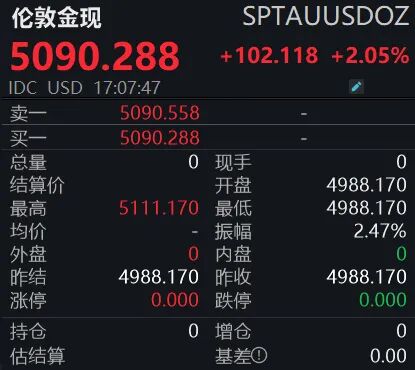
Core Viewpoint - The prices of gold and silver have surged to historic highs, with spot gold breaking the $5000 per ounce mark, driven by factors such as weakened dollar credibility, strong central bank demand for gold, and geopolitical premiums [1][11]. Market Performance - As of the report, spot gold rose by 2.05% to $5090.288 per ounce, reaching a peak of $5111.17, while spot silver surged by 6.06% to $109.6 per ounce, surpassing the $110 mark [3][5]. - In the futures market, COMEX gold futures increased by 2.02% to $5080.4 per ounce, with a peak of $5107.9, and COMEX silver futures rose by 7.54% to $108.97 per ounce, hitting a high of $110.065 [6][7]. Influencing Factors - The current gold price rally, which began in early 2025 at around $3000 per ounce, reflects significant changes in the macroeconomic environment [9]. - Short-term factors include ongoing geopolitical risks, such as tensions over Greenland's sovereignty and escalating US-Iran relations, which have heightened demand for safe-haven assets like gold [9]. - Mid-term factors involve the interplay between the Federal Reserve's policy path and its independence, with expectations of weakened monetary policy independence supporting gold prices [9][10]. - Long-term drivers include the structural weakening of the dollar credit system, with global central banks increasing gold reserves and a steady de-dollarization process [10]. Future Outlook - The long-term upward trend for gold remains intact, influenced by factors such as weakened dollar credibility, strong central bank demand, and geopolitical premiums [11]. - Analysts predict that gold prices could potentially reach $6000 per ounce by 2026, driven by ongoing geopolitical uncertainties and expectations of continued monetary easing [11]. - Investment strategies suggested include a diversified approach based on individual financial capacity and risk tolerance, with recommendations for different investment vehicles such as gold futures, ETFs, and physical gold [11].
美指震荡冲击短期支撑强劲 中长期弱势格局难改
Jin Tou Wang· 2026-01-18 06:46
Group 1 - The US dollar index has strengthened recently, reaching a two-week high, driven by multiple favorable factors and market focus on its impact on key psychological levels [1] - The rebound of the dollar is primarily attributed to the resonance of economic data and risk aversion, with recent inflation data meeting expectations and core inflation remaining stable, reducing market bets on aggressive rate cuts by the Federal Reserve [1] - Geopolitical risks, particularly tensions between the US and Iran, have heightened the dollar's safe-haven appeal, with rising oil prices driving risk-averse capital back to the dollar [1] Group 2 - There is a growing divergence in market views on the medium to long-term trajectory of the dollar, focusing on the Federal Reserve's policy path and debates over central bank independence [2] - The internal "hawk-dove" debate within the Federal Reserve has intensified, leading to significant disagreements on rate cuts, which contributes to ongoing policy uncertainty affecting the dollar's performance [2] - Institutions generally expect the dollar to maintain a "short-term strong, medium to long-term weak" pattern, with key signals including the timing of Federal Reserve rate cuts and the degree of global central bank policy divergence [2]