
零关税政策

Search documents
商务部国际贸易经济合作研究院学术委员会副主任张建平:海南高附加值产业将形成集聚与规模效应
Hai Nan Ri Bao· 2025-12-06 01:46
海南高附加值产业将形成集聚与规模效应 海南日报全媒体记者 王赫 "全岛封关后,海南在国际贸易、双向投资以及打造'两个总部基地'等领域将迎来关键发展节 点。"近日,商务部国际贸易经济合作研究院学术委员会副主任张建平在接受海南日报全媒体记者专访 时表示,伴随海南自贸港制度优势、政策红利与区位潜力持续叠加释放,高附加值产业将在海南形成显 著的集聚与规模效应。 "海南自由贸易港依托其在税收政策与贸易便利化方面的显著优势,已经实施了三张'零关税'清单 政策,涵盖了基础设施建设、加工制造、研发设计等重点行业领域,为相关产业的发展注入了强劲动 力。"张建平表示,"随着海南全岛封关运作的稳步推进,这三张清单将整合为一张完整、系统的'零关 税'清单,预计覆盖整体进口商品的比重将达到74%,这一举措将为海南自由贸易港的高质量发展构筑 起坚实有力的政策支撑。" 商务部国际贸易经济合作研究院学术委员会副主任张建平: 张建平期望海南能够充分利用政策优势和区位优势,对封关运作后实施的"零关税"政策、加工增值 免关税政策,与《区域全面经济伙伴关系协定》(RCEP)、中国—东盟自贸区3.0版等既有的区域性贸易 投资政策进行深度融合、系统集成 ...
海南封关下投资布局机会:封关背景下的产业落地与招商策略演变
Tou Bao Yan Jiu Yuan· 2025-12-04 12:46
Investment Policy and Management Model - Hainan Free Trade Port adopts a "one line open, two lines controlled" management model to balance trade facilitation and risk prevention, allowing foreign goods to enter freely while controlling domestic market safety[4] - The management model aims to establish Hainan as a competitive open economy by simplifying regulations for international trade while ensuring domestic regulatory compliance[5] Key Industries and Growth Opportunities - Hainan focuses on four leading industries: tourism, modern services, high-tech industries, and tropical efficient agriculture, leveraging policy advantages to enhance international tourism and service sector innovation[8] - The tourism sector is projected to receive 97.21 million visitors in 2024, a year-on-year increase of 8%, with total tourist spending reaching 204.01 billion yuan, up 12.5%[8] - The modern service industry is expected to grow by 3.6% in 2024, driven by reforms in financial services and the establishment of international education and healthcare hubs[9] - High-tech industries are developing rapidly, with significant advancements in sectors like electronic information and biomedicine, showcasing strong innovation potential[10] - Tropical agriculture is being modernized and internationalized, supported by policies that promote high-quality agricultural products and brand development[11] Future Industry Focus - Hainan is prioritizing three future industries: seed industry, deep-sea technology, and aerospace, with over 2,800 seed innovation enterprises established in the "South Breeding Silicon Valley"[13] - The deep-sea industry is expected to attract around 1,000 marine enterprises, focusing on deep-sea intelligent equipment and marine biomedicine[13] - The aerospace sector is leveraging Hainan's geographical advantages to develop a comprehensive aerospace industry chain, including satellite and rocket manufacturing[14] Investment Incentives and Market Dynamics - Hainan Free Trade Port offers zero-tariff policies for eligible enterprises, significantly reducing costs and promoting high-value-added processing industries[15] - The cross-border service trade negative list and other policies are designed to lower operational costs and attract financial investments, enhancing the growth of private and high-end industries[17] - In 2024, private enterprises accounted for 63.7% of Hainan's total import and export value, reaching 176.85 billion yuan, reflecting a 36.9% year-on-year growth[18]
【环球财经】乌干达企业家:中国零关税政策为乌咖啡出口提供新机遇
Xin Hua Cai Jing· 2025-12-03 08:08
Core Viewpoint - Uganda's coffee industry is poised for growth due to China's implementation of a zero-tariff policy on products from African countries, making the Chinese market more attractive for Ugandan coffee exports [1][2]. Group 1: Policy Impact - China's new policy provides a "friendlier business environment" for Ugandan coffee, potentially increasing farmers' incomes [1]. - The policy was announced during the China-Africa Cooperation Forum, which aims to implement zero tariffs on 100% of products from 53 African countries [1]. Group 2: Market Opportunities - Uganda's coffee exports to China saw a 190% year-on-year increase by March 2025, making China the second-largest coffee export destination for Uganda in Asia [2]. - The Ugandan coffee export revenue reached $1.14 billion in the 2023/2024 fiscal year, marking the highest level in 30 years, a significant increase from $846 million in the previous fiscal year [2]. Group 3: Industry Preparedness - To ensure a stable supply of quality coffee to China, Uganda must enhance cooperation and communication within the coffee industry [2]. - Over 40 Ugandan employees have participated in coffee processing technology training in China, with another 40 set to go for further training [2].
在中国大市场拥抱机遇
Ren Min Ri Bao· 2025-12-03 08:07
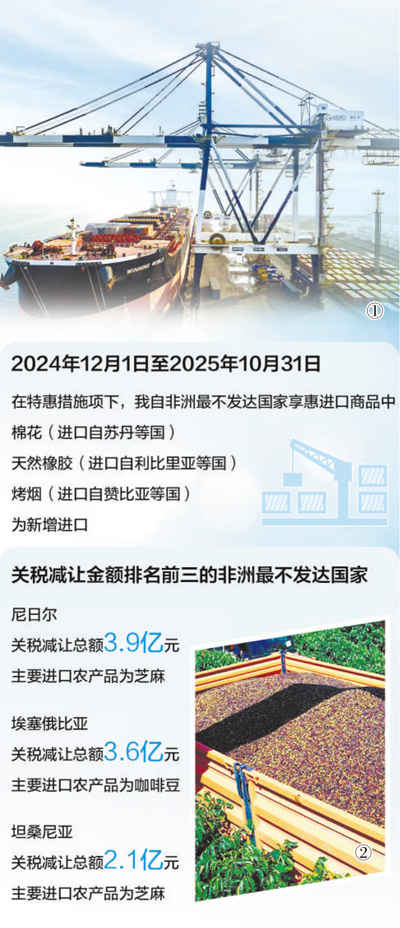
Core Insights - Starting from December 1, 2024, China will grant 100% zero-tariff treatment on products from the least developed countries that have diplomatic relations with China, expanding the zero-tariff policy to 53 African countries as announced in June 2023 [1] - The continuous upgrade of the zero-tariff policy has lowered the entry barriers for African products into the Chinese market, injecting strong momentum into China-Africa trade cooperation and contributing positively to global economic development [1] Group 1 - China is taking proactive steps to expand imports, showcasing its role as a major global player. As the world's second-largest goods import market, China is increasingly opening its doors to share development opportunities with more trade partners [1] - In the first three quarters of this year, imports from least developed countries that have diplomatic relations with China increased by 9.7% year-on-year. China has maintained its position as Africa's largest trading partner for 16 consecutive years, with imports from African countries growing by 10.8% year-on-year in the third quarter [1] Group 2 - The zero-tariff policy reflects a win-win scenario, allowing high-quality African products such as Sudanese cotton and Liberian natural rubber to enter the Chinese market for the first time, enriching consumer choices in China and opening markets for small and medium-sized enterprises in African countries [1] - This policy demonstrates China's commitment to high-level openness and serves as a bond for mutual benefit between China and Africa, providing opportunities for development and contributing to greater global economic growth [1]
零关税 让更多非洲产品丰富中国市场
Ren Min Ri Bao· 2025-12-03 01:55
Group 1: Trade Policy Impact - China will implement a zero tariff policy on 100% of products from the least developed countries that have diplomatic relations with China starting December 1, 2024, which aims to promote mutual development [1] - The zero tariff policy is expected to enhance the competitiveness of Ethiopian coffee in the Chinese market, with exports to China growing significantly [2][3] Group 2: Coffee Industry Developments - Ethiopian coffee exports to China have been growing at an annual rate of 27%, with over 34,000 tons exported in the 2024/2025 fiscal year, generating over $218 million in revenue [2] - The zero tariff policy has increased the price competitiveness of Ethiopian coffee, benefiting local farmers and related industries [2] - The Ethiopian Coffee and Tea Authority indicates that China has become Ethiopia's fourth-largest coffee export market [2] Group 3: Supply Chain Efficiency - The import of sesame from Mozambique to China has become more efficient, with direct sourcing channels improving the supply chain [4][5] - The company in Chengdu has expanded its direct sourcing network, importing 1,120 tons of white sesame from Niger, enhancing the quality control from the planting stage [4][5] Group 4: Rubber Industry Developments - The implementation of the zero tariff policy has allowed Shandong Triangle Tire Co., Ltd. to import natural rubber from Liberia with a tariff reduction of approximately 300,000 yuan [6][7] - The company has utilized the cost savings from reduced tariffs to invest more in R&D, leading to the development of energy-saving tires suitable for electric vehicles [7] - In the first ten months of the year, Shandong Province's imports from Africa reached 87.645 billion yuan, a year-on-year increase of 50.3% [7]

零关税,让更多非洲产品丰富中国市场(经济聚焦)
Ren Min Ri Bao· 2025-12-02 22:33
Group 1: Trade Policy Impact - From December 1, 2024, China will implement a zero tariff policy on 100% of products from the least developed countries that have diplomatic relations with China, aiming to enhance mutual development [6] - The zero tariff policy is expected to boost trade vitality between China and Africa, particularly benefiting African industries and enriching consumer choices in China [6] Group 2: Coffee Industry Growth - Ethiopia's coffee exports to China have been growing at an annual rate of 27%, with over 34,000 tons exported in the 2024/2025 fiscal year, generating over $218 million in revenue [7] - The zero tariff policy has significantly increased the competitiveness of Ethiopian coffee in the Chinese market, leading to a substantial rise in export volumes [7][8] - Ethiopian coffee producers plan to increase production to meet the growing demand from China, driven by the favorable tariff conditions [7] Group 3: Sesame Supply Chain Efficiency - Sesame, as Africa's largest agricultural export to China, is being imported more efficiently through direct sourcing channels, enhancing the supply chain from Mozambique to China [9] - The company has expanded its direct sourcing network, importing 1,120 tons of white sesame from Niger, with the first batch arriving in May [9][10] - Efficient logistics and a paperless customs process have streamlined the importation of sesame, reducing costs and improving delivery times [10] Group 4: Rubber Import and Production - The implementation of the zero tariff policy has allowed companies like Triangle Tire to import natural rubber from Liberia without tariffs, saving approximately 300,000 yuan [11] - The reduction in tariff costs enables companies to invest more in R&D, leading to the development of new tire products suitable for electric vehicles and extreme conditions [12] - In the first ten months of the year, Shandong province's imports from Africa reached 87.645 billion yuan, a 50.3% increase year-on-year, with natural and synthetic rubber imports also seeing significant growth [12]

对华贸易合作惠及发展中国家及其人民 与世界各国共享机遇、共同发展
Ren Min Ri Bao· 2025-11-30 22:14
Group 1 - China's commitment to promoting common development is emphasized in its "14th Five-Year Plan," which focuses on high-level opening up and creating win-win cooperation opportunities with countries worldwide [1] - The market demand from China is transforming into global opportunities, benefiting various countries and their industries [2][3] Group 2 - Pakistan's pine nuts exports to China have seen a significant increase, with exports expected to exceed $18 million in 2024, marking a 14% year-on-year growth [2] - South Africa's macadamia nut exports to China are projected to reach approximately 48% of its total production for the 2024 season, highlighting China's role as a key partner [3] - The participation of companies from least developed countries in trade fairs like the China International Import Expo has led to a 23.5% increase in exhibitors, facilitating their integration into the global value chain [4] Group 3 - Peru's trade with China has improved, benefiting local artisans and creating significant income opportunities, particularly for women in the handicraft sector [5] - China's zero-tariff policy for 53 African countries is expected to enhance market access for products like avocados and tea, providing crucial opportunities for local development [6] Group 4 - The establishment of efficient logistics and customs processes has significantly reduced the time and cost for importing fruits from ASEAN countries to China, enhancing competitiveness [6] - The upcoming launch of Hainan Free Trade Port is anticipated to facilitate easier exports of tropical fruits and agricultural products from Thailand to China, lowering trade costs [7] - China's trade policies are recognized as providing substantial market opportunities for developing countries, reinforcing its role as a vital trade partner [7]
海南矿业(601969.SH):公司进口布谷尼锂矿的锂精矿产品享受“零关税”政策
Ge Long Hui· 2025-11-25 08:37
格隆汇11月25日丨海南矿业(601969.SH)在互动平台表示,布谷尼锂矿项目位于西非马里当地,其出口 税收处理需遵循马里当地的法律法规。根据政策,海南岛内进口用于生产自用或以"两头在外"模式进行 生产加工活动所消耗的原辅料,实行"零关税"正面清单管理,免征进口关税、进口环节增值税和消费 税。综上,公司进口布谷尼锂矿的锂精矿产品享受"零关税"政策。 ...

供需矛盾并不明显,盘面或将维持震荡
Hua Long Qi Huo· 2025-11-24 03:09
研究报告 橡胶周报 供需矛盾并不明显,盘面或将维持震荡 投资咨询业务资格: 证监许可【2012】1087 号 投资咨询资格证号:Z0011566 电话:0931-8894545 邮箱:2367823725@qq.com 的免责声明。 摘要: 【行情复盘】 研究员:张正卯 上周天然橡胶主力合约 RU2601 价格在 15125-15580 元/吨 之间运行,上周 RU2601 期货价格震荡运行,总体微幅上涨。 期货从业资格证号:F0305828 截至 2025 年 11 月 21 日上周五下午收盘,天然橡胶主力合 约 RU2601 报收 15240 元/吨,当周上涨 25 点,涨幅 0.16%。 【后市展望】 上周国内天然橡胶期货主力合约价格震荡运行,总体微幅 上涨。 报告日期:2025 年 11 月 24 日星期一 展望后市,宏观方面,受非农数据影响,美联储降息预期 减弱,影响商品情绪。从基本面来看,供给方面,橡胶成本端 存在支撑。10 月天然橡胶进口数量同比小幅增加,1-10 月,中 国累计进口天然及合成橡胶增幅明显。需求方面,上周轮胎企 业开工率较上周均有下降,全钢胎、半钢胎延续累库累库。终 端车市方面, ...
海南全岛封关倒计时 不止零关税!玩海+“探”天,承包你的假期
Mei Ri Jing Ji Xin Wen· 2025-11-23 15:31
Core Viewpoint - The Hainan Free Trade Port will officially start its full island closure operation on December 18, with comprehensive infrastructure and facilities already in place, aiming to enhance trade and investment through favorable policies and efficient management [1][2]. Tax Policy Summary - The zero tariff policy will expand from over 1,900 items to 6,637 items, increasing the zero tariff coverage from 21% to 74%, significantly reducing procurement costs for businesses [2][3]. - The zero tariff includes not only import tariffs but also value-added tax and consumption tax, allowing companies to save approximately 20% on tax costs when importing production equipment [2]. - A dual 15% preferential tax policy will apply to corporate income tax and personal income tax, benefiting over 1,100 encouraged industries, including biomedicine and offshore wind power [2][3]. Industry Development Plans - The tourism sector will focus on high-end consumption projects, deep experience offerings, and innovative integration projects, aiming to transform marine tourism into a significant economic driver for the free trade port [4]. - Key projects include establishing regional headquarters for international cruise companies and developing deep-sea diving and marine sightseeing experiences [4]. - The development of two "green necklaces," the Ring Island Tourism Road and the Tropical Rainforest National Park Tourism Road, will feature high-quality resorts, camping sites, and wellness vacation projects [5]. Smart Tourism and Agricultural Integration - The initiative will promote smart tourism and the integration of agriculture, culture, and tourism, enhancing the overall visitor experience and operational efficiency [6].