AI训练

Search documents
老黄200亿「钞能力」回应谷歌:联手Groq,补上推理短板
3 6 Ke· 2025-12-28 08:21
Core Insights - Nvidia has made a significant investment of $20 billion to acquire Groq, a company specializing in chips for AI applications, indicating a strategic move to strengthen its position in the AI market amidst rising competition from Google's TPU and other new chip paradigms [2][3][18]. Group 1: Nvidia's Strategic Move - The acquisition of Groq marks a major strategic layout for Nvidia in the AI era, reflecting concerns over competition from new chip technologies like TPU [3][18]. - Gavin Baker, a notable tech investor, suggests that Groq's LPU (Logic Processing Unit) could address Nvidia's vulnerabilities in the inference market, which is crucial for AI applications [4][5][18]. Group 2: Performance Comparison - Groq's LPU is reported to outperform GPUs, TPUs, and most ASICs in inference speed, achieving a processing speed of 300-500 tokens per second, which is 100 times faster than GPUs [6][13]. - The LPU's architecture utilizes on-chip SRAM, eliminating the need for data retrieval from external memory, which is a significant advantage over GPUs that rely on HBM [12][13]. Group 3: Market Dynamics - The shift in AI competition is moving from training to application, with speed becoming a critical factor for user experience in AI applications [17]. - Nvidia's acquisition of Groq is seen as a response to the growing demand for speed in inference tasks, which could potentially disrupt Nvidia's current market dominance [18][19]. Group 4: Financial Implications - While Groq's LPU offers speed advantages, it has a much smaller memory capacity (230MB) compared to Nvidia's H200 GPU (141GB), necessitating a larger number of LPU chips for model deployment, which could lead to higher overall hardware investment [14][15][16]. - The inference chip market is characterized by high sales volume but low profit margins, contrasting with the high margins typically associated with Nvidia's GPUs [19].


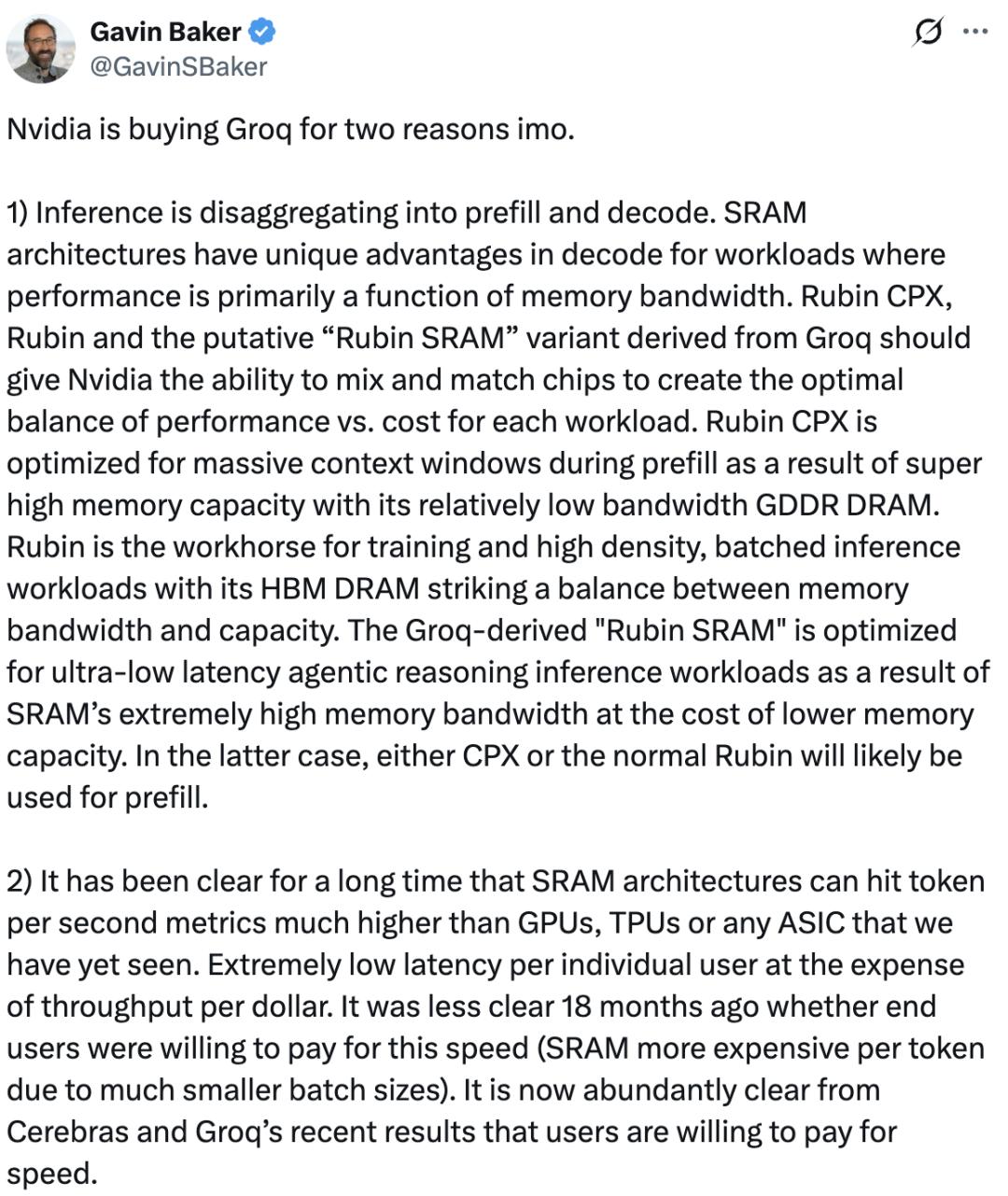
英伟达急了?或被谷歌TPU逼到墙角,黄仁勋不惜代价也要“收编”Groq
Hua Er Jie Jian Wen· 2025-12-25 10:21
据华尔街见闻此前文章,英伟达近日与Groq达成了一项非独家的技术许可协议。 按照披露,英伟达将把Groq的AI推理技术整合进未来产品体系中,而Groq创始人兼首席执行官Jonathan Ross、总裁Sunny Madra以及部分核心工程人员将加入英伟达。Groq公司本身仍保持独立运营,其云业 务Groq Cloud也将继续对外提供服务。 然而,如果只把它理解为普通的技术合作,显然过于表面。技术可以授权,但一家芯片公司的创始人和 核心架构团队,很少作为"附带条款"整体迁移。 英伟达真正看中的,从来不是Groq的收入规模,而是它背后的架构思想。而这套思想,与谷歌TPU高 度同源。 业内普遍认为,随着AI竞争重心从训练转向推理,GPU长期建立的统治优势开始出现松动,TPU在效 率与成本结构上的优势正逐步显现,并有望成为谷歌云未来十年的关键护城河,这一背景下,黄仁勋第 一次显露出被逼到墙角的焦虑。 可以肯定的是,一旦英伟达借助这次技术引入在推理架构上追近甚至抹平与谷歌TPU的差距,原本在谷 歌与OpenAI/英伟达阵营之间不断扩大的技术与生态裂口,很可能会迅速收敛,竞争格局也将重新回 到拉锯状态。 AI叙事正在从训 ...

英伟达豪掷200亿美金,谷歌TPU之父连夜投奔老黄
3 6 Ke· 2025-12-25 02:17
圣诞前夕,英伟达也没闲着。 一大早,CNBC独家爆料称,英伟达斥资史上最大200亿美金,一举收购了AI芯片初创Groq。 然而,实际上这并非是一场「收购」。 Groq官方发文做出回应:英伟达与Groq达成了一项推理技术授权协议。 与此同时,Groq创始人&CEO Jonathan Ross(谷歌TPU之父)、总裁Sunny Madra等工程团队一并加入英伟达。 这家Groq初创公司,未来还将独立运营,任命新的CEO。 这种合作方式,已经在业内成为「基操」,比如Meta与Scale AI、谷歌与Windsurf、微软与InfectionAI.... 不是收购,是「技术授权」 Groq在官网声明中强调,英伟达达成了「非独占性」技术授权协议(non-exclusive licensing)。 这意味着,英伟达将获得Groq核心推理技术使用权。未来,他们还计划将其低延迟芯片整合进产品体系中。 另外,Groq仍将独立运营,其云业务(GroqCloud)不受影响,新任CEO将由原财务主管Simon Edwards担任。 截至目前,这笔交易未披露具体细节。 仅有CNBC最初爆料称,将会达200亿美金级别,堪称英伟达史上最大 ...

CPO,百亿美元规模
半导体芯闻· 2025-12-24 10:19
Core Insights - The article discusses the advancements and market trends in the CPO (Co-Packaged Optics) technology within the optical communication industry, highlighting its growing importance for AI and data center applications [2][5]. Group 1: CPO Technology Developments - Nvidia announced the adoption of single-channel 200G CPO technology in its InfiniBand and Ethernet switches in March [2]. - Meta's testing in September demonstrated the reliability of Broadcom's previous CPO products, leading to Broadcom's launch of its third-generation single-channel 200G CPO product in October [2]. - At the TEF conference in December, Nvidia reported that AI clusters based on CPO switches showed a tenfold improvement in reliability compared to systems using pluggable optical modules, translating to a fivefold increase in cluster uptime [2]. Group 2: Market Trends and Predictions - Ciena's acquisition of Nubis Communications and Marvell's acquisition of Celestial AI indicate major companies' focus on CPO technology, with expectations of more M&A activities in this space by early 2026 [5]. - Currently, CPO applications are limited to Scale-Out network design switches, with the next challenge being to extend Scale-Up interconnects beyond single racks, aiming to scale GPU clusters from 128-144 chips to 500-1000 chips for accelerated AI training [5]. - Amazon is using AEC to interconnect Trainium accelerators across two racks, but this may not scale well to more racks, while Huawei employs 800G pluggable LPO optical modules in its vertical Scale-Up network [5]. Group 3: Future Market Outlook - LightCounting has raised its market forecast for CPO, which now includes 1.6T and 3.2T ports for Scale-Up scenarios with transmission distances under 50 meters [5]. - Broadcom and Nvidia are expected to launch integrated CPO Scale-Up switches, GPUs, or XPUs by 2026, with shipments starting in 2027 [8]. - By 2030, the market size for CPO engines covering both Scale-Up and Scale-Out scenarios is projected to reach $10 billion, with nearly 100 million CPO ports expected to be shipped [8].


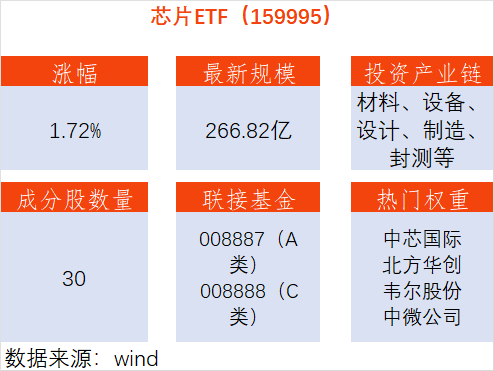
机构看好国产算力业绩释放,芯片ETF(159995.SZ)上涨1.72%,拓荆科技上涨9.37%
Mei Ri Jing Ji Xin Wen· 2025-12-12 06:06
Group 1 - The A-share market saw a collective rise in the three major indices, with the Shanghai Composite Index increasing by 0.17%, driven by strong performances in the electronics, communications, and defense sectors, while the comprehensive and retail sectors lagged behind [1] - The chip technology stocks performed well, with the chip ETF (159995.SZ) rising by 1.72%, and notable individual stocks such as Tuojing Technology up by 9.37%, Longxin Zhongke up by 6.42%, Beijing Junzheng up by 5.63%, and Haowei Group up by 4.48% [1] Group 2 - The global demand for AI inference is rapidly increasing, leading overseas Cloud Service Providers (CSPs) to significantly increase their capital expenditures on computing infrastructure, with a total capital expenditure of $97.9 billion in Q3 2025, reflecting a quarter-on-quarter increase of 10% [3] - Domestic CSPs are still in a catch-up phase compared to their overseas counterparts, but leading domestic firms like ByteDance are approaching the scale of Google in terms of token call volume and business size [3] - Domestic advanced process expansion is steadily progressing, and the acceleration of self-controllable advancements in the industry chain is expected to significantly enhance the supply capacity of the domestic computing power industry, allowing domestic computing power manufacturers to benefit from the rising demand for AI inference and training [3]

科技投资大佬:明年英伟达GPU将颠覆谷歌TPU优势
美股IPO· 2025-12-10 03:38
Core Viewpoint - Google currently holds a cost advantage in AI training with its TPU chips, operating at a negative 30% profit margin, which allows it to suppress competitors. However, this advantage is expected to reverse with the introduction of NVIDIA's Blackwell chip cluster in early 2026, potentially reshaping the competitive landscape of the AI industry [1][4][11]. Group 1: Cost Structure and Competitive Dynamics - Gavin Baker highlights that Google's TPU chips are akin to "fourth-generation jet fighters," while NVIDIA's Hopper chips are compared to "World War II P-51 Mustangs," indicating a significant cost advantage for Google [4]. - The transition from NVIDIA's Hopper to Blackwell is described as one of the most complex product transformations in tech history, with substantial increases in data center rack weight and power consumption [5]. - Baker anticipates that the first models trained on Blackwell will debut in early 2026, with xAI playing a crucial role in NVIDIA's deployment strategy [6]. Group 2: Supply Chain and Design Strategy - Google's conservative design choices and supply chain strategy may limit its long-term competitiveness, as it outsources backend design to Broadcom, incurring significant costs [7]. - The estimated annual payment to Broadcom could reach approximately $15 billion by 2027, raising questions about the economic rationale behind this outsourcing [7]. - The introduction of MediaTek as a second supplier is seen as a warning to Broadcom, but this diversification may slow down TPU's development pace compared to NVIDIA's rapid GPU iterations [9][10]. Group 3: Strategic Implications - Once Google loses its status as the lowest-cost producer, its strategic computing approach will fundamentally change, making it challenging to maintain a negative profit margin [11]. - The shift in cost dynamics with the Blackwell cluster moving towards inference applications could lead to significant financial strain for Google, potentially impacting its stock performance [11]. - Baker emphasizes that the gap between NVIDIA's GPUs and Google's TPUs will widen further with the release of the next-generation Ruben chip [12].
科技投资大佬Gavin Baker:明年英伟达GPU将颠覆谷歌TPU优势!一旦谷歌失去成本优势,可能重塑AI产业的竞争格局和经济模型
Ge Long Hui· 2025-12-10 03:36
Core Viewpoint - Google holds a cost advantage in AI training due to its TPU chips, compared to Nvidia's Hopper chips, which are considered outdated [1] Group 1: Cost Advantage - Gavin Baker highlights that Google's TPU chips provide a low-cost advantage in the AI training sector, likening them to "fourth-generation jet fighters" [1] - In contrast, Nvidia's Hopper chips are compared to "World War II-era P-51 Mustangs," indicating a significant technological gap [1] - This cost advantage allows Google to operate its AI business at a negative profit margin of 30%, effectively "sucking the economic oxygen out of the AI ecosystem" [1] Group 2: Future Competition - Baker warns that this situation may change with the introduction of Nvidia's Blackwell chip cluster in early 2026, which will enhance training capabilities [1] - The subsequent release of the more easily deployable GB300 chip is expected to further shift the competitive landscape [1] - If Google loses its cost advantage, it could reshape the competitive dynamics and economic models within the AI industry [1]

科技投资大佬:明年英伟达GPU将颠覆谷歌TPU优势
Hua Er Jie Jian Wen· 2025-12-10 03:06
Core Insights - Nvidia's next-generation Blackwell chips and subsequent products are expected to reshape the cost structure of AI training, potentially ending Google's TPU cost advantage [1] - The transition from Nvidia's Hopper to Blackwell is one of the most complex product transformations in tech history, creating an unexpected advantage window for Google [2] - Google's conservative design choices and supply chain strategies in TPU development may limit its long-term competitiveness [4][5] Group 1: Nvidia's Blackwell Chips - The Blackwell chip cluster is set to begin training use in early 2026, with the GB300 chip following, which will be easier to deploy [1][2] - The first models trained on Blackwell are expected to be launched by xAI in early 2026 [2] - The GB300 chip will feature "plug-and-play" compatibility, allowing for direct replacement of existing GB200 infrastructure without additional modifications [3] Group 2: Google's TPU Challenges - Google's TPU architecture decisions, including outsourcing backend design to Broadcom, may result in significant annual payments, limiting profitability [4] - The introduction of MediaTek as a second supplier signals a warning to Broadcom, but this diversification may slow down TPU development [5] - If Google loses its status as the lowest-cost producer, its strategic computing approach will fundamentally change, making it difficult to maintain a negative profit margin [6]
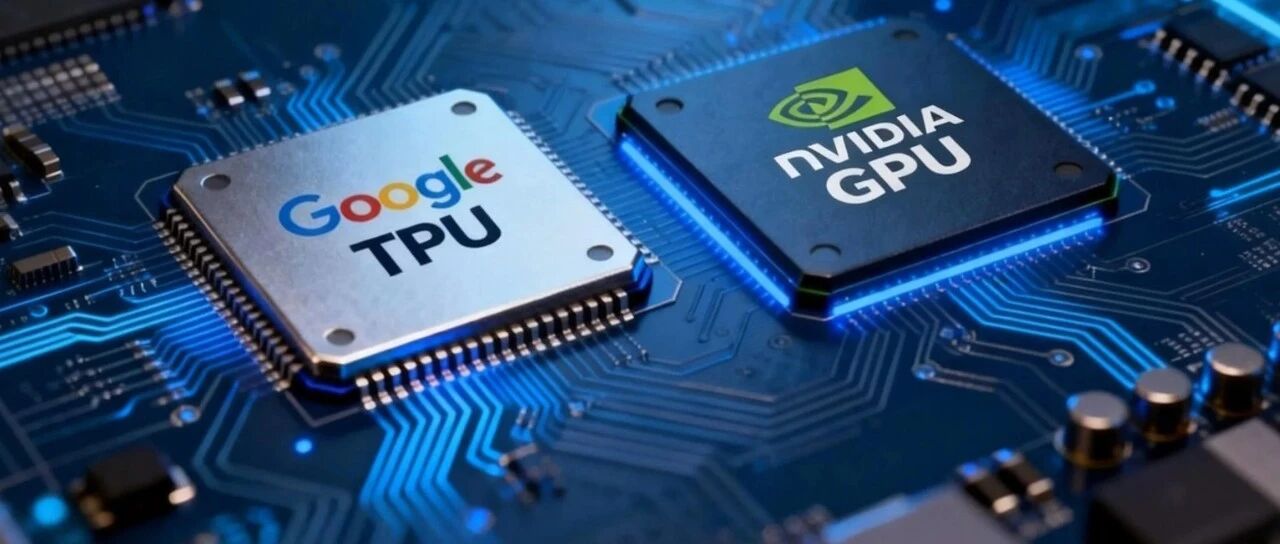
谷歌TPU杀疯了,产能暴涨120%、性能4倍吊打,英伟达还坐得稳吗?
机器之心· 2025-12-09 08:41
Core Viewpoint - Google's TPU is set to disrupt Nvidia's dominance in the AI chip market, with significant production increases and cost advantages for inference tasks [2][4][79]. Group 1: TPU Production and Market Strategy - Morgan Stanley predicts that Google's TPU production will surge to 5 million units by 2027 and 7 million by 2028, a substantial increase from previous estimates of 3 million and 3.2 million units, representing a 67% and 120% upward adjustment respectively [2]. - Google aims to sell TPUs to third-party data centers, complementing its Google Cloud Platform (GCP) business, while still utilizing most TPUs for its own AI training and cloud services [2][3]. Group 2: Comparison with Nvidia's GPU - Nvidia has historically dominated the AI chip market, controlling over 80% of it by 2023, but faces challenges as the market shifts from training to inference, where Google's TPU offers superior efficiency and cost advantages [8][12]. - By 2030, inference is expected to consume 75% of AI computing resources, creating a market worth $255 billion, growing at a CAGR of 19.2% [8][52]. Group 3: Cost and Efficiency Advantages of TPU - Google's TPU is designed for inference, providing a cost per hour of $1.38 compared to Nvidia's H100 at over $2.50, making TPU 45% cheaper [20]. - TPU's performance in inference tasks is four times better per dollar spent compared to Nvidia's offerings, and it consumes 60-65% less power [20][22]. Group 4: Industry Trends and Client Migration - Major AI companies are transitioning from Nvidia GPUs to Google's TPUs to reduce costs significantly; for instance, Midjourney reported a 65% reduction in costs after switching to TPU [34]. - Anthropic has committed to a deal for up to 1 million TPUs, highlighting the growing trend of companies seeking cost-effective solutions for AI workloads [35]. Group 5: Future Implications for Nvidia - Nvidia's profit margins, currently between 70-80%, may face pressure as Google captures even a small portion of the inference workload, potentially leading to over $6 billion in annual profit loss for Nvidia [22][59]. - The shift towards TPUs indicates a broader trend where companies are diversifying their AI infrastructure, reducing reliance on Nvidia's products [67].
首都在线跌2.04%,成交额2.26亿元,主力资金净流出233.79万元
Xin Lang Cai Jing· 2025-12-02 03:21
Core Viewpoint - Capital Online's stock has experienced a decline of 2.04% on December 2, with a current price of 20.60 CNY per share, while the company has seen a year-to-date increase of 48.09% [1] Financial Performance - For the period from January to September 2025, Capital Online reported a revenue of 926 million CNY, representing a year-on-year decrease of 12.05%. The net profit attributable to shareholders was -99.41 million CNY, showing a year-on-year increase of 32.11% [2] - The company has cumulatively distributed dividends of 20.57 million CNY since its A-share listing, with no dividends paid in the last three years [3] Stock Market Activity - As of December 2, the trading volume was 226 million CNY, with a turnover rate of 2.76% and a total market capitalization of 10.36 billion CNY [1] - The stock has appeared on the "Dragon and Tiger List" 16 times this year, with the most recent appearance on March 25, where it recorded a net buy of -174 million CNY [1] Shareholder Information - As of September 30, 2025, the number of shareholders decreased by 25.68% to 65,700, while the average circulating shares per person increased by 34.76% to 5,961 shares [2] - The second-largest circulating shareholder is Hong Kong Central Clearing Limited, holding 8.25 million shares, an increase of 4.72 million shares from the previous period [3] Business Overview - Capital Online, established on July 13, 2005, and listed on July 1, 2020, specializes in high-performance IDC services and cloud services. The revenue composition includes 49.89% from cloud hosting and related services, 45.83% from IDC services, and 4.28% from other income [1]