
新消费

Search documents
突如袭来!深圳,这18个人正在影响中国商界!
Sou Hu Cai Jing· 2025-08-14 16:28
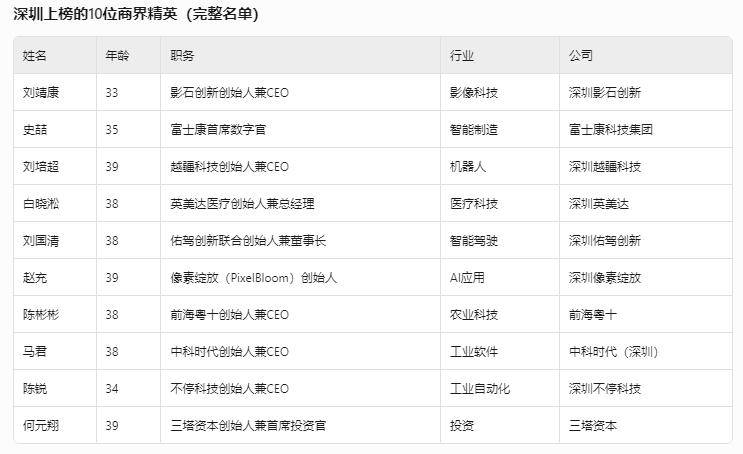
Group 1 - The "Fortune" (Chinese version) list of "China's 40 Under 40 Business Elites" showcases 10 influential business elites and 8 potential business elites from Shenzhen, highlighting the city's role as an innovation hub [1][5] - The list emphasizes the importance of young innovators who are not only focused on technological innovation but also on bridging gaps, understanding differences, and leading the future [4][5] - The current era is characterized as a transitional phase between "digital native" and "intelligent native," where AI is transforming human systems using data accumulated over the past 30 years [2][4] Group 2 - The list includes various sectors where young entrepreneurs are making significant contributions, such as artificial intelligence, healthcare, green technology, new consumption, and intelligent manufacturing [5] - The Shenzhen elites listed are involved in diverse industries, including imaging technology, smart manufacturing, robotics, medical technology, intelligent driving, AI applications, agricultural technology, industrial software, and automation [6][8][10][12][15][17][19][21][23][26][29] - The companies represented by these young leaders are recognized for their innovative approaches and significant market impact, such as Insta360, Foxconn, and Yuyuan Innovation, among others [8][10][12][15][19][21][26][29] Group 3 - The list of potential business elites includes individuals leading companies in AI and robotics, intelligent manufacturing, green technology, and investment, indicating a strong focus on future-oriented industries [29][30][32][34][36][38][40][41] - Notable companies among the potential elites include X Square Robot, SmartMore, and Angstrong Tech, which are pioneering advancements in robotics and AI technologies [30][34][36] - The achievements of these companies reflect a commitment to innovation and the development of solutions that address contemporary challenges in various sectors [30][34][36][38]

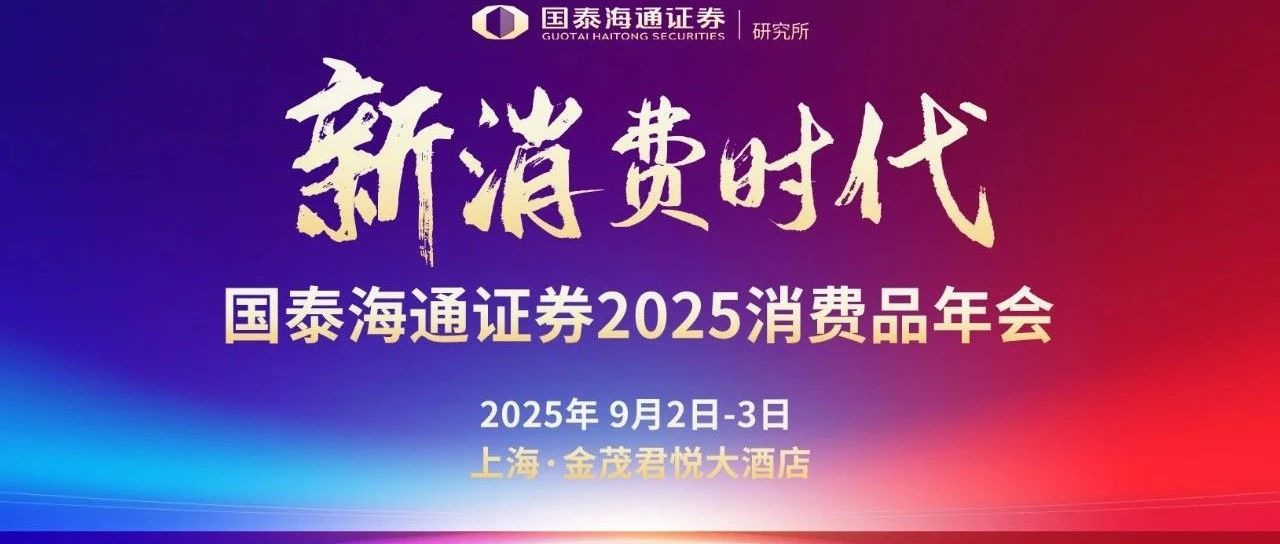
邀请函|国泰海通证券2025消费品年会-上海
国泰海通证券研究· 2025-08-14 13:29
Core Viewpoint - The article discusses the upcoming 2025 Consumer Goods Annual Conference organized by Guotai Junan Securities, focusing on future consumption trends, opportunities in various sectors, and the impact of demographic changes on consumer behavior [3][7]. Group 1: Conference Agenda Highlights - The conference will feature a keynote speech on future consumption trends from a demographic perspective by a population expert [7]. - Sessions will cover topics such as the resurgence of domestic beauty brands, the era of functional health products, and the jewelry industry in the new consumption era [7]. - A roundtable forum will discuss opportunities in the beauty industry, emphasizing growth and policy support [7]. Group 2: Industry Insights - The conference will address the high demand and technological innovations in the cleaning appliance sector, highlighting the interplay of policy, technology, and consumer needs [10]. - The luxury goods industry will be analyzed for trends and brand differentiation, providing insights into market dynamics [11]. - The pet economy's growth will be explored, identifying potential leading companies in this sector [11].
中泰资管天团 | 郑日:情绪强烈且易逝,如何理解新消费和情绪消费
中泰证券资管· 2025-08-14 11:33
Core Viewpoint - The article discusses the rise of "emotional consumption" as a significant trend in the capital market, particularly among younger consumers who prioritize emotional value alongside practicality and cost-effectiveness [1][4]. Group 1: Emotional Consumption Overview - Emotional consumption, also known as emotional spending, emphasizes the importance of emotional satisfaction in purchasing behavior, particularly among young people and singles [6]. - The trend of emotional consumption is linked to societal changes, such as Japan's aging population and declining marriage and birth rates, leading to a more individualized approach to consumption [6]. Group 2: Economic Context and Trends - Economic slowdowns often lead to a shift in consumer demand from functional to emotional value, as seen in historical contexts in both Japan and the U.S. [9]. - In Japan, post-bubble economic adjustments led to the growth of various sectors, including discount stores, pet economy, and virtual idol markets, highlighting the resilience of emotional consumption [9][10]. Group 3: Long-term Emotional Needs - Core emotional needs persist over time, but the forms of products and services evolve, requiring businesses to transform fleeting emotional sparks into lasting customer loyalty [13]. - Factors influencing the lifecycle of emotional consumption products include addictive design, social currency attributes, and cultural symbolism [14]. Group 4: Avoiding Homogenization - Emotional consumption products risk homogenization due to the ease of replicating emotional experiences through existing cultural symbols and marketing strategies [16]. - To maintain competitive advantage, companies must build an unreplicable emotional value chain and develop barriers through emotional technology, cultural integration, and dynamic social ecosystems [16].

给包凡的信 | Findme
投中网· 2025-08-14 09:37
Core Viewpoint - The article reflects on the return of a prominent figure in the investment banking industry, expressing a sense of anticipation and curiosity about the changes that have occurred during their absence, particularly in the context of evolving relationships and market dynamics [3][4]. Group 1: Industry Trends - The rise of generative AI has become a significant trend in the investment landscape, with major players like ChatGPT and xAI gaining attention and funding in 2023 [4][5]. - The "Big Model Six Dragons" emerged as key players in the AI sector, with numerous companies entering the market, indicating a rapid expansion and competition in AI technologies [6]. - New consumer companies, referred to as the "three sisters" in the Hong Kong stock market, have shown strong performance, suggesting emerging investment opportunities in the consumer sector [7]. Group 2: Personal Reflections and Relationships - The article discusses the evolution of personal relationships within the industry, questioning whether past friendships have changed and how perceptions of individuals have shifted over time [5][6]. - It highlights the importance of long-term relationships and the value of giving without immediate returns, reflecting a philosophy of trust and future potential [5]. - The narrative includes observations about various industry figures, noting their changing roles and public perceptions, which may influence future collaborations and opportunities [8][9]. Group 3: Company Dynamics - The article mentions the operational changes within a prominent investment firm, indicating a shift towards a more decentralized management structure, allowing for personal privacy and autonomy for key figures [10]. - It emphasizes the firm's successful fundraising efforts and the strategic decisions made in response to market conditions, showcasing adaptability in a fluctuating environment [10]. - The discussion includes the firm's historical context and its evolution over the past two decades, reflecting on its growth and the challenges faced [10][11].

0813港股日评:三大股指全线收涨,港股通商贸零售领涨-20250814
Changjiang Securities· 2025-08-14 04:41
Group 1 - The core viewpoint of the report indicates that the Hong Kong stock market experienced a significant rally, with all three major indices closing higher, driven by rising expectations of interest rate cuts by the Federal Reserve and sector rotation [2][9][10] - On August 13, 2025, the Hong Kong market's total trading volume reached HKD 284.04 billion, while southbound funds recorded a net sell of HKD 8.277 billion [2][9] - The Hang Seng Index rose by 2.58% to close at 25,613.67, while the Hang Seng Tech Index increased by 3.52% to 5,630.78, and the Hang Seng China Enterprises Index climbed 2.62% to 9,150.05 [7][9] Group 2 - The report highlights strong performances in specific sectors, with the retail trade sector leading with a 5.27% increase, followed by media at 4.45% and pharmaceuticals at 4.36% [7][9] - Tencent Music's half-year report showed a revenue increase of 13.43% year-on-year and a net profit growth of 115.85%, contributing to the media sector's overall rise [9][10] - The report anticipates that the Hong Kong stock market could reach new highs, driven by three core directions: the potential of AI technology and new consumption, continued inflow of southbound funds, and the impact of monetary policy changes in both China and the US [9][10]
基金经理年内最新10强揭晓!复胜陆航再夺百亿组冠军!国源李剑飞、榕树翟敬勇位列前3
私募排排网· 2025-08-14 03:36
Core Viewpoint - The A-share market in July exhibited characteristics of "index breakthrough, hot rotation, and increased trading volume," with the Shanghai Composite Index surpassing 3500 points for the first time on July 9 and closing above 3600 points at the end of the month. The private equity industry saw several fund managers achieve impressive performance amid the improving market conditions [2]. Summary by Categories Overall Performance - As of July 31, there were 533 fund managers with at least three products meeting ranking criteria, achieving an average return of 15.01% year-to-date. Among them, fund managers from firms with over 100 billion in assets had an average return of 17.82%, ranking first among six size groups [3][4]. Fund Manager Rankings - In the category of private equity firms with over 100 billion in assets, the top five fund managers based on performance included: 1. Lu Hang from Fusheng Asset 2. Yin Tao from Wenbo Investment 3. Zhan Haitao from Abama Investment 4. Xie Xiaoyang from Tianyan Capital 5. Jiang Yunfei from Jiuqi Investment [4][6]. Specific Fund Manager Insights - Lu Hang, the top fund manager, emphasized opportunities in new consumption and new technology, with his managed products showing significant returns [7]. - Zhan Haitao from Abama Investment, ranked third, has a background in quantitative investment and previously led ETF research at Everbright Securities [7][8]. - Xie Xiaoyang from Tianyan Capital, ranked fourth, has a strong academic background and extensive experience in trading and investment management [8]. Performance by Fund Size - In the 50-100 billion category, the top fund managers included: 1. Tong Xun from Tongxun Investment 2. Li Jianfei from Guoyuan Xinda 3. He Tianying from Tiansuan Quantitative [9][14]. - In the 20-50 billion category, the top managers were: 1. Li Jiajia from Haokun Shengfa 2. Xu Hongbing from Shenzhen Dream Factory [16][19]. - In the 10-20 billion category, the top managers included: 1. Sun Jie from Nengjing Investment 2. Cai Yingming from Longhang Asset 3. Zhai Jingyong from Rongshu Investment [20][24]. - In the 5-10 billion category, Liu Xianglong from Fuyuan Capital achieved the highest returns [25][27]. - In the 0-5 billion category, Yao Yong from Qinxing Fund ranked first [30][33]. Market Trends and Insights - The report highlights the increasing interest in sectors such as AI computing, new energy, and semiconductor industries, which are expected to be growth drivers in the coming years [24][35].
百亿主动权益基金仅20只!葛兰、张坤、谢治宇等纷纷“瘦身”!新星张璐夺冠!
私募排排网· 2025-08-14 03:36
Core Insights - The recent market recovery has led to an increase in the number of non-monetary funds exceeding 10 billion yuan, with 226 such funds reported as of the end of Q2, representing approximately 0.98% of the total, an increase of 34 funds from Q1 [4][5] - The number of active equity funds with over 10 billion yuan has stabilized at 20, with the new addition being the "Yongying Advanced Manufacturing Select C" fund managed by Zhang Lu [4][5] - The performance of these large-scale funds has improved significantly this year, with the average return of active equity funds being 14.31%, outperforming the CSI 300 index [5] Fund Performance - As of June 30, the total share of active equity funds was 31.2 trillion shares, a decrease of 129.7 billion shares (approximately 4%) from the end of last year [5] - The top-performing active equity fund this year is "Yongying Advanced Manufacturing Select C," with a return of 57.65% as of August 1, significantly higher than its benchmark return of 9.77% [9] - The largest active equity fund is "E Fund Blue Chip Select," managed by Zhang Kun, with a size of 34.943 billion yuan as of the end of Q2 [5] Key Holdings - The top five holdings of "Yongying Advanced Manufacturing Select C" include companies in the humanoid robot industry, such as Zhejiang Rongtai and Lingyun Shares, indicating a strong focus on this sector [9][10] - The "Zhongou Medical Health A" fund, managed by Guo Lan, has a significant holding in WuXi AppTec, which has seen a price increase of 31.14% since the end of Q2 [11][12] Investment Outlook - Zhang Lu from Yongying Fund emphasizes the importance of production ramp-up in core robotics companies and the supportive domestic policies for the robotics industry in the upcoming quarter [10] - Guo Lan highlights the potential for innovation drugs and structural opportunities in the consumer healthcare sector, particularly in medical aesthetics and home medical devices, as the economy recovers [13][14] - Xie Zhiyu from Xingzheng Global Fund suggests that sectors like innovative drugs, smart driving, and new consumption are more suitable for value investors due to their realistic performance support [17]

腾讯打头阵,大厂中报季来袭!恒生科技能否“牛回头”?
Sou Hu Cai Jing· 2025-08-14 01:47
过去数月,科网股走势"冰火两重天": 8月13日港股盘后,"港股的锚"—腾讯控股公布二季度财报数据。财报显示,AI技术及应用正加速转化为业绩动能。在资本开支同比三位数增长的高投 入背景下,当季腾讯实现营收1845亿元同比增长15%,同时实现毛利22%与经营利润(Non-IFRS)18%的双增长。 网易、腾讯等数字娱乐巨头势头强劲,股价频创阶段新高;而部分消费互联网权重股却因外卖竞争加剧而表现低迷。 当前,市场目光聚焦于AI与外卖两大领域,投资者密切关注管理层对未来资本开支、竞争补贴及"反内卷"策略的最新态度。 8月13日,恒生指数突破25000点,恒生科技指数飙升至5600点以上,其中腾讯音乐因财报大幅超预期而股价暴涨! 2025年二季度,腾讯研发投入达到202.5亿元,同比增长17%;资本开支191.1亿元,同比增幅达119%。 接下来,网易、京东、小米、百度、快手等大型科网股将于本轮财报季陆续公布相关业绩情况。 这一强势表现为即将到来的财报季增添了更多期待。哪些企业能交出亮眼成绩单?谁又将在绩后赢得资本青睐?还会有增量资金做多港股科技股吗? 中报披露高峰期,腾讯"打头阵" 就在本周,大型科技互联网公司的财 ...

新消费牛股 接连报喜
Shang Hai Zheng Quan Bao· 2025-08-13 15:37
Core Viewpoint - The new consumption sector in the Hong Kong stock market has shown strong performance in the first half of the year, with several companies reporting significant profit growth, leading to renewed optimism from investment institutions regarding the sector's future trajectory [1][6]. Group 1: Company Performance - Hong Kong-listed company Mao Geping expects a net profit of 665 million to 675 million yuan for the first half of the year, representing a year-on-year growth of 35% to 37% [1][4]. - Pop Mart announced a net profit growth of no less than 350% for the first half of the year, driven by increased global brand recognition and diverse product offerings [3][6]. - Lao Pu Gold anticipates a net profit increase of 279% to 288%, with expected revenues between 12 billion to 12.5 billion yuan, reflecting a year-on-year growth of 241% to 255% [3][4]. - Up Beauty expects a revenue of 4.09 billion to 4.11 billion yuan, with a profit growth of 30.9% to 35.8% [4][6]. - The food and beverage sector, represented by Guoquan, reported a revenue of 3.24 billion yuan, with a net profit growth of 122.5% [5][6]. Group 2: Market Trends and Analyst Insights - The new consumption sector has seen a surge in stock prices, with Lao Pu Gold up 220.12%, Pop Mart up 200.17%, and Up Beauty up 170.65% from January 1 to August 13 [2][6]. - Analysts express optimism about the new consumption sector, citing a shift in consumer preferences towards experiential and social consumption, which is driving demand for products in categories like trendy toys, tea drinks, and luxury jewelry [6][7]. - The current new consumption trend is characterized by structural growth driven by policy support, demographic changes, and technological advancements, with a focus on innovative products that meet evolving consumer needs [7][8].
新消费研究-情绪价值总论:始于情绪,终于情感,尊重时间,尊重经营
2025-08-13 14:53
Summary of Key Points from the Conference Call Industry Overview - The global healing economy is projected to reach $7 trillion by 2025, while China's emotional consumption market is expected to exceed 2 trillion RMB in the same year, with an annual compound growth rate exceeding 12% [1][2][3] - The cultural, film, and gaming industries are rapidly expanding, highlighting the importance of emotional value as a significant added value to products [1][3] Core Concepts and Arguments - Emotional value refers to the emotional satisfaction and psychological pleasure consumers derive from purchasing and using products. It encompasses both narrow emotional consumption sectors (e.g., trendy toys, stress-relief toys, emotionally-driven jewelry, and pets) and a broader range of products that must create emotional value [2][4] - Companies can enhance emotional value by improving product added value, increasing consumer pleasure, and boosting conversion rates. Traditional companies in sectors like pets, trendy toys, and jewelry have successfully attracted loyal users through innovative design and marketing strategies [1][4] - The Chinese market has vast potential for developing emotional value, with a focus on "starting with emotion and being loyal to management" to build sustainable, high-quality brand power [1][6] Risks and Considerations - The emotional value sector faces volatility risks, and investors should closely monitor industry dynamics and leading companies' performances while being cautious of over-reliance on single trends or short-term fads [1][7] - As GDP per capita increases, consumer demand is shifting from functional value to emotional and group value, indicating a need for companies to adapt to these changing consumer preferences [1][8] Market Dynamics - The increase in supply-side functional value disparity has concentrated asset value among a few brands, thereby elevating the importance of emotional value [1][10] - Rising incomes among younger generations (90s and 00s) drive higher demand for emotional value, as their spending structures differ significantly from previous generations [1][11] Strategic Insights - Companies should leverage AI and digital tools to capture consumer needs accurately and build a diverse product matrix to meet various consumer demands [2][16][17] - Agile supply chains are crucial for meeting emotional consumption needs, allowing companies to respond quickly to market changes [2][18] - Social media dynamics can enhance brand development and maximize channel efficiency by resonating emotionally with consumers [2][19] Case Studies and Examples - Companies like Bandai and Xiaomi exemplify successful emotional value strategies, with Bandai leveraging a mature platform for IP operations and Xiaomi transforming its automotive products into emotional carriers through user-centric design and ecosystem integration [2][21][27] - Shoujin Holdings demonstrates how social attributes can drive market value growth, emphasizing cultural representation and product quality [2][23] Conclusion - Emotional value is not limited to specific sectors but can be integrated into various traditional industries, suggesting a long-term strategic focus for companies aiming to enhance brand loyalty and consumer engagement [2][24][25] - Investors should remain vigilant against market exuberance and focus on sustainable growth factors to mitigate risks associated with emotional value investments [2][29]