
新型工业化

Search documents
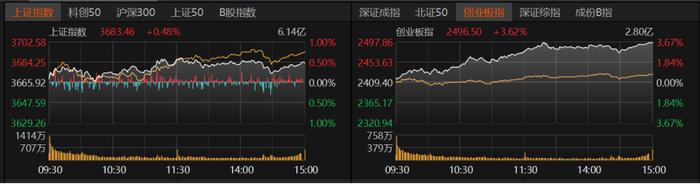
沪指“八连阳”,突破“9·24”高位
Guo Ji Jin Rong Bao· 2025-08-13 14:57
Market Overview - The A-share market continues to rise, with the Shanghai Composite Index breaking through the previous high of 3674.4 points, and the ChiNext Index increasing by nearly 4% [1][9] - The trading volume has expanded, reaching approximately 2.2 trillion yuan, indicating strong market activity [2][9] Sector Performance - Among the 31 primary industries, 22 sectors saw gains, with the telecommunications sector leading at a 4.91% increase, followed by non-ferrous metals and electronics, both exceeding 2% [4][5] - Notable stocks in the telecommunications sector include Guangku Technology and Beiwai Technology, which hit the daily limit [4] - The healthcare, power equipment, defense, machinery, automotive, non-bank financials, and computer sectors also performed well, with several stocks reaching their daily limit [4] Investment Sentiment - Recent policies aimed at stabilizing growth and boosting domestic demand have positively influenced market confidence, alongside a continuous inflow of northbound capital [9][10] - Analysts suggest that the current market is in a mid-bull phase, with potential opportunities in AI-related industries, innovative pharmaceuticals, and gold [10][11] Short-term Outlook - There is a cautionary note regarding the ChiNext Index, as short-term profit-taking may lead to a need for consolidation, advising against chasing high prices [1][11] - The market is expected to maintain a structural trend, with a focus on low-valuation, high-dividend stocks and technology innovation as primary investment themes [11][12]

低利率环境:哪些企业盈利更稳定?
2025-08-13 14:53
Summary of Key Points from Conference Call Records Industry Overview - The conference call discusses the performance of various industries, particularly focusing on industrial enterprises, public utilities, and manufacturing sectors in a low-interest-rate environment. The overall profit share of industrial enterprises is expected to remain above 15% in 2023-2024, with a slight decline to 12.5% in the first half of 2025, still higher than the pre-pandemic average of 5.9% [1][2]. Core Insights and Arguments - **Profit Recovery in Key Sectors**: Industrial enterprises' profit share has significantly rebounded, with public utilities also seeing an increase to 12.1% as of mid-2023, up from a pre-pandemic average of 6.9% [2]. - **Manufacturing Sector Decline**: Manufacturing profit share has decreased to approximately 75%, with export-oriented industries like computers and electronics maintaining stable profits due to overseas demand recovery [1][2]. - **Mining Sector Volatility**: The mining sector's profits have been affected by fluctuations in the Producer Price Index (PPI), with a notable decline in 2023 due to commodity price adjustments and insufficient demand [1][4]. - **Investment Returns**: High capital return rates are observed in public utilities, coal, and petrochemical sectors, while the real estate sector shows lower returns, particularly since 2021 [5]. Additional Important Insights - **Driving Factors for Profit Changes**: Key drivers include price fluctuations, overseas demand, policy support for equipment updates, and consumer recovery in sectors like beverages and metals [4]. - **Sector-Specific Performance**: High-performing sub-sectors include energy metals, coal, oil and gas extraction, aerospace, and electronics, with strong growth potential in smaller segments despite overall weaker performance in some primary categories [6]. - **Impact of PPI on Utilities**: A decrease in mining PPI has alleviated cost pressures for public utilities, leading to a recovery in profit margins, although this trend may reverse due to insufficient end-demand [7]. - **China's Export Dynamics**: China's export share has improved due to pandemic-related shifts, with a temporary recovery in 2023-2024 driven by inventory replenishment in Western manufacturing [8]. - **Outward Expansion of Chinese Enterprises**: The trend of Chinese companies expanding overseas has positively impacted profitability, particularly in home appliances, non-ferrous metals, and machinery sectors [9][10]. - **Policy Support for Emerging Industries**: Recent industrial policies emphasize the importance of maintaining industrial security and promoting new industrialization, benefiting sectors like energy metals and biomanufacturing [11]. - **Growth Potential in Service Consumption**: There is significant potential for growth in service consumption, with government initiatives aimed at enhancing domestic demand and expanding service sectors such as health care and home services [12].
可转债周报 | 继续走高,转债ETF规模均创历史新高
Xin Lang Cai Jing· 2025-08-13 08:40
Policy Tracking - The central bank and seven departments issued guidelines to support new industrialization, encouraging financial institutions to assign financial officers to key industry chain enterprises, advanced manufacturing clusters, and national high-tech industrial development zones [5][6] - The Ministry of Industry and Information Technology and seven departments released implementation opinions to promote the innovation and development of the brain-computer interface industry, outlining five key tasks and 17 specific measures [5][6] Secondary Market - The equity market saw a collective rise in major indices, with the Shanghai Composite Index, Shenzhen Component Index, and ChiNext Index increasing by 2.11%, 1.25%, and 0.49% respectively [7] - The convertible bond market followed suit, with major indices rising by 2.31%, 2.25%, and 2.42% for the China Convertible Bond Index, Shanghai Convertible Bond Index, and Shenzhen Convertible Bond Index respectively [8][10] - Daily average trading volume in the convertible bond market exceeded 900 billion yuan, with a significant net subscription of 37.11 billion yuan in convertible bond ETFs, marking the seventh consecutive week of growth [10][12] Market Overview - The convertible bond market's total outstanding size reached 6,513.45 billion yuan, a decrease of 825.48 billion yuan since the beginning of the year [35] - The average price of convertible bonds rose to 146.24 yuan, with a median price of 130.12 yuan, reflecting a 3.88 and 3.1 yuan increase respectively from the previous week [30] - The market is expected to continue its upward trend due to a "slow bull" equity market and strong demand dynamics, despite potential performance risks as the earnings disclosure period approaches [12]

格力博涨0.22%,成交额3.16亿元,近5日主力净流入-1348.44万
Xin Lang Cai Jing· 2025-08-13 08:26
Core Viewpoint - Greebo is expanding its product offerings in the electric garden machinery sector, focusing on new markets and innovative products, while benefiting from the depreciation of the RMB and strategic partnerships in robotics [2][4][7]. Group 1: Company Overview - Greebo (Jiangsu) Co., Ltd. specializes in the research, design, production, and sales of new energy garden machinery, with a revenue composition of 74.25% from new energy garden machinery, 14.40% from AC electric garden machinery, and 11.35% from other sources [7]. - The company was established on July 2, 2002, and went public on February 8, 2023 [7]. Group 2: Market Expansion and Product Development - Greebo has successfully launched go-karts and motorcycles in U.S. supermarkets, receiving positive consumer feedback, and plans to introduce more products like bicycles and scooters to maintain its market leadership [2]. - The brand Greenworks has gained significant recognition in North America and Europe, with several products consistently ranking as bestsellers on Amazon [2]. Group 3: Financial Performance - For the first quarter of 2025, Greebo reported a revenue of 1.535 billion yuan, a year-on-year decrease of 6.14%, while net profit attributable to shareholders increased by 36.93% to 178 million yuan [8]. - The company has distributed a total of 29.996 million yuan in dividends since its A-share listing [9]. Group 4: Strategic Partnerships - Greebo has formed a strategic partnership with Zhiyuan Robotics to jointly explore the global robotics market, focusing on high-end smart products in the U.S. market, including quadruped robotic dogs and humanoid robots [2].
租”力全开 为新型工业化装上“加速齿轮
Jin Rong Shi Bao· 2025-08-13 04:04
Core Insights - The financing leasing industry is focusing on transforming its traditional model to better integrate into the real industrial chain, enhancing its role as a "device updater" and "technology upgrader" in the new industrialization process [1][3] Industry Development - As of June 2025, there are approximately 7,020 financial leasing and financing leasing companies in China, with a total contract balance of about 5.42 trillion yuan [2] - The industry is encouraged to rely on policy support to accelerate transformation and expand its influence [2] Policy Guidance - The People's Bank of China and seven other departments issued guidelines to support new industrialization, emphasizing the dual functions of financing and asset leasing [3] - The guidelines aim to deepen the collaboration between financing leasing and key sectors such as electronic information, aviation manufacturing, and green low-carbon industries [3] Green Leasing Initiatives - Hebei Province has implemented a series of supportive policies for independent energy storage projects, including a direct leasing business for energy storage equipment worth 176 million yuan [4] - Experts suggest that financial leasing companies should innovate green leasing products, integrating tools like "green bonds" and "carbon finance" [4] Financial Innovation - A notable policy initiative is the promotion of asset securitization for manufacturing financing leasing, which is expected to enhance liquidity and expand funding sources [5][6] - This initiative will help leasing companies optimize asset management and improve funding allocation efficiency [6] Infrastructure Support - The guidelines also emphasize the importance of supporting digital infrastructure construction through long-term loans and various financing methods [7] - Financing leasing companies are encouraged to provide support to service providers in digital transformation, creating a closed-loop ecosystem [7] Collaborative Efforts - The guidelines call for enhanced cooperation among various financial institutions to mitigate risks and improve information sharing [8] - Financing leasing institutions are encouraged to develop service systems that combine leasing with guarantees, securities, and equity investments to support advanced manufacturing [8]
2025年7月图说债市月报:金融赋能新型工业化转型升级,关注制造业债券投资机遇-20250813
Zhong Cheng Xin Guo Ji· 2025-08-13 03:32
Group 1 - The report emphasizes the importance of financial support for the new industrialization transformation, highlighting investment opportunities in manufacturing bonds due to favorable policies [5][6][7] - The July manufacturing PMI is reported at 49.3, indicating a contraction in the manufacturing sector, with new orders and production indices also showing declines [8][26] - The issuance of credit bonds decreased in July, totaling 12,455.3 billion, a reduction of 1,471.83 billion from the previous month, while the net financing amount decreased to 2,787.19 billion [10][38] Group 2 - The report notes that the average issuance rates for credit bonds generally declined, with specific examples showing decreases between 2-29 basis points, while some specific bonds saw slight increases [39][40] - The report indicates that the credit risk remains manageable, with a rolling default rate of 0.23% in July and no new defaulting entities [14][16] - The report highlights the ongoing tightening of implicit debt regulation, emphasizing the need to prevent "the risk of risk disposal" [18][19]
聚焦新型工业化 信托行业如何破题
Jin Rong Shi Bao· 2025-08-13 02:54
从智能网联汽车到空天经济,从半导体与集成电路制造到具身智能机器人,这些引领未来发展的领 域有一个共同标签——新型工业化。 何谓新型工业化?在业内人士看来,新型工业化是在信息化、自动化、智能化的背景下,通过技术 创新和产业升级实现的工业生产方式的变革。 近日,中国人民银行等七部门联合印发《关于金融支持新型工业化的指导意见》(以下简称《指导 意见》),强调加强金融支持新型工业化能力建设,旨在提升金融服务新型工业化效能。 作为我国金融体系的重要组成部分,信托业在服务实体经济方面具有重要作用。中国信托业协会发 布的《2024年度中国信托业发展评析》显示,2024年,信托业将22.25万亿元资金信托中占比28.81%的 资金直接投向实体经济部门,并通过证券市场将占比46.17%的资金间接支持实体经济部门,两者合计 资金量达到16.68万亿元。 在此背景下,聚焦新型工业化,信托公司可以怎样做? 产融结合 回归本源 赋能科技 推动创新 科技创新是新型工业化的核心动力,而长期资本的注入则是科技企业成长的关键支撑。 值得注意的是,《指导意见》提到要"引入长期资金和发展耐心资本,加快科技成果转化""推动社 会资本投早、投小、投长 ...
以金融活水滋养工业发“新枝”
Jin Rong Shi Bao· 2025-08-13 02:54
Core Insights - The financial support for new industrialization is crucial for driving the transformation of traditional industries and fostering emerging sectors, enhancing the resilience of industrial supply chains [2][4] - The recent data indicates a significant increase in medium to long-term loans for the manufacturing sector, reflecting the robust financial backing for industrial development [1][2] Group 1: Financial Support Mechanisms - The People's Bank of China reported a 10.7% year-on-year growth in the balance of medium to long-term loans for the industrial sector, reaching 26.27 trillion yuan by the end of Q2 2025, with an increase of 1.74 trillion yuan in the first half of the year [1][2] - The issuance of green and technology-related bonds exceeded 1 trillion yuan in the first half of this year, showcasing the financial sector's commitment to supporting sustainable industrial practices [1][2] Group 2: Policy Initiatives - The "Guiding Opinions" released by the People's Bank of China and seven other departments outlines 18 targeted measures to optimize financial services for traditional manufacturing, enhance the synergy of various financial tools, and strengthen policy incentives [2][4] - The dual drive of precise policy implementation and market mechanism improvement is pivotal in leveraging financial support for industrial transformation and upgrading [2][4] Group 3: Financing Innovations - Financial innovations such as tailored leasing solutions for high-tech equipment and operational leasing for low-altitude economy aircraft are addressing the capital-intensive needs of the manufacturing sector [3][4] - A comprehensive financial support system is being established to facilitate the entire innovation cycle, from R&D to mass production, ensuring that financial services are aligned with the specific needs of technology-driven enterprises [4][5] Group 4: Talent Development - The cultivation of compound talents who understand both technology and finance is essential for effectively matching financial products with the needs of innovative industries [5] - Initiatives such as interdisciplinary training in universities and industry qualification certification are being implemented to enhance the skill sets of professionals in the finance and technology sectors [5]
“租”力全开 为新型工业化装上“加速齿轮”
Jin Rong Shi Bao· 2025-08-13 02:54
Core Insights - The financing leasing industry is focusing on transforming its traditional model to better integrate into the real industrial chain, enhancing its unique advantages of "financing + asset utilization" to support new industrialization [1][3] - The industry aims to play a crucial role as an "equipment renewal accelerator" and "technology upgrade booster" in the new industrialization process, requiring a shift from being merely a "funding provider" to becoming an "industry service provider" [1][3] Industry Development and Scale - As of June 2025, there are approximately 7,020 financial leasing and financing leasing companies in China, with a total contract balance of about 5.42 trillion yuan [2] Policy Support and Guidance - The People's Bank of China and seven other departments issued the "Guiding Opinions on Financial Support for New Industrialization," emphasizing the dual functions of financing leasing in supporting digital transformation and green equipment acquisition [3][5] - The guiding opinions provide a clear policy direction for the financing leasing industry to participate in the manufacturing sector's transformation and upgrading [3] Focus Areas and Strategic Directions - The financing leasing industry is expected to deepen its collaboration with key sectors such as electronic information, aviation manufacturing, digital agriculture, and green low-carbon initiatives [3] - The unique "asset utilization" function of financing leasing is highlighted as a significant advantage in supporting the high-end, intelligent, and green development of manufacturing [3] Innovative Financial Solutions - A notable policy initiative includes promoting the securitization of manufacturing financing leasing debt assets, which is expected to enhance liquidity and expand funding sources for leasing companies [5][6] - The industry is encouraged to provide financing support for digital infrastructure projects, including 5G and industrial internet, to facilitate the digital transformation of enterprises [7] Collaborative Efforts and Ecosystem Building - The guiding opinions stress the importance of collaboration among various financial institutions to enhance information sharing and business cooperation while mitigating financial risks [8] - Financing leasing companies are encouraged to create service systems that integrate leasing with guarantees, securities, and equity investments to support advanced manufacturing [8]
从产品创新到长线资金布局 保险业全链条护航新型工业化
Jin Rong Shi Bao· 2025-08-13 01:27
Group 1 - The People's Bank of China and six other departments issued guidelines to support new industrialization, proposing 18 targeted measures to enhance the financial system for manufacturing by 2027 [1] - The insurance industry is developing a service ecosystem covering the entire lifecycle of technological innovation, including trial insurance to facilitate technology transfer and comprehensive insurance for innovation processes [1][2] - A pilot project in Zhoushan, Zhejiang, has implemented a "trial insurance + comprehensive financial support" model, providing 1 billion yuan in bank support and 1 billion yuan in insurance coverage for technology companies [2] Group 2 - The first trial insurance for drug research and development was established in Wuhan, focusing on risk coverage during the trial phase, addressing a significant gap in the market [3] - A large insurance company suggests establishing a compensation mechanism for trial insurance to cover specific losses, gradually transforming "uninsurable risks" into "insurable risks" [4] - The insurance sector is encouraged to develop various technology insurance products to support the transformation and upgrading of manufacturing and safeguard data asset security [5][6] Group 3 - The insurance industry is expected to provide approximately 9 trillion yuan in technology insurance coverage and invest over 600 billion yuan in technology enterprises by 2024 [6] - Multiple insurance companies are innovating technology insurance products tailored to the needs of technology enterprises, covering various stages from research and development to application [7] - Policies are being implemented to facilitate insurance capital flow into key areas of new industrialization, with a focus on long-term stable funding for advanced manufacturing [8][9] Group 4 - Recent regulatory changes have reduced the institutional costs for insurance investments in strategic emerging industries, stimulating investment activity in sectors like artificial intelligence and big data [9][10] - Insurance funds can utilize diversified investment tools to meet the funding needs of technology enterprises at different development stages, including convertible bonds and corporate venture capital [11]