
生成式AI

Search documents
海通国际给予知乎"优于大市"评级,港股目标价14.8港元
Ge Long Hui· 2025-12-03 05:38
Group 1 - Haitong International initiated coverage on Zhihu with an "outperform" rating, highlighting its unique position in the Q&A community and the potential of AI applications [1][2] - Zhihu's total revenue for Q3 2025 is projected to be approximately 659 million yuan, with a 16.3% year-on-year reduction in non-GAAP operating losses, indicating improved operational efficiency and quality [1] - As of the end of Q3, Zhihu's cash and cash equivalents, along with short-term investments, totaled 4.58 billion yuan, demonstrating a strong cash reserve [1] Group 2 - Haitong International believes Zhihu's high user engagement and trust in the "professional discussion" space will continue to attract high-value users and brand budgets [2] - The firm predicts Zhihu's total revenue for Q4 2025 and the fiscal year 2025 to be 640 million yuan and 2.75 billion yuan, respectively, with a target price of 14.8 HKD based on a price-to-sales ratio of 1.2 times for FY 2025 [2] - The integration of generative AI in Q&A expansion, personalized recommendations, and advertising creative generation is expected to enhance content supply and commercial conversion efficiency on the platform [2]
目标价上调至370美元!汇丰:Gemini 3成功让谷歌(GOOGL.US)搜索“转守为攻”
智通财经网· 2025-12-03 03:00
Core Viewpoint - HSBC believes that Google's Gemini 3 series of large language models has mitigated potential disruption risks to its search business from generative AI, enhancing confidence in Google's ability to maintain and grow its market share [1]. Group 1: Analyst Insights - Analyst Paul Rossington considers Gemini 3 Pro to be superior to ChatGPT 5.1, which strengthens confidence in Google's search market position [1]. - Based on the positive outlook for Gemini 3, Rossington maintains a "buy" rating for Google and raises the target price from $335 to $370 [1]. Group 2: Future Projections - If Google successfully commercializes TPU externally, it could generate revenue equivalent to 10% of Nvidia's (NVDA.US) revenue by 2030, potentially adding about 6% to Google's current market value [1]. - There are reports that Meta (META.US) is in discussions with Google regarding TPU collaboration [1]. Group 3: Strategic Developments - The complete AI strategy is making substantial progress through the release of Gemini 3 and the potential external commercialization of TPU, which will inject new momentum into Google's long-term development prospects [2].

AI芯片大战升级!亚马逊推出首款3nmAI芯片Trainium 3,挑战英伟达、谷歌
Tai Mei Ti A P P· 2025-12-03 02:12
Core Insights - The competition in the AI chip sector is intensifying, with Amazon launching its new AI chip Trainium 3, which is designed for high-performance generative AI workloads [2][3] - Trainium 3 is built on a 3nm process and manufactured by TSMC, offering significant improvements over its predecessor, Trainium 2 [2] - AWS emphasizes the cost-effectiveness of Trainium chips, claiming they can reduce training and inference costs by 50% compared to equivalent GPU systems [5] Group 1: Product Features and Performance - Trainium 3 boasts a computing power that is 4.4 times greater than the previous generation, with a memory bandwidth that is four times higher and a 40% increase in energy efficiency [3] - The new Trainium 3 UltraServer can deploy up to one million Trainium 3 chips, increasing the deployment capacity tenfold [3] - Each Trainium 3 chip integrates 144GB of high-bandwidth memory, while competitors like Google's TPU and NVIDIA's latest offerings have higher memory capacities [3][4] Group 2: Market Position and Competition - AWS has not provided direct performance comparisons between Trainium 3 and competitors like NVIDIA and Google, which raises questions about its competitive standing [3][6] - NVIDIA maintains a strong market position, with its CFO asserting that no competitors can challenge its dominance, citing the company's ecosystem and standards [6] - Despite competition, AWS and NVIDIA announced a collaboration to integrate NVIDIA's NVLink Fusion technology into future Trainium chips, enhancing interconnectivity and server communication [8] Group 3: Market Adoption and Future Prospects - Trainium 3's initial customer base is limited, primarily serving companies like Anthropic, which has a close relationship with AWS [10] - AWS aims to replicate the architecture developed for Anthropic on new servers to attract larger clients, although Anthropic has multiple chip options, including NVIDIA's products [10] - AWS's broader strategy includes launching various AI models and services, indicating a commitment to vertical integration in the AI space [11][12]





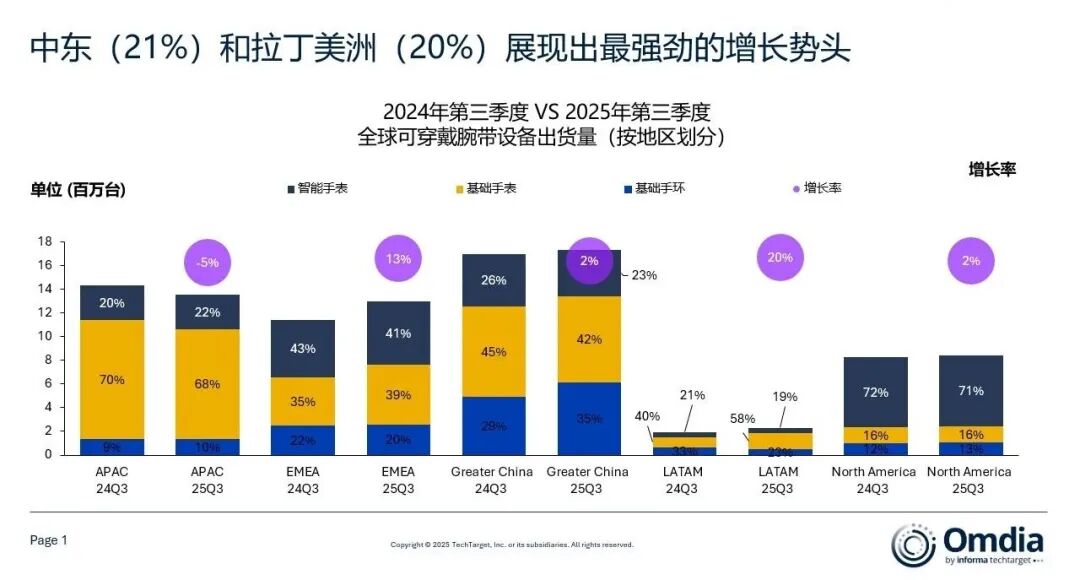
Omdia:三季度全球可穿戴腕带设备市场小幅增长3% 出货量达到5460万台
Zhi Tong Cai Jing· 2025-12-03 01:43
Core Insights - The global wearable wristband device market is projected to see a slight growth of 3% in Q3 2025, with shipments reaching 54.6 million units. Despite limited shipment growth, market value is expected to surge by 12% year-on-year, reaching $12.3 billion, indicating a consumer shift towards higher-end wearable devices [1][4]. Market Overview - The average selling price (ASP) has increased by 9% year-on-year to $225, driven by leading market players. The top five manufacturers—Xiaomi, Apple, Huawei, Samsung, and Garmin—account for 84% of the market value and 63% of the shipment volume, putting pressure on smaller companies in terms of price competition and user acquisition [4][6]. Dual-Track Strategy - Leading manufacturers are successfully implementing a dual-track strategy targeting specific price segments. In the entry-level market, basic bands have rebounded by 12%, primarily driven by Xiaomi, Huawei, and Samsung. The segment priced between $50 and $99 has seen a significant growth of 56%, while the segment below $50 has declined by 2%. In the smartwatch category, the mid-range segment priced between $200 and $300 has grown by 21%, while the $300 to $500 segment has decreased by 8% [6][7]. High-End Market Growth - The high-end market is experiencing revenue growth driven by advancements in AI and 5G technologies. Manufacturers are focusing on advanced differentiation capabilities rather than competing solely on price, incorporating enhanced computing power, application support, and connectivity features [7][8]. New Models and Innovations - New models are significantly boosting the high-end market, with price segments of $500-$700 and above $700 growing by 29% and 34% year-on-year, respectively. Companies are exploring new areas to drive premiumization, integrating AI coaching into devices. The latest Apple Watch Series 11 has entered the 5G era, and both Apple and Garmin have added emergency satellite communication features to their flagship outdoor watches. Although smartwatch shipments are expected to grow only 1% in Q3 2025, the shipment value is projected to increase by 8%, indicating a shift towards premiumization [8].

埃森哲成了OpenAI的“布道者”,中国的“华与华”们却在卖营销方案 | 马上评
Tai Mei Ti A P P· 2025-12-03 01:11
Core Insights - OpenAI and Accenture have formed a strategic partnership aimed at accelerating AI transformation in Western enterprises, marking a potential new era for AI adoption in the region [1][3]. Group 1: Partnership Details - Accenture will equip its thousands of IT professionals with ChatGPT Enterprise and act as OpenAI's primary partner to help global businesses adopt and deploy generative AI technology [3]. - The collaboration aims to address key challenges faced by enterprises in effectively integrating AI into their workflows, moving beyond mere technical licensing [3][4]. Group 2: Challenges in AI Transformation - Many enterprises struggle to realize significant business value from AI, often limiting their efforts to pilot projects without achieving scalable applications [3][4]. - A lack of understanding among executives regarding the complexities of AI transformation leads to underestimating the challenges of data governance, talent acquisition, and cross-department collaboration [4][5]. - AI transformation requires deep involvement from top management to align strategy, allocate resources, and foster a culture that supports continuous iteration and scaling [4][5]. Group 3: Talent and Organizational Barriers - There is a scarcity of cross-disciplinary talent who understand both AI technology and business needs, making it difficult for companies to fill this gap through short-term hiring [5][6]. - Organizational inertia and departmental silos hinder the effective application of AI, as different departments often operate independently, preventing end-to-end optimization of business processes [5][6]. Group 4: Comparison of Global Approaches - Western enterprises are generally more willing to invest in consulting services to address internal management and operational challenges, while Chinese companies tend to rely on internal teams and lack systematic planning for AI transformation [6][7]. - Accenture's recent financial report indicates a threefold increase in revenue related to generative AI and a significant investment plan to optimize its business for AI-related initiatives [7][8]. Group 5: Market Dynamics in China - Chinese enterprises possess unique advantages in AI, such as vast data resources and market potential, but face challenges in professional consulting services for deep process transformation [7][8]. - The lack of specialized consulting firms in China limits the ability to effectively implement AI transformations, as many local firms focus on short-term projects rather than long-term strategic investments [8].


AI ASIC需求继续狂飙!迈威尔(MRVL.US)净利润暴增876% 豪掷32.5亿美元押注光互连
智通财经网· 2025-12-03 00:28
Core Viewpoint - Marvell Technology (MRVL) reported strong Q3 earnings and raised its revenue outlook, highlighting the robust demand for AI ASIC chips in the data center market, particularly in competition with Nvidia's AI GPU technology [1][3]. Financial Performance - For Q3 of FY2026, Marvell's total revenue reached $2.07 billion, a 37% year-over-year increase, slightly above Wall Street's expectation of $2.05 billion [3]. - Non-GAAP earnings per share (EPS) were approximately $0.76, exceeding the analyst consensus of $0.74 and up from $0.43 in the same quarter last year [3]. - The company reported a GAAP net profit of approximately $1.9 billion, a significant increase from a net loss of $676 million in the same quarter last year [3]. Future Outlook - Marvell's management expects Q4 revenue to be around $2.2 billion, which is significantly higher than the analyst average estimate of $2.18 billion [2]. - The company anticipates total revenue for the next fiscal year to reach approximately $10 billion, with a projected 25% growth in data center business revenue [2]. Strategic Acquisition - Marvell announced a $3.25 billion acquisition of Celestial AI, a startup focused on optical interconnect technology, to enhance its networking product portfolio [1][4]. - The acquisition is expected to leverage Celestial AI's research in silicon photonics, which could significantly improve AI model performance and energy efficiency in data centers [4][5]. Market Dynamics - The demand for AI ASIC technology is expected to grow exponentially, driven by the increasing need for AI computing infrastructure [8]. - Marvell and its competitor Broadcom are collaborating with major cloud providers like Amazon and Google to develop customized AI ASIC solutions for their data centers [3][4]. Competitive Landscape - The competition in the AI ASIC market is intensifying, particularly with Broadcom, as both companies aim to capture a larger share of the growing demand for AI computing solutions [1][4]. - Analysts have noted a bullish sentiment towards both Marvell and Broadcom, with target price increases reflecting confidence in their future performance [13].


ChatGPT三岁生日,谷歌却为它准备了“葬礼”
虎嗅APP· 2025-12-02 23:55
Core Insights - The article reflects on the transformative impact of ChatGPT and generative AI over the past three years, highlighting the shift from initial excitement to widespread anxiety among various stakeholders [10][11]. - The competitive landscape has evolved significantly, with Google’s Gemini 3 emerging as a formidable challenger to OpenAI, marking a pivotal moment in the AI industry [17][34]. Group 1: Evolution of AI Technology - OpenAI has maintained a leading position in AI technology with advancements through GPT-3.5, GPT-4o, and GPT-5, which have set benchmarks in speed, reasoning, and accuracy [22][23]. - The initial phase of AI development was characterized by human-like interactions, with a focus on dialogue and prompt engineering, which has since been disrupted by rapid advancements in AI capabilities [24][25][28]. Group 2: Market Dynamics and Competition - Google has successfully repositioned itself in the AI race with the launch of Gemini, which has significantly increased its user engagement, reaching 650 million monthly active users [37]. - Despite OpenAI's dominance with over 800 million weekly users, the time users spend interacting with Gemini has surpassed that of ChatGPT, indicating a shift in user preference [39]. Group 3: Financial Strategies and Risks - OpenAI is leveraging a debt-supported growth strategy, with partners like Oracle and SoftBank collectively bearing nearly $100 billion in debt to support OpenAI's infrastructure needs [53][54]. - OpenAI's financial strategy involves utilizing external funding to minimize its own financial risk, as it has not significantly tapped into its credit lines [55][56]. Group 4: Future Outlook - The competitive pressure is mounting on OpenAI, with expectations for rapid monetization and the need to maintain operational focus amidst increasing scrutiny [45][46]. - Experts suggest that OpenAI's extensive application matrix could provide new revenue streams, potentially stabilizing its financial position despite current challenges [65].

海通国际给予知乎“优于大市”评级 看好其社区价值和AI应用前景
Zheng Quan Ri Bao Wang· 2025-12-02 11:45
Core Insights - Haitong International initiates coverage on Zhihu with an "outperform" rating, highlighting its unique positioning in the Q&A community and the potential of AI applications [1][2] Financial Performance - In Q3 2025, Zhihu reported total revenue of approximately 659 million yuan, with a non-GAAP operating loss narrowing by 16.3% year-on-year, indicating improved operational efficiency and quality [1] - Zhihu's cash reserves are robust, totaling 4.58 billion yuan as of the end of Q3, which includes cash and cash equivalents, time deposits, restricted funds, and short-term investments [1] Strategic Initiatives - The company is actively optimizing operations to eliminate inefficiencies, which has resulted in a slight loss as part of its investment in sustainable long-term operations [1] - Zhihu has implemented share buybacks and cost-reduction measures to strengthen its capital and profit flexibility, with positive expectations for profitability and margin improvement in 2025-2026 [1] AI Development - Zhihu's AI application, Zhihu Zhidao, has seen significant growth, with its penetration rate exceeding 15% by the end of Q3, nearly four times the level from the same period last year [1] - Future upgrades for Zhihu Zhidao will enhance AI capabilities across various scenarios, including search, content creation, and consumption, further increasing AI usage within the community [1] Market Outlook - Haitong International anticipates Zhihu's total revenue for Q4 2025 and the fiscal year 2025 to be 640 million yuan and 2.75 billion yuan, respectively, with a projected price-to-sales ratio of 1.2 times for FY 2025 [2]

海通国际给予知乎“优于大市”评级,看好其社区价值和AI应用前景
Zhi Tong Cai Jing· 2025-12-02 10:47
Group 1 - Haitong International initiated coverage on Zhihu (02390) with an "outperform" rating, highlighting its unique positioning in the Q&A community and the potential of AI applications [1][2] - The company forecasts Zhihu's target price at HKD 14.8 for 2025, with projected total revenue of approximately RMB 6.59 billion for Q3 2025 and a non-GAAP operating loss narrowing by 16.3% year-on-year [1][2] - Zhihu's cash reserves are robust, totaling RMB 4.58 billion as of the end of Q3, which supports its capital and profit flexibility [1] Group 2 - The usage and penetration of Zhihu's AI product, Zhihu Zhida, have been steadily increasing, with a penetration rate exceeding 15%, nearly four times that of the same period last year [1] - Haitong International believes that Zhihu's high user engagement and trust in its "professional discussion" space will continue to attract high-value users and brand budgets, benefiting from the generative AI trend [2] - The firm predicts Zhihu's total revenue for Q4 2025 and the fiscal year 2025 to be RMB 640 million and RMB 2.75 billion, respectively, with a projected price-to-sales ratio of 1.2 times [2]
12.2犀牛财经晚报:六大行全面停售5年期大额存单 11月A股新开户数238万户
Xi Niu Cai Jing· 2025-12-02 10:24
Group 1: Banking and Financial Products - Major banks in China have stopped offering 5-year large-denomination time deposits, with only shorter-term products available [1] - The 3-year large-denomination time deposit rate is 1.55%, while the 1-year and 2-year rates are both 1.20% [1] - In November 2025, A-share new account openings reached 2.38 million, a 3% increase from October, with a total of 24.84 million new accounts opened in the year, reflecting a year-on-year growth of 7.95% [1] Group 2: Investment and Market Trends - The bond fund "Huachen Future Stable Income" experienced a significant net value decline, with a cumulative drop of 6.81% over three trading days due to market conditions affecting certain bonds [2] - The gaming console market is expected to see a 4.4% decrease in shipment volume in 2026 due to rising storage chip prices impacting overall product costs [2] Group 3: Corporate Developments - Nestlé is reportedly considering selling its Blue Bottle Coffee chain, with the expected valuation likely to be below $700 million [4] - Lenovo's ISG division in Shanghai has reportedly undergone mass layoffs affecting hundreds of employees [5] - Huijin Tong announced the resignation of its general manager Zhang Chunhui, with Jin Zhijian appointed as the new general manager [6] - ST Zhongqingbao's vice president Qin Ping has resigned for personal reasons [7] - Guomai Culture reported an estimated loss of approximately 40 million yuan from its investment in the film "The Stars of the Three Kingdoms" [8] - Yutong Bus announced a sales increase of 8.62% year-on-year in November, with total sales for the first 11 months up by 6.14% [9] - Huakang Clean won a bid for a purification system project worth 176 million yuan, which represents 10.29% of its expected revenue for 2024 [10] - Plai Ke plans to acquire a 4.04% stake in Zhongpu Biological for 17.51 million yuan, which will give it control over the company [11] Group 4: Market Performance - Guangzhou Port expects a 14.7% year-on-year increase in container throughput for November, with a total of 2.399 million TEUs [13] - The Design Institute announced winning 17 projects with a total value of approximately 278 million yuan [14] - Weisheng Information reported winning projects worth 65.32 million yuan in November, accounting for 2.38% of its expected revenue for 2024 [15] - The market saw fluctuations with the ChiNext index dropping by 0.69%, while the Fujian sector showed strong performance [16]