量子计算

Search documents
计算机行业周报:HarmonyOS6发布,行业喜迎新机遇-20251027
Guoyuan Securities· 2025-10-27 03:44
Investment Rating - The report maintains a "Recommended" investment rating for the computer industry [6]. Core Insights - The computer industry index (Shenwan) rose by 3.58% during the week of October 20-24, 2025, outperforming the Shanghai Composite Index, which increased by 2.88% [1][11]. - The release of HarmonyOS 6 by Huawei on October 22 is a significant event, focusing on deep ecological collaboration and enhanced user experience, with a 15% improvement in smoothness compared to HarmonyOS 5 [4][22]. - The report highlights the strong performance of sub-sectors, with the computer equipment index rising by 4.74%, IT services II by 3.00%, and software development by 3.29% [1][12]. Summary by Sections 1. Index Performance - The computer industry index increased by 3.58%, ranking high among other indices, with notable performances from sub-sectors [1][11][12]. 2. Major Events - Huawei's launch of HarmonyOS 6 is a pivotal development, enhancing user experience and ecosystem collaboration [4][22]. - Other significant announcements include Kuaishou's AI programming products and ByteDance's 3D generation model [16][18]. 3. Key Announcements - Guangdian Yuntong obtained a Money Service Operator License in Hong Kong, marking a key advancement in cross-border payment services [2][20]. - Tonghuashun reported a 56.72% year-on-year increase in revenue for Q3 2025, reaching 1.481 billion yuan [2][20]. 4. Investment Perspective - The report suggests focusing on companies deeply involved in the HarmonyOS ecosystem, as it is expected to drive new momentum for domestic software development [4][22].
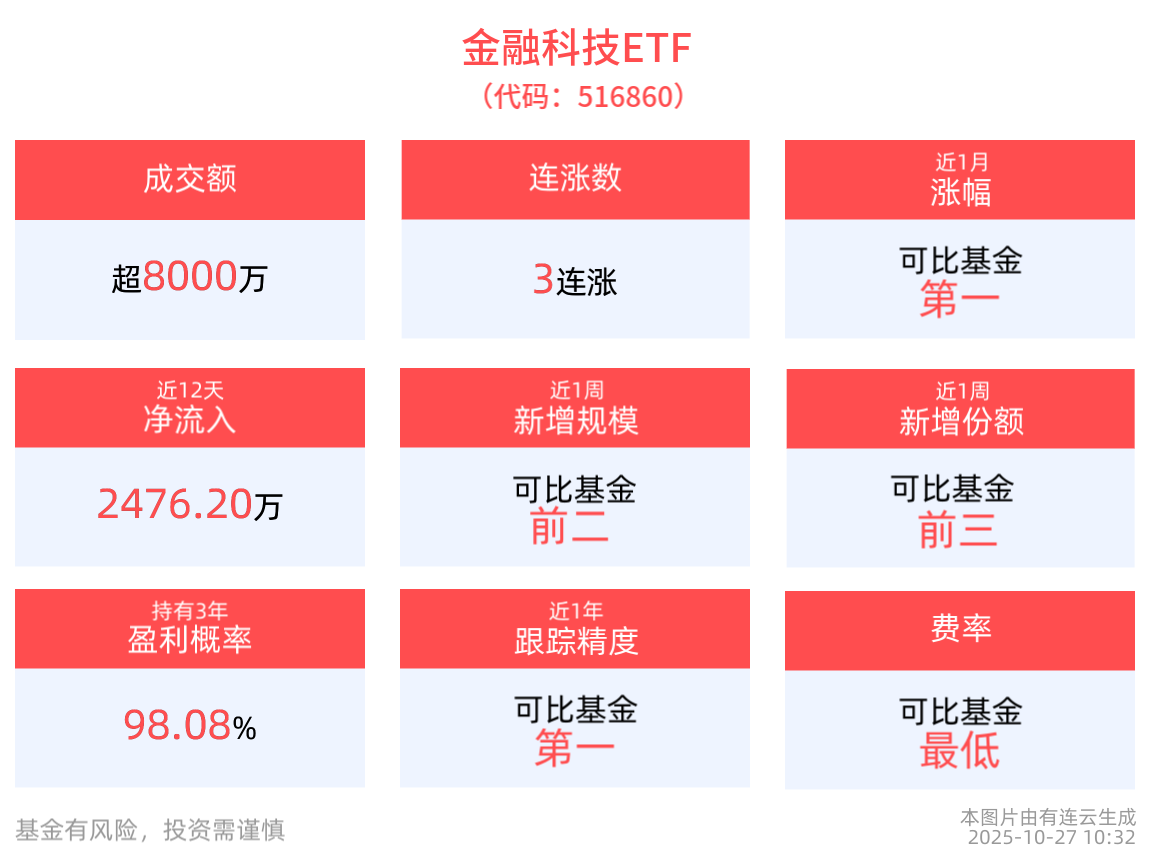
2025金融街论坛年会今日开幕,金融科技ETF(516860)冲击3连涨,恒宝股份涨停
Xin Lang Cai Jing· 2025-10-27 03:04
Group 1 - The core theme of the 2025 Financial Street Forum is "Innovation, Transformation, and Reshaping Global Financial Development," with a significant focus on the integration of finance and technology [3] - The China Securities Financial Technology Theme Index rose by 0.65%, with notable increases in constituent stocks such as Hengbao Co., Ltd. (up 9.99%) and Guoao Technology (up 6.63%) [3] - The Financial Technology ETF (516860) has shown a cumulative increase of 3.85% over the past week, ranking 1/6 among comparable funds [3] Group 2 - The Financial Technology ETF recorded a turnover rate of 3.54% with a transaction volume of 88.2366 million yuan, and its average daily transaction volume over the past month was 179 million yuan, ranking in the top 2 among comparable funds [3] - The "14th Five-Year Plan" emphasizes technological self-reliance and innovation, aiming to accelerate the integration of technology and industry, particularly in artificial intelligence and algorithmic fields [3] - The Financial Technology ETF has seen a significant increase in scale, growing by 64.6857 million yuan over the past week, ranking 2/6 among comparable funds [4] Group 3 - The top ten weighted stocks in the China Securities Financial Technology Theme Index account for 55.55% of the index, including companies like Tonghuashun and Dongfang Caifu [5] - The Financial Technology ETF has experienced a net inflow of 14.977 million yuan recently, with a total of 24.762 million yuan over the past 12 trading days [4]


研判2025!中国量子芯片行业发展历程、产业链及市场规模分析:国家战略赋能,行业驶入发展快车道[图]
Chan Ye Xin Xi Wang· 2025-10-27 01:17
Core Insights - The Chinese quantum chip industry is experiencing rapid growth due to national emphasis and strategic planning, with a projected market size of approximately 596 million yuan in 2024, representing a year-on-year increase of 39.25% [1][8]. Industry Overview - Quantum chips are integrated circuits designed based on quantum mechanics principles, utilizing qubits for computation, which allows for parallel processing and exhibits exponential acceleration potential in fields like cryptography and materials simulation [2][4]. Industry Development History - The quantum chip industry in China has evolved through three stages: exploration (1985-2012), technological breakthroughs (2013-2019), and large-scale application (2020-present). Key milestones include the establishment of the first quantum computing research group in 2003 and the launch of China's first superconducting quantum computer in 2020 [4][5]. Industry Chain - The upstream of the quantum chip industry includes materials like superconductors and ion trap materials, while the midstream focuses on research and production of quantum chips. The downstream applications are primarily in quantum computing, communication, and simulation [6][7]. Market Size - The rapid development of the quantum chip industry is supported by significant advancements in quantum computing technology, with the global quantum computing market expected to reach $5.4 billion in 2024, growing by 14.89% [8]. Key Companies - Major players in the industry include Benyuan Quantum and Guoshield Quantum. Benyuan Quantum leads in superconducting quantum computing and has achieved mass production of quantum chips, while Guoshield Quantum excels in quantum communication and is expanding into quantum computing [10][11]. Industry Development Trends 1. **Technological Integration**: The future of the quantum chip industry will see diverse technological routes, including atomic and ion trap methods, and silicon-based semiconductor quantum dots, fostering innovation and development [12]. 2. **Practical Applications**: Quantum chips will increasingly address real-world problems, with successful implementations in finance and logistics, enhancing efficiency and reducing costs [13]. 3. **Domestic Supply Chain Enhancement**: The industry is expected to see increased domestic production of materials and equipment, with significant advancements in manufacturing processes and capabilities [14].


长线看好量子计算,稀缺铲子股为何值得重视?
2025-10-27 00:31
Summary of Quantum Computing Industry Conference Call Industry Overview - The conference call focuses on the **quantum computing industry**, highlighting the transition from research to commercialization, particularly with **Guangdong Quantum** becoming controlled by **China Telecom** [1][3]. - The **15th Five-Year Plan** includes quantum technology as a key economic growth point, ensuring ample funding support for the industry's long-term development [1][3]. Key Points and Arguments - **Strong Growth Indicators**: Domestic quantum computing companies like **Liangxi** and **Guangdong Quantum** have shown significant increases in contract liabilities and revenue, indicating robust growth momentum [1][3]. - **Investment Recommendations**: The call recommends focusing on leading companies such as **Guangdong Quantum** (system integration) and **Core Instruments** (equipment), which are expected to drive sector growth and achieve substantial revenue increases [1][4][5]. - **Market Catalysts**: Key factors driving the market include: - **Policy Support**: Both domestic and U.S. government initiatives are backing quantum computing [2][6]. - **Investment from Major Players**: Companies like **NVIDIA** have invested heavily in quantum computing, indicating confidence in the sector's future [6]. - **Technological Breakthroughs**: Advances in chip technology and the ability to simulate complex problems position quantum computing favorably in sectors like finance, pharmaceuticals, and chemicals [2][7]. Financial Performance - **Contract Liabilities and Revenue Growth**: Companies in the sector are experiencing contract liabilities and revenue growth exceeding 100%, making them attractive investment targets [5][20]. - **Projected Market Growth**: By 2028, the global quantum computing market is expected to reach **$37 billion**, with China potentially capturing one-third of this market [19][21]. Investment Landscape - **Emerging Companies**: Companies like **Benyuan Quantum** and **Guangdong Quantum** are preparing for IPOs, which could significantly increase their market valuations [9]. - **Key Players**: The leading domestic quantum computing companies include **Guangdong Quantum**, **Benyuan**, and **Guoyi**, all of which are expected to expand their market share significantly [18][21]. Technical Insights - **Importance of Cooling Systems**: The cooling systems are critical for maintaining superconductivity in quantum computers, with companies like **Core Instruments** leading in this area [23][24]. - **Role of Measurement and Control Systems**: These systems are essential for the operation of quantum bits, with high precision required for effective functioning [25]. Market Dynamics - **Investment Trends**: The U.S. plans to invest **$5 billion** in quantum computing from 2025 to 2029, while China is expected to invest significantly more annually [19]. - **Supply Chain Insights**: The demand for components like cables and cooling systems is expected to grow exponentially as the number of qubits in quantum computers increases [26]. Conclusion - The quantum computing industry is poised for significant growth driven by technological advancements, strong policy support, and increasing investments from major players. Companies like **Guangdong Quantum** and **Core Instruments** are highlighted as key investment opportunities due to their strong performance and market positioning [27][28].
软银批准向OpenAI追加投资225亿美元;给出100美元目标价!英伟达“唯一的空头”:这不是我第一次看到泡沫丨全球科技早参
Mei Ri Jing Ji Xin Wen· 2025-10-27 00:05
Group 1: OpenAI Developments - OpenAI is developing a new AI tool that generates music based on text and audio prompts, which could impact the music production and film scoring industries [1] - The tool may allow for music to be added to existing videos or provide accompaniment to vocal tracks, indicating a shift in traditional content creation methods [1] Group 2: IBM and Quantum Computing - IBM has successfully run a key quantum error correction algorithm on AMD's affordable chips, with results expected to be published on October 27 [2] - This achievement is part of IBM's long-term plan to develop a quantum computer named Starling by 2029, with the algorithm's completion ahead of schedule by one year [2] Group 3: Apple Maps Advertising - Apple plans to introduce advertising in its Maps application as early as next year, allowing businesses to pay for promotion in search results [3] - This move is expected to challenge Google Maps' business model and intensify competition in the local services and digital advertising markets [3] Group 4: Nvidia Stock Outlook - Seaport Global Securities analyst Jay Goldberg issued a "sell" rating for Nvidia, setting a target price of $100, citing skepticism about the AI hype [4] - Goldberg compares the current situation to the dot-com bubble, warning that a slowdown in spending could quickly reverse market dynamics [4] Group 5: SoftBank's Investment in OpenAI - SoftBank's board has approved an additional investment of $22.5 billion in OpenAI, part of a total planned investment of $30 billion [5] - This funding aims to support OpenAI's rising costs in AI model development and operations, paving the way for its transformation into a public benefit corporation and eventual IPO [5]


计算机行业“一周解码”:“十五五”规划擘画制造业升级路径,量子计算加速引领未来科技变革
Bank of China Securities· 2025-10-26 23:51
Investment Rating - The industry investment rating is "Outperform the Market" [2][42] Core Insights - The "14th Five-Year Plan" outlines a path for upgrading the manufacturing industry, emphasizing intelligent and green development [3][14] - Quantum computing is entering the verification stage, with practical applications expected to take time [17][19] - The release of the bionic robot H2 by Yushu Technology marks a new phase in humanoid robotics [20][23] - OpenAI's launch of the ChatGPT Atlas browser signifies a paradigm shift in human-computer interaction [24][26] Summary by Sections Industry Investment Rating - The report rates the computer industry as "Outperform the Market," indicating expectations for the industry index to perform better than the benchmark index over the next 6-12 months [2][42] Key Developments - The "14th Five-Year Plan" emphasizes high-quality development, technological self-reliance, and the construction of a modern industrial system, focusing on intelligent, green, and integrated development [14][16] - Google's recent breakthrough in quantum computing with the "Quantum Echoes" algorithm demonstrates a performance 13,000 times faster than the world's strongest supercomputer, paving the way for future applications in fields like medicine and materials science [17][19] - Yushu Technology's new bionic robot H2 features 31 joints and enhanced flexibility, reflecting significant advancements in humanoid robotics [20][21] - OpenAI's ChatGPT Atlas browser integrates AI capabilities directly into the browsing experience, allowing users to interact with AI for tasks like summarizing content and answering questions [24][25] Company Dynamics - GuoDianYunTong's subsidiary obtained a money service operator license in Hong Kong, enhancing its capabilities in cross-border payments [5] - iFlytek reported a 10.02% year-on-year increase in total revenue for Q3 2025, reaching 6.078 billion yuan, with a significant 202.40% increase in net profit [5] - Yushu Technology's IPO preparations indicate a strategic shift towards national and international market positioning [21]
Down 26%, Should You Buy the Dip on IonQ?
The Motley Fool· 2025-10-26 23:43
Core Viewpoint - IonQ's stock has experienced a significant decline of 26% from its peak in October, raising questions about whether this presents a buying opportunity or signals a deeper downturn [1]. Industry Overview - Quantum computing is poised to revolutionize data processing, enabling advanced applications such as genetic data decoding, encryption decryption, and financial market analysis [3][4]. - IonQ is recognized as one of the largest and most successful developers in the quantum computing sector, with a trailing revenue of $52.4 million and a market cap of $21.8 billion [5]. Company Analysis - IonQ focuses on trapped ion systems, which are considered more natural than the superconducting gates used by competitors, leading to high-quality data with less error correction [6]. - Despite its advantages, IonQ's data processing speed is slower than that of superconducting circuits and requires more precise engineering [6]. - The company faces significant challenges in achieving business-grade quantum computing systems ahead of competitors, which could position it as a future tech leader [7]. Financial Performance - IonQ's stock is currently trading at extremely high valuations, with a price-to-sales ratio of 415.5 times trailing revenue, indicating unsustainable valuation levels [9]. - The company reported a net loss of $464.3 million over the last four quarters, with free cash flow at a negative $155.1 million, raising concerns about its financial sustainability [10]. - IonQ's current market dynamics suggest that it may struggle to maintain operations without additional capital, as it relies heavily on investor funding [10]. Competitive Landscape - IonQ competes with major players like Alphabet and IBM, which have substantial resources and established technology patents in quantum computing [11]. - The trapped ion approach may face obsolescence if superconducting circuits prove to be the superior long-term solution [11]. Investment Outlook - The current high valuation and financial losses suggest that investors should wait for a more favorable entry point before considering IonQ shares [12][13].

李成钢:中美就稳妥解决多项重要经贸议题形成初步共识;商业航天卫星密集发射,我国成功发射高分十四号02星,长征系列运载火箭的第603次飞行——《投资早参》
Mei Ri Jing Ji Xin Wen· 2025-10-26 23:36
Group 1: Important Market News - China and the U.S. reached a preliminary consensus on several key economic and trade issues during discussions held in Kuala Lumpur on October 25-26, 2023 [1] Group 2: Industry Insights - China's commercial aerospace sector is experiencing a surge in satellite launches, with the successful launch of the Gaofen-14 02 satellite on October 26, 2025, marking the 603rd flight of the Long March series rockets. The satellite will provide high-precision geospatial information for national economic development [2] - The commercial aerospace market in China is projected to grow from 9.2 billion yuan in 2020 to 310 billion yuan by 2024, with a compound annual growth rate exceeding 100%, significantly outpacing global growth [2] - IBM has successfully run its quantum error correction algorithm on AMD's commercial FPGA module, achieving speeds approximately 10 times faster than required for real-time error correction. This breakthrough reduces reliance on expensive custom hardware [3] - The quantum computing industry is expected to reach a market size of hundreds of billions of dollars between 2025 and 2030, driven by technological advancements, policy support, and market demand [3] - A research team from Peking University has utilized cryo-electron tomography to analyze the micro-3D structure of photoresist molecules in liquid environments, leading to a significant reduction in lithography defects. This advancement addresses a critical bottleneck in the semiconductor manufacturing process [4] - The research achieved a resolution better than 5 nanometers, overcoming traditional limitations in observing photoresist behavior [4] Group 3: Company Updates - Yirui Technology announced that its shareholder, Shanghai Yiyuan He Rui Investment Consulting Co., Ltd., plans to reduce its stake by up to 3.24 million shares, representing 1.53% of the total share capital, through block trading from November 17, 2025, to February 16, 2026 [6] - Bixing Wulian disclosed that its shareholder, Fengtu Huizheng, intends to reduce its holdings by up to 2.36 million shares, accounting for 3% of the total share capital, during the same period [6]
“十五规划”干货来了!
Sou Hu Cai Jing· 2025-10-26 10:42
Core Insights - The article emphasizes the transition of China's economy from stability to rapid growth, highlighting the "15th Five-Year Plan" as a blueprint for modernization and high-quality development [3][5]. Group 1: High-Quality Development - The focus is on "high-quality development," shifting from quantity to quality, indicating that efficiency and effectiveness will be the new benchmarks for growth [3][5]. - Quality is described as the "hard currency" for the next phase of economic development, moving away from mere production to producing better goods and services [3]. Group 2: Technological Independence - The plan marks a "leading period" for technological self-reliance, with an emphasis on original innovation in fields such as AI, chips, and quantum computing [3]. - The narrative suggests that China is no longer catching up but is now aiming to lead in technological advancements [3]. Group 3: Expanding Domestic Demand - The strategy shifts from "supply-driven" to "demand-driven," with consumption, social security, and education identified as key growth drivers [3]. - This approach aims to encourage citizens to spend and invest, thereby stimulating economic growth [3]. Group 4: High-Level Openness - The article discusses a transition from "passive openness" to "institutional confidence," promoting active sharing of opportunities and collaborative rule-making in a complex international environment [3]. - This new posture reflects a proactive approach to global engagement [3]. Group 5: Green Transformation and Security - The plan incorporates green transformation as a fundamental aspect, emphasizing the importance of environmental sustainability alongside energy security and national defense modernization [3]. - This dual focus aims to ensure both ecological balance and national safety [3].

季报行情再成焦点!公募调仓换股路径浮现
券商中国· 2025-10-26 10:29
Core Viewpoint - The third quarter earnings reports of listed companies are becoming a focal point, with over 80% of companies showing positive earnings forecasts, indicating a strong performance outlook for the fourth quarter and into early next year [1][3]. Earnings Forecasts - As of October 24, over 150 A-share listed companies have disclosed their third-quarter earnings forecasts, with 124 companies (over 80%) showing positive expectations. Among these, 91 companies expect profit increases, 23 expect slight increases, and 10 companies anticipate turning losses into profits [2]. - A total of 136 companies are expected to be profitable in the third quarter, with 101 companies projected to have profits exceeding 100 million yuan, and 22 companies expected to exceed 1 billion yuan. China Life leads with a profit forecast of 156.785 billion yuan [2]. - 48 companies are expected to see a year-on-year net profit growth exceeding 100%, with three companies (Shuobeide, Xianda Co., Chujian New Materials) projecting growth rates over 2000% [2]. Sector Performance - The high earnings forecast rate and significant profit growth are concentrated in sectors such as electronics (semiconductors, components), non-ferrous metals (precious metals, new metal materials), brokerage and insurance, and chemicals (agricultural and chemical products) [3]. - Among the 1,088 companies that have disclosed their formal third-quarter reports, 874 companies achieved profitability, with 647 companies showing positive year-on-year net profit growth [3]. Market Sentiment and Strategy - The earnings reports are crucial for public funds as they influence market sentiment and trading behavior, leading to what is termed "earnings report trading." Fund managers will adjust their strategies based on the earnings signals from these reports [4][5]. - Fund managers are focusing on sectors with demand recovery, cost improvements, and optimized market structures, seeking growth opportunities with high certainty [5]. Technology Sector Insights - The technology sector is expected to shift from being driven by expectations to being driven by actual earnings, with strong performance in sub-sectors like semiconductor domestic substitution, overseas computing power chains, and AI-related companies [6][7]. - The storage industry is experiencing a demand explosion and significant recovery in profitability, with leading companies generally undervalued due to high demand certainty over the next two years [6]. Investment Focus - Fund managers are particularly interested in the technology and high-end manufacturing sectors, with a focus on artificial intelligence and its related supply chains, as well as the battery industry represented by lithium batteries [7].