
集成电路

Search documents
上海国投先导投决总金额已近260亿元 带动超1000亿元社会资本注入三大先导产业
Zheng Quan Shi Bao Wang· 2025-07-28 03:28
Group 1 - The Shanghai Guotou Company hosted a forum titled "Intelligent Chain Science and Technology Innovation Empowering AI Innovation Ecosystem" during the 2025 World Artificial Intelligence Conference, marking the official launch of the selection for the third batch of market-oriented sub-funds [1] - The third batch of sub-funds is required to be equity investment funds established or relocated within Shanghai, focusing on three leading industries: integrated circuits, biomedicine, and artificial intelligence [1] - Shanghai Guotou plans to deepen cooperation with leading enterprises in the three key industries through a market-oriented selection mechanism, enhancing the layout of CVC funds and aligning investment strategies with industry innovation trends [1] Group 2 - Since meeting investment conditions in late September last year, Shanghai Guotou has quickly made decisions on 36 projects within ten months, with a total investment amount of 25.955 billion yuan, attracting over 100 billion yuan in social capital into the three leading industries in Shanghai [1] - Shanghai Guotou has established a comprehensive post-investment evaluation system, assessing sub-funds based on various dimensions such as return on investment, focus rate, performance, compliance, and contributions to the relevant industrial ecosystem in Shanghai [2] - During the 2025 World Artificial Intelligence Conference, Shanghai Guotou organized multiple roadshow activities daily, showcasing its fund managers alongside leading enterprises and ecological partners in fields such as large models, chips, and applications [2]
恒坤新材IPO上会被暂缓审议 保荐机构为中信建投
Zhong Guo Jing Ji Wang· 2025-07-26 09:14
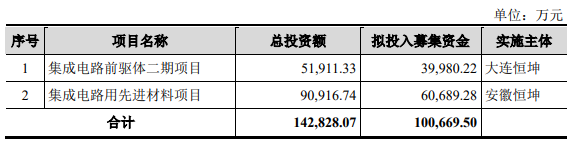
Core Viewpoint - The Shanghai Stock Exchange's Listing Review Committee has postponed the initial public offering (IPO) review of Xiamen Hengkang New Materials Technology Co., Ltd. (Hengkang New Materials) [1] Group 1: Company Overview - Hengkang New Materials focuses on the research and industrial application of key materials in the integrated circuit field, being one of the few domestic companies capable of developing and mass-producing key materials for 12-inch integrated circuit wafers [1] - The company primarily engages in the research, production, and sales of photoresist materials and precursor materials [1] Group 2: Shareholding Structure - As of the signing date of the prospectus, Yi Rongkun directly holds 19.52% of the voting rights in the company and indirectly controls an additional 5.94% through various entities, totaling 40.87% of the voting rights [1] Group 3: IPO Details - Hengkang New Materials plans to publicly issue no more than 67,397,940 shares, which represents up to 15% of the total share capital after issuance, with a minimum of 10% [1] - The company has granted the lead underwriter an over-allotment option of up to 15% of the aforementioned new shares [1] Group 4: Fundraising Purpose - The company aims to raise ¥1,006.695 million (approximately $100.67 million) for the second phase of the integrated circuit precursor project and the advanced materials project for integrated circuits [2] Group 5: Project Investment Breakdown - The total investment for the second phase of the integrated circuit precursor project is ¥519.1133 million, with ¥399.8022 million planned to be funded from the raised capital [3] - The advanced materials project for integrated circuits has a total investment of ¥909.1674 million, with ¥606.8928 million to be funded from the raised capital [3] - The combined total investment for both projects is ¥1,428.2807 million, with ¥1,006.695 million to be raised [3] Group 6: Listing Committee Inquiries - The Listing Committee raised several inquiries regarding the company's technology sources, revenue recognition methods, and financial practices, including potential risks related to intellectual property disputes and the rationale behind financial decisions [4][5]


对立的传言,有关H20!
是说芯语· 2025-07-25 23:29
Core Viewpoint - The article discusses two conflicting rumors regarding the H20 supply chain, focusing on NVIDIA's potential increase in H20 production and its implications for both NVIDIA's supply chain and domestic competitors. Group 1: Rumors and Market Reactions - The first rumor suggests a ban on major customers using H20, which is less widespread compared to the "Han Wang 690" rumor [2] - The second rumor indicates that NVIDIA is preparing for H20 production, requesting TSMC to provide 5,000 to 9,000 wafer capacities [3][4] Group 2: Implications of H20 Production - Due to H20's excellent performance and exclusive supply to China, NVIDIA has strong motivation to expand production [5] - Increasing H20 production could allow NVIDIA to capture market share and expedite the development and mass production of B-series special supply chips, potentially prioritizing H20 over B-series [6] - The exploration of H20 will not negatively impact the promotion of NVIDIA's Blackwell, as H20 is not considered a high-end product and will not psychologically affect other major customers [7] Group 3: Benefits to the Supply Chain - If production resumes, it will undoubtedly benefit NVIDIA's supply chain, as the value and maturity of H20 are recognized, leading to increased procurement [8] - The situation is not necessarily negative for domestic graphics cards, as there are procurement requirements and subsidies that will likely boost domestic card volumes [9] Group 4: Market Sentiment - The current market is characterized by rapid rotation driven by abundant liquidity, with a need for careful discernment amidst fluctuating emotions [10] - Although information about H20's supply restoration has not widely circulated, the prevailing sentiment is positive for both NVIDIA's supply chain and domestic competitors [11] - NVIDIA and Broadcom are reaching new highs, indicating a robust North American computing chain [12]

深交所副总经理李鸣钟:支持创业投资完善“募投管退”闭环生态 为新质生产力提供“接力棒”式服务
Zheng Quan Shi Bao Wang· 2025-07-25 12:59
Group 1 - The event highlighted the collaboration between Shenzhen Stock Exchange (SZSE) and venture capital institutions to enhance the inclusiveness and adaptability of the system, aiming to support the development of new productive forces through effective financing services [1][2] - SZSE has established a mechanism for regular collaboration with venture capital institutions, promoting high-quality development in venture capital and encouraging participation in industry matching activities [2] - The statistics indicate that 705 companies listed on the Growth Enterprise Market received investments from 2,615 venture capital institutions, totaling 70.989 billion yuan, with 218 newly listed companies since the registration system reform receiving 29.3 billion yuan from 992 venture capital institutions [1] Group 2 - SZSE plans to deepen the reform of the Growth Enterprise Market to better align with the development of new productive forces, supporting companies in core technology sectors like artificial intelligence and integrated circuits [3] - The exchange aims to enhance the quality and investment value of listed companies through active mergers and acquisitions, streamlining the review process for eligible restructuring projects [3] - SZSE is focused on optimizing the supply of innovative products and services, creating a comprehensive ecosystem for innovation capital that supports the entire lifecycle from intellectual property to continuous development [3]

深交所副总经理李鸣钟:持续深化创业板改革,完善适配新质生产力发展的制度机制
news flash· 2025-07-25 12:39
Core Viewpoint - Shenzhen Stock Exchange is committed to deepening the reform of the ChiNext board and improving the institutional mechanisms that align with the development of new productive forces [1] Group 1: Reform Initiatives - The Shenzhen Stock Exchange will further deepen the reform of the ChiNext board, emphasizing the unique characteristics of the board and enhancing its functionality [1] - There will be a focus on strengthening the coordination with industrial policies to support companies in breakthrough core technologies such as artificial intelligence, quantum information, and integrated circuits [1] Group 2: Support for Technology Companies - The exchange will support high-quality companies to apply for the second and third sets of standards on the ChiNext board [1] - The aim is to promote the growth and strengthening of technology-based listed companies [1] Group 3: Resource Allocation - The initiative seeks to facilitate the aggregation of more resources and factors towards the field of technological innovation [1]
净利润不到1亿,科创板IPO上会暂缓审议,今年以来首家!拟募资10亿,中信建投保荐
Sou Hu Cai Jing· 2025-07-25 10:39
Core Viewpoint - Hengkun New Materials is seeking to raise 1.007 billion yuan through an IPO on the Sci-Tech Innovation Board, focusing on the development and production of key materials for integrated circuit manufacturing [1] Financial Performance - The company's projected operating revenues for 2024 are 547.94 million yuan, with a net profit of 97.1 million yuan [1][2] - Historical operating revenues for 2022, 2023, and 2024 are 321.77 million yuan, 367.71 million yuan, and 547.94 million yuan respectively, showing a growth trend [2] - Net profits for the same years are 100.90 million yuan, 89.85 million yuan, and 96.92 million yuan, indicating fluctuations in profitability [2] Assets and Liabilities - Total assets as of December 31, 2024, are projected to be 2.645 billion yuan, up from 2.091 billion yuan in 2023 and 1.633 billion yuan in 2022 [3] - The company's equity attributable to shareholders is expected to reach 1.500 billion yuan in 2024, compared to 1.382 billion yuan in 2023 and 1.273 billion yuan in 2022 [3] - The asset-liability ratio is projected to be 43.26% in 2024, up from 33.92% in 2023 and 22.19% in 2022, indicating increasing leverage [3] Customer Concentration - The top five customers account for 99.22%, 97.92%, and 97.20% of the company's main business revenue over the past three years, reflecting a high customer concentration risk [4] Research and Development - The company invests 16.17% of its operating revenue in R&D for 2024, up from 14.59% in 2023 and 13.28% in 2022, highlighting a commitment to innovation [3] Investment Projects - The funds raised will be allocated to two main projects: the second phase of the integrated circuit precursor project and the advanced materials project for integrated circuits, with total investments of 5.191 billion yuan and 9.091 billion yuan respectively [6] Market Position - Hengkun New Materials is one of the few domestic companies capable of developing and mass-producing key materials for 12-inch integrated circuit wafer manufacturing, positioning it as an innovative player in the industry [1]

上海经济半年报出炉:GDP同比增长5.1%
第一财经· 2025-07-25 07:38
Economic Overview - The city's GDP reached 26,222.15 billion yuan in the first half of the year, with a year-on-year growth of 5.1% [1] - The first industry added value was 36.54 billion yuan, growing by 1.9%; the second industry added value was 5,445.91 billion yuan, growing by 3.9%; and the third industry added value was 20,739.70 billion yuan, growing by 5.4% [1] Industrial Production - Industrial added value increased by 5.0% year-on-year, with total industrial output value growing by 5.6%, accelerating by 2.1 percentage points compared to the first quarter [2] - Key industries such as computer, communication, and other electronic equipment manufacturing saw a 21.7% increase, while railway, shipbuilding, and aerospace manufacturing grew by 18.1% [2] - The three leading industries in manufacturing achieved a 9.1% growth, outpacing the overall industrial output [2] Tertiary Sector Growth - The tertiary sector's added value grew by 5.4%, with information transmission, software, and IT services increasing by 14.6% [3] - The financial sector's added value reached 4,500.81 billion yuan, growing by 8.8% [3] Investment Trends - Fixed asset investment rose by 6.2%, with industrial investment increasing by 19.8% and urban infrastructure investment growing by 17.9% [4] - New residential property sales area reached 7.9564 million square meters, a 1.6% increase [4] Consumer Market - The total retail sales of consumer goods amounted to 8,260.41 billion yuan, with a year-on-year growth of 1.7% [5] - The sales of energy-efficient home appliances surged by 63.9% due to the trade-in policy [6] Financial Market Performance - Major financial markets saw a transaction volume increase of 6.6%, with the Shanghai Stock Exchange's securities transaction volume growing by 28.6% [7] - By the end of June, the balance of deposits in financial institutions reached 22.90 trillion yuan, a 7.5% increase [7] Price Stability and Income Growth - The consumer price index (CPI) rose by 0.1% year-on-year, while the industrial producer price index decreased by 2.8% [8] - The per capita disposable income reached 46,805 yuan, growing by 4.6% [8] Innovation and New Drivers - The number of valid invention patents reached 293,700, increasing by 12.2% [12] - High-tech manufacturing output grew by 16.0%, with significant increases in the production of smart devices [12] Policy Effects - Retail sales showed signs of recovery, with a 1.7% year-on-year increase [13] - Industrial investment continued to expand, particularly in electronic information products, which saw a 43.0% increase [13] Market Dynamics - The volume of goods transported and international container throughput increased by 7.5% and 6.1%, respectively [14] - The industrial output of private enterprises grew by 8.8%, outperforming the overall industrial output growth [14]
风险保障11.84万亿元!广东人保财险为近1.6万家科技企业“护航”
Guang Zhou Ri Bao· 2025-07-24 10:56
Core Viewpoint - Guangdong Insurance Company is focusing on enhancing technology insurance services to support technological innovation and provide comprehensive risk protection for emerging industries in Guangdong [1][2]. Group 1: Technology Insurance Development - The company emphasizes the need for high professional capabilities in technology insurance due to the rapid technological updates and complex risks in the innovation sector [1]. - Guangdong Insurance has provided risk protection for multiple R&D projects in key laboratories and startups, covering nearly 16,000 technology companies with a total risk protection amount of 11.84 trillion yuan as of June 2025 [1]. Group 2: Strategic Focus Areas - The company will continue to focus on major technological breakthroughs in strategic emerging industries such as artificial intelligence, low-altitude economy, biomedicine, and integrated circuits [2]. - Plans include the establishment of specialized technology insurance centers in cities like Guangzhou, Foshan, and Dongguan, and the integration of external resources to enhance the "insurance + service + technology" model [2].
广东工行熊焘:计划在广州、东莞、珠海设立总规模超120亿元的AIC股权直投基金矩阵
Guang Zhou Ri Bao· 2025-07-24 06:56
Core Viewpoint - The Guangdong branch of the Industrial and Commercial Bank of China (ICBC) is focusing on technology finance as a key strategy to support the development of technology-driven enterprises in the Greater Bay Area, with significant growth in loans to technology companies and plans for investment funds in key industries [1][2]. Group 1: Technology Finance Initiatives - As of June 2025, the loan balance for technology enterprises at Guangdong ICBC reached 286.8 billion yuan, an increase of 23.2 billion yuan from the beginning of the year, representing an 8.8% growth [1]. - The bank plans to establish a matrix of seven AIC equity investment funds with a total scale exceeding 12 billion yuan, focusing on key industries such as artificial intelligence, robotics, new energy, and integrated circuits [1]. - Two funds have already been launched with a combined scale of 3.1 billion yuan, including an investment of 340 million yuan in a leading domestic photomask company [1]. Group 2: Support for Manufacturing and Talent - The manufacturing sector's merger and acquisition loan balance at Guangdong ICBC reached 19.8 billion yuan as of June 2025, focusing on horizontal expansion and vertical integration of leading enterprises [2]. - The "Scientist Entrepreneurship e-loan" program has issued loans to 16 entities, totaling approximately 5 million yuan, aimed at attracting high-level talent from local universities and institutions [2]. - Since the introduction of new financial policies in September 2024, the bank has facilitated 20 loan agreements for stock buybacks and increases by listed companies, amounting to 4 billion yuan, positioning itself as a leader in this area [2]. Group 3: Future Plans and Organizational Structure - The bank aims to deepen its focus on technology finance, exploring innovative financial models to integrate innovation chains, industrial chains, capital chains, and talent chains [3]. - A specialized organizational structure has been established to cater to the characteristics of technology enterprises, including a "Greater Bay Area Manufacturing Center + Technology Finance Center + Technology Branch" framework [2].

二〇二五年“全球独角兽”和“中国独角兽”等榜单陆续发布,我市多家企业上榜
Nan Jing Ri Bao· 2025-07-24 02:46
Core Insights - The report highlights the rapid growth and high potential of unicorn companies in Nanjing, with 8 companies listed among China's unicorns for 2024 and 9 listed in the global ranking for 2025, placing Nanjing seventh nationally [1][2] Group 1: Unicorn Company Overview - Unicorn companies are defined as privately held startups founded within the last 10 years, valued at over $1 billion, possessing unique core technologies and competitive advantages [2] - Nanjing's 8 unicorn companies have a total valuation of $14.7 billion, with the leading companies being T3 Mobility, Zhongqi Chuangzhi, and Pengbo Biotech, among others [2][3] - The sectors represented by Nanjing's unicorns include smart mobility, intelligent networking, innovative pharmaceuticals, artificial intelligence, integrated circuits, digital entertainment, and industrial internet [2] Group 2: Industry Trends and Focus - Integrated circuits have been the leading sector for unicorn companies for four consecutive years, with new entrants like Zhanxin Semiconductor focusing on high-performance analog integrated circuits [4] - Nanjing's strategy emphasizes innovation in key sectors such as artificial intelligence, new energy vehicles, and biomedicine, aligning with the city's modernization goals [4][5] - The city has established several innovation platforms in the integrated circuit industry, enhancing its capacity for technological advancement and attracting quality enterprises [4] Group 3: Supportive Environment for Growth - Nanjing has implemented a series of policies to foster a conducive environment for unicorn companies, focusing on innovation-driven development and creating a robust ecosystem for high-growth tech firms [6] - Recent policies aim to provide targeted support in areas such as innovation incentives, financial supply, talent services, and application scenarios to accelerate the growth of unicorns and gazelle companies [6][7] - The city has seen successful listings of several unicorn companies on stock exchanges, indicating a positive growth trajectory for the sector [7]