
硬科技

Search documents
科创板,七周年!
证券时报· 2025-11-05 00:12
Group 1: Core Insights - The Sci-Tech Innovation Board (STAR Market) has been established for seven years, focusing on "hard technology" and continuously innovating its institutional mechanisms to enhance the capital market's role in fostering new productive forces [1][9] - As of now, there are 592 listed companies on the STAR Market, raising a total of 934.6 billion yuan through IPOs and 208.8 billion yuan through refinancing, exceeding 1.1 trillion yuan in total [1] - The compound annual growth rates for revenue and net profit of STAR Market companies over the past five years are 18% and 9%, respectively, based on 2019 figures [1] Group 2: Institutional Support for Growth - The STAR Market's multi-dimensional and inclusive listing system has significantly supported the development of hard technology enterprises, with 57 unprofitable companies now listed, of which 22 have turned profitable [3] - The median R&D intensity of 35 STAR Market companies in the growth tier reached 44.34%, with their revenue increasing by 35.09% year-on-year in the first three quarters [3][7] - The STAR Market has facilitated the listing of companies like Zejing Pharmaceutical, which transitioned from zero revenue at IPO to 5.93 billion yuan in revenue in the first three quarters of this year [3] Group 3: Industry Cluster Effects - The STAR Market has seen the emergence of industry clusters, particularly in integrated circuits and biomedicine, with over 120 listed companies in the integrated circuit sector alone [5] - Leading companies like SMIC have raised 53.2 billion yuan through their IPOs, driving the collaborative development of upstream and downstream enterprises in the semiconductor industry [6] Group 4: R&D Investment and Innovation - In 2024, the total R&D investment of STAR Market companies is projected to reach 168 billion yuan, more than three times their net profit, indicating a strong commitment to innovation [7] - The continuous increase in R&D investment has led to significant technological breakthroughs, with 35 STAR Market companies ranking first globally in their respective segments [7] Group 5: Capital Market Reforms - The STAR Market has served as a "testing ground" for capital market reforms, providing replicable experiences for other markets and contributing to the improvement of foundational systems [9] - The introduction of the "1+6" reform measures aims to further enhance the STAR Market's role in supporting high-level technological self-reliance and innovation [9]


“硬科技”企业成长路径更清晰
Jing Ji Ri Bao· 2025-11-04 22:20
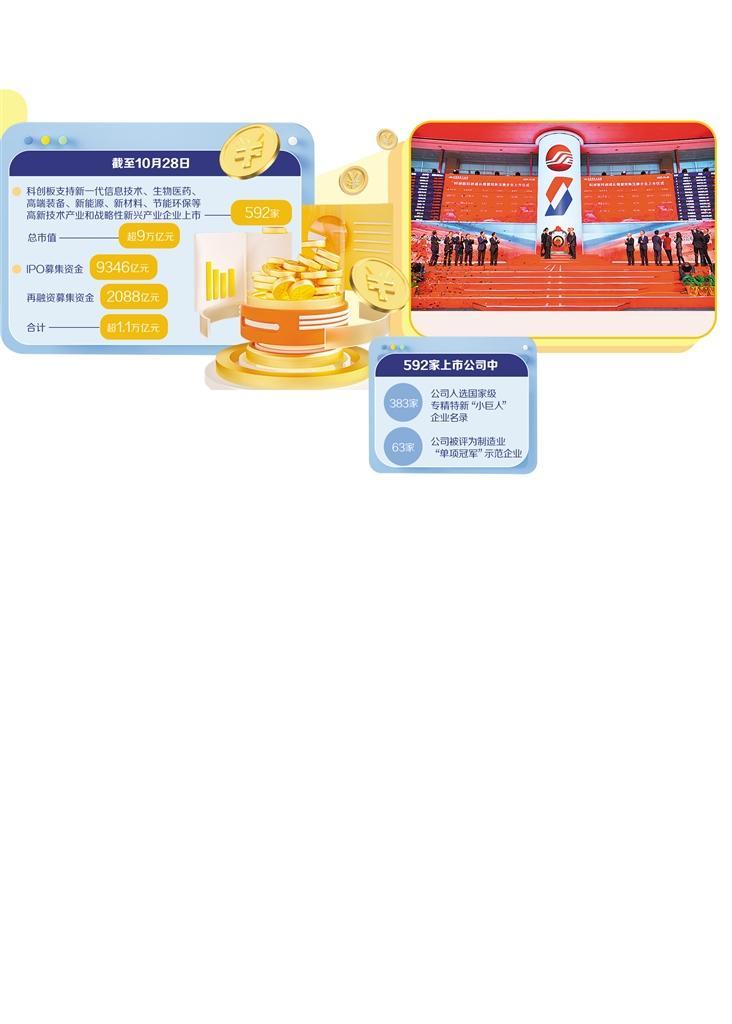
登录新浪财经APP 搜索【信披】查看更多考评等级 科创板科创成长层首批新注册企业上市仪式现场。(资料图片) 10月28日,科创板迎来科创成长层首批3家新注册企业上市,资本市场包容度、适应性进一步提升。目 前,科创板已汇聚592家科技企业,总市值超9万亿元,已成为中国"硬科技"企业上市"首选地"。 中信证券全球投资银行委员会主任孙毅表示,此次科创板科创成长层迎来首批新注册企业,是全面注册 制走深走实的关键一步。科创板科创成长层以"更包容的上市标准、更契合的监管逻辑、更完善的发行 机制",为处于成长期、研发投入高、科创属性强的"硬科技"企业量身打造了资本市场新赛道。 中国证监会副主席李超表示,科创板改革"试验田"作用日益显现,引领带动全市场基础制度持续完善, 有力支持了一批集成电路、生物医药等领域高科技企业,服务科技创新的强劲势能正加快集聚。 有力支持科技创新 自2018年11月份宣布设立科创板并试点注册制以来,科创板从无到有、从小到大,市场保持稳健发展, 市场功能稳步发挥,服务科技创新和新质生产力发展迈出新的坚实步伐。 坚守"硬科技"定位。截至10月28日,科创板支持新一代信息技术、生物医药、高端装备、新能源、 ...
“硬科技”企业成长路径更清晰——科创板科创成长层迎来首批新注册企业上市
Jing Ji Ri Bao· 2025-11-04 22:08
Core Insights - The launch of the first three new registered companies in the Sci-Tech Innovation Board's growth layer marks a significant enhancement in the capital market's inclusivity and adaptability [1][2][3] - The Sci-Tech Innovation Board has gathered 592 technology companies with a total market capitalization exceeding 9 trillion yuan, establishing itself as the preferred listing venue for "hard tech" companies in China [1][4] - A series of policy measures, including the "New National Nine Articles" and the "1+6" policies, have aligned the growth paths of "hard tech" companies with the support cycles of the capital market, injecting new vitality into the support for technological innovation [1][2][5] Policy and Market Developments - The China Securities Regulatory Commission (CSRC) introduced the "1+6" policy on June 18, 2023, which includes the establishment of a growth layer on the Sci-Tech Innovation Board aimed at supporting technology companies that are not yet profitable but have significant breakthroughs and commercial prospects [2][3] - The three newly listed companies—He Yuan Bio, Xi'an Yicai, and Bibet—are the first to be registered under this growth layer, optimizing listing standards and enhancing financing channels for high-investment sectors like artificial intelligence and innovative pharmaceuticals [2][3][4] - Since the establishment of the Sci-Tech Innovation Board in November 2018, it has supported the listing of 592 companies in high-tech and strategic emerging industries, raising over 1.1 trillion yuan through IPOs and refinancing [4][5] Financial Performance and R&D Investment - In 2024, the total R&D investment of companies on the Sci-Tech Innovation Board is projected to reach 168.1 billion yuan, which is more than three times the net profit of the board, reflecting a year-on-year growth of 6.4% [5] - By the first half of 2025, R&D investment is expected to reach 84.1 billion yuan, exceeding net profit by 2.8 times, with a median R&D investment as a percentage of revenue at 12.6% [5] Future Directions and Regulatory Enhancements - The Shanghai Stock Exchange plans to enhance its role as a "testbed" for reforms, focusing on identifying high-quality technology companies and supporting sectors like artificial intelligence and commercial aerospace [7] - The CSRC emphasizes the need for continuous improvement in the capital market's inclusivity and adaptability, aiming to deepen reforms in areas such as issuance, underwriting, and mergers and acquisitions [6][7] - There is a strong focus on investor protection and the development of patient and long-term capital to improve market attractiveness and competitiveness [7]
科创板打造 “硬科技”企业成长新天地
Zhong Guo Zheng Quan Bao· 2025-11-04 20:40
Core Viewpoint - The Sci-Tech Innovation Board (STAR Market) has evolved into a preferred platform for "hard technology" companies in China, supporting high-level technological self-reliance and innovation since its establishment seven years ago [1][2]. Group 1: Growth and Development of STAR Market - The STAR Market has seen over 590 companies listed, raising more than 900 billion yuan through IPOs, including various special types of enterprises [2][3]. - The STAR Market has become the primary domestic financing platform for many technology companies that previously could not meet profitability requirements for listing abroad [3][4]. - The introduction of the "1+6" reform policy has led to the establishment of the Sci-Tech Growth Layer, allowing more companies to access capital markets [4][6]. Group 2: Financial Performance and R&D Investment - Companies in the Sci-Tech Growth Layer reported a 35.1% year-on-year increase in revenue, while net profit losses decreased by 45.4%, with a median R&D intensity of 44.3% [5]. - The STAR Market has facilitated significant financing activities, with 18 new IPO applications and nearly 150 industry mergers and acquisitions since the "1+6" policy was introduced [6]. Group 3: Support for Emerging Industries - The STAR Market is expanding its support for emerging industries, including artificial intelligence and commercial aerospace, by allowing more companies to meet the fifth set of listing standards [7]. - The expansion of the fifth set of standards is expected to attract more technology-driven companies to the STAR Market, enhancing their access to long-term funding [7].


科创板打造“硬科技”企业成长新天地
Zhong Guo Zheng Quan Bao· 2025-11-04 20:17
Core Insights - The Sci-Tech Innovation Board (STAR Market) has evolved into a preferred platform for "hard technology" companies in China, supporting their listing and financing needs since its establishment seven years ago [1][2] - The board has seen over 590 companies listed, raising more than 900 billion yuan, including various types of enterprises that previously struggled to meet profitability requirements [2][3] - Recent reforms, including the introduction of the "1+6" policy, have enhanced the board's inclusivity and adaptability, allowing more companies, especially those in emerging industries, to access capital [3][4] Group 1: Growth and Development - The STAR Market has become a key driver for the growth of strategic emerging industries, with a focus on sectors like integrated circuits, where over 120 companies are listed [2][4] - The board's reforms have led to a significant increase in IPO applications and mergers, with nearly 150 new transactions reported since the "STAR Market Eight Articles" policy was introduced [4][5] - Companies listed on the STAR Market have shown improved innovation capabilities, with a median R&D intensity of 44.3% among the newly registered firms [3] Group 2: Financial Performance - In the first three quarters of the year, companies in the STAR Market's growth layer reported a 35.1% increase in revenue while reducing net losses by 45.4% [3] - The STAR Market has successfully attracted long-term capital, with over 100 ETFs listed and a total index product scale exceeding 330 billion yuan [5] - The board's supportive measures for sectors like artificial intelligence and commercial aerospace are expected to further enhance its appeal to technology-driven enterprises [5]
七载深耕硬科技 科创板引领资本市场向“新”而行
Zheng Quan Shi Bao· 2025-11-04 17:43
Group 1 - The core idea of the article highlights the significant achievements and ongoing reforms of the Sci-Tech Innovation Board (STAR Market) in China over the past seven years, emphasizing its role in supporting "hard technology" enterprises and enhancing the capital market's inclusivity and adaptability [1][5][6] - As of now, there are 592 listed companies on the STAR Market, with a total of 934.6 billion yuan raised through IPOs and 208.8 billion yuan through refinancing, exceeding 1.1 trillion yuan in total [1] - The compound annual growth rates for revenue and net profit attributable to shareholders of STAR Market companies over the past five years are 18% and 9%, respectively, based on 2019 figures [1] Group 2 - The STAR Market's multi-dimensional and inclusive listing system has effectively supported the growth of hard technology enterprises, with 57 unprofitable companies now listed, of which 22 have achieved profitability [2] - The 35 companies in the STAR Market's growth tier reported a 35.09% year-on-year increase in revenue for the first three quarters, while net profit saw a reduction in losses by 57.24% [2] - The median R&D intensity for these companies stands at 44.34%, indicating a strong focus on innovation and development [2] Group 3 - The STAR Market has fostered a clustering effect in industries such as integrated circuits and biomedicine, creating a collaborative development matrix led by industry "chain masters" [3] - Over 120 companies in the integrated circuit sector are listed on the STAR Market, covering all aspects of the industry chain, which has enhanced the autonomy of China's integrated circuit industry [3] - For instance, the IPO of SMIC raised 53.2 billion yuan, supporting its innovation and expansion while also benefiting upstream and downstream enterprises in the semiconductor industry [3] Group 4 - The total R&D investment of STAR Market companies is projected to reach 168 billion yuan in 2024, which is over three times the net profit of the sector [4] - In the first three quarters of this year, R&D investment totaled 113.35 billion yuan, 2.6 times the net profit, with a year-on-year growth of 9.01% [4] - Approximately 30% of STAR Market companies have products or projects that are innovative within their industries, with over 80% targeting import substitution and self-sufficiency [4] Group 5 - The STAR Market has served as a "testing ground" for capital market reforms, implementing a series of institutional innovations in areas such as issuance, listing, trading, and mergers and acquisitions [5] - The experiences gained from the STAR Market's reforms have provided valuable insights for the reform of other markets, such as the ChiNext and main boards [5] - The implementation of the registration system on the STAR Market has accelerated the legislative process for the revised Securities Law, further enhancing the foundational systems of the capital market [5] Group 6 - The China Securities Regulatory Commission announced the continuation of the STAR Market's demonstration effect, introducing further reforms to support high-level technological self-reliance [6] - The establishment of the growth tier has improved financing channels for high-quality technology companies, providing a more suitable growth platform for "hard technology" firms [6] - The Shanghai Stock Exchange aims to enhance its role as a "testing ground" for the STAR Market, focusing on identifying high-quality technology enterprises and supporting emerging fields such as artificial intelligence and commercial aerospace [6]

七载深耕筑根基:科创板以制度创新托举科技自强
Zheng Quan Ri Bao· 2025-11-04 15:44
Core Insights - The Sci-Tech Innovation Board (STAR Market) has achieved significant milestones in its seven years, with 592 listed companies raising a total of over 1.1 trillion yuan (approximately 934.6 billion yuan from IPOs and 208.8 billion yuan from refinancing) [1] - The board focuses on "hard technology" enterprises, aligning its listing and financing mechanisms with national strategic needs and market demands, thus enhancing its role in supporting technological innovation and new productivity [2][4] Group 1: Market Performance and Growth - The STAR Market has seen a compound annual growth rate (CAGR) of 18% in revenue and 9% in net profit for listed companies over the past five years, starting from 2019 [2] - Among the 57 companies that were unprofitable at the time of listing, 22 have since achieved profitability, demonstrating the board's effective support for unprofitable tech firms [2] - The median R&D intensity for companies in the STAR Market is 44.34%, indicating a strong commitment to innovation and development [2] Group 2: Industry Focus and Innovation - The STAR Market has become a hub for strategic emerging industries, particularly in integrated circuits, biomedicine, and new materials, fostering a complete industrial chain [4] - In the integrated circuit sector, over 120 companies are listed, enhancing the self-sufficiency of China's semiconductor industry [4] - In biomedicine, 21 out of 22 companies that adopted the fifth set of listing standards have successfully launched self-developed drugs or vaccines, with significant commercial progress [5] Group 3: Policy and Institutional Support - The STAR Market has established a flexible and inclusive listing system, allowing for differentiated standards based on market capitalization, revenue, and R&D investment [7] - The introduction of a "small and fast" financing mechanism has improved the efficiency of capital raising for tech companies [7] - Over 60% of companies in the STAR Market's growth layer have implemented stock incentive plans, covering approximately 12,000 individuals, which enhances talent motivation [7] Group 4: Future Directions and Capital Attraction - The STAR Market aims to further support "hard technology" enterprises and expand its focus to include artificial intelligence, commercial aerospace, and low-altitude economy sectors [8] - The board's reforms have led to improved market liquidity and pricing efficiency, attracting long-term capital from social security funds and insurance [9]
11家A股公司率先披露2025年业绩预报
Zheng Quan Ri Bao· 2025-11-04 15:44
Group 1 - The core viewpoint of the articles highlights that 11 companies in the A-share market have disclosed their expected performance for the year 2025, with 5 companies anticipating a year-on-year increase in net profit attributable to shareholders [1] - Luxshare Precision Industry Co., Ltd. expects a net profit of between 16.518 billion yuan and 17.186 billion yuan for the reporting period, representing a year-on-year growth of 23.59% to 28.59% [1] - The reason for the performance change is attributed to the company's ongoing globalization strategy, leveraging overseas production bases to respond flexibly to regional market demands and provide resilient and cost-effective manufacturing solutions [1] Group 2 - Among the 11 companies, hard technology companies show stronger performance confidence, with structural growth driven by policy, technological breakthroughs, and market demand [2] - Hard technology enterprises are encouraged to increase R&D investment, deepen collaborations with universities and research institutions, and focus on high-value-added businesses to solidify their technological advantages [2] - The development of hard technology companies is characterized by a mix of those still in the investment phase and those that have reached stable profitability, emphasizing the importance of clear application scenarios for technological innovation [2]

2025硬科技创新大会创投支持科技创新发展会议在西安举办
Zheng Quan Ri Bao· 2025-11-04 14:30
Group 1 - The conference themed "New Order and New Opportunities" focused on the development of technology finance and innovation in Xi'an, emphasizing the importance of venture capital in supporting technological innovation and industrial upgrades [1] - The release of the "2025 Shaanxi Province Private Equity and Venture Capital Development White Paper" provided insights into capital layout characteristics and policy implementation effectiveness, serving as a reference for government policy improvement and efficient financing for tech enterprises [1] - The establishment of the Xi'an Technology Finance Alliance and the signing of multiple investment cooperation agreements aimed to solidify the foundation of the technology finance ecosystem from various dimensions [2] Group 2 - The thematic reports presented by industry experts covered topics such as the trends in technology finance during the 14th Five-Year Plan, equity empowerment for technological innovation, and the practical aspects of university technology transfer, offering valuable perspectives for the development of the Shaanxi venture capital industry [2] - A roundtable discussion on "Developing Patient Capital and Reshaping the Long-term Investment Ecosystem" involved key figures from various investment firms, focusing on nurturing patient capital and optimizing the venture capital ecosystem [3]
陕西省政府投资引导基金创新合作座谈会在沪举办 沪陕携手共筑硬科技金融生态
Zhong Zheng Wang· 2025-11-04 13:00
Core Insights - The meeting aimed to promote deep integration of financial technology between Shanghai and Shaanxi, focusing on the theme "Double Hearts Converge, Tides Surge in Sci-Tech Innovation" [1] - The event highlighted the collaboration between government-guided funds and market capital to support the development of hard technology industries [1] Group 1: Event Overview - The Shaanxi Provincial Government Investment Guidance Fund Innovation Cooperation Symposium was held in Shanghai, guided by the Shaanxi Provincial Finance and Commerce Departments [1] - The event is part of a series of "Fund + Project" investment and financing docking meetings [1] Group 2: Strategic Collaborations - Strategic cooperation agreements were signed between Shaanxi Financial Investment and major state-owned platforms such as Shanghai Pudong Development Bank and Guotai Junan Securities, totaling 3 billion yuan [2] - The Shaanxi Provincial Government Investment Guidance Fund completed concentrated signing with four sub-funds, also amounting to 3 billion yuan, indicating deeper cooperation in fund investment between Shanghai and Shaanxi [2] Group 3: Focus Areas - The project roadshow showcased quality projects in three hard technology sectors: biomedicine, high-end manufacturing, and artificial intelligence, attracting significant attention from investment institutions in the Yangtze River Delta [2] - The Shaanxi Provincial Government Investment Guidance Fund aims to attract more "smart capital" to support the high-quality development of the hard technology industry through a more market-oriented and professional operational mechanism [2]